
November 26 2026
Sadakat Aman Khan: Carrying a four-generation musical legacy across seven seas

(Nov 26, 2026) A fourth-generation Hindustani classical musician from West Bengal, Sadakat Aman Khan is introducing the harmonium to audiences overseas, blending its traditional sounds with hardcore metal. An MBA graduate from Coventry University London, he also works as a business analyst in London and has spoken at TEDx events on music and creativity.
During his early years in the quiet town of Malda, West Bengal, Sadakat Aman Khan’s days were steeped in the musical traditions of the Kasur-Patiala Gharana. His grandfather, Sangeetacharya Ustad Md. Yunus Khan, was a noted Hindustani classical vocalist; his father, Ustad Sahadat Rana Khan, is a prominent vocalist of the Patiala Gharana and Sadakat is a fourth-generation musician and accomplished harmonium player based in the UK.
Illustrious as his legacy may sound, being part of a musical family came with its share of rigour and discipline. Waking up at 4 am every day to practise, while much of the world was in deep slumber, and spending hours perfecting a single note on the harmonium under the watchful eye of his father was part of his daily routine. “I did not fully enjoy it as a child. It was only around the age of 14 that I began to genuinely love the process,” he admits in a chat with The Global Indian.
View this post on Instagram
Experimenting with traditional sounds
Academics were given equal importance at the Khan household and the artiste went on to complete a Bachelor of Technology in Computer Science Engineering from Kalinga Institute of Industrial Technology (KIIT University), Bhubaneswar.
It was during this time that he began experimenting with Western music and classical tunes. This exploration eventually led him to develop a genre he calls Harmonium Metal, a blend of hardcore metal and the harmonium. It was an unusual departure from the traditional music he had grown up learning, but one that allowed him to explore the instrument’s possibilities in a different way.
Encouraged by his mother, Najhum Ara Razi, to balance his studies with music, his academic pursuits eventually took him to the UK, a move that he saw as an opportunity to explore life beyond India. “I wanted to broaden my academic and personal horizons, become more independent and experience a different environment,” he observes.
He went on to study MBA in Global Business at Coventry University in London, and explore new possibilities for himself as a musician in the multi-cultural English capital. “I had always wanted to experiment with sound, explore how the harmonium might speak in different musical settings and reach listeners
who may have never encountered Hindustani classical music. Being in London allowed me to develop those ideas while continuing to perform and remain connected to my tradition.”
Putting a spotlight on the harmonium
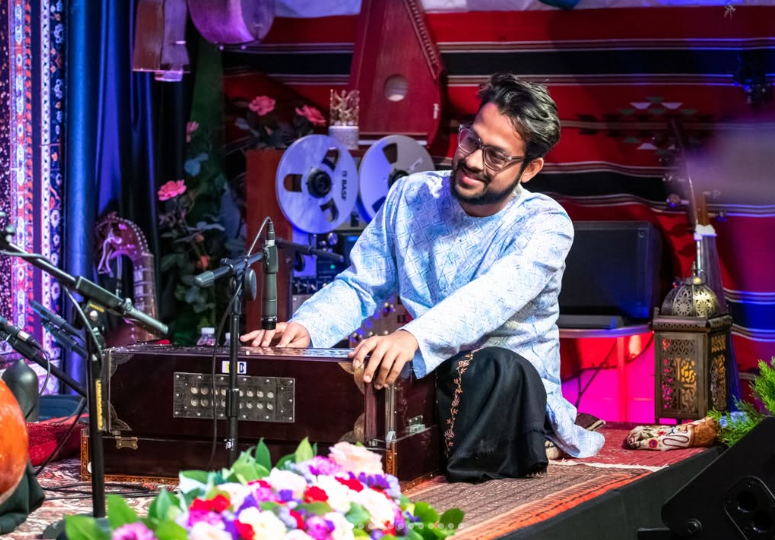
After completing his MBA, Sadakat continued to build his musical career in the UK. He began performing publicly in 2010, and his concerts have since taken him to audiences in India and overseas. In 2020, he made his international debut with a solo concert at Nanhua University in Taiwan and has also performed alongside musicians such as Ustad Shafqat Ali Khan, Ustad Waseem Ahmed Khan and Ustad Raza Ali Khan over the years.
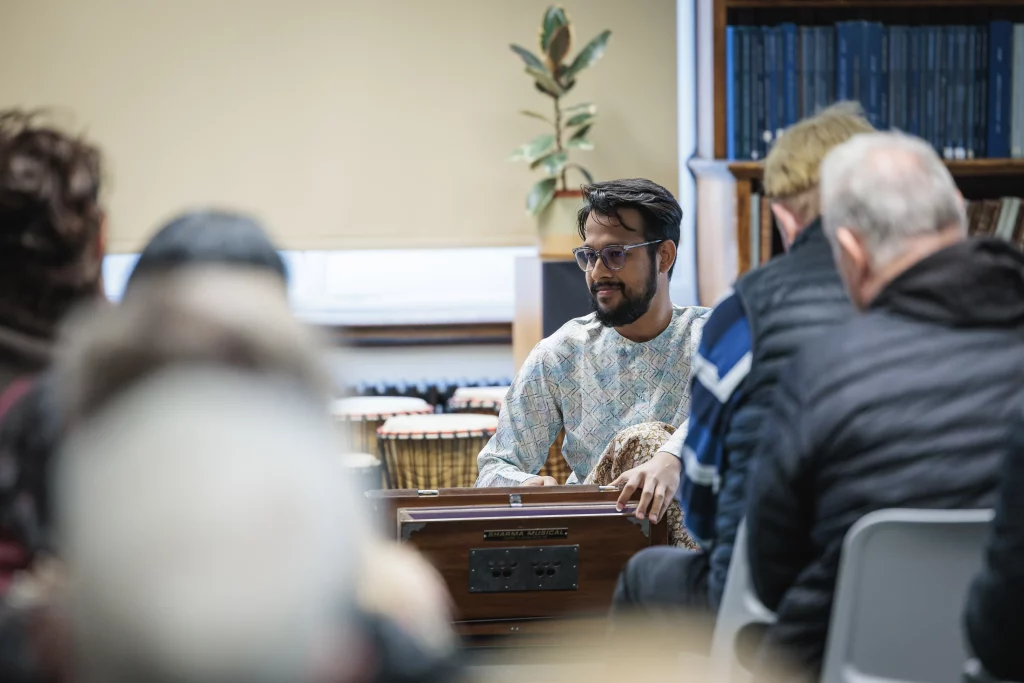
In the UK, venues such as St George’s Hanover Square and Westminster Music Library have given him a platform to present the harmonium as a solo instrument. The response has been encouraging, especially from those encountering it in this format for the first time.
I have found that listeners who may be unfamiliar with the instrument are often surprised by the depth and variety it can offer when presented in a solo setting.
Sadakat Aman Khan
Taking this music to a wider audience also means making it accessible to those who may not know much about Hindustani classical music. “I try to make the music welcoming without simplifying it: I introduce the raga, explain something about its mood or structure, and then allow the performance to speak for itself.”
Passing on the tradition
Today, alongside his performances, Sadakat also teaches young students in an attempt to pass on what he learnt from his father and grandfather. According to him, there is more to learning music than mastering an instrument. “I try to help them develop not only instrumental technique but also an understanding of raga, rhythm, listening and the discipline that classical music requires.”
He also organises and host concerts, bringing Indian classical musicians and audiences together and creating opportunities for artists to perform. “I enjoy collaborating with musicians from different backgrounds, because those exchanges can introduce the harmonium and Hindustani music to new listeners. Whatever the format, I try to keep a strong grounding in classical training and musical integrity,” he says.
With a strong belief that giving back is part of a musician’s responsibility, he tries to create platforms where emerging performers can be heard alongside more experienced musicians. “My efforts are currently rooted in these personal and community-based activities rather than a formal charitable organisation. In the future, I would like to develop this work further, particularly to make quality music education and performance opportunities more accessible,” he informs.
A heart that remains in India
Living away from India has given him a different perspective on the country. “When you live away from home, familiar things can acquire a deeper meaning: the language, the food, the family gatherings and, especially for me, the sound of raga.”
But Sadakat still remains closely connected to his roots and travels back two or three times a year to meet family, students and fellow musicians. An occasion that he makes a special effort to attend is the annual concert held at his family home in Malda on August 15, in memory of his grandfather, Sangeetacharya Ustad Md. Yunus Khan.
The concert brings together musicians and those associated with his grandfather’s legacy, keeping the family’s musical roots alive in the town where Sadakat grew up.
Whatever my schedule may look like, I try to keep myself free for the annual concert in Malda held in memory of my grandfather. It is more than just an annual event; it is a personal commitment to his memory, the musical tradition he represented and the generations of musicians connected to him.
Sadakat Aman Khan
For all the opportunities London has offered, Malda remains central to his sense of belonging. “London is where I live and continue to build my professional life, but Malda remains the place where my musical identity was formed and where my family’s history is.”
Looking ahead, he hopes to take the harmonium to more international audiences, continue exploring new musical collaborations and create greater opportunities for young musicians. The challenge, he believes, is to let tradition evolve without losing what makes it distinct. “My aim is to preserve its depth while allowing it to meet new audiences and musical languages with respect,” he sums up.
- Follow Sadakat Aman Khan on Instagram, YouTube, LinkedIn and his website


Written By: Deepa Natarajan Lobo
Charu Suri: Grammy-nominated musician’s journey from Chopin to Charukesi

Written By: Mallik Thatipalli