
June 12 2026
From education in Moscow and Milan to India’s craft heritage: Dr Promil Pande’s three-decade mission
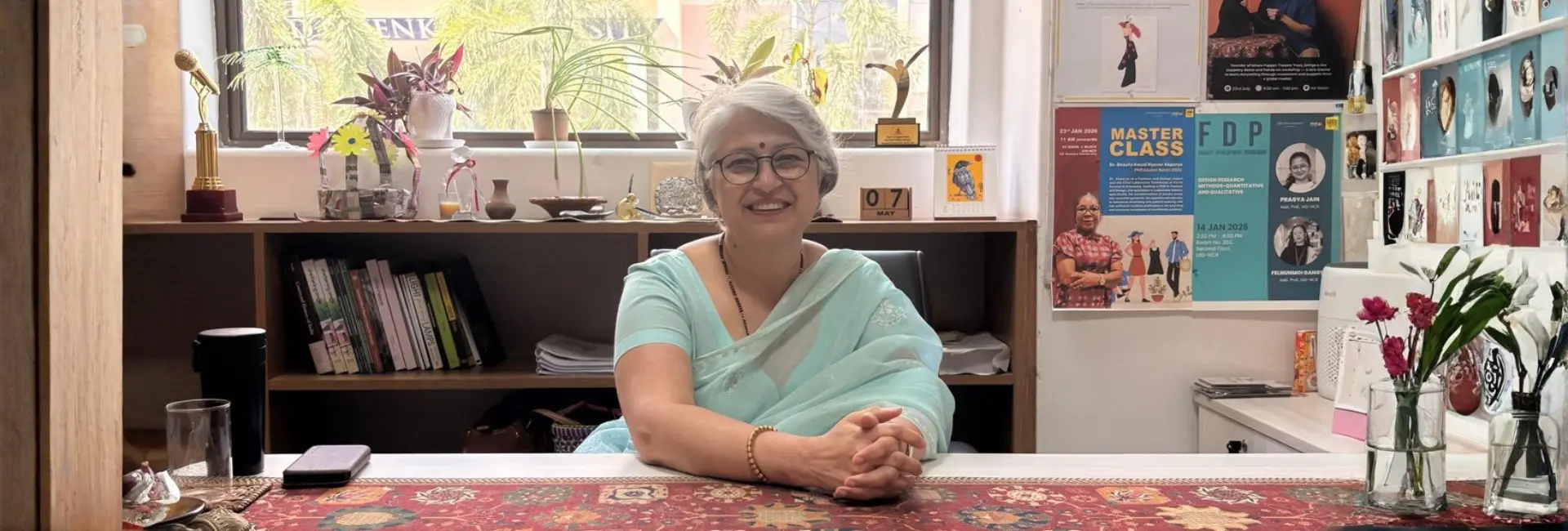
(Jun 12, 2026) Trained at the Moscow Textile Institute and SDA Bocconi in Milan, Dr Promil Pande has spent three decades as a professor, author, and co-founder of The Sidhast Foundation pushing India’s craft traditions from the margins of design education to the centre of it. Along the way, she has worked on developmental projects with the Ministry of Textiles and UNDP.
After completing her dual masters in fine arts and textile design technology from the Moscow Textile Institute in 1988, Dr Promil Pande went on to build one of the more quietly consequential careers in Indian design education. She followed her time in Moscow with an executive MBA in luxury management from SDA Bocconi School of Management in Milan, and later a PhD in design from the Sushant School of Art and Architecture, Gurgaon, where her doctoral research focused on the floor-covering traditions of Kashmir. Over a career spanning more than thirty years, she has held positions as dean, professor, and visiting professor at institutions including GD Goenka University, Pearl Academy, and NIFT Delhi, and currently serves as Professor and Dean at UID-NCR, GD Goenka University, Gurgaon, and as a PhD supervisor at UID, Karnavati University, Gandhinagar.
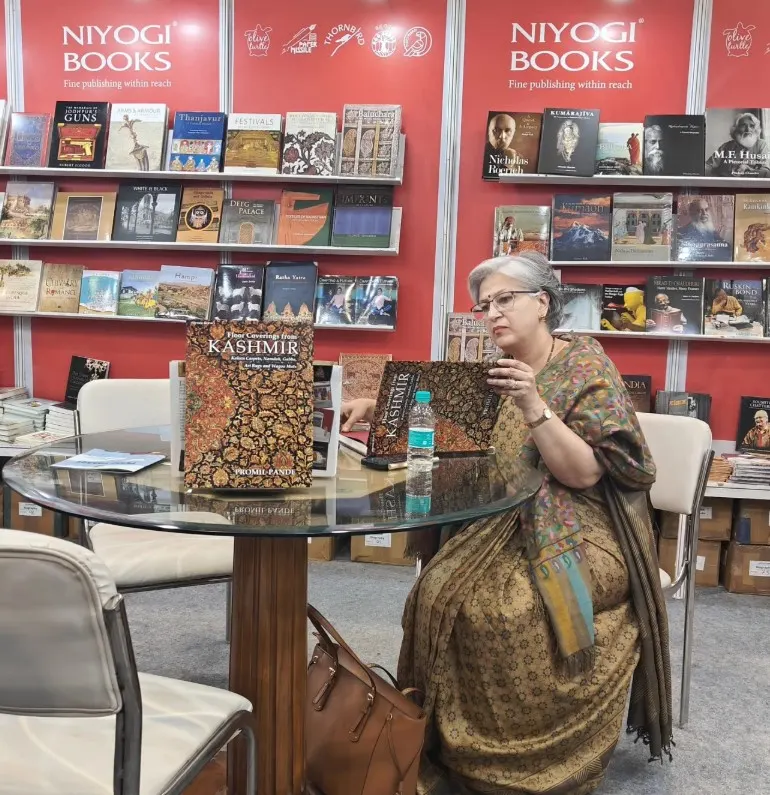
In 2010, she co-founded The Sidhast Foundation, a cultural and social initiative whose name translates literally as “skilled hand,” working towards the preservation and evolution of India’s craft traditions. Her book Floor Coverings from Kashmir, published in 2023, drew wide critical attention and is now regarded as a significant reference work in the field.
A diplomat’s daughter and a love for traditional textiles
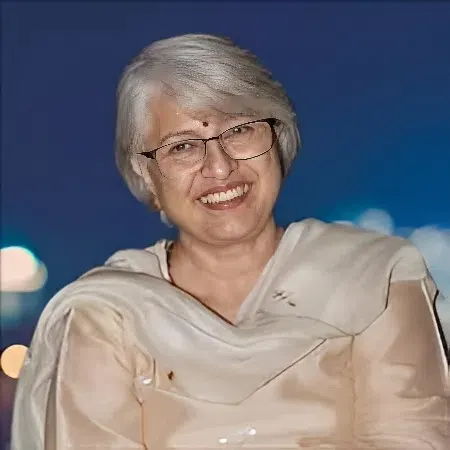
Growing up she had seen and experienced a variety of traditional textiles at home, with both her mother and grandmother wearing only sarees. “My father was a diplomat, and notwithstanding where he was posted, my mother would wear only sarees,” she says.
The unstitched genius of the saree had neither a problem of ‘fit’ nor a ‘last season’ trend problem. Over the years my appreciation for sarees and traditional textiles has grown, just as with time they have gained value. The diverse differences in material usage, weaves, and embroideries are all symbols of regional identities.
Dr Promil Pande
The project that set the course
In 2000, Dr Promil Pande was part of a project developed and sponsored by the DC Handicrafts office (New Bloom on the Loom) that wanted to build an identity for Indian carpets misconstrued as mere copies of Persian carpets. “That was when I sought to research indigenous weaving practices with a focus on carpet traditions. Literature, however, was limited, perhaps the reason that may have motivated me many years later to author a book on the floor coverings of Kashmir that was published by Niyogi Books in 2023,” she adds.
Craft, identity, and cultural memory
Her PhD research focused on Kashmir’s floor-covering traditions, as during her research for the carpet project, she realised that documentation of Indian carpets was limited. “The relationship between craft, identity, and cultural memory is not linear; it is an interconnected ecosystem of communities. Craft in India is never just a product or a means of livelihood; it is a repository of tangible and intangible knowledge and practices of communities that gives them their identities,” she says.
From Moscow to Milan: an education that shaped a vision
Her academic formation remains the foundation of everything she does. “I was fortunate to have had the opportunity to have studied and trained as an ‘artist-technologist’ under an integrated postgraduate course that remains the foundation of modern global industrial textile design there. My education, therefore, was a combination of rigorous, artistic, and technical foundations of textile engineering with the polished aesthetics and commercial acumen of Italian luxury management, which was a focused executive programme that created a fascinating multi-layered understanding of Indian design and its ecosystem. These global academic experiences had a profound impact,” she explains.
Celebrated in culture, struggling in the market
Often culturally celebrated, India’s craft traditions remain economically vulnerable, believes the author and professor. While consumer appreciation for handmade goods is at an all-time high, the structural reality for the artisan remains fraught as they continue to battle erratic income and seasonal job work anonymously.
To move India’s craft traditions to economically robust, sustainable enterprises, the ecosystem must shift from an NGO-driven philanthropy model or job work executioners to a market-driven business model giving credit where it is due.
Dr Promil Pande
They are part of a supply chain system as mere executioners of someone else’s design, often westernised or urban designers, for international brands that neither pay fair prices nor acknowledge cultural origins, she mentions.
Giving artisans equity, not just employment
Throughout her career, Dr Promil Pande has been vocal about giving artisans equity and shares a few remedial measures that she has been trying to push to make a difference for their sustainable future. “As most Indian artisans operate in the unorganised, informal sector, it makes them vulnerable to labour exploitation and limits access to formal financial systems; therefore, protecting their interests by having suitable systems in place and conducting awareness programmes for the same may keep them informed and protected. Shifting the power dynamics to Artisan-Producer Companies, whereby artisans collectively own the corporate entity, enables them to retain equity, pool resources for raw materials, and command better bargaining power with global buyers,” she explains.
The author and professor also believes that technology can safeguard the human and cultural value of the practice of artisans and when technology serves the artisan’s vision rather than dominating it, innovation becomes the ultimate guardian of tradition.
View this post on Instagram
What design education is getting wrong
Dr Promil Pande feels that design education in India is not adequately preparing students to engage with local craft ecosystems and indigenous material intelligence. She has been very vocal about it as an academic.
While India possesses some of the world’s most prestigious design institutions such as the National Institute of Design and the National Institute of Fashion Technology, the foundational pedagogy of design education in India remains deeply rooted in a Western, post-Industrial Revolution paradigm.
Dr Promil Pande
“Indigenous systems are taught as short-term projects, often limited to documenting the artisans and their craft practices like ethnographic subjects and creating a modern derivative product, while the designers then return and operate out of their urban studios. This treats craft as an exotic, historical artefact to be mined for aesthetics, rather than a living, evolving science,” she explains.
A career by design
With a career that spans research, entrepreneurship, education, and cultural advocacy, the professor informs that these roles were never planned as separate silos. Rather, they are parts of a continuous, self-sustaining feedback loop.
“Research informs entrepreneurship, which informs education. Education acknowledges and appreciates cultural advocacy, and cultural advocacy protects the system. In the context of global design ecosystems, operating in only one of these spheres leaves you incomplete. If you only advocate, you risk becoming sentimental; if you only monetise, you risk exploiting; if you only teach, you risk becoming disconnected from reality. When integrated, these roles inform and strengthen one another in very specific, practical ways,” she concludes.
From the textile studios of Moscow to the craft villages of India, Dr Promil Pande has spent three decades proving that India’s greatest design resource was always here, waiting to be taken more seriously.
ALSO READ: How Jaya Jaitly gave India’s crafts a future
Share with



Written By: Vikram Sharma
Nagaland to the World: How Jesmina Zeliang is taking indigenous crafts global

Written By: Mallik Thatipalli
Rohit Naag: Reviving centuries-old crafts at award-winning studio Nolwa

Written By: Mallik Thatipalli