
October 26 2026
Physicist Ashoke Sen becomes first Indian to win Oskar Klein Medal, adding to global honours and Padma Bhushan
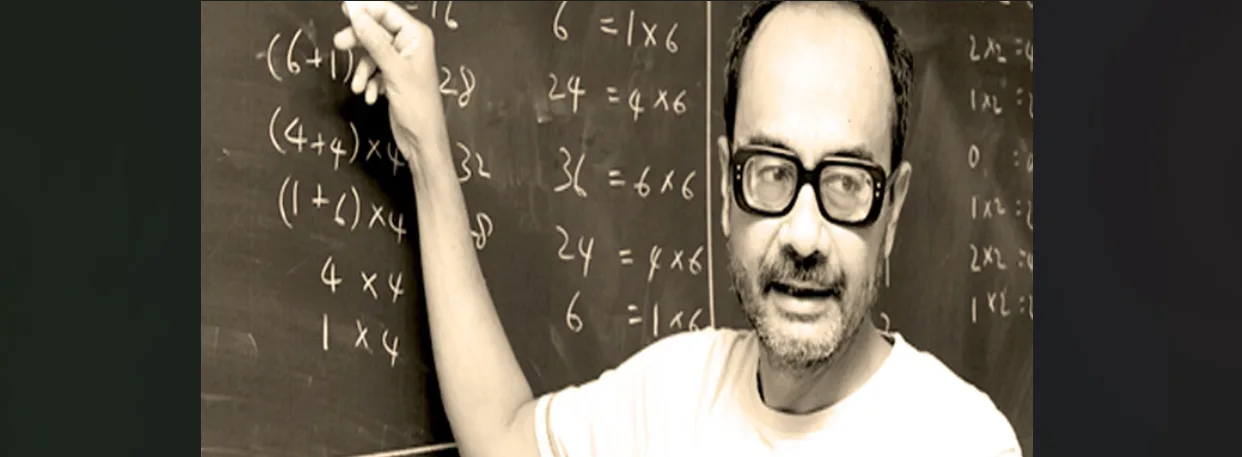
(Oct 26, 2026) A recipient of the Fundamental Physics Prize, Padma Bhushan and Dirac Medal, Ashoke Sen has spent decades exploring string theory and the possibility of a unified description of nature. After pursuing doctoral research and working in the United States, he returned to India to continue his research career. Now a professor at Bengaluru-based International Centre for Theoretical Sciences (ICTS), he has become the first Indian physicist to receive the prestigious Oskar Klein Medal, one of the highest honours in theoretical physics.
What does a scientist do when a problem refuses to yield an answer for months? For Ashoke Sen, the response is sometimes to set it aside, pick up an entirely different research paper and start reading. Sometimes, an idea from that unrelated paper helps him find a way forward.
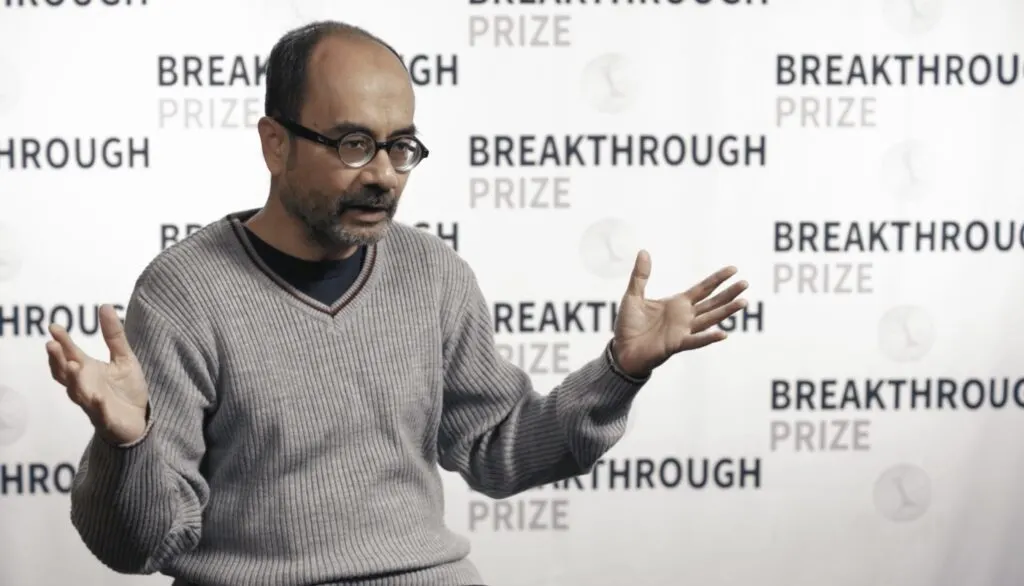
“For me, for example, it helps when I’m stuck, just take a completely different paper and start reading, even though it has nothing to do with my research,” Sen, one of India’s leading theoretical physicists said during a conversation a few months ago at the School of Mathematics and Natural Sciences at Chanakya University.
Other times, Sen attends seminars, talks to students or exchanges ideas with colleagues. Informal conversations can be just as valuable. “In most academic institutes a lot of discoveries happen over a cup of tea or coffee,” he remarked.
Sen’s experience offers a glimpse into the everyday reality of scientific research, where progress can be slow and the answers are not always obvious. It also reflects the approach he has taken throughout his career, exploring different possibilities rather than expecting every problem to have a straightforward solution.
The professor at Bengaluru-based International Centre for Theoretical Sciences (ICTS) has spent decades studying string theory, an ambitious attempt to explain the most fundamental building blocks of nature and the forces that govern them.
In 2026, he became the first Indian physicist to receive the prestigious Oskar Klein Medal, awarded jointly by Stockholm University and the Nobel Committee for Physics of the Royal Swedish Academy of Sciences. His other honours include the Fundamental Physics Prize, the Dirac Medal and the Padma Bhushan.
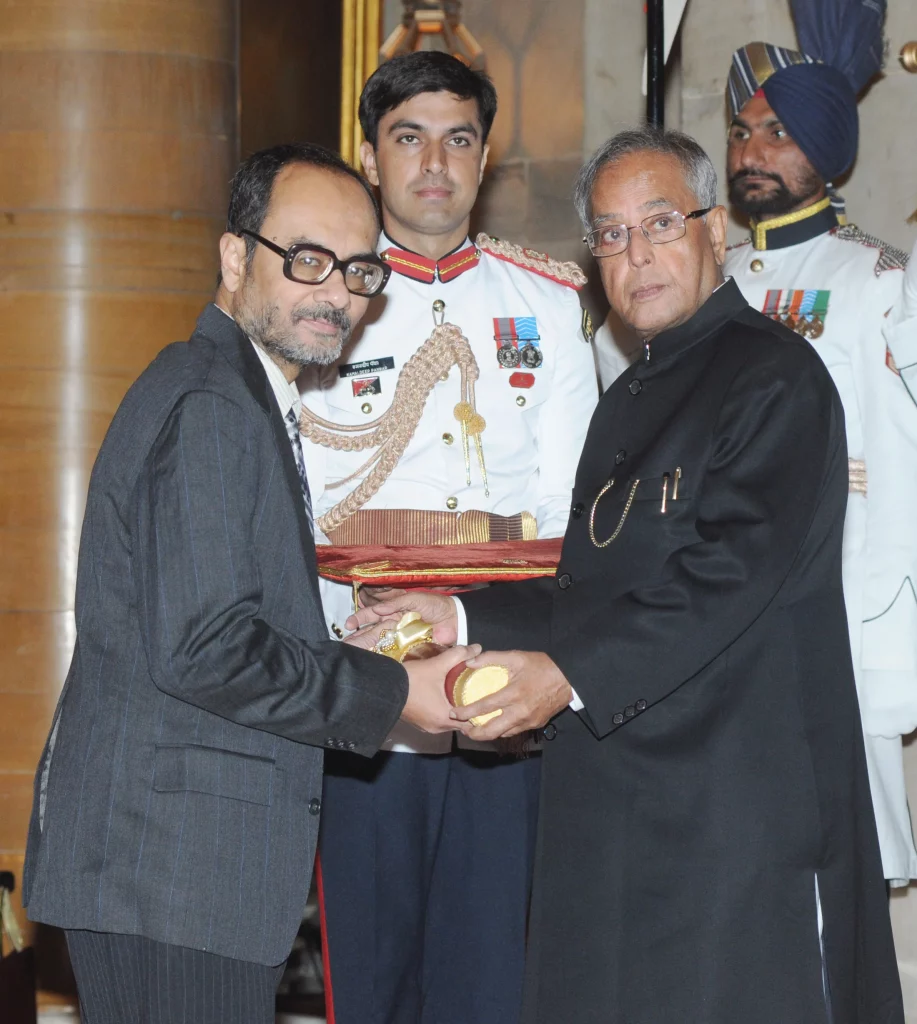
Physicist Ashoke Sen received Padma Bhushan in 2013
Ashoke Sen holds an honorary fellowship at India’s National Institute of Science Education and Research (NISER). He is also a Morningstar Visiting Professor at the Massachusetts Institute of Technology (MIT) and a distinguished professor at the Korea Institute for Advanced Study. A leading figure in string theory, Sen was among the first recipients of the Breakthrough Prize in Fundamental Physics, recognised for research showing how different string theories could represent different limits of a common underlying theory.
Why physicists want one theory to explain nature
Nature operates through fundamental forces such as gravity, electromagnetism and the weak nuclear force. Physicists have developed theories to explain them, but bringing all these forces together in one framework remains a major challenge.
String theory offers one possible approach. It proposes that the universe’s most basic building blocks may not be tiny particles, but incredibly small strings whose different vibrations give rise to different particles.
The aim is to find a single theory that explains all fundamental forces and elementary particles, including gravity. “If you have a theory of gravity that is separate from a theory of electric force or a theory of weak force then how do you explain the property of an electron?” he asked.
Nature does not operate in separate compartments, he argued. The goal is to develop a theory that accounts for the forces together. This would not explain every phenomenon, from how molecules form to how life emerges, but would focus on the most fundamental building blocks of nature.
The main goal of string theory is to find a theory that incorporates all forces of nature and explains all elementary particles that we see in nature.
Ashoke Sen
How different theories may describe the same reality
One of Sen’s important contributions concerns S-duality, which reveals connections between versions of string theory that may initially appear unrelated.
He explains that a theory can look different depending on the conditions under which it is studied. When a parameter is small, one description may be useful. When it becomes large, another version of string theory may emerge.
Such connections suggest that theories that appear different may be describing aspects of the same underlying framework. Finding these relationships is part of the work of theoretical physicists, though research rarely follows a fixed path. Scientists explore different questions and look for connections, sometimes by tackling a smaller problem they can understand more clearly.
The mathematics involved depends on the problem. Some questions rely more on physical insight, while others require advanced mathematical tools. “Number theory, algebraic geometry, these are the two things that are very often used in string theory. But topology plays an important role,” Sen mentioned.
A journey that began with curiosity
Sen did not begin his school years with a detailed understanding of what it meant to be a scientist. His interest in mathematics and science developed gradually, supported by books, teachers and classmates.
“For me I think it was a very slow process,” he said. He recalls that he wanted to become a scientist even though he did not fully understand what scientific work involved.
Science was a glamour subject at that time. So I thought I want to be a scientist even though I had no idea what science was about.
Ashoke Sen
An older cousin sometimes brought him popular science books, which gave him an opportunity to explore scientific ideas beyond the classroom.
His interest deepened when he went to Presidency College in Kolkata to study physics. There, he found classmates who were interested in the subject and teachers who helped him learn. “Peers are certainly important. We had also very good teachers,” he said.
Sen completed his bachelor’s degree in physics in 1975 and his master’s degree at the Indian Institute of Technology Kanpur in 1976. He then went to Stony Brook University in the United States for his PhD, where he moved into quantum field theory and particle physics.
His development as a scientist was not marked by one decisive moment. “It was very gradual,” he says. The people around him also mattered. Sen recalled that scientists such as S. N. Bose and M. N. Saha were known beyond academic circles, providing young people with examples of Indians who had made important contributions to science.
Having such figures to look up to, he believes, can help students imagine a future in scientific research.
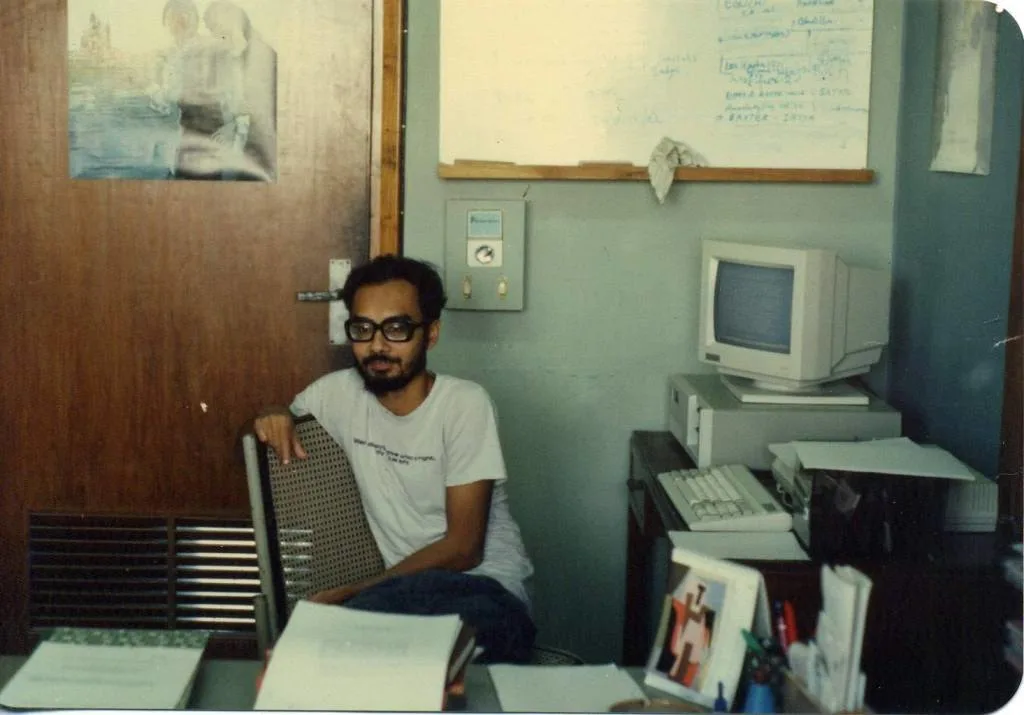
Ashoke Sen during earlier days of his career
Why persistence matters more than a flash of insight
Research often means spending months on a problem without finding an answer. For Ashoke Sen, persistence matters more than a sudden flash of insight.
Sustained effort certainly is more important. Without sustained effort I think it is very hard to get anywhere because even insights really come from sustained effort.
Ashoke Sen
In his conversation at the School of Mathematics and Natural Sciences of Chanakya University, he urged students to recognise the difference between what they know and what they have yet to understand “You should be able to distinguish between what you know and what you don’t know.” Recognising these gaps, he said, helps students identify what they need to learn and where to put in the effort.
Teaching science beyond examinations
Sen believes science education should nurture curiosity, not just prepare students for exams “We don’t teach them to be curious. We teach them more to pass exams and get good marks.”
He advocates a more curiosity-driven approach to undergraduate science, with students actively thinking through problems rather than memorising information to reproduce in examinations. Smaller classes, he believes, can encourage greater interaction and discussion. For Sen, the goal is not simply to teach more, but to help students ask questions and explore ideas for themselves.
Using artificial intelligence with caution
Artificial intelligence is changing how researchers approach their work. It can help them explore questions, review documents and identify issues they might otherwise overlook. Sen has used AI to examine his own research papers and consider how a referee might respond to them.
“If you have written some paper and you want to see if you have missed out something or if you want to see how the referees might react, you ask the AI to referee it,” he explained.
He finds this useful because AI can provide a broad overview. But it can also make mistakes. “Sometimes it’ll put pi in the numerator instead of in the denominator,” he said. For a researcher who understands the subject, such errors may be recognisable. For someone encountering a topic for the first time, distinguishing between a correct answer and a convincing but incorrect one can be more difficult.
My feeling is that if you know certain things AI is very useful but you cannot trust AI on a completely new subject. I mean, you have to be able to judge whether what AI is saying is correct or not.
Ashoke Sen
His concern is not that AI has no place in research. Rather, researchers need sufficient knowledge to assess its answers instead of accepting them without question. “Otherwise AI is a very useful tool,” he said.
Trying science before deciding what comes next
Sen believes students should give science a chance even if they are unsure about pursuing it as a career. A PhD in physics does not necessarily lead to a lifetime in academic research, he pointed out. Some researchers move into fields such as software and artificial intelligence.
Now an ICTS-Infosys Madhava Chair Professor at the International Centre for Theoretical Sciences in Bengaluru, the award-winning physicist continues to explore fundamental questions about nature. His research spans S-duality, tachyon condensation, black-hole entropy and superstring perturbation theory.
In 2026, he became the first Indian physicist to receive the Oskar Klein Medal, adding to other global honours.
The relationship between string theory and the physical universe remains an open question. Sen’s approach to research reflects the patience it takes to pursue it: exploring different ideas, learning from others and returning to difficult problems with a fresh perspective.
ALSO READ: Path to glory: Meet Dr. Deepak Dhar, the first Indian physicist to win a Boltzmann Medal
Ashoke Sen
| Born | Jul 15, 1956, Calcutta, India |
| Based | Bengaluru, India |
| Studied | BSc, Presidency College, Calcutta | MSc, IIT Kanpur | PhD, State University of New York at Stony Brook |
| Languages | English, Hind, Bengali |
Signature work
Ashoke Sen’s research has shown how different versions of string theory, which may initially appear unrelated, can be connected mathematically. His work on unstable structures called D-branes has further advanced the understanding of string theory and its potential to explain the fundamental particles and forces of nature.
Idea
Exploring how string theory could help explain the fundamental particles and forces of nature within a single framework.
Network
Collaborated with physicists worldwide and contributed to the development of ideas connecting different versions of string theory.
Impact
nature. His research has deepened the understanding of string theory, helping physicists explore how the fundamental particles and forces of nature might be explained within a single framework, and influenced efforts to develop a unified description of nature.
Inspired by Ashoke Sen 's journey?
Yours follows the same Hero's pattern — Separation, Initiation, Transformation, Return.
Share with




Written By: Mallik Thatipalli
