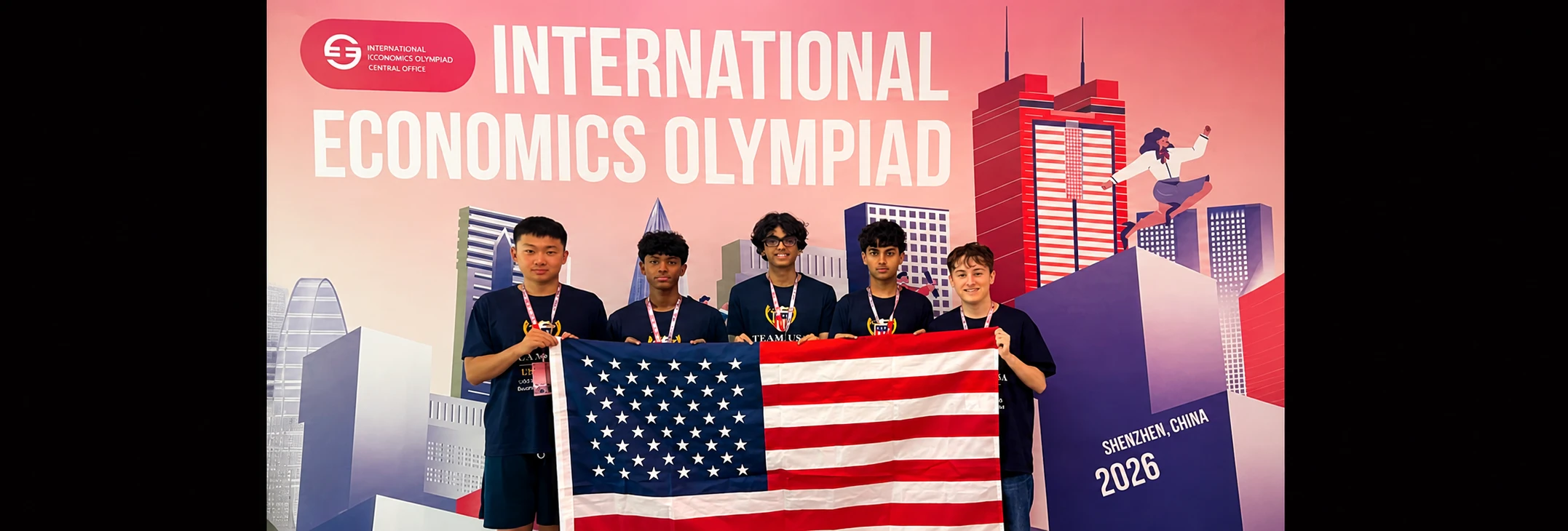


(Jul 26, 2026) When Team USA made its debut at the 2026 International Economics Olympiad (IEO), held in Shenzhen, China, from July 12 to 19, it returned with an impressive haul of one gold, one silver and one bronze medal. Founded in 2018 and supported by 2007 Nobel laureate in Economic Sciences Eric Maskin, the IEO has grown from 13 participating countries at its inaugural edition in Moscow to more than 52 countries this year, making it one of the world’s premier competitions for high school students in economics, finance and business. Each participating country fields a team of up to five students, who compete in individual economics and finance examinations before collaborating on a business case challenge that tests analytical thinking, teamwork and presentation skills.
Selected through the USA Economics and Business Olympiad (USAEBO), the five-member Team USA delegation of Eli Orbach, Praneeth Annapureddy, Jesse Zhang, Utsav Sunil Kumar and Shashank Madala earned one gold, one silver and one bronze medal, while also securing the Best in Economics honour, a place in the IEOx Youth Talks finals and a sixth-place finish in the Business Case Competition among 52 participating countries.
As Team USA celebrates its successful first appearance at the Olympiad, in an interaction with The Global Indian, Praneeth Annapureddy, Shashank Madala and Utsav Sunil Kumar offer a more personal glimpse into their journey to the International Economics Olympiad and the experience of representing Team USA.
Praneeth Annapureddy
BASIS Chandler, Chandler, Arizona
Silver medallist Praneeth Annapureddy discovered economics through an unlikely route. His curiosity about the stock market led him to ask bigger questions about how markets work and eventually drew him to economics. “At the start I didn’t understand much of it and the whole thing seemed like a mystery. My curiosity pushed me to research the actual mechanics behind it, and the further I went, the more I realized the answers I was looking for were all economics,” says Praneeth, whose family traces its roots to Andhra Pradesh and Telangana. Representing Team USA at the International Economics Olympiad was a dream come true for him. “What I was most excited about was meeting a whole new group of people who were just as passionate about economics as I was. Sitting in a room in Shenzhen with the top students from 52 countries, all approaching the same problem differently, taught me more than any amount of studying could have.”
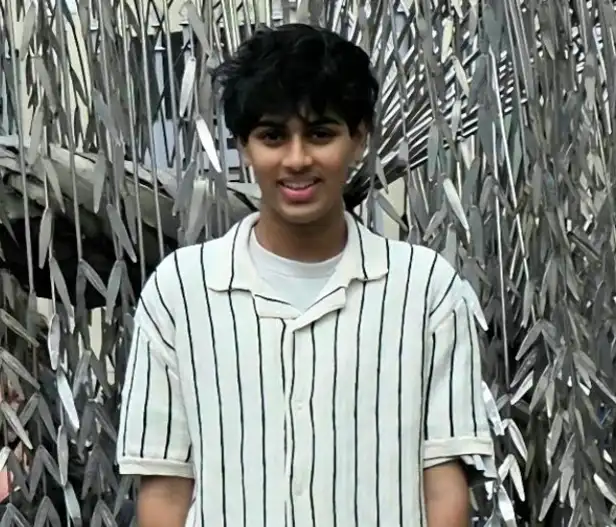
Outside academics, Praneeth enjoys debating global issues because it helps him develop his own opinions while learning from others. Through debate, he says, he has met friends who have given him perspectives he would never have considered on his own. He also enjoys watching sports and playing the piano and violin. Looking ahead, he hopes to study economics and finance before starting his own business. “I’m drawn to quantitative work, using data and models to figure out how markets actually behave. I like the problem-solving side of entrepreneurship, taking something that doesn’t work well and figuring out how to make it work better.”
Utsav Sunil Kumar
Heritage High School, Frisco, Texas
At 16, Utsav Sunil Kumar was selected as a finalist in the IEOx Youth Talks during Team USA’s debut at the International Economics Olympiad. His interest in economics grew out of his love for mathematics, business and understanding how money influences decisions and opportunities. “As I became increasingly fascinated by money, how it moves through markets, influences decisions, and shapes opportunities, I discovered economics and finance as fields that combined all these interests,” says Utsav, whose family hails from Karnataka. Representing Team USA was, he says, “an incredible honor and one of the most memorable experiences of my life.” Competing alongside students from around the world and helping Team USA finish sixth in the International Business Case Competition made the experience even more meaningful. “Since I am only 16, I hope to return in future years and bring home an individual medal for the United States.”
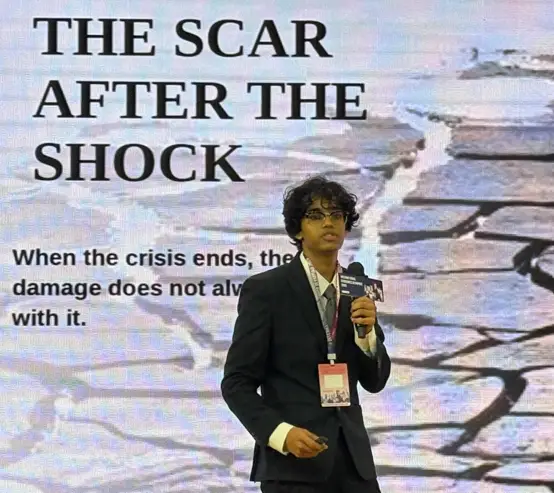
Away from academics, Utsav enjoys playing basketball because it allows him to relax, compete and spend time with friends. He is also deeply involved in research and contributes to projects connected with MIT, Stanford and Harvard in areas including invariant theory and cancer genomics. Looking ahead, he hopes to study mathematics, artificial intelligence and business while pursuing a minor in economics. He wants to combine these fields through research and entrepreneurship to build technologies that solve meaningful real-world problems. He is already working with Shashank and Praneeth on Gallium, their next startup, as they develop the venture and begin pursuing funding. “I want to combine these fields through research and entrepreneurship to build technologies that solve meaningful real-world problems.”
Shashank Madala
Robbinsville High School, Robbinsville, New Jersey
For Shashank Madala, economics became relevant while building Kora, an AI-based app designed to help caregivers better understand the emotions and needs of autistic children. As he worked on the app, he realised that creating useful technology was only one part of the challenge. “I also wanted to understand whether families would use it, how it could remain affordable, and what helps an idea grow enough to reach the people who need it,” says Shashank, whose family originates from Andhra Pradesh. Those questions sparked his interest in economics and how innovation can reach the people it is meant to serve.
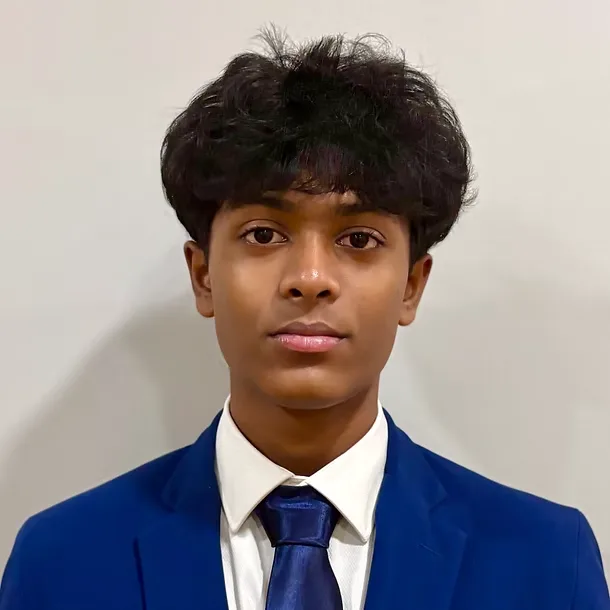
Being one of only five students selected nationwide to represent Team USA at the International Economics Olympiad was, he says, “both exciting and humbling.” Meeting students from more than 50 countries showed him “how differently people can approach the same economic problem,” while Team USA’s sixth-place finish in the International Business Case Competition reflected “how much our team trusted and learned from one another.” Outside academics, Shashank founded Lumin AI, an organisation that expands access to AI education for students across different communities and countries. He also enjoys playing varsity tennis, mentoring younger students and spending time with friends and family. In the future, he hopes to study computer science, artificial intelligence, economics and entrepreneurship before building technology companies focused on accessibility, financial technology and education. “I am most interested in work where strong technology can create real opportunities for people.”
For Team USA, the debut appearance at the International Economics Olympiad ended on a positive note with medals and recognition. For the students on the team, it also marked a great opportunity to represent the United States on a global stage while pursuing a discipline that increasingly shapes public policy, markets and everyday life. Their individual stories may be different, but together they reflect the curiosity and commitment that define the next generation of young economists.
- Follow Praneeth Annapureddy, Utsav Sunil Kumar and Shashank Madala on LinkedIn
ALSO READ: Sarthak Dhole: The teen behind India’s first Philosophy Olympiad medal in seven years, with a growing list of accomplishments