
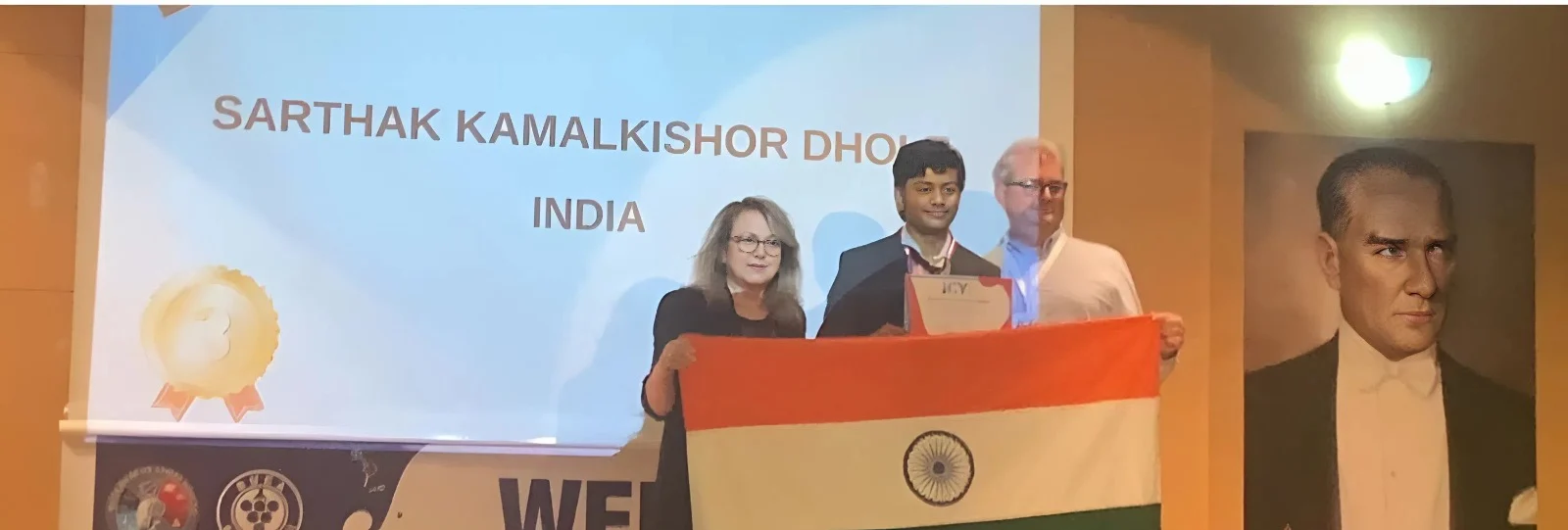


(Jun 14, 2026) At 17, Sarthak Dhole has represented India at eight international competitions in philosophy, physics and economics. He co-founded Philosium, a philosophy education network active in more than 60 countries, helped build Project Nexus to promote scientific research among school students worldwide, and founded HEADSPACE, an alopecia (hair loss) support initiative recognised by the Indian Medical Association and active in four Indian cities. He has spent two years volunteering at Rajasthan’s Mukundara Hills Tiger Reserve and has received scholarships and awards worth more than 80 lakh rupees over the course of his academic journey.
The teenager is currently celebrating his latest milestone.
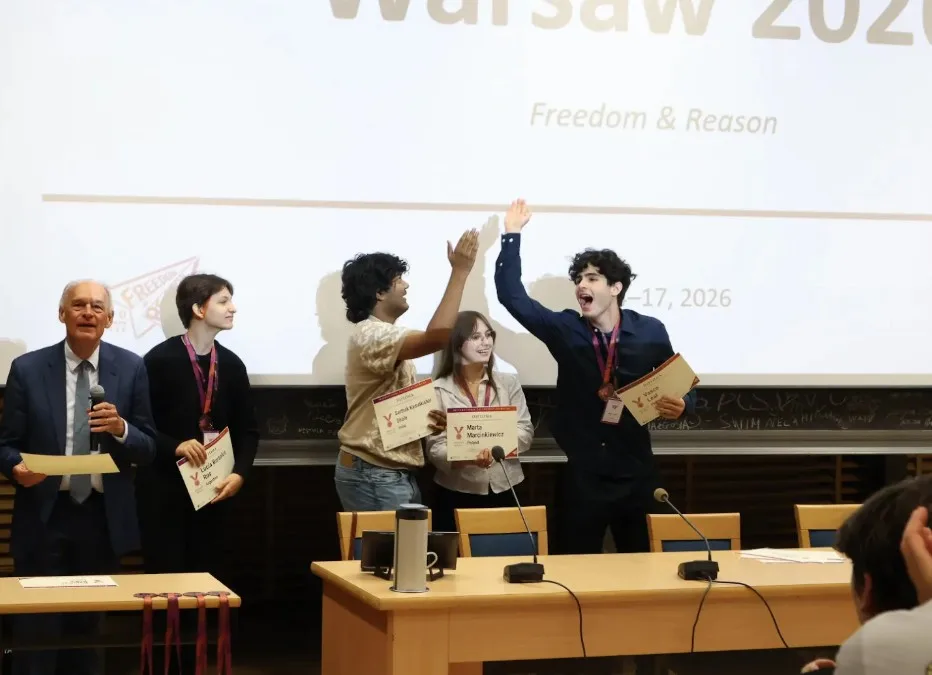
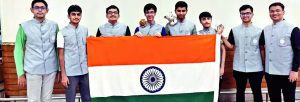
On 17 May 2026, the Jaipur-based student won a bronze medal at the 34th International Philosophy Olympiad in Warsaw, Poland, becoming the first Indian in seven years to reach the podium at one of the world’s most demanding intellectual competitions. Remarkably, he achieved the feat despite never having formally studied philosophy in school.
A full scholarship student at Jayshree Periwal International School, where he is pursuing the International Baccalaureate Diploma, Sarthak receives not only tuition-free education but also free hostel boarding.
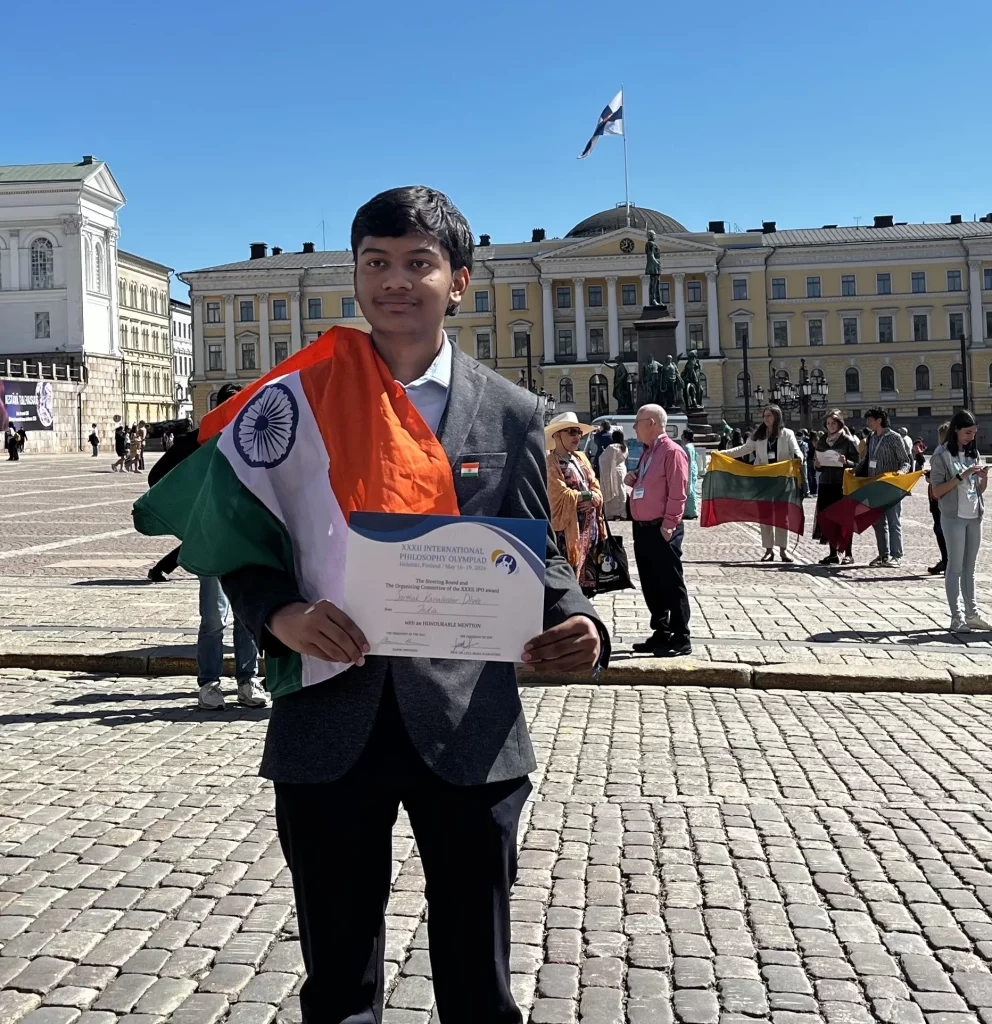
The bronze medal was the culmination of a three-year journey. Sarthak had topped India’s national selection and represented the country at the International Philosophy Olympiad in Helsinki in 2024 and Bari in 2025 before finally securing a medal in Warsaw on his third appearance.
“Three times is the charm. And the charm is bringing home India’s first IPO medal this decade,” he said in a chat with The Global Indian.
Three attempts, one breakthrough
The International Philosophy Olympiad brings together some of the brightest school students from around the world. Participants are given four hours and can use only a dictionary to write an essay on one of four philosophical prompts. Their work is judged on philosophical understanding, argumentation, coherence and originality.
Sarthak qualified for the international event three years in a row after topping India’s national selection each time.
In Helsinki in 2024, he finished among the top 20 and received an Honourable Mention. In Bari in 2025, he returned for another attempt. In Warsaw in 2026, he finally reached the podium, placing among the top 10 students in a field of 124 participants from 57 countries.
“Participants are given four hours and no access to any external resources except a dictionary to write about one of the four provided prompts,” he explained. “These essays are evaluated based on relevance to the topic, philosophical understanding of the topic, persuasive power of argumentation, coherence, and originality.”
His mentors included Dr Meera Baindur and Dr Mani Sachdev, who led the Indian delegation, as well as former participants Dr Abhishek Dedhe and Dimitrije Golubovic.
Questions that began at home
Originally from Akola in Maharashtra, Sarthak grew up in a family of doctors. Conversations around medicine and ethics sparked many of the questions that eventually drew him towards philosophy.
“I was fascinated initially by questions of bioethics because both of my parents were doctors and I had that exposure to the field,” he said. “Later and perhaps more profoundly, I was greatly influenced by Philosophy of Science and art.”
An art gallery called Experimenter introduced him to books and ideas that deepened his interest.
“What I love the most about philosophy is that it has given me the vocabulary to think deeper about the problems that I once used to think of as a kid like do Nishad and I see the same red? How do I know if I am living in a simulation?”
Physics was the first love
Although philosophy brought him international recognition, physics came first.
“It is what drew me to seriously consider the prospect of becoming an academic right from middle school. I would be fascinated by how accurately these theoretical models that we study can explain the physical world,” he said. “In 2024, I became the youngest member of India’s team at the International Young Physicists’ Tournament in Budapest, often called the Physics World Cup.” He will represent the country again at the 2026 edition in Zurich.
His international appearances have also included the International Economics Olympiad in Baku in 2025, the International Zhautykov Olympiad in Physics in Almaty in 2026, and science fairs in Izmir in 2024 and New Delhi in 2026. At the national level, he has repeatedly ranked among the top five in the country in physics and economics competitions.
Having placed among the top one per cent in the National Standard Examination in Biology, he saw connections between animal behaviour, economics and physical modelling.
“I saw how behavioural economics is quite closely related to ethology,” he said. “The other aspects of economics I found were very closely related to physics and physical modelling.”
Building Philosium across 60 countries
During the International Philosophy Olympiad in Helsinki in 2024, Sarthak took the initiative to launch Philosium with fellow participants from South Korea and France.
Two years later, the organisation has grown into a network of more than 150 volunteers across over 60 countries. It runs local chapters, reading groups, a journal, a podcast and an educational curriculum. It has also collaborated with the American Philosophical Association and the Philosophy Teaching and Learning Organization.
As his fellow founders are now at university, Sarthak currently manages the initiative and focuses particularly on publications, symposia and reading groups.
“I believe highly in curating this sense of community in those who have a philosophical bent of mind so that they feel company on their journey,” he said.
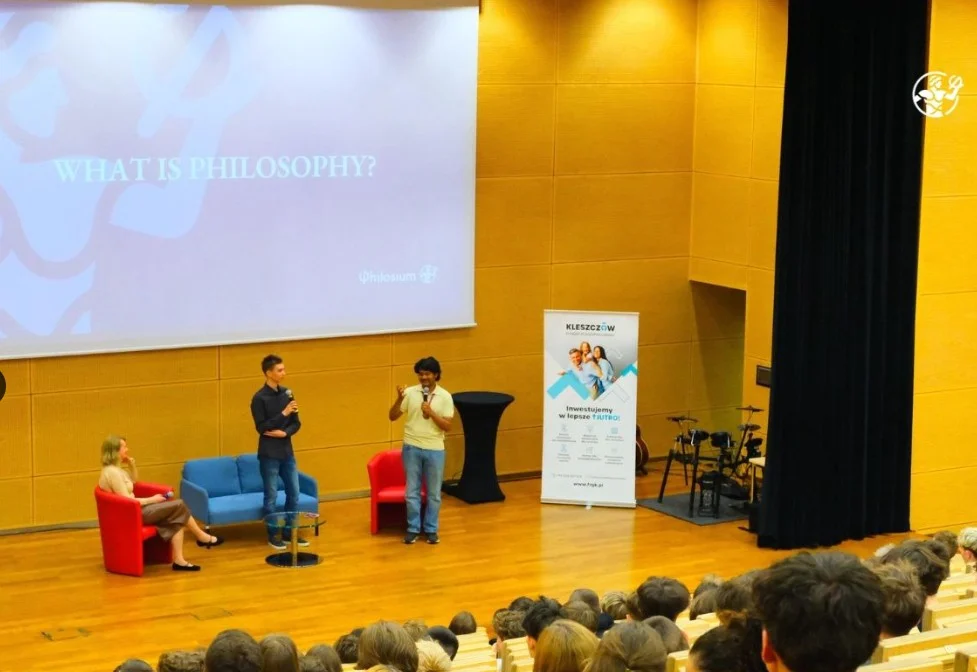
Sarthak at Philosium Conference in Poland
Taking philosophy beyond classrooms
During his visit to Poland in 2026, Sarthak organised a workshop in Kleszczów, where nearly 450 technical school students with no previous exposure to philosophy attended. Students also travelled from nearby villages, and around 10 per cent of the town’s population turned up.
He later conducted sessions in Makarska, Croatia, taking the total audience to more than 600 participants. On 30 May 2026, he hosted a conference in Budapest that brought together leading philosophers of science, including John D. Norton.
“I hope we are able to produce even more IPO medallists this way who have not had a formal introduction to philosophy,” he said.
Project Nexus and scientific research
Alongside Philosium, Sarthak co-leads Project Nexus, which seeks to make scientific research more accessible to high school students and now reaches young people in more than 60 countries.
He believes many of his interests are interconnected. “I believe I am able to manage a lot of these activities because they are quite interrelated and they are all causes and topics I am genuinely passionate about,” he said.
Conservation and a research fellowship
Outside academics, Sarthak has volunteered for two years at the Mukundara Hills Tiger Reserve in Rajasthan.
He recently received the Non-Trivial research fellowship, awarded to fewer than two per cent of applicants. Working with the Indian Forest Service, he is conducting research in anthropology and ecopedagogy and exploring ways to preserve folk ethics through conservation-themed board games in local schools. His bronze medal winning essay in Warsaw, he notes with some amusement, begins with a tiger allegory.
Living with alopecia and founding HEADSPACE
Three years ago, Sarthak began experiencing alopecia. The experience inspired him to create HEADSPACE, a support initiative that is now active in four Indian cities and recognised by the Indian Medical Association.
He also teaches members experimental art forms such as cyanotypes to help them express themselves and build resilience.
Kathak, photography and painting
Sarthak has been learning Kathak since the second grade. He is also passionate about photography and painting and is currently experimenting with cyanotypes which is a photographic printing process that produces distinctive deep blue images.
Helping send India’s first IYNT team abroad
Sarthak is part of the organising body behind India’s national selections for the International Young Naturalists’ Tournament. The country’s first-ever team is scheduled to compete in Georgia in August 2026. He sees the initiative as part of his broader effort to make scientific research more accessible to young people.
Looking beyond disciplines
For university, Sarthak hopes to study physics and philosophy together and explore complex systems. “It is us humans who have posited these artificial distinctions between fields,” he said. “Knowledge exists as a rhizome in nature and nature does not discriminate between the sciences and the humanities.”
Throughout his journey, he credits his parents and his school for their support.
ALSO READ: Bhuvan Siripurapu: The teen who made his mark at the 2025 International Linguistics Olympiad

This is amazing! India’s old schools like Nalanda have a lot of Philosophy that students like these need to share with the world