
September 24 2026
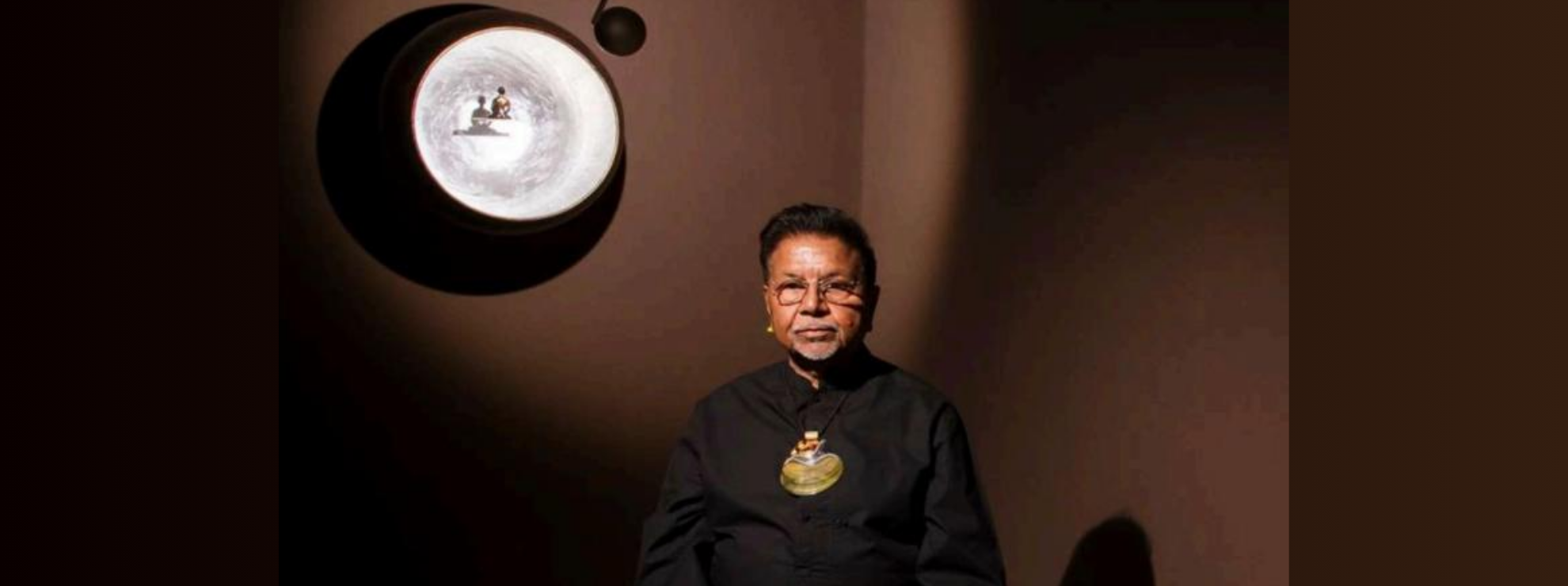
Vipul Kumar: A sculptor shaped by stone, clay and time
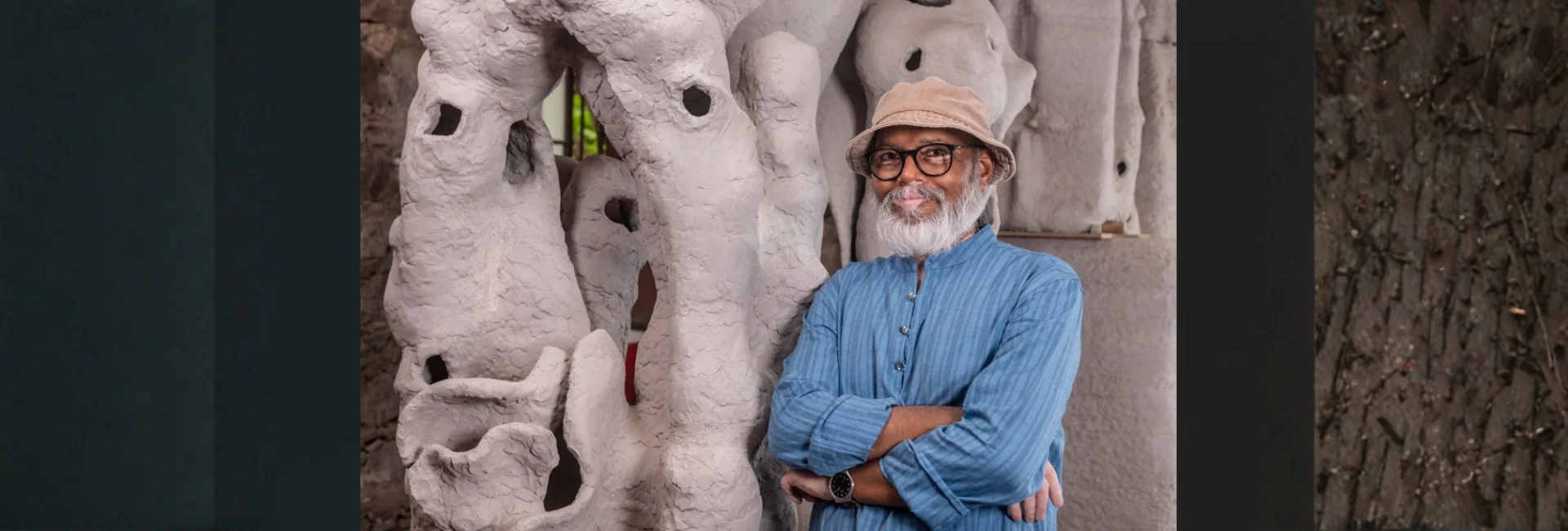
(Sep 24, 2026) Indian sculptor Vipul Kumar works across stone and ceramics, with a practice shaped by years of exhibitions, residencies and fellowships. From public spaces to private collections, his sculptures have found audiences across India and beyond.
In Bhainslana, a small village in Rajasthan edged by stone quarries and a landscape that is at once harsh and quietly generative, 56-year-old Vipul Kumar has built a practice that resists the easy rhythms of the contemporary art world. His sculptures, often monumental yet intimate, carry the memory of material, of time, of a hand that has learnt to wait.
Working largely away from metropolitan centres, Kumar has shaped a language that moves between clay and fire, abstraction and figuration, holding within it questions of environment, spirituality and human presence. His latest exhibition, curated by Anita Dube and presented by Art Explore, offers a compelling look at an artist who has allowed process, rather than pace, to define his journey.
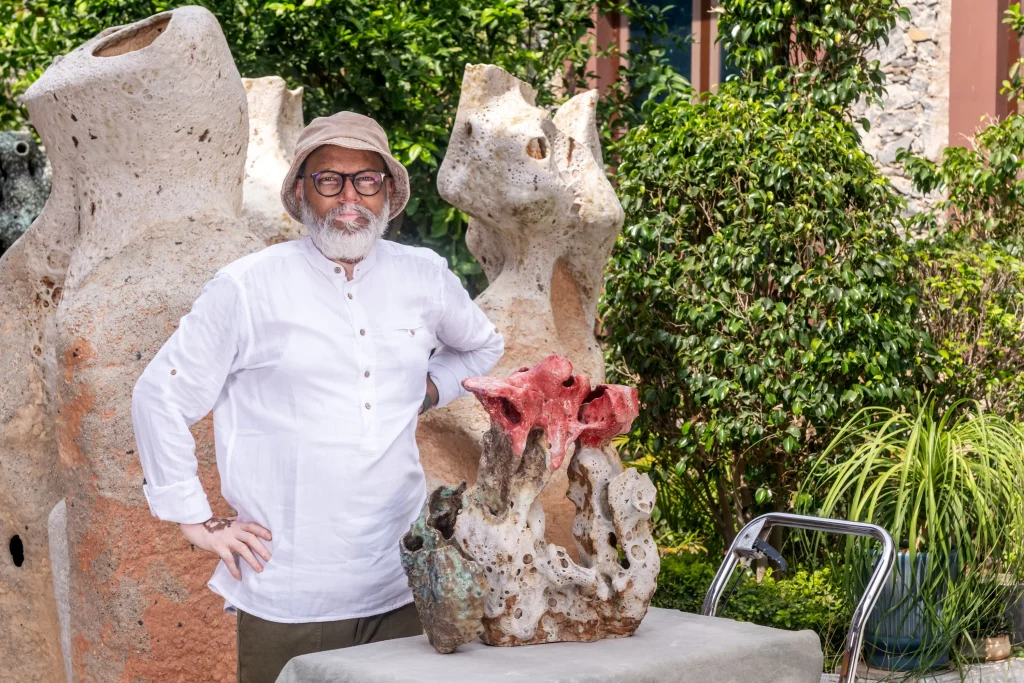
Learning from resistance
Kumar’s early years in Bhainslana did not come with the markers one associates with an artist’s formation. There were no galleries to visit, no exhibitions to track. Instead, there was material. Stone, in particular, was not an abstract medium but part of everyday life. “The landscape, the stone quarries and the materials around me were part of everyday life,” he tells The Global Indian, recalling a childhood shaped by observation rather than instruction. That proximity to material, and the absence of distraction, has remained central to his practice.
He began as a stone carver, a discipline that demands a kind of respect bordering on caution.
Stone taught me a lot about resistance, weight and structure. You cannot treat it casually. Every decision has consequences because you are removing material. There is no undoing in stone, no easy revision. The act of carving becomes a negotiation between intent and limitation.
Vipul Kumar
That early training continues to shape how he approaches clay, a medium that appears, at first glance, far more forgiving. Clay allows for addition and subtraction, for reworking and rethinking. But Kumar carries into it the discipline of stone. The understanding of weight, of balance, of how a form holds itself in space, remains embedded in his process. “The understanding of weight and structure that I developed through stone remains with me,” he says.
Just as crucial is the patience stone demanded. “You have to listen to the material,” he says, almost as a principle rather than a recollection. In an art ecosystem that often privileges speed and visibility, Kumar’s insistence on time, on staying with the material long enough for it to reveal itself, feels quietly radical.
The accident that stayed
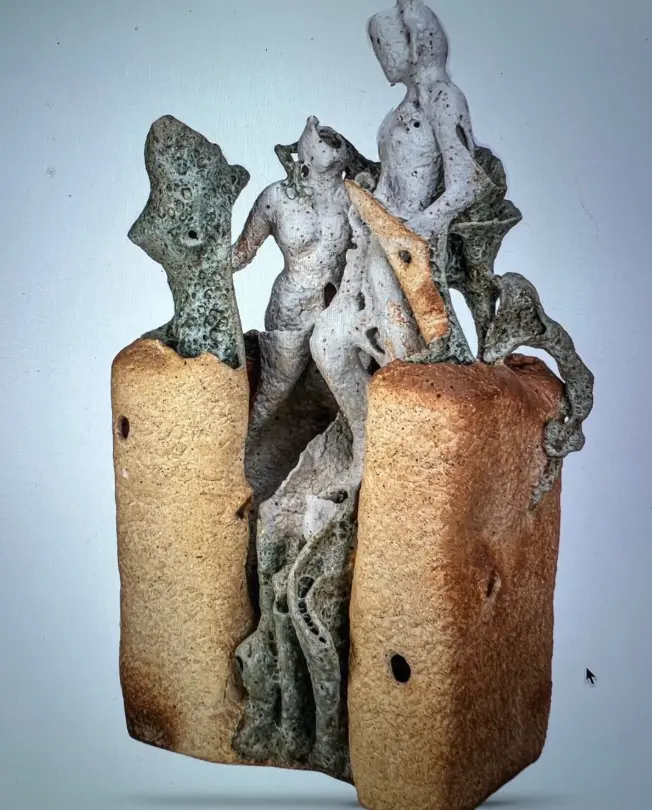
Ceramics entered Kumar’s life without intention. It was not a pivot planned or strategised but a gradual drift into a medium that began to open up new possibilities. “Ceramics came into my life unexpectedly,” he reminiscences and adds. “What began almost as an accident slowly became a way of thinking and working”.
What drew him in was not just the tactile nature of clay but its transformation. Unlike stone, which reveals form through subtraction, clay moves through states. It is shaped, dried, fired. It changes. “I became increasingly interested in what clay could do, how it responded to the hand and how fire could transform something that was still fragile and unfinished,” he says.
The kiln, in this process, becomes less a tool and more an interlocutor. It introduces uncertainty into the act of making. “The kiln is always a moment of uncertainty,” Kumar expounds. “Once the clay enters the kiln, I have to let go of control”. For an artist trained in the exacting demands of stone, this surrender is significant. It marks a shift from control to collaboration, from certainty to acceptance.
When the work emerges, it is no longer entirely his. “The work has already been made by my hands, but fire takes over,” he says, describing that moment of release. This relationship with unpredictability is not incidental to his practice. It is foundational. “If I knew exactly what would happen every time, the process would lose something,” he adds later.
The studio in Bhainslana mirrors this continuity between life and work. There is no rigid separation. Tools, materials and finished pieces coexist, allowing for an ongoing engagement with the work even in moments of apparent pause.
Sometimes I may not be physically working on a sculpture, but I am still looking at it, thinking about it.
Vipul Kumar
The practice, then, is not confined to the act of making but extends into a way of being. Sound, too, enters this space with care. Classical music often plays as he works, not as background but as a structuring presence. “It creates a certain rhythm in the studio and allows me to remain with the work,” he says . At other times, silence takes over. The alternation between the two suggests a practice attuned to shifts in attention and energy.
View this post on Instagram
Form, philosophy and the environment
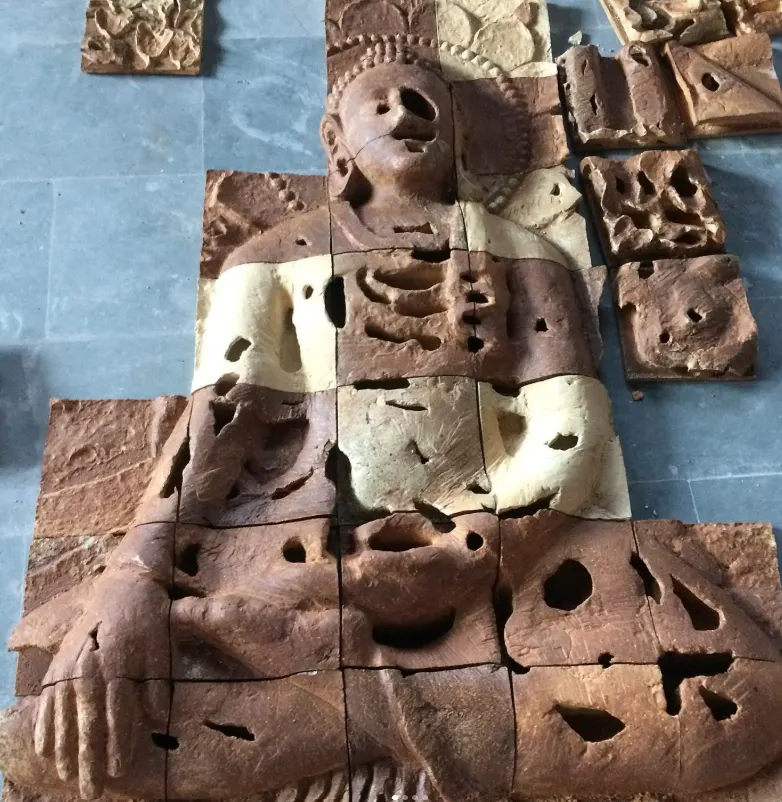
Kumar’s sculptures move between abstraction and recognisable form without settling firmly into either. Figures seem to emerge and recede, forms hold suggestions of mythology, memory or landscape without resolving into clear narratives. This ambiguity is deliberate. “I allow the form to develop rather than forcing it to become exactly what I imagined,” he adds. The work, in this sense, is discovered rather than imposed.
He resists the idea that a sculpture must explain itself. “I like the possibility that the viewer can bring their own experience to it,” he says. This openness aligns with the philosophical influences that underpin his thinking. Figures like Kabir and Gandhi, along with Buddhist thought, have shaped his engagement with ideas of impermanence, attachment and existence. Yet, these do not appear as overt references. “I do not consciously try to illustrate a philosophy in my sculptures,” he says.
Instead, they enter the work indirectly, as part of a broader way of seeing. His time in Varanasi and Sarnath, places marked by layered histories and spiritual inquiry, deepened this perspective. The result is a body of work that feels contemplative without being didactic.
Working with scale and uncertainty
Scale plays a significant role in how this language unfolds. Kumar often works with large forms, a choice that brings with it both risk and possibility. “Scale changes the relationship between the body and the sculpture,” he confesses. Larger works demand a different kind of engagement, both from the artist and the viewer. They occupy space more assertively, drawing the body into relation with them.
At the same time, working at scale introduces technical challenges, especially with clay. “There is also a certain risk involved because clay behaves differently as the scale increases,” he notes. That risk, however, is part of the appeal. It keeps the process alive, unsettled.
Underlying all of this is Kumar’s engagement with the environment, not as subject but as condition. “I see myself as working within it,” he says simply. The materials he uses, clay, water, air, fire, are not separate from nature but part of it. The act of making becomes a momentary participation in a much longer process. “I am simply participating in that process for a moment,” he says.
Working away from major art centres has allowed Kumar to sustain this relationship without the pressures of constant visibility. “I have always been more concerned with the work than with where it is being seen,” he smiles. That distance has afforded him a certain freedom, even as it has required patience in terms of recognition.
Mentors have played their part in shaping his trajectory. Artists like Himmat Shah and Balbir Singh Katt offered different but equally important insights, from discipline to ways of thinking about form. Yet, Kumar is clear that these influences are not templates to be followed. “Ultimately each artist has to find their own language,” he shares.
A practice rooted in place
In Bhainslana, that language continues to evolve, shaped by material, by time, by a practice that privileges attention over urgency. Outside the studio, Kumar reads, travels and listens to music, activities that fold back into his work in subtle ways. “They become part of how I see and think, even when I am away from the studio,” he notes.
There is a quiet consistency to his approach, a refusal to separate life from work, process from outcome. In an art world that often moves quickly, Kumar’s practice asks a different question. Not what is new, but what endures when one stays with a material, and with oneself, long enough.
- Follow Vipul Kumar on Instagram
ALSO READ: Naresh Kumar Kumawat: Sculpting India’s spirit for the world
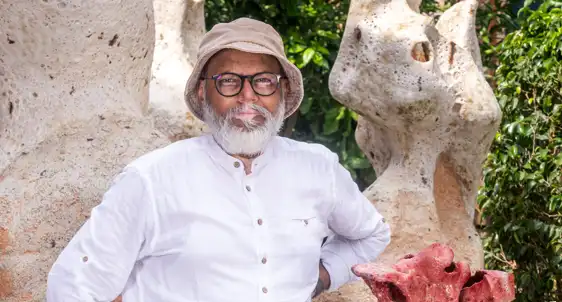
Vipul Kumar
| Born | Feb 6, 1970 |
| Based | Bhainslana, Rajasthan, India |
| Studied | BFA and MFA in Sculpture, BHU, India |
| Languages | Hindi, English |
Signature work
Vipul Kumar’s signature practice lies in working across stone and ceramics, bringing the discipline of carving into dialogue with the unpredictability of clay and fire. His large-scale sculptures explore form, human presence, nature and impermanence while leaving space for the material and the viewer to shape the experience.
Idea
Exploring the relationship between material, nature and human presence through stone and ceramics, allowing process and material to influence the final form.
Network
His artistic journey has connected him with institutions, fellow artists and art communities through exhibitions, sculpture camps, fellowships and an Indo-Japanese sculpture symposium.
Impact
His sustained practice from Bhainslana demonstrates how contemporary sculpture can evolve outside major metropolitan art centres, while his works in public and private collections extend the reach of his artistic language
Inspired by Vipul Kumar 's journey?
Yours follows the same Hero's pattern — Separation, Initiation, Transformation, Return.
Share with


Written By: Deepa Natarajan Lobo
Priyanka Rana: The Bay Area sculptor listening to what wood has to say
Written By: Vikram Sharma