
August 15 2026
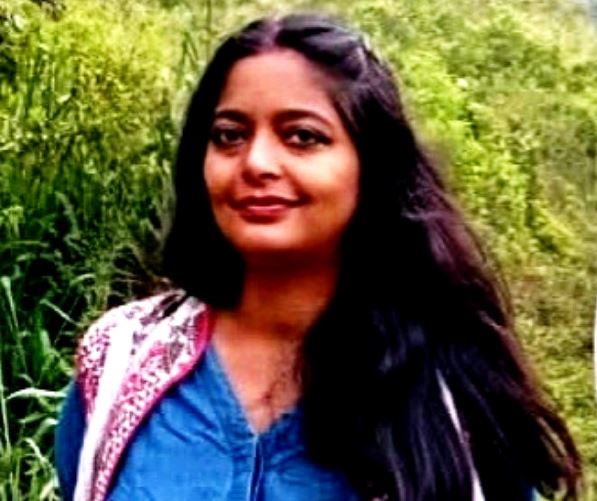
Safeena Husain: Nation building through Educate Girls, Ramon Magsaysay Award and TIME honour along the way

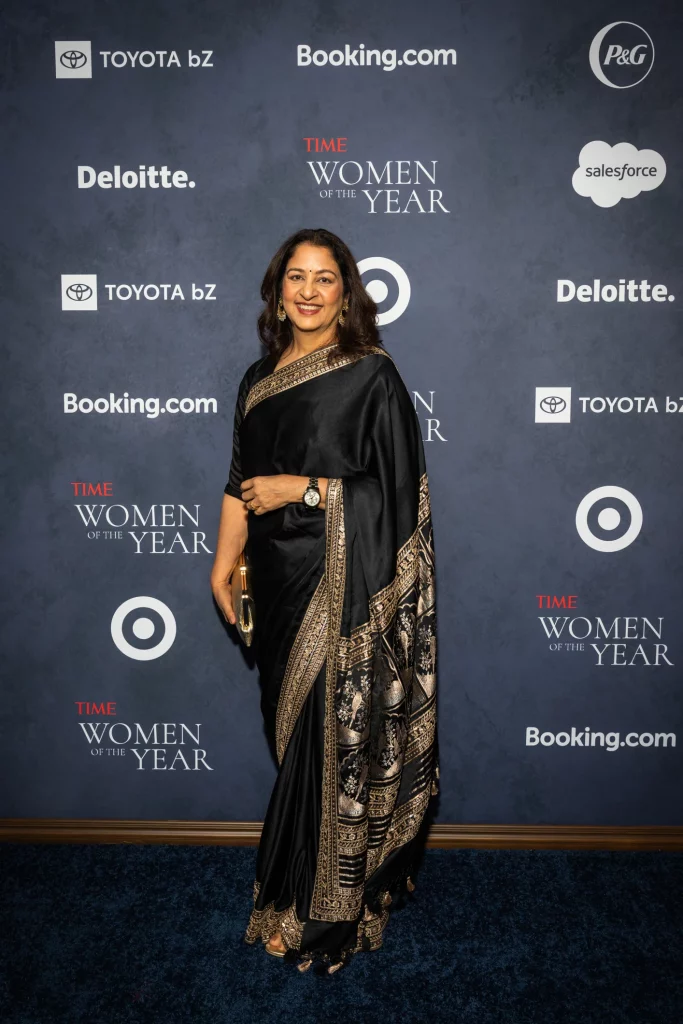
(Aug 15, 2026) Safeena Husain, founder of Educate Girls, has built a community-led movement across more than 31,500 villages in India. Under her leadership, Educate Girls became the first Indian non-profit to receive the 2025 Ramon Magsaysay Award, while Safeena was named one of TIME’s Women of the Year in 2026.
“It was my aunt who stepped in and fought for my education,” Safeena recalls. “I had a turbulent childhood in New Delhi, marked by poverty, abuse and a three-year break from school,” she shares with The Global Indian.
At a time when it would have been easy for her education to end, her aunt fiercely advocated for her and helped her return to school.
The second chance changed the course of my life. School gave me a voice, a sense of agency and choice to imagine a future beyond my circumstances. Years later, I became the first person in my family to attend the London School of Economics. For me, that journey remains proof of what education can unlock when even one person refuses to give up on a girl.
Safeena Husain
Safeena graduated from the London School of Economics in 1995 with a Bachelor of Science in Economic History. She then spent several years working in international development, including public health, community development and poverty alleviation, with assignments across Asia, Africa and Latin America. The experience brought her into close contact with communities dealing with poverty and social exclusion and showed her how individual circumstances are often shaped by larger systems.
When she returned to India in 2005, girls’ education became the question she wanted to pursue. Two years later, she founded Educate Girls, the non-profit organization that works towards girls’ education in India’s rural and educationally backward areas by mobilizing communities.
What started with a focused pilot in Rajasthan has since grown into a movement working across more than 31,500 villages. More than 55,000 Team Balika volunteers are part of the effort, which has mobilised more than 2.2 million previously out-of-school girls for enrolment and supported improved learning outcomes for more than 2.5 million children.
Team Balika
Safeena did not want Educate Girls to be an outside organisation arriving in a village with a ready-made answer. The starting point was community ownership.
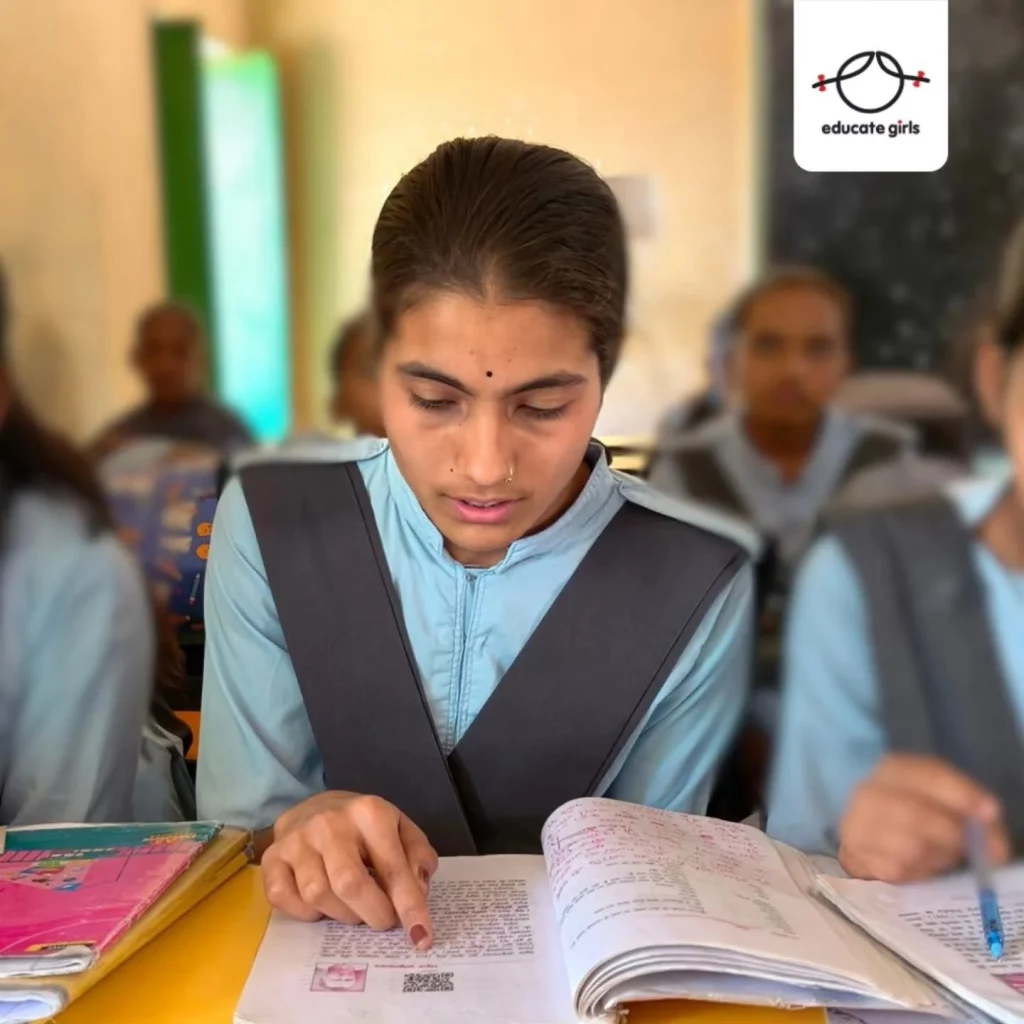
That led to the creation of Team Balika, a network of village-based volunteers who identify girls who are out of school, speak with their families, work with community influencers and help girls return to education. The model has grown from its early experiments into a network of more than 55,000 community champions.
Their work can involve walking long distances, visiting homes repeatedly and persuading families who may have several reasons for keeping a daughter out of school.“What people often underestimate is the persistence behind their work,” Safeena says.
Team Balika volunteers live by the belief, “Mera gaon, meri samasya, main samadhan” — my village, my problem, I am the solution. They travel long distances, work through extreme heat and floods, and return to the same homes again and again. They listen patiently, build trust with families and keep the conversation going until a girl is given the chance to return to school.
Safeena Husain
That last part matters. An out-of-school girl is rarely kept away from a classroom by one decision alone. It can be poverty, household responsibilities, concerns about safety, social expectations, geography or the belief that educating a daughter is less important than educating a son. The job, therefore, is not simply to locate a girl. It is to change the conditions around her.
Rather than building a parallel education structure, the organisation works with existing government systems and public schools. It engages communities, supports school improvement and focuses not only on getting girls into classrooms but also on whether children are actually learning. The NGO’s model is designed to leverage existing community and government resources rather than create parallel service delivery.
View this post on Instagram
Using data and AI to find the girls who are hardest to reach
As the organisation grew, another question emerged, and that was, how do you retain the precision of a village-level intervention when you are working across tens of thousands of villages?
Technology became part of the answer. Educate Girls uses data and technology to identify communities where the concentration of out-of-school girls is likely to be highest and to help its field teams focus their resources. Its current model describes technology-supported door-to-door surveys and profiling alongside community mobilisation.
Safeena sees artificial intelligence as potentially useful in making that process even more precise. “AI can help us predict where out-of-school girls are most likely to be, identify patterns, and make our work faster and more efficient,” she says. “It can guide us towards the communities that need attention most.”
But she is equally clear about where technology stops.
AI can point us to the right door. Everything that happens after that depends on human connection. In rural, remote and tribal communities, questions of gender, safety and agency require patience, context and human judgment.
Safeena Husain
Making education about learning, not just enrolment
Getting a girl through the school gate is only one part of the problem. Many children who have spent time away from school return carrying learning gaps with them. Others have been enrolled but have not acquired foundational skills.
Educate Girls therefore works on learning outcomes alongside enrolment. Its interventions include remedial learning and community-based programmes designed to help children catch up. In its 2024–25 annual report, the organisation reported supporting 1,81,251 children through its foundational learning programme, while 2,85,237 out-of-school girls were brought back to classrooms that year.
The second-chance programme
The organisation has also developed second-chance pathways for older girls and young women who have missed years of schooling.
This is where the stories of Bunty, Mamta and Halima stay with Safeena. Each had left school between 10 and 14 years earlier before returning through Educate Girls’ second-chance programme. Bunty scored 74 percent and topped the Madhya Pradesh State Open School examination. Mamta scored 85 percent and ranked third in Rajasthan, while Halima scored 79 percent and topped Bihar.
For Safeena, their marks are evidence of something deeper. “These women were never lacking in ability,” she says. “What they lacked was a pathway back to learning.” Educate Girls’ second-chance programmes seek to create that route, including through state Open School systems.
In 2024–25, its Pragati programme supported 15,500 adolescent girls and young women to return to education through the state Open School system.
First organisation in Asia selected for the TED Audacious Project
Safeena also brought an unusual question to the social sector, and that was, ‘could funding itself be tied more closely to results?’
Between 2015 and 2018, she led Educate Girls’ participation in the world’s first Development Impact Bond in education. Instead of funding being based simply on activities undertaken, the model linked payment to outcomes in enrolment and learning.
The programme exceeded its targets, providing an early demonstration that outcomes-based financing could be applied to education. For Safeena, the significance was larger than one financing experiment. It showed that a non-profit working in difficult environments could be expected to articulate measurable outcomes and be held accountable for achieving them.
That appetite for scale and experimentation also helped Educate Girls become the first organisation in Asia selected for the TED Audacious Project. Its subsequent work under the initiative set an ambitious target of reaching some of India’s hardest-to-reach girls. By March 2025, Educate Girls reported that it had brought 1.56 million girls targeted under the initiative back to classrooms across Rajasthan, Madhya Pradesh, Uttar Pradesh and Bihar.
The organisation’s current ambition is to reach 10 million learners by 2035.
Ramon Magsaysay Award: Recognition for a collective journey
The scale and experimentation of the programmes have brought Safeena and Educate Girls some of the world’s most significant recognition in education and social impact.
In 2025, Educate Girls became the first Indian non-profit to receive the Ramon Magsaysay Award. In 2026, Safeena was named one of TIME’s Women of the Year. The honours followed other milestones. In 2017 NITI Aayog conferred upon her the Women Transforming India Award. In 2023, Safeena became the first Indian woman to receive the WISE Prize for Education. In 2024, the London School of Economics awarded her an honorary doctorate.
Yet Safeena does not describe the awards as the destination.
I look back on that journey with deep gratitude and humility. The Ramon Magsaysay Award received by Educate Girls and my recognition as one of TIME’s Women of the Year are deeply meaningful, but they reflect a much larger collective journey.
Safeena Husain
That collective includes the girls, families, teachers, colleagues, community members, government partners, Preraks and more than 55,000 Team Balika volunteers. The awards, in that sense, belong to the movement as much as to its founder.
Writing the stories behind the movement
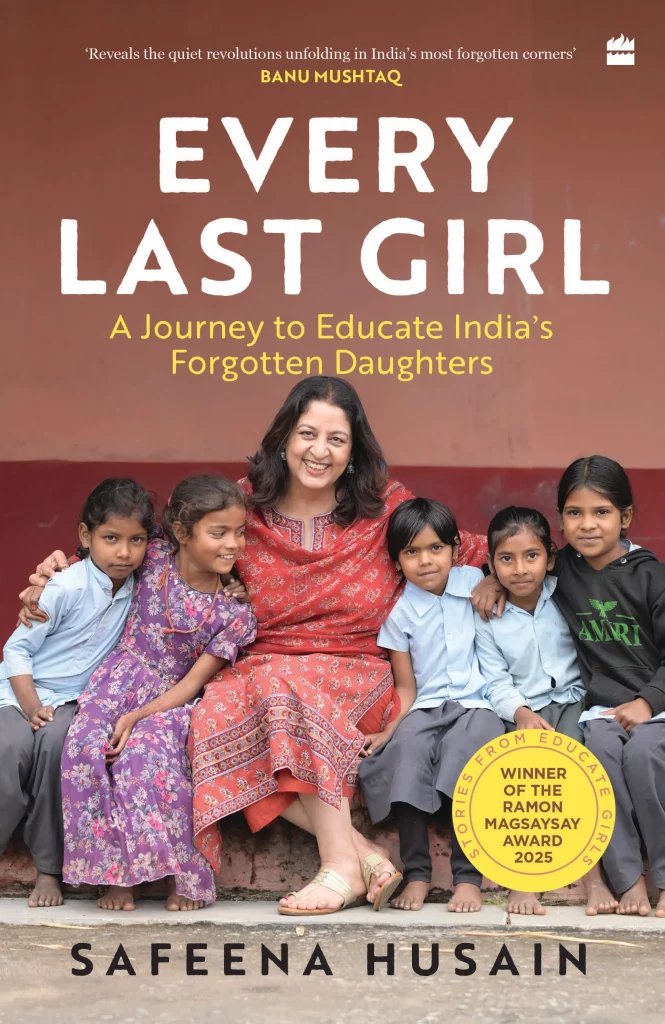
In January 2026, Safeena added another dimension to that journey with Every Last Girl: A Journey to Educate India’s Forgotten Daughters, launched at the Jaipur Literature Festival. The book traces the development of Educate Girls through her own experience and first-hand stories from India’s villages, with a focus on what it takes to reach girls who are furthest from opportunity.
The timing is significant. After almost two decades of building the organisation, Safeena has not simply documented its milestones. She has tried to make visible the people and experiences behind them.
The book brings together her personal journey, the evolution of Educate Girls and the realities encountered in rural communities. It examines why girls continue to be excluded from education and what happens when communities, volunteers and institutions work together to change that trajectory.
At its heart, Every Last Girl is a promise that we will not stop until every girl has the opportunity to learn, dream and shape her own future.
Safeena Husain
The question she hopes readers carry from the book is deliberately personal: “What can I do, within my own sphere of influence, to ensure that no girl is left behind?”
A role for those beyond the village
For members of the Indian diaspora with expertise, influence, capital or networks, Safeena sees multiple ways to contribute. It could be through CSR, family foundations, strategic partnerships or long-term funding. It could also be an introduction to someone who can open a door, professional expertise that can strengthen an organisation or a willingness to keep girls’ education visible in boardrooms and public conversations.
But she believes meaningful engagement starts with understanding the work rather than simply funding it from a distance.
“Meeting the girls, their families and Team Balika volunteers can help one understand the realities on the ground and where one’s support can make the greatest difference,” she says.
It is perhaps fitting that Safeena’s own journey began with one person doing something similarly direct. Her aunt did not solve the larger problem of girls’ education. She did something smaller and more immediate by refusing to allow one girl (Safeena) to lose her chance.
That intervention changed Safeena’s life. Nearly three decades later, she went on to build Educate Girls around the belief that such chances should not depend on luck or circumstance. They should be supported by communities, strengthened by public systems, informed by data, measured through outcomes and sustained by people willing to keep showing up.
And perhaps that is the most consequential part of Safeena Husain’s story. The girl whose education once depended on one determined aunt went on to build a movement designed to ensure that many more girls get their own second chance.
Safeena Husain
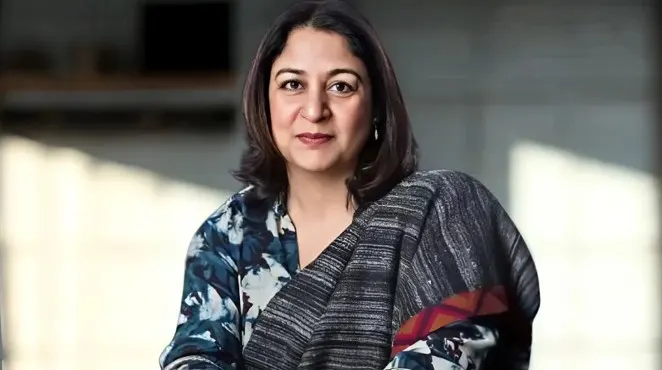
| Born | Jan 21, 1971 |
| Based | Mumbai, India |
| Studied | BSc in Economic History at London School of Economics and Political Science |
| Languages | Hindi, English |
Signature work
Educate Girls: Founded in 2007, Safeena’s flagship organisation uses community mobilisation, data, technology and government partnerships to bring out-of-school girls back to education and improve learning outcomes at scale.
Idea
Built Educate Girls around community ownership, combining grassroots mobilisation with data, technology and partnerships with government systems to bring girls back to education at scale.
Network
Built Team Balika into a network of 55,000+ community volunteers, alongside partnerships with government, philanthropists, development organisations and global institutions.
Impact
Supported more than 2.2 million previously out-of-school girls to return to education and helped improve learning outcomes for more than 2.5 million children across 31,500+ villages.
Giving Back
Advocates for girls’ education through community engagement, second-chance learning and systems change, while encouraging others to contribute through their expertise, networks, influence and capital.
Inspired by Safeena Husain 's journey?
Yours follows the same Hero's pattern — Separation, Initiation, Transformation, Return.
Share with


Written By: Amrita Priya
Cycle Didi pedals to empower: Sudha Varghese has been working for the Musahars for over 50 years


Written By: Vikram Sharma