
November 21 2026
Ranjeet Tayi: From childhood matchbox collector to Silicon Valley AI leadership and UX honours in Austria

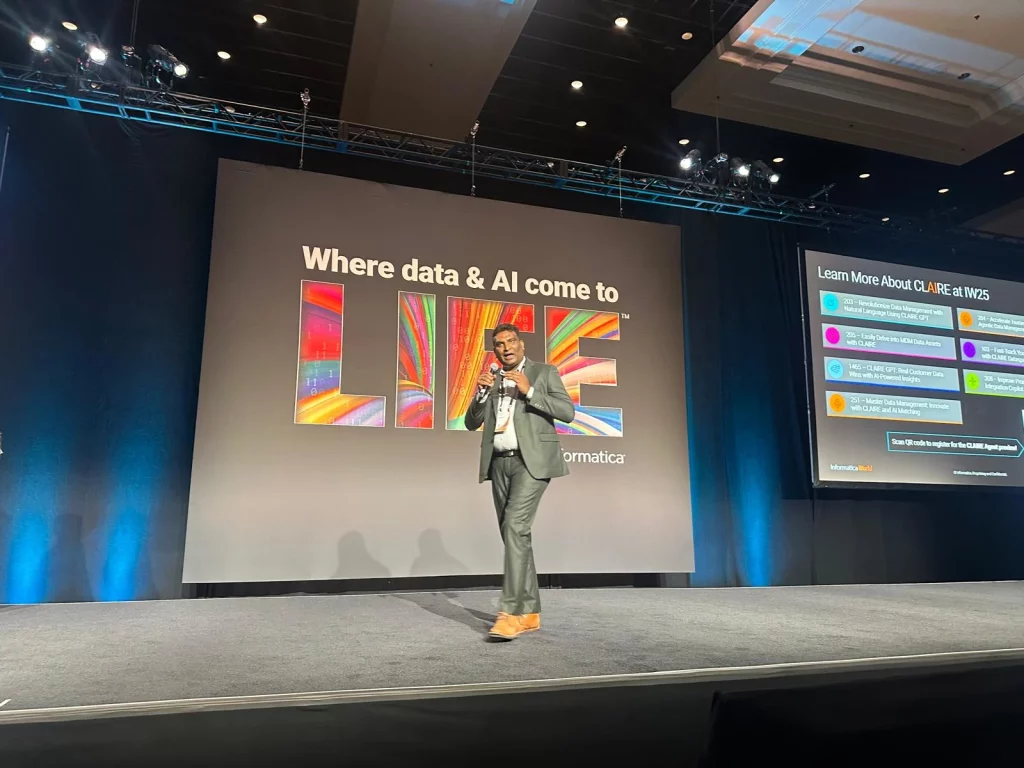
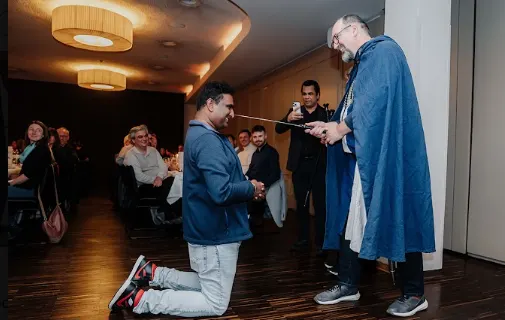
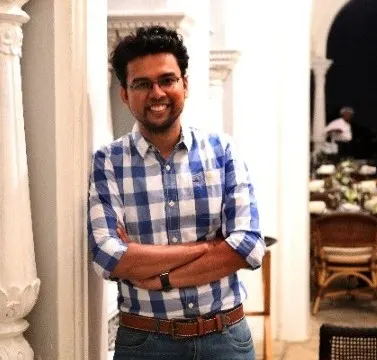
(Nov 21, 2026) From a childhood matchbox collection in Hyderabad to designing how people and AI agents work together at Salesforce in Silicon Valley, Ranjeet Tayi has built a design career that spans continents. With eight patents, talks at more than 50 international conferences, guest lectures from UC Berkeley to IIT Hyderabad and jury roles on leading global design awards, he has now been inducted as a UX Experience Knight at the World Usability Congress in Graz, Austria. The honour, conferred on a handful of practitioners at one of the world’s leading UX gatherings, recognises his sustained contribution to the profession and places him among a community of international design leaders.
It is 10.30 in the morning in Silicon Valley when Ranjeet Tayi joins us over Zoom. On his desk is a small object that has travelled with him through the different stages of his career: a matchbox. He holds it up as he talks about the hundreds he collected as a child in Hyderabad, fascinated by their colours, illustrations and unusual packaging.
Today, the design leader, who works on AI experiences at Salesforce, has eight patents to his credit. He has also received the Indian Tech Icon Award and an extraordinary ability visa from the US government in recognition of his professional achievements. His contribution to the design community was recognised with the UX Experience Knight Award, an honour that reflects his sustained work in advancing user experience design and championing the profession. Yet, for Ranjeet, the origins of this journey can be traced to a simple childhood fascination with an everyday object.
The matchbox, he explains, was his first lesson in design, branding and usability, long before he knew these were disciplines one could build a career around. It was a curiosity that took him from an early animation and visual effects venture in Hyderabad to usability research, enterprise software and, eventually, Silicon Valley.
He has a phrase for what drives him: “Good design for better living.” It is a philosophy that has remained remarkably consistent, even as the technology around him has changed.
The matchbox and the making of a designer
Ranjeet grew up in Hyderabad in a family with a strong public-service background. His father and grandparents worked in the government sector, and he was a curious creative child, but his fascination with matchboxes was perhaps more unusual than most. He collected hundreds of them, drawn to their colourful illustrations and the variety of images printed on their covers. There were film stars such as Amitabh Bachchan, religious figures, birds, household objects and all kinds of unexpected designs.
What began as collecting soon became an exercise in observation. Why, he wondered, would a matchbox carry the image of a glass, a ship or a celebrity? Why were certain colours and illustrations so attractive? And why did a matchstick burn only up to a particular point rather than consume the entire stick?
By the time he was in Class III, he had arrived at three ideas. The illustrations and colours were about design and attraction. The images were a form of advertising and branding, making everyday objects memorable. The safety feature of the matchstick was an example of usability and human factors. Even the way the sticks fitted neatly inside the box spoke to engineering.
“I realised it’s all about branding, design, usability. That is product design & engineering,” he tells The Global Indian.
The little discovery proved unexpectedly influential. He went on to study advertising, mass communication and design management, and later built a career around usability and human-centred design. A matchbox still sits on his desk. When he needs inspiration, he sometimes strikes a match, returning to the object that first made him look at the world differently.
From visual effects to usability
His professional journey began in 2002, when he co-founded Mind Visions, an animation and visual effects company in Hyderabad. At the time, the local industry was still taking shape, with only a handful of established players. The company went on to work on visual effects for films across India. Ranjeet exited the venture in 2006, while his co-founder continued to run it.
The Design whiz was ready to explore another emerging field: usability research. He approached Pure IT Usability Research, one of the few companies in India working in human factors and usability engineering at the time. A casual conversation with its chief executive, Jaya Deshmukh, which he had expected to last ten minutes, stretched to three hours. By the end, the conversation had led to a job offer, which he accepted.
From Hyderabad to Silicon Valley
Ranjeet’s years in Hyderabad were marked by a steady involvement in the city’s creative and design communities. Alongside his professional work, he helped curate / organise Ignite Hyderabad, a platform for talks and ideas, and was part of the Hyderabad Photography Club. Weekend photography outings, exhibitions and public events gave him opportunities to engage with people outside his immediate professional circle.
Enterprise software and the move west
In 2007, he moved into enterprise software, joining SumTotal, before moving to Informatica in 2011. It was a significant transition, bringing together his interests in technology, data and design. Two years later, the company’s leadership encouraged him to move to its US headquarters. He was offered the option of relocating to Texas, but Ranjeet had a different destination in mind.
“I said no. I don’t want to move to Austin. I want to be in Silicon Valley,” he recalls.
For someone fascinated by startups, venture capital and innovation, the Valley represented an opportunity to be closer to the ideas and people shaping the technology industry. The move gave him a front-row seat to several waves of change.
Designing AI before it was mainstream
His work increasingly focused on making complex enterprise data platforms more intuitive and intelligent. Around 2015, Ranjeet began exploring the possibilities of artificial intelligence in enterprise software, long before generative AI entered mainstream conversation. By 2018, he was helping shape the experiences around Informatica’s CLAIRE AI engine, later establishing and leading an AI Experience team. His work evolved across intelligent data management, conversational AI, CLAIRE GPT, contextual copilots and purpose-built AI agents.
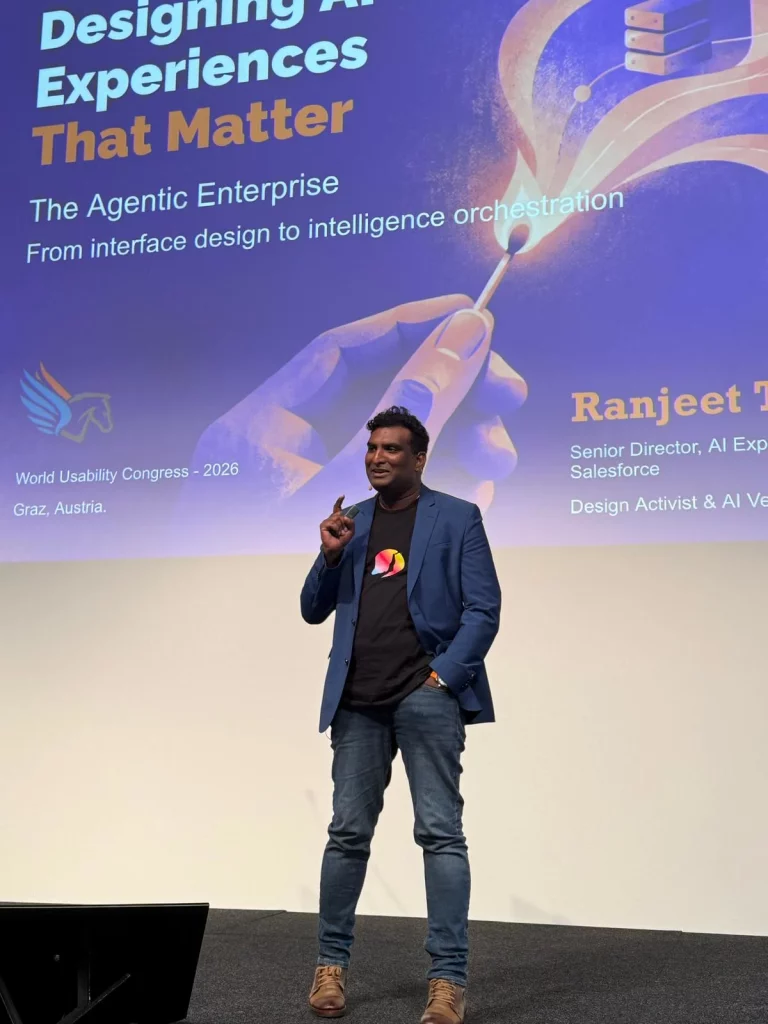
Following Salesforce’s acquisition of Informatica in 2025, Ranjeet entered a new chapter as Senior Director of AI Experience at Salesforce. Today, his focus extends beyond traditional user interfaces to designing how humans and intelligent AI agents collaborate, make decisions and work together effectively with trusted data context.
AI also needs to be designed. A system may be technically powerful, but its value depends on whether people can understand it, trust it and use it effectively.
Ranjeet Tayi
His team works across research, design and innovation, developing concepts for how AI could assist users, reduce repetitive work and function as a collaborator.
Recognition from Santa Clara to Graz
His professional contributions have earned international recognition. In 2024, Ranjeet was named an Honored Listee in Marquis Who’s Who in America. In 2025, he received the Indian Tech Icon Award as “The Mastermind of Impact” at Santa Clara University, recognizing his achievements in AI and design leadership. The award was presented by Mayor Stacy Jimenez at an event attended by prominent Silicon Valley civic leaders, including mayors Lisa Gillmor, Carmen Montano and Liang Chao.
In October 2026, the design multi-hyphenate received a particularly meaningful recognition when he was honoured as a UX Experience Knight at the World Usability Congress in Graz, Austria. He joined a distinguished community of global design leaders and visionaries, including Hannes Robier, Joe Lanzisero, Russ Wilson, Maria Giudice and Mirjam Wouters, among others.
Designing a more human future with AI
For decades, designers focused on how humans interact with software through screens, menus and workflows. But artificial intelligence is fundamentally changing that relationship. Software is no longer simply responding to instructions. Intelligent systems can understand context, make recommendations and increasingly act on behalf of people.
For Ranjeet, the most important question about artificial intelligence is not how much work it can take over, but what it can make possible for people. He sees enormous potential in automating repetitive tasks, freeing up time for more meaningful work and helping individuals become more capable. He often describes this as making every user “10x” more effective.
But he is equally clear about where human judgement should remain. “How can you help them where the decision-making should always be human?” he asks. In his view, AI should take on routine processes and help people make better-informed decisions, not replace their creative abilities or independent thinking.
He points to areas such as healthcare, weather forecasting, disaster prediction, agriculture and sustainability as places where AI could make a substantial difference. Better predictions could help identify diseases earlier, improve responses to natural calamities and support farmers dealing with changing environmental conditions. The technology, he believes, should ultimately serve people.
Preparing for the disruption
He is also realistic about the disruption it will bring to employment. Comparing the present moment with earlier technological shifts, he recalls how bank employees in Hyderabad’s Koti area protested when ATMs were introduced, fearing that their jobs would disappear. His advice is not to ignore the disruption, but to prepare for it.
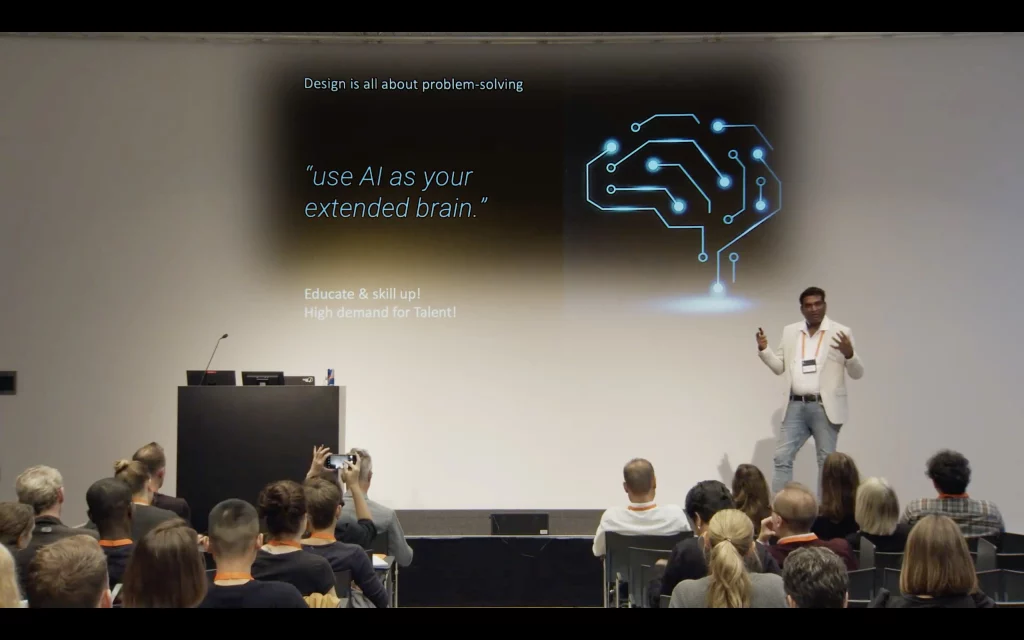
People who learn to use AI effectively will have an advantage over those who resist it. That’s why upskilling is very, very important.
Ranjeet Tayi
Ranjeet is a co-chair of UX India & UMO Design, one of the country’s biggest user experience design platforms and helped organize UX conferences & many design programs, contributes to design councils and on many non-profit professional boards internationally. For Ranjeet, design is more than a profession. He considers himself a design activist, committed to the belief that good design can improve human life.
A life beyond the screen
His lifelong fascination with matchboxes is now evolving into a philosophy of leadership, decision-making and purposeful action. He is developing MatchLit, a collection of short motivational reflections and philosophical ideas expressed through matchbox-inspired storytelling, alongside the Matchbox Framework, a simple physical thinking system designed to help people focus, prioritize and commit to action. “Infinite ideas. Finite matches. One strike changes everything” captures the philosophy behind the initiative.
Do it or don’t do it
“There are only two things in life, I believe in. Do it or don’t do it,” he says. If something matters, he believes, one should make a start rather than wait for the ideal moment. He also makes a conscious effort to surround himself with people who challenge him and from whom he can learn. Some of his most interesting conversations, he says, have happened over coffee or while travelling. Even Uber drivers have introduced him to unexpected perspectives. He recalls meeting a 78-year-old driver who was learning artificial intelligence, and another who had previously worked as a software engineer and now vibe codes during EV charging. Their stories reminded him that people find new directions at different stages of life.
Family, sport and backyard experiments
At home, he shares that appetite for trying new things with his wife, Santhoshi, a software engineer at Apple, and their daughters, Nriti, 13, and Kriti, eight. He enjoys involving the children in conversations about entrepreneurship, stock trading and problem-solving.
Family time is often built around experiments and spontaneous plans. At home, their projects often involve creative thinking and sport. Ranjeet has built a multi-purpose court in the backyard, with facilities for Volleyball, badminton, and pickleball, alongside a basketball hoop and a small golf course. He enjoys motorcycling and playing pickleball, while the children pursue their own sporting interests.
More than four decades after he first started collecting matchboxes in Hyderabad, one still sits on his desk in Silicon Valley. The object that sparked his imagination as a child is now inspiring his next chapter: helping others turn ideas into decisions and decisions into meaningful action.
The matchbox may be small. The possibilities it represents are anything but.
- Follow Ranjeet Tayi on LinkedIn
ALSO READ: Good Design for Better Living: Bapu Kaladhar’s blueprint for a better tomorrow


Written By: Vikram Sharma
Good Design for Better Living: Bapu Kaladhar’s blueprint for a better tomorrow


Written By: Amrita Priya