August 12 2026
Geetha Murali: The Room to Read CEO helping millions of children rewrite their futures

As CEO of Room to Read, Dr. Geetha Murali leads one of the world’s largest education nonprofits. Since its founding, the organization has benefited more than 60 million children across 29 countries with literacy and life skills programs that promote gender equality. But long before she was shaping global conversations on literacy and gender equality, her own family’s story had already taught her a profound lesson that educating one girl can change generations.
For Geetha Murali, the story that shaped her life’s work began decades before she was born. It began with her mother, whose decision to pursue an education in the face of generations of child marriage transformed the future of their family.
My mother grew up in a family where child marriage had been practiced for generations. My grandmothers were married at the ages of two and fourteen. My mother chose a different future. She pursued an education when that wasn’t the expected path, and in doing so changed the trajectory of our family.
Geetha Murali
Exceptionally bright, Geetha’s mother had completed high school by the age of 12. Yet her family would fund the education of only their eldest son, while their three older daughters were expected to marry. Refusing to accept that future, she joined the Indian Army as a nurse, eventually moving to the United States on a nursing visa. There, she worked her way through university before building a distinguished career as a biostatistician.
Success, for her, was never an individual accomplishment. The financial stability she earned enabled her to support her siblings back in India, helping them continue their own education and pursue careers that would otherwise have been out of reach.
That lesson has stayed with Geetha throughout her life. “Education became deeply personal to me because I had seen what became possible when someone could live a life of their own choosing,” she tells The Global Indian.
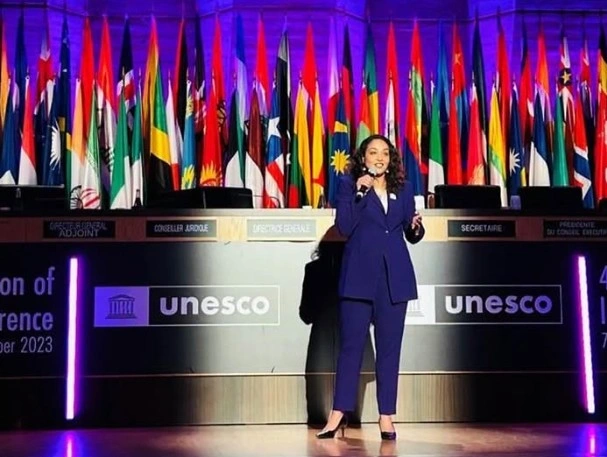
Education isn’t simply about learning something new. It’s about expanding what’s possible. The moment someone begins to believe a more fulfilling future is possible, the trajectory of a family can change for generations.
Geetha Murali
Today, that belief lies at the heart of the organisation she leads. Founded in 2000, Room to Read partners with governments, schools and communities and partner organisations to improve children’s literacy and life skills. To date, the organisation has benefited more than 60 million children across 29 countries.
A global voice for education
Today, Geetha is recognised as one of the leading voices in global literacy and gender equality. She served on the board of the Global Press Institute, is a member of the Young President’s Organisation, and is a Founding Circle member and social impact advisor for Neythri, a global network of South Asian professional women. Geetha regularly speaks at international forums on education, leadership and social justice. As an Executive Producer for the Webby Award-winning She Creates Change, she has helped amplify the voices of adolescent girls around the world.
Her contributions have earned international recognition. She has been named a CNBC Changemaker, received the YPO Global Impact Award, been recognised by WIRED among leaders shaping the next 25 years, and was knighted by the King of Cambodia for her contributions to education. Under her leadership, Room to Read has also been recognised by former US First Lady Michelle Obama and the Gates Foundation for its work in girls’ education and literacy.
For Geetha, however, the mission has never been merely professional. Long before she became the organisation’s CEO, she had already witnessed on a personal level what educating one girl could accomplish.
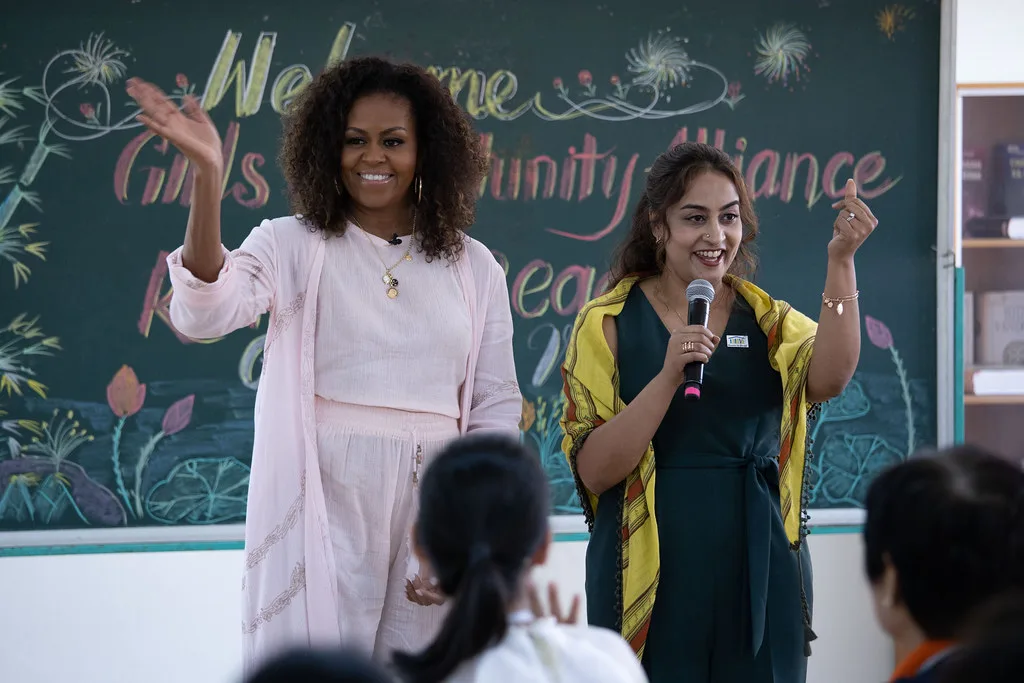
Geetha Murali with former US First Lady Michelle Obama
Growing up between two worlds
Born in New York, Geetha Murali grew up between India and the United States, an experience that shaped how she sees the world.
India has never been just a place I come from. It’s part of how I see the world.
Geetha Murali
Growing up between the two countries taught her to appreciate different cultures and perspectives, and molded an outlook that would later become one of her greatest strengths as she worked with governments, educators and communities across continents.
But as a young student, her ambitions were far more conventional. Like her mother, she excelled academically. She earned a master’s degree in biostatistics from The University of North Carolina at Chapel Hill before beginning her career in the pharmaceutical industry. She later completed both a master’s degree and a doctorate in South Asian politics at the University of California, Berkeley. Together, these disciplines combined the analytical rigour of quantitative science with a deep interest in society, governance and human behaviour.
During her PhD, Geetha travelled through villages across India researching political participation. But instead of discussing politics, parents spoke about everyday challenges that shaped their children’s futures, including safer streets, schools closer to home and better opportunities. Those conversations changed the course of her career. Academic research no longer felt enough; she wanted to work directly with communities to create tangible change.
The experience would shape every career decision she made thereafter.
View this post on Instagram
From corporate boardrooms to classrooms
Geetha’s career gradually evolved from the corporate world to the social sector, combining the analytical discipline of business with a growing commitment to education and social impact.
Alongside her corporate experience, she became involved with initiatives that explored how education and technology could expand opportunities for underserved communities. She contributed to programmes including the American India Foundation‘s Digital Equalizer initiative and Adobe Systems’ Adobe Youth Voices, reinforcing her belief that education could transform lives.
Finding a mission at Room to Read
When Geetha Murali joined Room to Read in 2009, the organisation was still less than a decade old.
It was founded in 2000 by former Microsoft executive John Wood. He had left the tech giant to tackle global illiteracy, and established Room to Read with co-founders Erin Ganju, who helped build its scalable education model, and Nepali development professional Dinesh Shrestha, whose decades of grassroots development experience helped shape its community-based approach. Built on the belief that world change starts with educated children, the organisation’s focus on strengthening education systems rather than replacing them deeply resonated with Geetha. One opportunity led naturally to another.
I joined Room to Read to build our corporate partnerships, then had the opportunity to lead our development work, followed by development and communications. Each role built naturally on the last.
Geetha Murali
Her motivation, she explains, never centred on titles. “Rather than pursuing a particular title, I was drawn to the challenges the organization needed to solve and where I felt I could contribute most.”
Becoming Room to Read’s first non-founder CEO
In 2018, Geetha became Room to Read’s Chief Executive Officer, succeeding co-founder Erin Ganju and becoming the organisation’s first leader who was not part of its founding team.
“Becoming CEO felt less like a destination than the next opportunity to serve the organization in a different way,” she says.
Today, she oversees a global workforce of around 1,200 employees, supported by more than 20,000 partners and volunteers, while leading an organisation whose literacy and girls’ education programmes have been recognised by the Gates Foundation and former US First Lady Michelle Obama.
Today, when she reflects on Room to Read’s reach, the number that matters most is not 60 million children.
What I’m most proud of isn’t our organizational growth. It’s seeing approaches we’ve helped develop become part of how education systems work every day. When governments, educators, and communities carry that work forward as their own, that’s when we know we’ve succeeded.
Geetha Murali
The power of possibility
Among the countless classrooms Geetha has visited, one memory has stayed with her. Early in her time at Room to Read, she met girls in Bangladesh who had recently joined its Girls’ Education Program. Quiet during a formal meeting, they opened up once the male staff stepped outside.
“They leaned in with curiosity,” she recalls. They wanted to know how she travelled the world without her husband. Then one girl asked, “If we stay in the program, will you come back and visit us?”
Months later, Geetha met girls in India who had spent several years in the programme. Through Room to Read’s partnership with the International Cricket Council, they had travelled, attended cricket matches and met international players. Their questions had shifted to university, careers and the futures they imagined for themselves.
“I couldn’t stop thinking about the girls I’d met in Bangladesh,” she says. “The most important shift isn’t when a girl learns something new. It’s when she begins to think differently about herself.” That belief in people and in institutions that help them realise their potential would be tested like never before.
View this post on Instagram
Leading through COVID and a personal health crisis
If becoming CEO marked a new chapter in Geetha Murali’s leadership journey, the years that followed would test every conviction she held about resilience, institutions and the meaning of leadership itself.
When the COVID-19 pandemic shut schools across the world, the crisis struck at the very heart of Room to Read’s mission. Millions of children, particularly those in underserved communities, suddenly found themselves cut off from classrooms and books.
For an organisation dedicated to literacy and girls’ education, standing still was not an option. Instead, teams across countries improvised. Learning reached children through radio broadcasts, community reading circles, boats travelling to remote villages, camel caravans in difficult terrain, and countless locally designed solutions that reflected the realities of each community.
The most challenging chapter of my life was leading Room to Read through the COVID-19 pandemic while facing an unexpected personal health crisis of my own.
Geetha Murali
As she led Room to Read through one of the greatest disruptions in modern education, doctors discovered a tumour compressing her spinal cord, forcing her to undergo emergency surgery.
She found herself relearning one of the most fundamental human abilities. “Overnight, I went from navigating a global crisis to learning how to walk again, while trying to remain present for my family and for an organization I cared so deeply about.”
Looking back, Geetha says she remembers not the surgery but the people who carried her through it. “What stays with me most isn’t the surgery. It’s the people,” she says, recalling the colleagues, board members, partners, family and friends who stepped forward during her recovery. The experience reinforced her belief that leadership is never a solo endeavour and strengthened her resolve to build an institution where leadership is shared rather than centred on one individual.
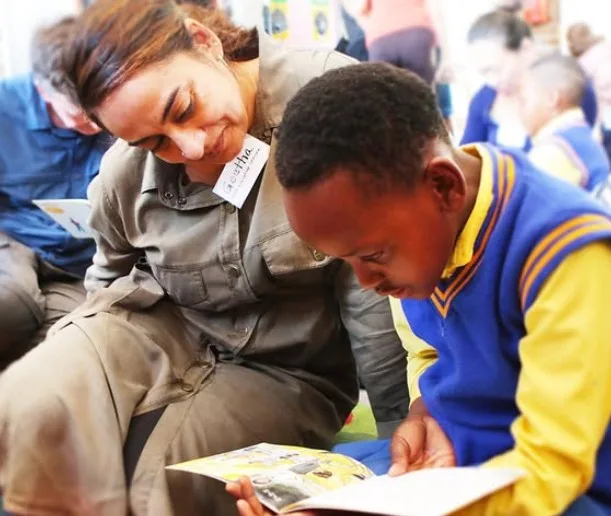
Leadership isn’t about becoming indispensable. It’s about building an institution that outlasts every one of us.
Geetha Murali
She often thinks about what she hopes people will say decades from now. “If, years from now, Room to Read is clearly known as an organization that expands opportunity and enriches the lives of children around the world, regardless of who leads it, that will be one of my greatest accomplishments,” she says.
What keeps her grounded
Outside work, it is relationships that keep her grounded. “The people in my life keep me grounded,” she says. “That begins with my family, both the one I was born into and the one I’ve built over the years.”
There is also dance. Having trained since the age of four, Geetha sees movement as more than an art form. “Dance has always been more than something I do,” she says. “It’s how I come back to myself.”
And then there are books and words. “Some people collect objects,” she says with a smile. “I collect sentences.” Whether discovered in novels, poetry, speeches or song lyrics, certain lines stay with her, gathering new meaning each time she revisits them.
“Perhaps that’s why I’ve always been drawn to dance and to words,” she reflects. “One speaks through the body. The other through language. Both have a way of connecting us to something larger than ourselves.”
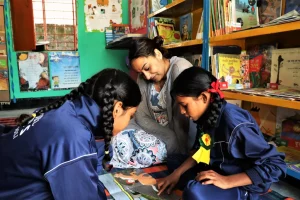
Every time Geetha meets a girl who begins to imagine a different future, she sees echoes of her own mother’s story. One woman who chose education transformed an entire family. Through Room to Read, she hopes millions more children will have that same opportunity because the power of education lies not only in changing lives, but in changing generations.

Share with



Written By: Vikram Sharma
Dr Sunita Gandhi: The Cambridge-trained physicist and former World Bank economist accelerating learning