
September 05 2026
Bompelly Bhavani: Recipient of the National Teachers Award 2026 for her transformative work

(Sep 5, 2026) From transforming a rural government girls’ school in Telangana through joyful, low-cost teaching to studying Finland’s education system firsthand, Bompelly Bhavani’s 18-year teaching journey has now earned her the National Teachers Award 2026.
Bompelly Bhavani is not an ordinary government school teacher. Once she enters the classroom, her energetic presence is enough to motivate her students and set the tone for the day.
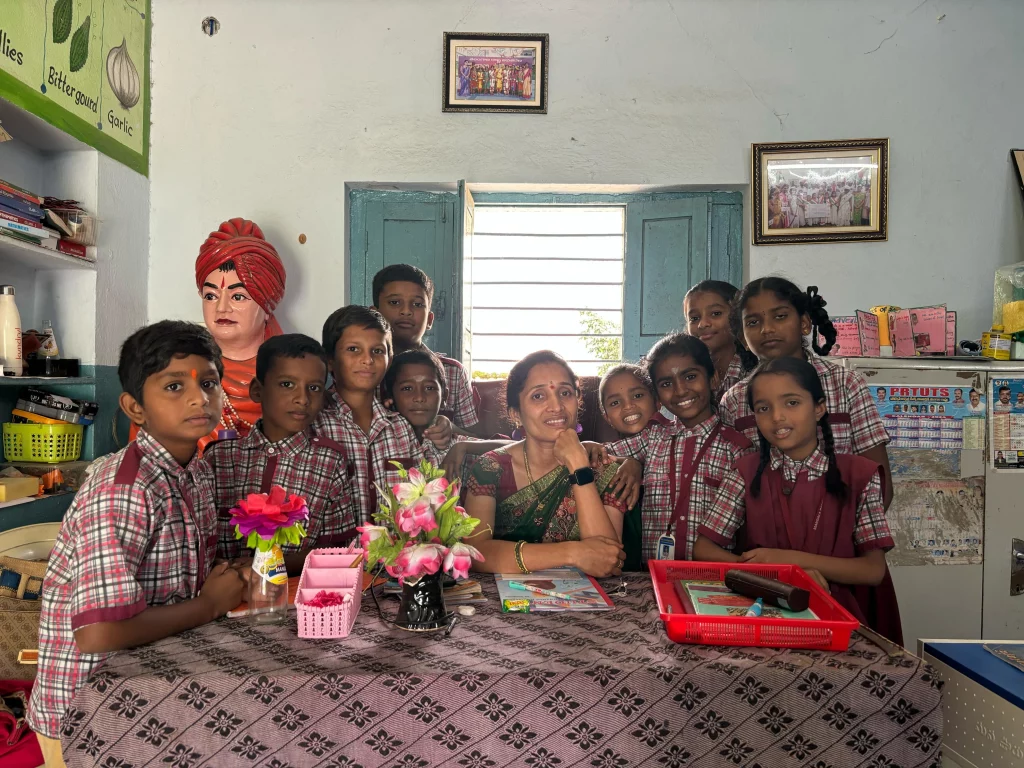
For the 130 students of MPPS Girls School in Gandhari, Kamareddy district, Telangana, Bhavani ma’am, as she is fondly known, is much more than a teacher. She is a friend, mentor and motherly figure who has created a warm, nurturing environment where children feel comfortable being themselves.
Her commitment to teaching, love for her students and joyful methods have transformed a rural government school and challenged the perception that educational excellence depends on urban institutions or abundant resources.
After 18 years in the profession and several recognitions, Bhavani has now been selected for the National Teachers Award 2026 for her contribution to school education, innovative teaching practices, student development and the transformation of a rural government girls’ school.
“If every teacher takes ownership of their school the way they would their own home, we can bring meaningful change to India’s education system, one school at a time,” says Bhavani, Secondary Grade Teacher (SGT) at MPPS Girls School, Gandhari, in a conversation with The Global Indian.
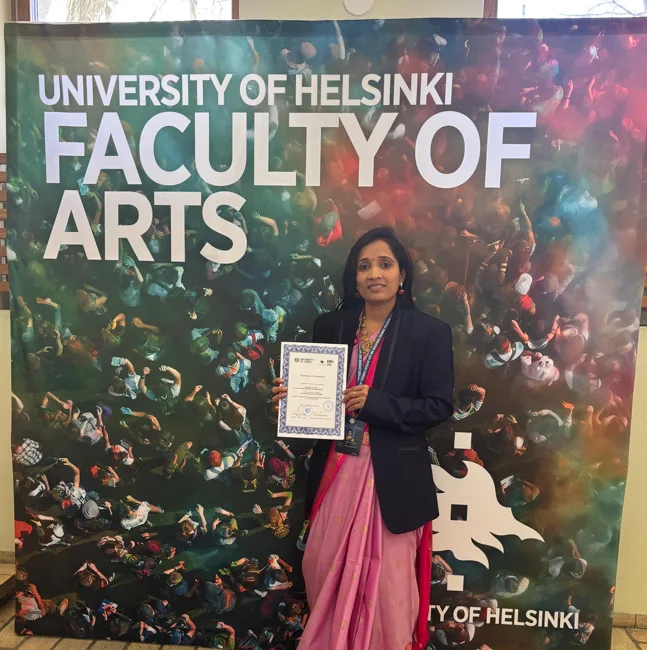
Her journey has taken her from a rural classroom in Telangana to Finland, where she studied educational practices, and from receiving the Telangana Best Teacher Award in 2025 to being recognised by UNICEF for her work in child protection. Her National Teachers Award 2026 recognition is, in many ways, a reflection of what a committed teacher can achieve when schools, parents and communities work together.
National Teachers Award 2026
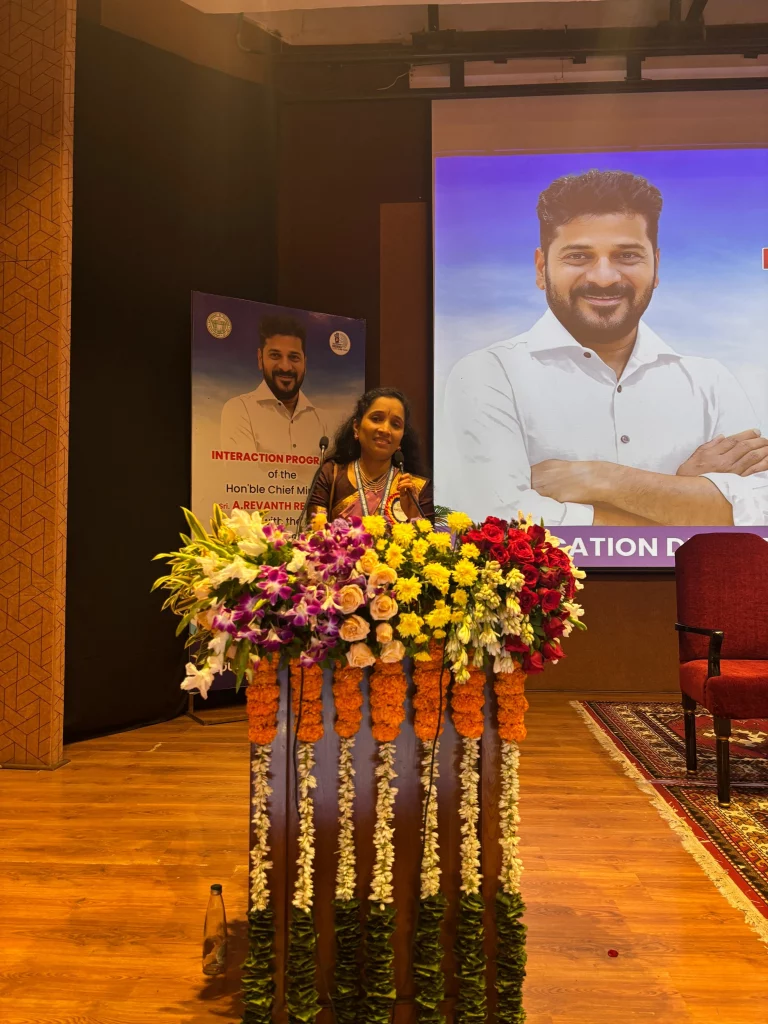
For Bhavani, the national recognition belongs as much to her students and community as it does to her. “The achievement is not only a personal honour, it stands as a proud moment for my students, parents, colleagues, school community in Gandhari and Telangana,” she says.
Bhavani will receive the prestigious award from President Droupadi Murmu at a ceremony at Vigyan Bhavan, New Delhi, on September 5, Teachers’ Day. The awards are presented annually to teachers who make exemplary contributions to improving the quality of school education and promoting the holistic development of students.
Bhavani is among 48 school teachers selected from across the country following multiple stages of scrutiny and evaluation by an independent national jury.
For her, however, the award represents much more than classroom teaching. “It represents recognition of a broader educational journey encompassing innovative teaching, technology integration, child protection, community mobilisation among other aspects,” she says.
Transforming a rural government school
When Bhavani joined MPPS Girls School, Gandhari, enrolment stood at just 40 students, a surprisingly low number for a large village. “I investigated the reasons and identified four key gaps: poor infrastructure, no pre-primary section, no English medium, and a shortage of teachers,” she recalls.
With support from colleagues and the state government, she began addressing these challenges one by one. By 2022, the school had introduced a pre-primary section and English-medium instruction. Enrolment subsequently rose from 40 to more than 130 students.
The number of government teachers also increased from two to five. A library and computer laboratory were established, five toilets and 75 dual desks were added, electricity facilities were improved and digital learning was introduced. But Bhavani believes infrastructure alone cannot transform a school.
Working with young children requires patience and care. We created a homely, nurturing environment and introduced joyful, play-based learning. Children began looking forward to school, and parents’ trust in us grew steadily.
Bompelly Bhavani
The impact is reflected in attendance of more than 80 per cent and zero dropouts, as the school has evolved into a safer and more engaging learning environment for its students. The transformation also brought the community closer to the school. As enrolment grew, parents came forward to construct a new classroom. The Village Development Committee (VDC) supported the school for four years, while Bhavani’s husband, along with a donor, sponsored curriculum-themed wall paintings across the campus.
In total, the community contributed around ₹15 lakh towards the school’s infrastructure. “Every corner of the school now teaches something,” says Bhavani.
Learning through play, technology and experience
Bhavani’s teaching philosophy is rooted in a simple progression: known to unknown, simple to complex and concrete to abstract.“We developed low-cost and no-cost teaching-learning materials (TLM),” she says. Her approach centres on learning by doing, with lessons incorporating play, movement and exploration.
We learn by playing, dancing and exploring. When children enjoy the process, they naturally want to spend more time at school, and that, to me, is the real sign that teaching is working.
Bompelly Bhavani
Educational games have become an important part of her classroom. Snake and Ladder, Magic Cube, Spin and Win and Business Game are used to turn abstract concepts into interactive learning.
Snake and Ladder helps students learn alphabets and Varnamala, while Magic Cube develops logical thinking, concentration and problem-solving skills. Spin and Win is used to teach place-value concepts, and Business Game allows students to understand arithmetic operations through practical activities.
Bhavani also believes children learn better when lessons extend beyond the classroom. Her students have undertaken educational visits to places such as Golconda Fort and Nehru Geological Park in Hyderabad, with these experiences connected to their curriculum.
What Bhavani brought back from Finland
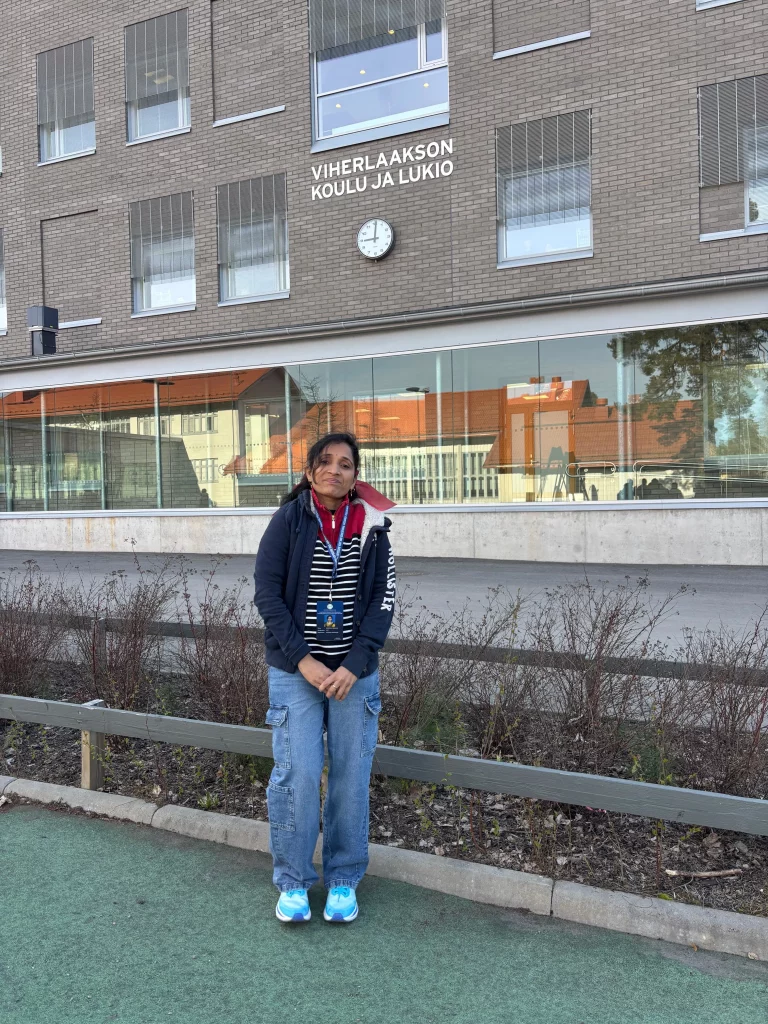
In April 2026, Bhavani was selected by the Telangana government for an Educational Exposure Programme to Finland, giving her an opportunity to observe the country’s education system firsthand.
Finland is widely recognized as having one of the best education systems in the world, so the opportunity to observe their methods firsthand was invaluable.
Bompelly Bhavani
What stood out to her was the atmosphere inside Finnish schools: calm, joyful and respectful of both students and teachers. “Teachers there enjoy a remarkable degree of autonomy, students learn in an environment of genuine freedom, and parents place enormous trust in their teachers.”
Bhavani says around 98 per cent of schools in Finland are government-run and that there is no ranking system between schools, with schools treated on an equal footing.
She also observed that formal examinations do not begin until after ninth class, helping reduce academic pressure during the early years. Education from grades one through ten is completely free, while equal importance is given to academic and vocational education.
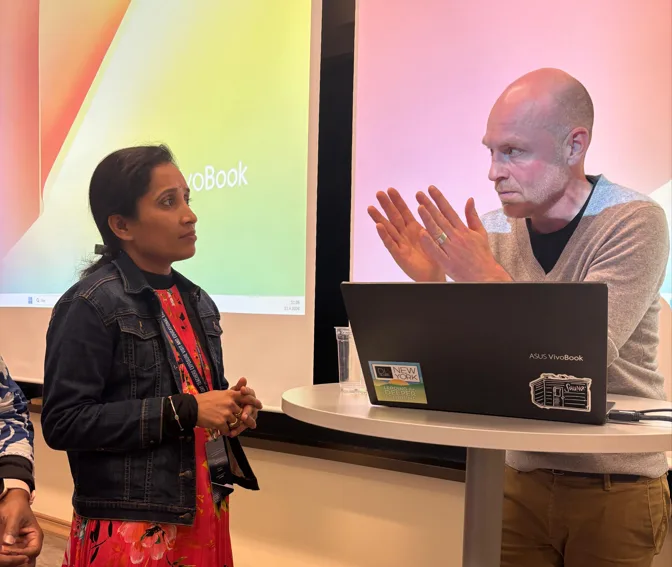
A practice that caught her attention was the continuity between teachers and students. Up to class six, she says, a single teacher stays with the same class, allowing deep familiarity and trust to develop.
Finnish classrooms, she adds, place considerable emphasis on experiential and practical learning, with strong integration of ICT tools. The mother tongue is treated as an important foundation for learning, while physical spaces are used creatively and books are made accessible beyond conventional libraries, including in hallways and common areas.
Bhavani brought one of these ideas back to Gandhari almost immediately. On returning from Finland, she placed books across the school, including in the veranda, dining area, playground and sitting spaces, following the philosophy “learn to read, read to learn.” “This simple change has done a lot to build a genuine reading habit among our students,” she says.
From top student to Telangana teacher
Born in Gandhari, Bhavani began her schooling at Vivekananda Public School, a private institution, where she studied until class 7. She then moved to Zilla Parishad High School, Gandhari, a government school, and completed class 10 there. She continued at the same campus, joining Government Junior College, Gandhari, for her intermediate studies.
Her academic performance improved significantly as she progressed. While she had ranked among the top 10 until class 7, she secured the first rank consistently from class 8 through intermediate.
Yet her school years also showed her what students can miss when resources and time are limited. Her school and college operated from the same building on a shift system, with school classes in the morning and college in the afternoon. “Because of this tightly packed schedule, it was genuinely difficult to keep up with academics, let alone find time for sports or arts. As a result, I missed out on those activities altogether,” she says.
Her father, Bompelly Rajulu, is a businessman, while her mother, Bompelly Lalitha, is a homemaker. Her husband, Yacham Sudheer, works as a Senior Manager at IBM. Bhavani qualified through the District Selection Committee (DSC) in 2006 and was appointed as a teacher in Lingampet Mandal.
Her first posting was at MPPS Komatpally in February 2008, where she worked for about a year and a half. She then moved to MPPS Pet Sangam in 2009 and served there for nine years.
In 2018, she joined MPPS Girls School, Gandhari, where she has now completed eight years. Increasing enrolment and improving the quality of education have remained consistent priorities throughout her career. At Pet Sangam, where enrolment was around 40 when she joined, her efforts helped increase it to 80.
Beyond the classroom
Bhavani’s work does not stop when the school day ends. Although regular school hours are from 9 am to 4 pm, she conducts additional classes to prepare students for competitive entrance examinations such as Navodaya and Gurukulam.
I go to school even on holidays to conduct these special sessions, because I want every child who has the potential to get into these residential schools to have a real shot at it.
Bompelly Bhavani
She has also introduced yoga, classical dance, music, moral values, cursive writing and value education, while encouraging students to participate in national and local festival celebrations.
Her interest in technology grew after she received the Telangana State-level Best Teacher Award in 2025 along with ₹10,000 in prize money. “I added another ₹10,000 of my own and bought a computer to start technical education at the school. My husband began visiting on weekends to teach technical classes to the students,” she says.
Following the initiative, the state government sanctioned three additional computers to support slow learners through digital learning. The school’s transformation was also featured in the book The Journey of Hope: How One Teacher Transformed a School from Nothing to Everything.
Child protection and community outreach
For Bhavani, education also means ensuring that children are safe. She says children in many rural areas can face abuse from people they know and trust, while some may not even understand that they are being victimised.
To address this, she regularly conducts child-safety awareness sessions for students and parents, including sessions on the Protection of Children from Sexual Offences (POCSO) Act. She has also uploaded these sessions to YouTube to reach a wider audience. Her work in this area was recognised by UNICEF, which nominated her as a District Child Protection Officer.
She has also extended her educational work into the digital space as an educational content creator. Her online content covers innovative teaching practices, student activities and talents, competitive examination guidance and educational resources. Her digital outreach includes approximately 7.69 lakh subscribers on a Students’ Activities channel and around 1.26 lakh subscribers on a Competitive Exams Learning channel.
A teacher who keeps learning
Bhavani believes teachers cannot help students grow unless they continue to learn themselves. She has regularly updated her skills through in-service and online training programmes, including a 30-day programme at RIESI, Bengaluru, focused on English language teaching and a 60-hour TESOL training programme introducing globally recognised teaching pedagogies.
Her learning extends beyond professional development. She is also studying Bharatanatyam and Carnatic music, interests that keep her connected to art and culture.
What needs to change in Indian education
Bhavani believes one of the most urgent changes India needs is a reduction in exam pressure, particularly during the early years of a child’s education. She wants children to develop a genuine love for learning rather than associate education with the fear of examinations.
She also believes rural government schools need better-resourced pre-primary sections with trained caregivers, along with improvements in basic infrastructure.
Real transformation happens not just through policy, but through teachers who are willing to go beyond the classroom, to become mentors, innovators, and community builders.
Bompelly Bhavani
Her commitment to supporting children extends beyond her own school. Bhavani has played a key role in launching the Navjeevan Foundation to support orphans, semi-orphans and other students in need.
Preparing children for the future
Looking ahead, Bhavani wants her students to become comfortable with Information and Communication Technology while also discovering their strengths in sports, arts and other career pathways, including the armed forces. “At the heart of it, my ambition remains simple: the all-round development of every child I teach,” she says.
For a teacher who began her journey in the same rural community where she now teaches, the ambition is personal as well as professional. Bhavani’s story demonstrates how a government school can change when a teacher takes ownership, experiments with new approaches and brings parents and the wider community into the process.
ALSO READ: ‘Slum Queen’ Rouble Nagi bags GEMS Global Teacher Prize 2026
Bompelly Bhavani
| Born | Aug 10, 1986 |
| Based | Gandhari, India |
| Studied | Government Junior College, Gandhari, India |
| Languages | English, Telugu |
Signature work
As a teacher Bhavani has been engaged in advancing joyful, low-cost and experiential learning, while strengthening infrastructure, digital education and community participation in her school. Her work also extends beyond academics through child-safety awareness, competitive-exam preparation and initiatives that encourage students to explore their strengths in sports, arts and technology.
Idea
Making rural education more joyful, inclusive and practical through play-based learning, technology and low-cost teaching methods.
Network
Working with teachers, parents, the Village Development Committee, donors and the wider community to strengthen the school and support students.
Impact
Transformed a rural government girls’ school by improving enrolment, attendance, infrastructure and learning opportunities, while building greater trust and participation among students, parents and the wider community.
Giving Back
Beyond the classroom, Bhavani supports children in need through the Navjeevan Foundation, while extending her child-safety awareness and educational initiatives to the wider community.
Inspired by Bompelly Bhavani 's journey?
Yours follows the same Hero's pattern — Separation, Initiation, Transformation, Return.
Share with


Written By: Vikram Sharma

