
November 09 2026
Asit Kumar Patnaik: From the bylanes of Banaras to the halls of international art galleries

(Nov 9, 2026) From shaping clay idols as a school student in Cuttack to creating expressive figurative paintings that have travelled across the world, New Delhi-based artist Asit Kumar Patnaik has spent three decades exploring human emotions, relationships and the power of artistic experimentation.
During his early years in Cuttack, Asit Kumar Patnaik would often stand by the roadside watching clay artists busy at work. The process and the results, which were the idols of Durga, Ganesha and Kali, left him spellbound. He would rush back home to recreate smaller idols along with simple figures of fishes and ducks. This was during his school days and he was only in class 3!
His father noticed his interest and quietly encouraged him by collecting the clay creations, leaving them to dry and proudly displaying some of them to guests. “They would appreciate my work and be surprised at my hidden talent which made me very happy. I never got appreciation for my studies, but I got it for art,” quips Patnaik in a chat with The Global Indian.
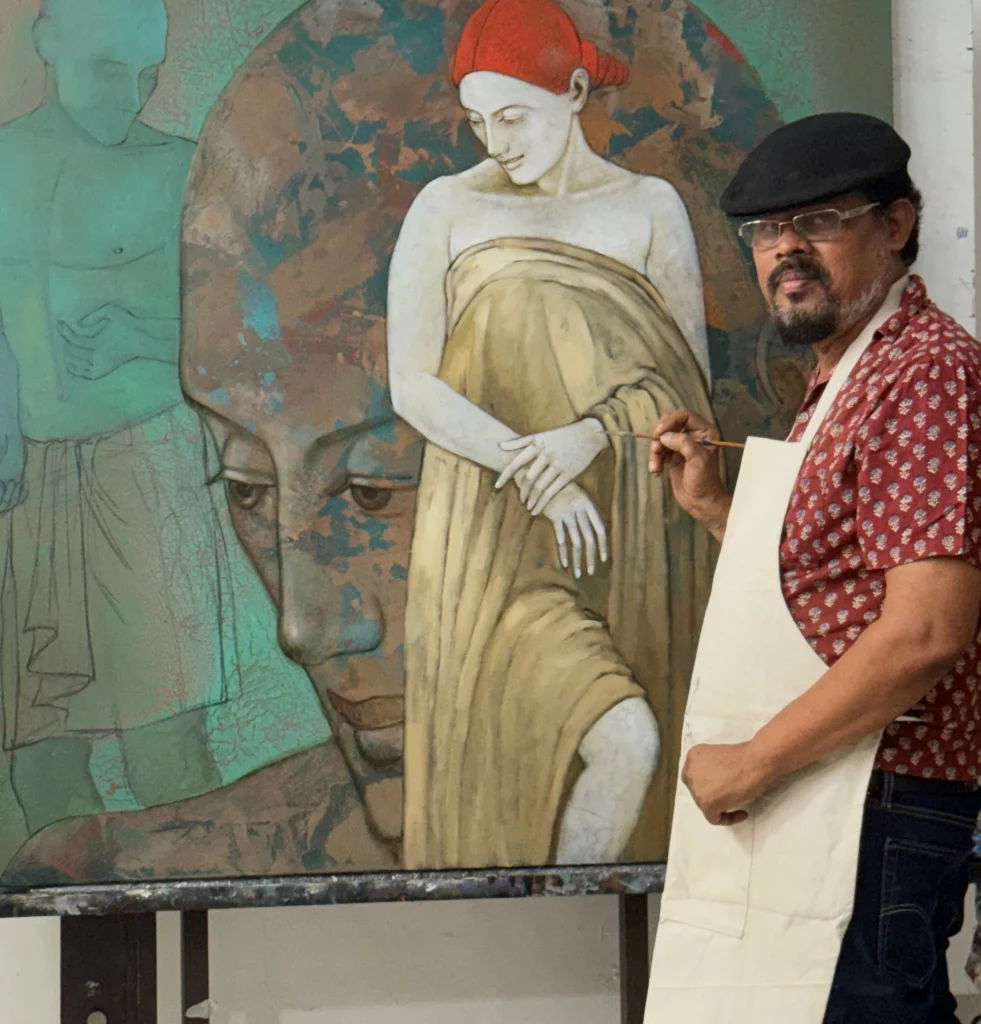
These early moments laid the foundation for an illustrious career spanning three decades for the artist, known for his distinctive figurative paintings, layered textures, and expressive male and female forms.
Besotted by Banaras
Born in 1968, Patnaik studied Bachelors in Fine Arts (BFA) at Government College of Art and Crafts, Kallikote, before moving to Banaras Hindu University (BHU), where he completed his Master of Fine Arts (MFA) in Painting.
The spiritual City of Light with its narrow lanes, old buildings, ghats, bulls, buffaloes, tangas and sadhus had a profound impact on the young, impressionable mind of Patnaik. The aging structures, the serene ghats, and the visitors from different countries and backgrounds offered him a wealth of subjects to sketch as he soaked in the city’s distinct pulse and rhythm.
I totally fell in love with the holy city. Every corner was artistic, and I started practising art with far more intensity than I ever did in Odisha during my BFA course.
Asit Kumar Patnaik
Sketching became part of his daily routine as he began paying particular attention to the scribbled lines in his drawings and wondering how he could reproduce their energy on canvas. This curiosity led him to experiment with unusual tools and materials, including ‘mehendi’ cones, tubes, needles and blades, to create different textures and effects. Needless to say, he went onto receive a gold medal in MFA from BHU.
Inspired by people
Banaras, with its many corners, colours and people, also amplified his captivation for human beings.
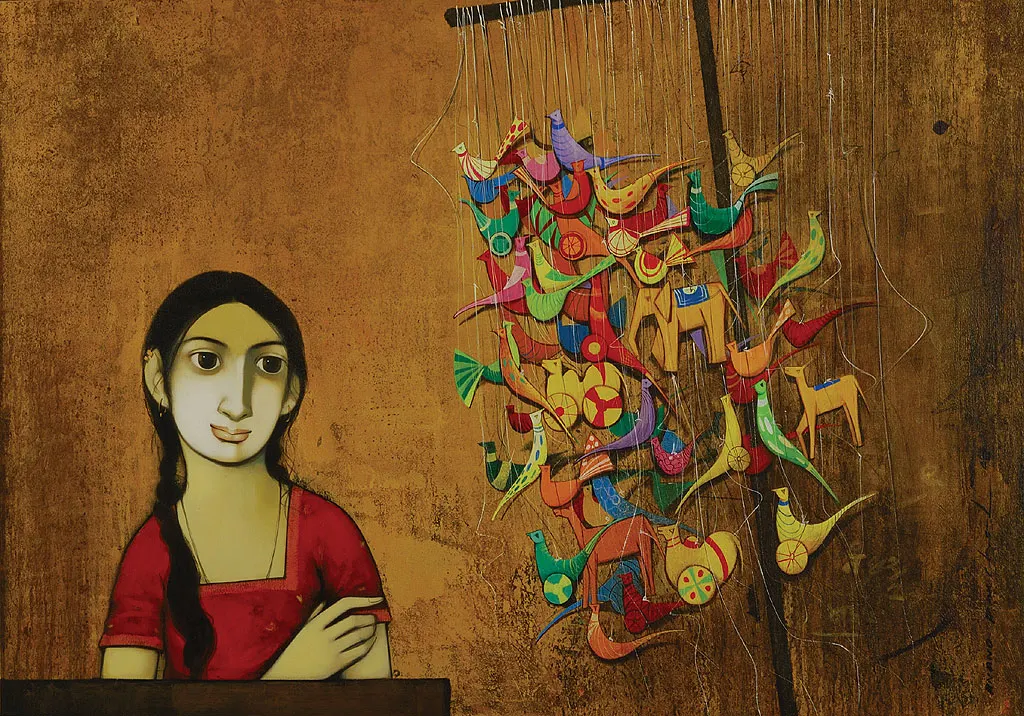
Human relationships have always fascinated me because they are never simple. In Banaras, I observed people from different cultures and backgrounds. Later in life, I observed relationships more closely around me and realised that love, longing, companionship, misunderstanding, and hope are universal. They do not change with time or place.
Asit Kumar Patnaik
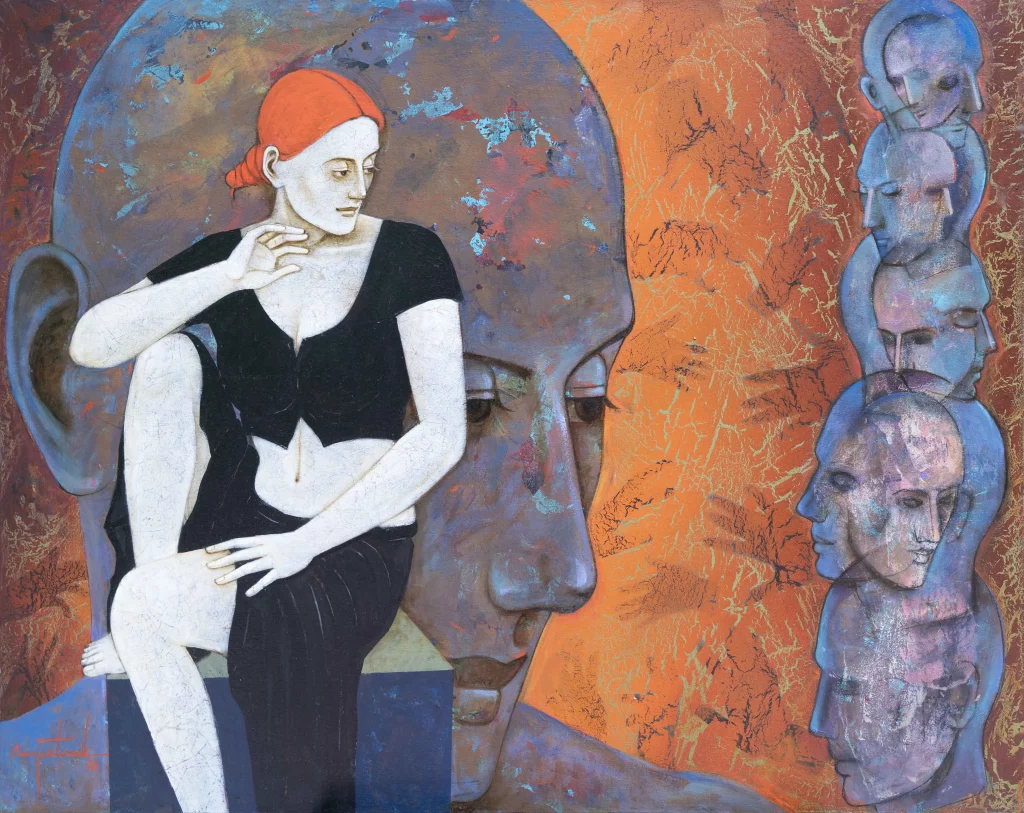
This can be clearly seen in his series ‘Man-Woman’ where the emotion, the silence, the distance, and the connection between the two genders is starkly visible on canvas. “What continues to fascinate me is that this subject is endless. Every painting leaves me with a new story, a new mood.”
Another recognisable feature in his work is the recurring red-haired woman whose flowing tresses are an integral part of the painting’s visual rhythm. For Patnaik, the red has two associations: energy and allure. But the woman is also deeply personal, rooted in his memories of his mother, who raised five children after the early loss of their father. “My mother was a strong and brave woman who looked after us alone. She gave us a comfortable life and was always around, solving every small problem to keep us happy,” he reminisces.
Her strength also shaped his perception of women and their standing in society. “That’s why I always depict woman as a symbol of strength for the society.”
The flowing red hair, therefore, is not merely an aesthetic device. “It is a symbol of a woman’s power, her freedom, and her presence. She carries emotion, courage, sacrifice, and sensuality all together. The hair flows because a woman cannot be confined.”
Texture too remains central to his process. “It gives life to my figures and creates mood, depth, and emotion. For me, a flat surface is never enough,” he shares.
View this post on Instagram
Taking his art beyond borders
Patnaik’s work has travelled well beyond India, finding audiences through exhibitions in Europe, the Middle East and the United States. His international exhibition history includes the Florence Biennale in 2011, Spectrum Miami and Art Expo New York in 2016, World Art Dubai from 2017 to 2019, the Bienal Izmir in Turkey in 2019, and the Affordable Art Fair in London in 2020. His paintings are also held in public and private collections across several countries, including the US, UK, UAE, Australia, Japan and Switzerland.
A significant milestone came in 2024, when he received the Best Solo Exhibitor Award at Art Expo New York. At the same event, a collector acquired three of his large canvases, a gesture that strengthened his confidence in taking his work to international audiences.
Although travel has offered him fresh perspectives, with Prague holding a special place for its galleries, museums, architecture, streets and sculptures, and London leaving him spellbound with its distinct contemporary rhythm, he believes that it’s curiosity alone that has kept the artist in him alive.
I believe an artist should never be satisfied with a fixed formula. If I stop experimenting, I will stop growing.
Asit Kumar Patnaik
Continuum and looking ahead
His latest exhibition, ‘Continuum: A 30-Year Retrospective’, is on view at the Chawla Art Gallery in New Delhi till November 14. Bringing together around 50 artworks spanning 1995–2026, including previously unseen paintings and works on paper, the exhibition traces the evolution of his practice across three decades. “Each painting reminds me of a time, a place, and a struggle. Some works remind me of my failures, some of my breakthroughs. But together, they form one continuous story.”
Looking back at three decades has been an emotional experience for the artist. “Be it as a small boy in Cuttack making clay fish and ducks to a young student in Banaras sketching in the ‘gallis’, to the artist that I am today in Delhi; I have always been on the search for new ways to express human emotions. The medium, the city and the scale have changed but the quest remains the same,” he reflects.
‘Continuum’ is also his way of telling the viewer that art is not made in one day. “It is a lifelong process of evolving, unlearning, and discovering yourself again and again.”
His goal now is to further strengthen his presence in the international art market and have his work recognised by more collectors abroad. “It is my dream to have a work of mine be part of a museum’s permanent collection,” he says.
Patnaik also wants to explore more minimal and contemporary compositions, reducing forms and creating greater space for thought and silence. Another aspiration of his is to create a major retrospective bringing together his Banaras period, the couple series, the red-haired woman and his recent works.
Yet, for all the recognition he has achieved, Patnaik’s biggest goal remains the same – to keep painting honestly always. “I want people across the world to recognise my work without even seeing my signature,” he sums up.
- Follow Asit Kumar Patnaik on Instagram
ALSO READ: Ramakanth Thumrugoti: An international artistic journey shaped by human relationships


Written By: Vikram Sharma
Ramakanth Thumrugoti: An international artistic journey shaped by human relationships

Written By: Vikram Sharma
When MF Husain paid 11 dirhams for artist Kalpana Shah’s painting in Dubai

Written By: Deepa Natarajan Lobo