
September 11 2026
Ramakanth Thumrugoti: An international artistic journey shaped by human relationships

(Sep 11, 2026) Returning to Japan in September 2026, nearly 11 years after his first exhibition there, artist Ramakanth Thumrugoti reflects on an international artistic journey shaped by human relationships, identity, silence and self-discovery.
Much of Ramakanth Thumrugoti’s art work is about human relationships. When he was younger, he was interested in relationships between people – the space between two people, what they expect from one another, intimacy, identity, disappointment, loneliness, connection and the strange distances that can exist even between people who are very close.
Those very aspects come alive in all his work as an artist — depending on what people make of it. “Art becomes a lot richer when the viewer is invited into the discussion,” renowned artist and founder of Hyderabad-based Transcend Art Space, tells The Global Indian.
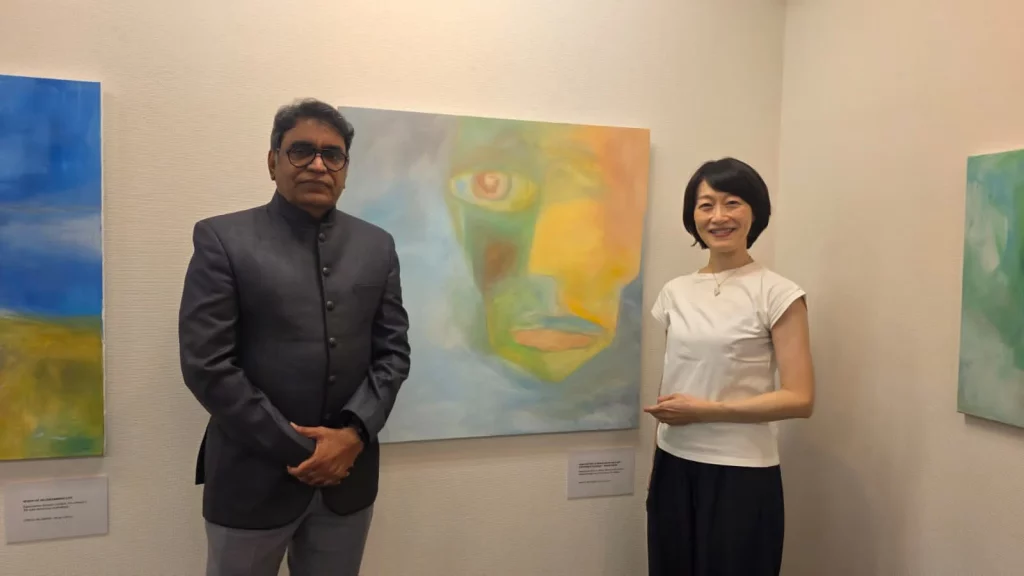
Ramakanth Thumrugoti with a Japanese film star at his recent art exhibition held in Tokyo. The exhibition titled ‘ INWARD,’ was open for art lovers between August 31 and September 5
Returning to where the journey began
Over the last two decades, Ramakanth has mesmerised art aficionados across the world with his work, which speaks for itself. “Returning to Japan in 2026, almost 11 years after my first show there, is like coming home to where a very significant part of my journey started. It’s more than just another international exhibition,” says the artist, who first showcased his work in Japan in 2007 and then in 2015.
“INWARD is the relationship we have with ourselves. The title probably gives you a clue as to where I am as an artist today,” says Ramakanth of the theme of his ongoing exhibition at Ushio Gallery, Ginza, Tokyo, which commenced on August 31 and will continue till September 5.
Some of his works on display are — The Mirror Hesitated Before Reflecting Me, Fear of Discovering Oneself, I Rehearsed My Life Instead of Living It, I Should Have Heard the Silence of My Heart, A Stranger Within and The Self I Protect Is the One That Imprisons Me.
“They explore memory, identity, silence, self-recognition, and the versions of ourselves we sometimes spend a lifetime avoiding.”
He says the person (himself) who returned to Japan in 2026 is obviously not the same person who came to Hikone in 2007. “He’s not the same artist either. Perhaps INWARD is also a conversation between the two versions of myself.”
He says Japan has accompanied him in the different stages of his artistic life. His 2007 exhibition in Japan, which was the beginning of his four-part series was titled ‘Of Human Bondage.’ Ramakanth recalls people standing in front of the works, spending time with them, and responding in ways he hadn’t expected.
“Some things were there that I hadn’t put there deliberately. As an artist you have an instinct to explain yourself, first. Eventually I learned not to do that.”
The series began a continuing exploration of human relationships. “What I discovered was simple — emotion doesn’t always have to be translated.”
“Japan holds a very important place in my life,” says Ramakanth, who feels there is something about the Japanese appreciation of silence, restraint, discovering beauty in imperfection and incompleteness that really resonates with him.
“You don’t need to explain everything or fill every empty space. Thats very much how I think about art,” says the artist, who feels greatly honoured to present his works in Japan, a country known for its fine artistic sensibilities.
He describes Japan as a great source of inspiration as well. “Subtle, existentialistic and crafty, many Japanese artists like Hokusai and Hirushige have influenced my artistic pursuits. This is one place I notice art as the part of living.”
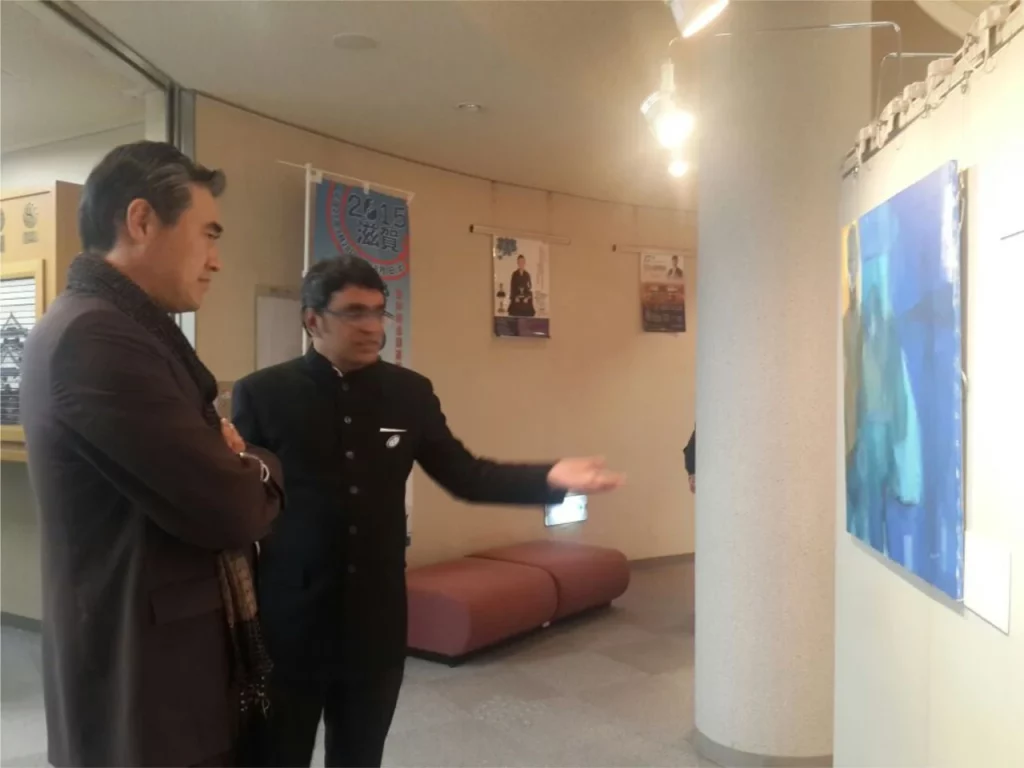
Ramakanth with Takashi Okubo, the then Mayor of Hikone City, Shiga Prefecture in Japan, during one of his previous art exhibitions
An international artistic journey
His work then traveled internationally with private shows and presentations in Singapore, France, the United States and Germany. “Collectors from around the world began acquiring the paintings,” says the artist, whose later works include Lightness of the Living Moments and, in 2015, Travelogue of a Stray Bird and Other Works at Miyuki Art Gallery in Ginza. He feels that the most interesting thing about displaying work abroad is how people respond to the same work in so many different ways.
Someone in Japan might see silence where someone in India sees chaos. What started as a very different feeling for me may give someone else hope. I’ve come to enjoy that ambiguity.
Ramakanth Thumrugoti
Two parallel lives: Art and advertising
“I don’t remember a time when I decided to be an artist. I was always one, I suppose,” says Ramakanth, whose father was an educationist and an artist. He grew up in Hyderabad and was good at drawing from his school days.
“Friends and people who came to our house would look at my drawings and paintings, and sometimes take them home, even before I started showing my work professionally.”
Ramakanth built a career in advertising and communications and launched his company RBC Worldwide. “For many years, I lived these two parallel lives – the communication professional and the artist. I never saw the two as mutually exclusive,” says Ramakanth, whose work in Branding and communications developed his skills in design, color, composition and communication.
“Painting, by contrast, gave me space with no client, no brief, and no market research.”
But what influenced him were the western post-war philosophies, art and literature, powerful writings of Maugham, Camus, Dostoevsky, Nitsche, Mrza Ghalib and drawings and paintings of Gustav Klimt and many post modern artists. The learnings of such studies led him to develop an art theory called Transcend Art.
Transcend Art presents the idea which tells that post-modern art appreciation is a triangular affair — the art, artist and viewer share the common intellectual space.
Ramakanth Thumrugoti
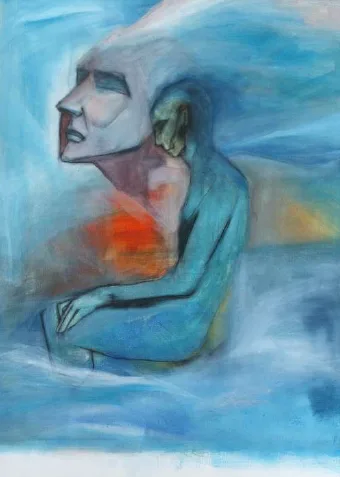
One of the paintings of Ramakanth Thumrugoti
Staying true to his artistic voice
One of the challenges in his journey has been to resist the temptation to follow style du jour. “This can be difficult for an artist. And I have a special dislike for populism in art.”
Ramakanth has worked on advanced subjects based on his intellectual stance. “There’s always a market telling you what’s selling and a gallery telling you what’s being seen. Buy I couldn’t care less,” says Ramakanth, whose works have been bought by collectors in India and throughout the United States, Europe, the Middle East, and the Far East.
His work ‘The Ecstasy of Untethered Love’ was picked by the Children’s Hope Foundation, Dubai. “What makes The Ecstasy of Untethered Love so special is that the meaning of the painting and the purpose that it eventually served came together quite beautifully.”
A panel from the Children’s Hope Foundation chose the work, and it was auctioned at the Burj Al Arab in Dubai in 2013. Patrons and guests gathered to support under privileged children in Africa who needed medical and educational assistance.
When art found a purpose
Ramakanth says artists spend an incredible amount of time by themselves.
You make something in your studio, quietly, without knowing if anyone will ever see it, much less how far it will go. Then one day, something born of that solitude is hanging in the Burj Al Arab, adding a little to the lives of children.
Ramakanth Thumrugoti
He says the auction also confirmed his belief that art doesn’t have to be the domain of an artist, a gallery, and a collector. It can get out of that world. “It can gather resources, back a cause, spark a conversation, or just make someone pause for a moment and feel something.”
Knowing a painting could support work with children opened up a whole new perspective for Ramakanth on what an artwork could do once it left his studio. “That experience remains very meaningful to me.”
Going forward, Ramakanth doesnt really want to measure the future by how many canvases he makes. “I want to take the language I have created further and keep investigating the relationship between visual art, literature, and human experience.” He aims to build platforms and ecosystems for other artists.
At this point in my life, the question is not only: What can I create? It is also what can I help enable for others?
Ramakanth
Some of his paintings have been sold, with the proceeds supporting Anandapriya — a not-for-profit founded by his wife Ananda UVL to promote and preserve Indian classical performing arts, and supported as a CSR activity of his company, RBC Worldwide.
“India’s traditional arts are an extraordinary inheritance. But an art form only survives if the people who practise it can survive,” says the artist, who believes that many traditional artists carry knowledge built up over generations, yet don’t always have the visibility, recognition, or opportunity they deserve.
“I feel I was a little lucky. Many artists aren’t,” says Ramakanth, who founded the company YANA, a global art ecosystem that addresses the business of visual arts at a global scale, with a singular mission — delivering financial freedom for the artist. “It means a great deal to me if the sale of my contemporary art can contribute, in some small way, to keeping another artistic tradition alive,” says Ramakanth, who doesn’t really see a separation between being an artist and giving back.
For Ramakanth, an artist’s legacy is not just the work signed with his name. “It should include the people, opportunities, institutions, and ideas they helped foster along the way.”
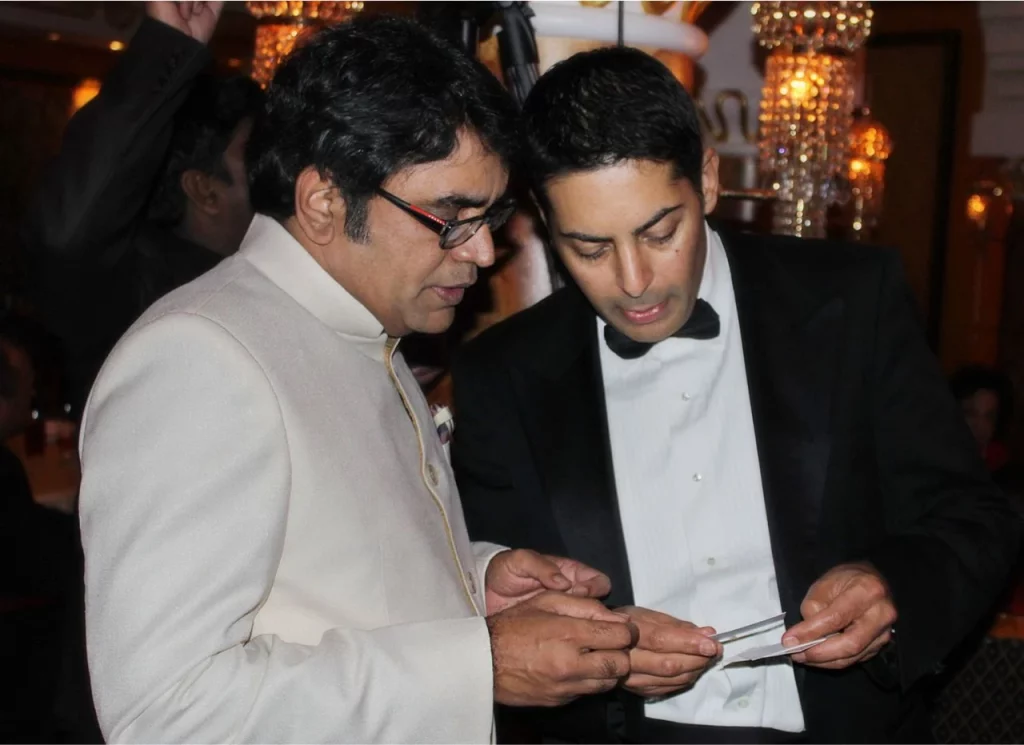
The artist with the highest bidder at the exhibition and auction of his paintings at Burj Al Arab, a few years ago
Reading, watching and observing people
He says Literature was never really outside his painting. “Sometimes writers have helped me gain a more profound understanding of human nature than painters,” says Ramakanth, who likes literature, poetry, cinema, design, architecture and travel. “And I do love conversations, especially with people who don’t necessarily agree with me.”
He says some of his happiest memories are quite mundane — walking around Hyderabad with friends, hours in libraries, watching films at the Alliance Française and then sitting somewhere arguing about art or cinema or poetry, usually with more seriousness than the subject probably warranted!
“If I could give you the romantic version of an artist’s life, I would — wake up, walk into a beautiful studio, paint till sunset, and come out with a masterpiece! It never really worked that way for me,” smiles Ramakanth, who has spent a lot of time working in art and advertising, branding and entrepreneurship at the same time, which make his days so different from each other.
But what is constant is reading and watching people.
I notice the silences in conversations, what people say and don’t say, the distance between two people sitting next to each other, how relationships evolve over time. I’m interested in those mundane moments.
Ramakanth
After all, he says, painting takes solitude. “Sometimes I need to pull away from everything else and go into the studio. I don’t paint every day, but I think about paintings almost every day.”
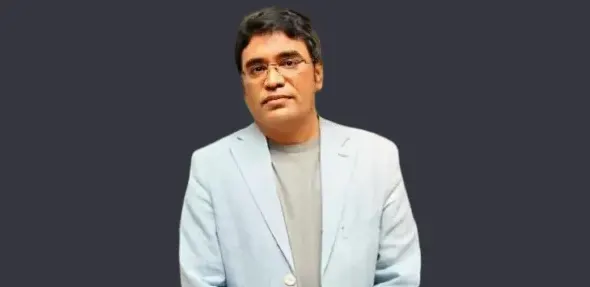
Ramakanth Thumrugoti
| Born | Hyderabad, India |
| Based | Hyderabad, India |
| Studied | Bachelor's, Osmania University, Hyderabad, India |
| Languages | Telugu, Hindi, English |
Signature work
Ramakanth Thumrugoti’s body of work explores human relationships, identity, silence and the spaces between people, inviting viewers to bring their own interpretations to his paintings.
Idea
His “Transcend Art” approach views art as a shared intellectual space between the artist, artwork and viewer, allowing interpretation to become part of the experience.
Network
Through his work in art, advertising and branding, as well as initiatives such as Transcend Art Space and YANA, he has built connections across artists, collectors, creative professionals and audiences in India and abroad.
Impact
His work explores human relationships, identity, silence and self-discovery, while his exhibitions have taken these ideas to audiences across Japan, the UAE, Singapore, France, the US and Germany.
Giving Back
He has supported causes through his art, including the auction of The Ecstasy of Untethered Love in Dubai for the Children’s Hope Foundation, while some paintings have also supported Anandapriya, his wife Ananda UVL’s initiative promoting Indian classical performing arts, and CSR activities of his organisation, RBC Worldwide.
Inspired by Ramakanth Thumrugoti 's journey?
Yours follows the same Hero's pattern — Separation, Initiation, Transformation, Return.
Share with


Written By: Deepa Natarajan Lobo
Raghava KK: Building global conversations through art and ideas
Art & Culture, Cover Story, Indian Artists
Written By: Sarbani Sen
Artist Anjini Prakash Laitu: The Colourman of Dubai
Art & Culture, Cover Story, Fashion, Indian Artists
Written By: Amrita Priya