
September 15 2026
Asim Waqif: Making art from the discarded

(Sep 15, 2026) From discarded materials and bamboo to site-specific installations, New-Delhi based artist Asim Waqif brings art, architecture, ecology and design together in works that invite viewers to experience space differently, while engaging with international art spaces and exhibitions.
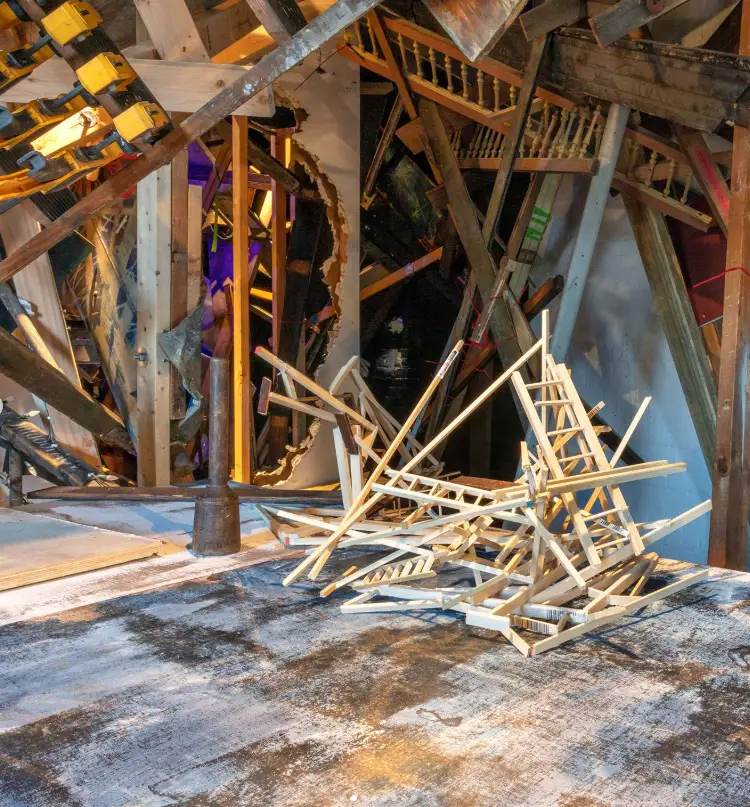
In December 2012, artist Asim Waqif’s debut solo show, titled Bordel Monstre (Monstrous Mess), was held at Palais de Tokyo in Paris. He used detritus from previous exhibitions and repurposed it to create an immersive installation, which stunned art aficionados across the globe.
In a review of the installation, American artist Robert Barry wrote: “Bordel Monstre is a fascinating exercise in making use of things otherwise neglected. If its exterior form resembles the damage wrought by a force of nature, its construction was as spontaneous and unplanned as the weather.”
That review aptly sums up Asim’s work, which is influenced by interdisciplinary fields of art, architecture, ecology and design. “It’s amazing actually how the appreciation of some discarded material changes once it becomes part of a sculpture or installation,” renowned contemporary artist Asim Waqif tells The Global Indian.
Materials and detritus
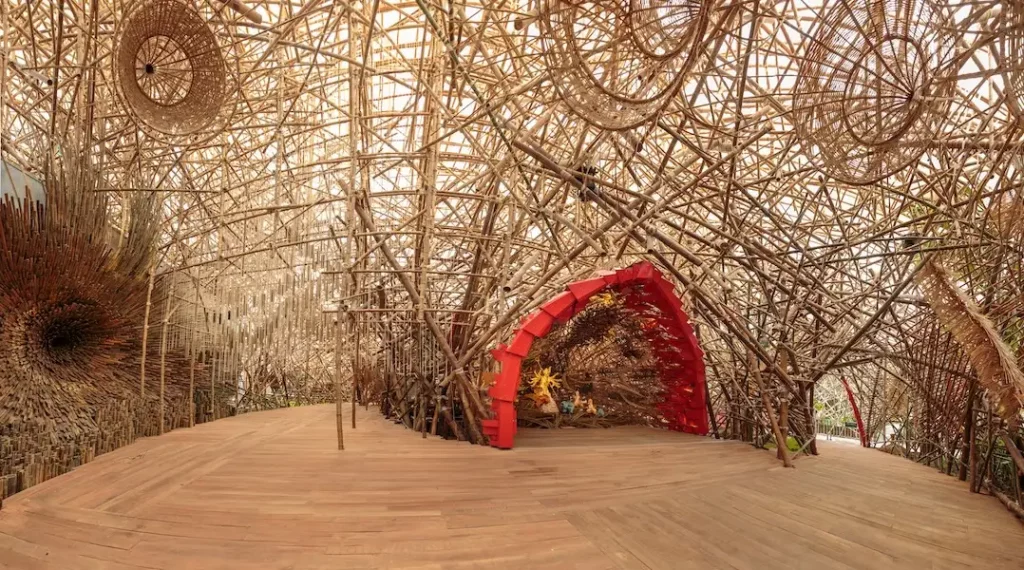
Materials have always been the starting point for Waqif’s works. The sheer voluptuousness of Waqif’s sculptures, their combinations of natural and industrial materials, bring together a brutality and a delicacy that might seem incompatible.
Before delving into the meanings and messages of his sculptures, viewers are confronted with an aggressive material presence in his work, usually fusing incongruous elements together and harnessing an improbable sense of balance.
Filled with distractions and obstructions, his often maze-like artworks ask the viewer to actively experience the architecture instead of passively observing it.
We’re discarding so much stuff. There’s so much trash lying everywhere. In India, we see it openly while Europe and the US have become very good at hiding it, but it’s not that they’re creating any less trash.
Asim Waqif
He says people in his grandparents’ time never wanted to throw away anything. “Once the first use of something was over, they would find some other use, and a third use. For them thrift was a very important value. That made me start thinking about how discarded and devalued material could be repurposed,” says Asim, who has undertaken residencies at the Rockefeller Foundation Bellagio Center in Italy and has been a visiting scholar at the Rhode Island School of Design.
From Paris to Venice
Asim’s masterpieces, which have been shown at many biennials internationally, are currently on display at the Venice Biennale, which is one of the oldest running cultural festivals in the world.
“Venice was a tough project in terms of planning and logistics. I am happy I survived without any major disaster,” smiles Asim, who has had exhibitions in London, Paris, New York, and Pittsburgh.
Among his various works being showcased there are monumental bamboo installations that sit between art and architecture.
One of his installations titled “Chaal” resembles a massive, golden-brown mass with protruding culms, which is a carefully orchestrated structure. “We arranged multiple bamboo species by density to honour local home building techniques once common in Assam and Meghalaya.”
He, however, feels there are just too many regulations and restrictions, and fabrication is prohibitively expensive in Venice. “There has been a massive footfall of viewers from around the world,” says Asim, who was part of the India Pavilion in the Venice Biennale.
He says it is good to see India taking its first steps in having a long-term presence at biennales like Venice. “The art scene in the country will benefit from international participation and exposure if we are able to sustain it in the long term.”
Bordel Monstre and Salvage
With Bordel Monstre, Asim presented a spectacular installation at the Palais de Tokyo in Paris in 2012.
After his arrival, he explored many places in Paris and wanted to investigate the abandoned spaces in the city. “With the help of Palais de Tokyo and SAM Art Projects (a private initiative supporting contemporary art), I got in touch with some graffiti artists and we explored things together, which was extremely interesting.”
Later, while he was being given a tour of Palais de Tokyo, he happened to visit the service yard of the museum. “There was a lot of rubbish lying there which they wanted to get rid of. I suggested that they give me the rubbish for my project, they did.”
In 2017, Waqif’s large-scale site-specific immersive installation, Salvage, was mounted in downtown Vancouver, in association with the Vancouver Art Gallery, Canada.
Architectural in nature, it was assembled using doors, windows, roofs, tiles and wall sections, which were either sourced from demolition sites or discarded materials from local buildings.
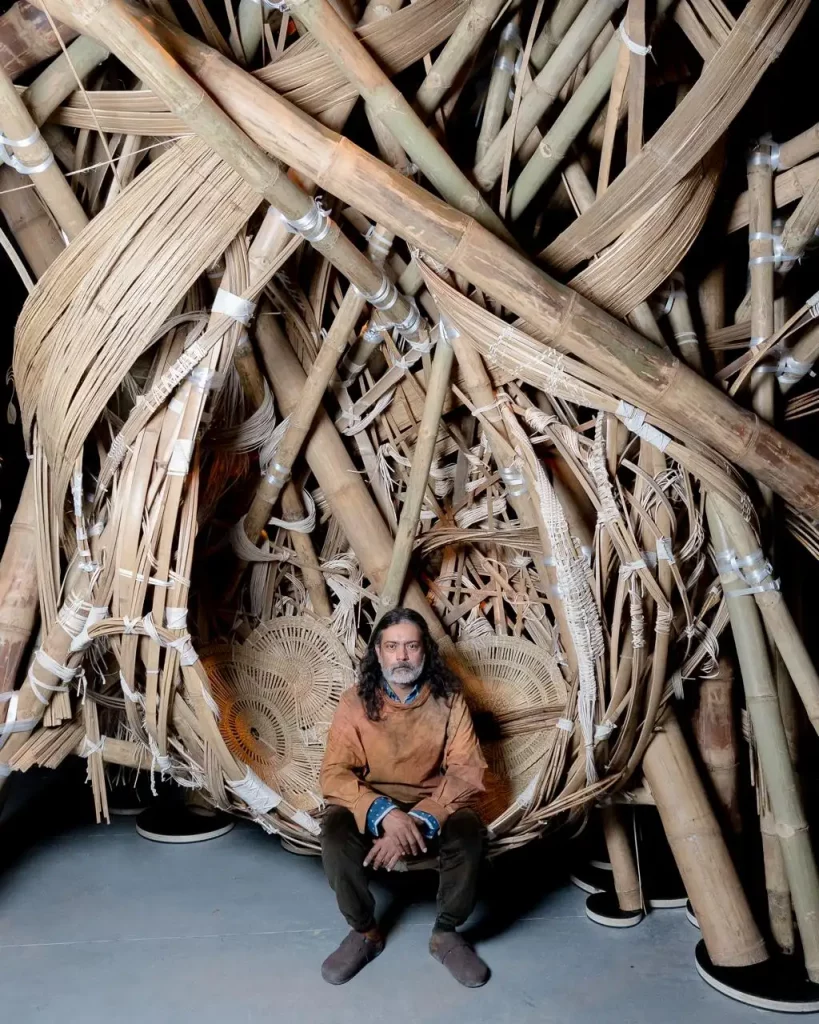
Bamboo has been central to Asim’s artwork for more than three decades, ever since he began experimenting as an architecture student. He describes it as cheap, versatile and surprisingly resilient.
Once, he used bamboo to create his piece for the Hong Kong art fair. “It made sense in Hong Kong because there is a lot of bamboo there. Most people who came to see it thought because of the material that it was created by a local artist.”
In his workshop, he has a full set of carpentry, some metalwork, cane, bamboo, among other assorted materials. He also has many knives and blades, some traditional and others hi-tech, and enjoys sharpening these blades himself.
From architecture to art
Asim grew up in Hyderabad and had a fairly normal childhood. “I remember flying kites a lot. We used to make our own manna by rubbing crushed glass bulbs and overcooked rice onto cotton thread.” Later, many of his friends were doing tuition classes for engineering. “I was absolutely not interested in that.”
Someone told him about architecture and Asim decided to give it a try. “I was kind of okay at drawing, and one of my cousins was an architect and he recommended the School of Planning and Architecture in Delhi. That’s how I ended up in Delhi studying architecture.”
Asim was never really passionate about arts. He would rarely go to see exhibitions and never in his wildest dreams did he imagine that he would become an artist. After he finished a course in architecture, he was working in set design and exhibition design for some years.
“Frankly, though I studied architecture, I never really practised it as the curriculum was too theoretical,” says the artist, who knew how to make elaborate drawings of various constructions, but had not worked with the actual materials himself.
He even did some apprenticeships, for example, working as a carpenter and trying to learn how to use the tools, basically in very old-school workshops. “However, I did set up an architectural office with some friends in Delhi, but I was consulting more on short-term projects like exhibition design, set design for television, and for theatre and films, as well as advertising films.”
He wanted to innovate whilst working with materials and found the short-term projects for set design and exhibition design much more interesting. “Here, many things could be fluid and I could keep changing things right up until the last minute, which is something I enjoy,” says Asim, who even made documentaries and anthropological films.
“One day, I came to know about Khoj, an arts organization in Delhi. One of my friends used to work there,” recalls Asim, who happened to visit the place and found lots of interesting things happening there. He ended up proposing to Khoj that he too would like to try something.
“Coming from a design background, it was a very interesting experience because I was my own client. I could push ideas as far as I wanted or stop when I wanted, and I found these dynamics very refreshing,” says Asim, who created his first art project in 2005.
Initially, no one in the arts scene took him seriously as everyone believed he was an architect. “In 2010, I started introducing myself as an artist, and that really changed things and a lot of avenues opened up,” says Asim, who did a public-art project in Delhi in 2008.
The message in his work
Asim’s process involves an archaeological fascination that integrates how a city governs its ecological environment — that which lies beneath the bed of a city.
He pulls out the clutter to promptly consider its reorganization and asks: what will it really take for a society to face its garbage, unwanted products?
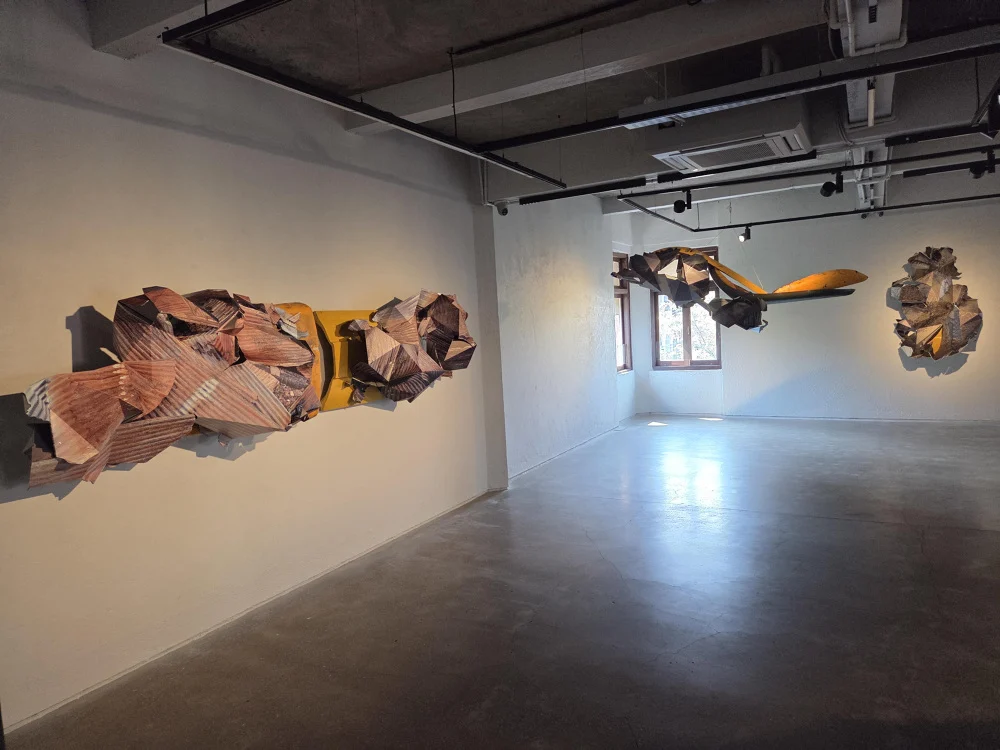
Presently, Asim’s two works are on display at the Kalakriti Art Gallery in Hyderabad. One of the works has got to do with the demolition works in the country.
“This work is based on a demolition that happened in a place called Madrasi Camp in Delhi in 2025, where people had been living for 40-50 years, but were thrown out to make a new infrastructure project,” says Asim, who juxtaposed the picture of this demolished slum onto some scrap components of a bulldozer.
“I think the city and people and society has been developing much faster than the development agency can plan for.”
The other work is from a series of experiments he has been doing with cyanotype, an analog printing process. “Cyanotype on paper or fabric is fairly straightforward but I wanted to do it on folded metal plates. It is a very delicate and temperamental process,” says Asim, who developed it after many months of trial and error.
Road ahead
By the time he finished studying architecture and worked in an office, Asim discovered that architectural practice was not something that he wanted to do. “But somehow in the last 4-5 years I’ve become quite excited about architecture, and I’m looking for an adventurous client to make something.”
Asim has many interests and doesn’t want to restrict himself to just being obsessed with art. “I am an avid trekker. I did some mountaineering courses and climbed some peaks early on,” informs Asim, who is doing a more exploratory kind of trekking, walking lesser-known trails in the Himalayas. He also enjoys reading fiction and listening to music as well.
- Visit Asim Waqif’s website to view his work
ALSO READ: Simran KS Lamba: Breathing new life into industrial waste, creating timeless art
Share with


Written By: Mallik Thatipalli
Simran KS Lamba: Breathing new life into industrial waste, creating timeless art


Written By: Vikram Sharma