
September 13 2026
Agnishwar Jayaprakash: From winning gold at the South Asian Games to nation-building with Made-in-India drones
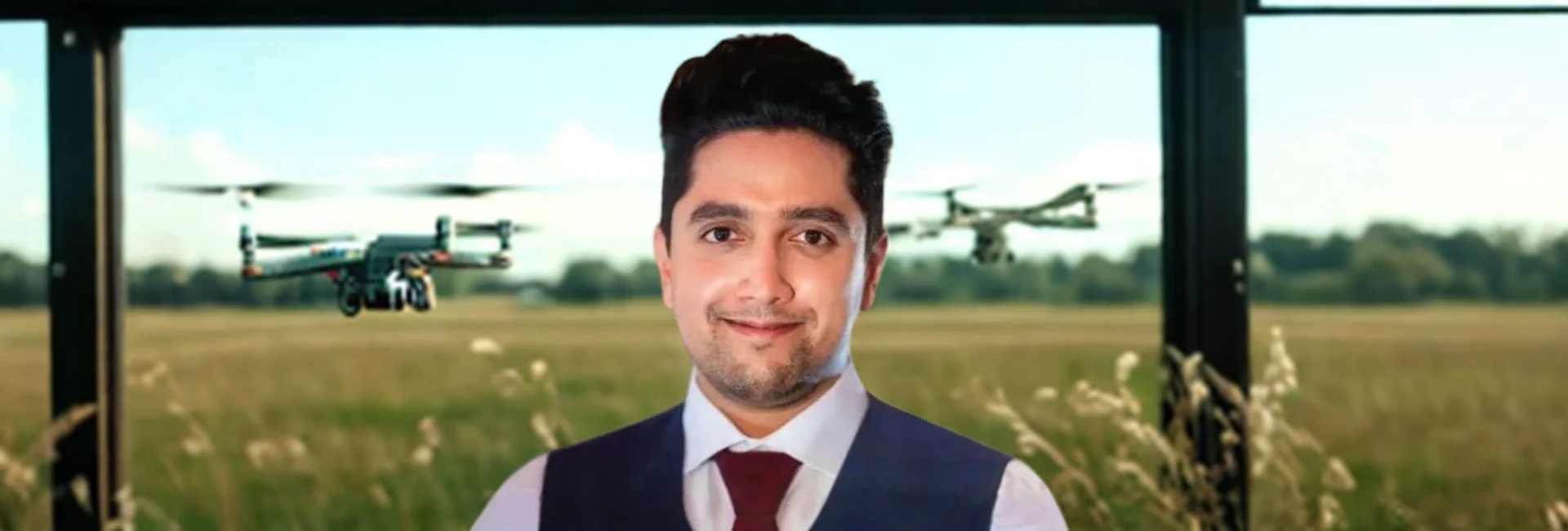
Former international swimmer turned entrepreneur Agnishwar Jayaprakash is building Garuda Aerospace as part of India’s Made-in-India ambition. The company’s large drone fleet serves major companies such as Tata, Adani, Reliance, L&T and Godrej, as well as government organisations including SAIL, NTPC and NHAI. Backed by MS Dhoni as an investor and brand ambassador, Garuda also made headlines when PM Modi flagged off the Kisan Drone Yatra in 2022, showcasing the use of drones for agricultural applications such as crop spraying and precision farming.
At 36, Agnishwar Jayaprakash has already lived several professional lives. A competitive swimmer who won South Asian gold medals, he moved into entrepreneurship before finding his way to drones. Today, he is the founder and CEO of Garuda Aerospace, where his early interest in building solutions for India has evolved into a technology business with ambitions beyond the country. The company is now preparing for its next phase of growth after receiving SEBI’s final approval for its IPO.
Yet, the different chapters of his journey are connected by a common thread: discipline, technology and a desire to solve real-world problems. From building Ignite-India, a youth innovation ecosystem that reached thousands of schools and colleges across India, to developing drones for agriculture, defence and disaster response, Agnishwar has consistently looked at technology through the lens of its practical use.
“Technology should not just be about innovation for its own sake. It should ultimately improve lives and create opportunities,” Agnishwar remarks in a chat with The Global Indian. That approach now underpins Garuda Aerospace as the company looks towards international expansion, partnerships with Airbus, Lockheed Martin and Thales, and plans to scale its portfolio from 44 to 120 drone platforms.
View this post on Instagram
Discipline, ambition and the making of a problem-solver
Long before drones became part of his professional life, Agnishwar learned to work with pressure, uncertainty and the demands of high performance in the swimming pool.
Growing up in Chennai, his early years were shaped by discipline and curiosity. His parents encouraged him to explore, but swimming soon became central to his formative years.
Swimming taught me that success is often decided long before you step into the competition,” he reflects. “It is about showing up every day, pushing yourself, and staying focused on the goal.
Agnishwar Jayaprakash
Competing internationally and winning South Asian gold medal gave him confidence, but the lessons went beyond the podium. The sport taught him how to respond when things did not go according to plan, and how to keep working towards a goal despite setbacks.
“There were races I won and races I lost, but every experience made me understand myself better,” he says. “How I respond under pressure, how much more I can push, and where I need to improve.” That understanding would later prove useful in a very different arena: entrepreneurship.
Finding inspiration in nation-building
Even as sport occupied much of his early life, Agnishwar was thinking about a larger question: how could technology and innovation contribute to India’s development? The ideas of Dr. A.P.J. Abdul Kalam had a strong influence on him. Kalam’s emphasis on innovation and nation-building planted an early belief that technology, when aligned with purpose, could help shape the future of a country.
After pursuing a bachelor’s in business law from Annamalai University, he did his MBA in marketing from Queens University of Charlotte. In 2017–18, he attended Harvard Business School’s Program for Leadership Development (PLD), an executive education programme focused on leadership and strategy.
“Harvard exposed me to diverse businesses and ways of thinking,” he says. “It made me realise that while contexts may change, the fundamentals of building a strong business remain universal. Understanding people, solving real problems, and executing well.” The combination of Indian grounding and international exposure would become a recurring theme in his entrepreneurial career.
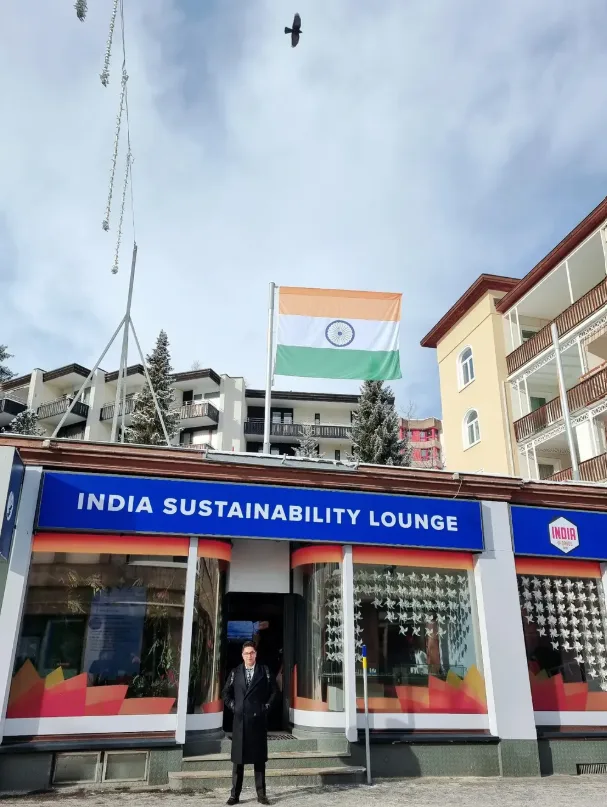
Agnishwar Jayaprakash at Davos 2023, where he spoke about Garuda Aerospace and India’s drone technology at the World Economic Forum
From youth innovation to the UN
By the time Garuda Aerospace entered the picture, Agnishwar had already been working with young people and ideas at considerable scale. Through Ignite-India, the innovation ecosystem he founded, he reached thousands of students across the country, encouraging them to think creatively and move from ideas to action.
“I strongly believed that India’s young population has enormous potential,” he says. “What they often need is the right platform and exposure.”
The initiative was recognised by the United Nations as one of the top socio-economic programmes globally, giving Agnishwar an opportunity to engage more closely with questions of policy, development and global challenges.
His work with the UN, including under Assistant Secretary General Lakshmi Puri, added another dimension to his understanding of technology and development. “It made me understand how interconnected development challenges are,” he explains. “And how technology can bridge gaps in access, productivity, and opportunity.”
It was around this period that another technology began to command his attention.
Seeing the potential of drones
Agnishwar did not arrive at drones because of one defining moment. Instead, the potential became clearer as he saw the range of problems the technology could address. “There wasn’t one defining moment,” he says. “But I began to see how drones could solve real problems, especially in areas where conventional systems fall short.”
Agriculture, healthcare, disaster management and infrastructure were among the areas where drones could make a difference by reaching difficult terrain, improving efficiency and reducing risk. For Agnishwar, however, the opportunity went beyond the machines themselves. He saw the need for an ecosystem that could bring together talent, applications, services and scale.
When we started Garuda Aerospace in 2015, I believed the opportunity was much bigger than just manufacturing drones. India needed to build a complete ecosystem, from talent and applications to services and scale.
Agnishwar Jayaprakash
View this post on Instagram
Building an ecosystem around drone technology
That idea became central to Garuda Aerospace’s evolution. In its early years, the company focused on demonstrating that drones could move beyond novelty and deliver tangible value, particularly in agriculture.
As its work expanded into defence, infrastructure and surveillance, so did its partnerships, including collaborations with organisations such as Bharat Electronics Limited, Thales and Tata Elxsi. “Each partnership helped us deepen our capabilities,” he says. “We moved from building drones to building an ecosystem around AI, autonomy, and advanced applications.”
Today, that ecosystem forms the basis of Garuda’s growth story, as the company looks to apply drone technology across a wider range of industries and geographies.
From IPO milestone to international expansion
Garuda Aerospace’s recent IPO approval marks another stage in that journey. For Agnishwar, however, the milestone is less about the listing itself and more about what it represents after years of building the company.
When you build a company from the ground up, you experience every stage. The uncertainty, the small wins, the moments that test your conviction. This milestone reflects the trust people have placed in us.
Agnishwar Jayprakash
The next phase involves expanding the company’s portfolio from 44 to 120 drone platforms, each designed around specific requirements across sectors. “The goal is not just to increase the number of drones,” he explains. “It is to develop the right technology for the right problem.”
That distinction is important to his approach. For Agnishwar, scale is meaningful only when it is accompanied by useful technology and applications.
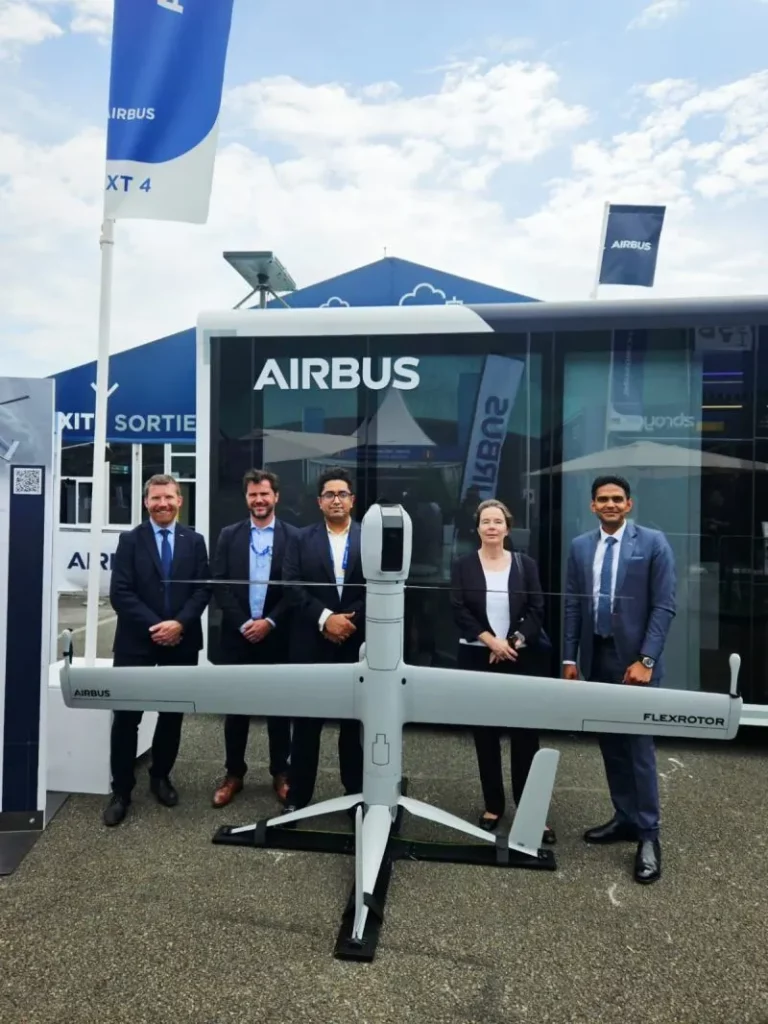
Garuda Technologies Inc and France-based Extensee SAS signed an MoU at Eurosatory 2026 in Paris to expand Airbus Flexrotor drone deployment across global markets
Drones and the future of defence
Defence is expected to become the company’s largest revenue driver in the coming years, as India’s focus on self-reliance and advanced surveillance capabilities grows.
“Drones will play a critical role in surveillance, logistics, and mission-critical operations,” he says. “Our responsibility is to build these capabilities within India.” The ambition, however, extends beyond the domestic market. Garuda is also looking towards Africa, the United States and the United Kingdom as it scales internationally.
“Global exposure has shaped how I think,” he says. “It taught me to think globally while staying rooted in India’s strengths.”
Taking Indian innovation abroad
The company’s collaborations with global players such as Airbus, Lockheed Martin and Thales are part of that international strategy. For Garuda, these partnerships also provide an opportunity to compete beyond India while taking Indian engineering and innovation to wider markets.
I believe India has the talent and engineering capability to build globally competitive deep-tech companies.Our ambition is to build Garuda as an Indian company with global relevance.
Agnishwar Jayaprakash
From novelty to practical agricultural tool
Agriculture remains another important area of Garuda’s work, and it is here that Agnishwar has seen perhaps the clearest change in how people perceive drones.
“Earlier, drones were seen as a new technology,” he says. “Today, farmers see them as practical tools that save time and improve efficiency.”
The opportunity now lies in expanding their role across the agricultural cycle, from crop monitoring and precision farming to data-driven decision-making. For Agnishwar, this evolution captures what he has believed about technology from the beginning: its value ultimately lies in how effectively it addresses a real need.
View this post on Instagram
Building with purpose, staying grounded
Despite operating at the intersection of technology, entrepreneurship and international expansion, Agnishwar’s approach remains rooted in a relatively simple principle. “The biggest lesson I’ve learned is that a good idea must solve a real problem, irrespective of geography,” he says.
Building from India, he believes, offers advantages in scale, talent and cost efficiency. But taking an Indian company into international markets demands something more. “You have to compete on quality, reliability, and innovation, not just cost,” he adds.
Away from work, family and routine provide a counterbalance to the pace of entrepreneurship. “Spending time with my wife and son keeps me grounded,” he says. “Swimming is still a big part of my life. It helps me disconnect and recharge,” he signs off.
Share with





Written By: Bindu Gopal Rao