
July 22 2026
Pawan Chandana and Naga Bharath Daka: The Skyroot founders behind India’s first privately developed rocket to reach orbit
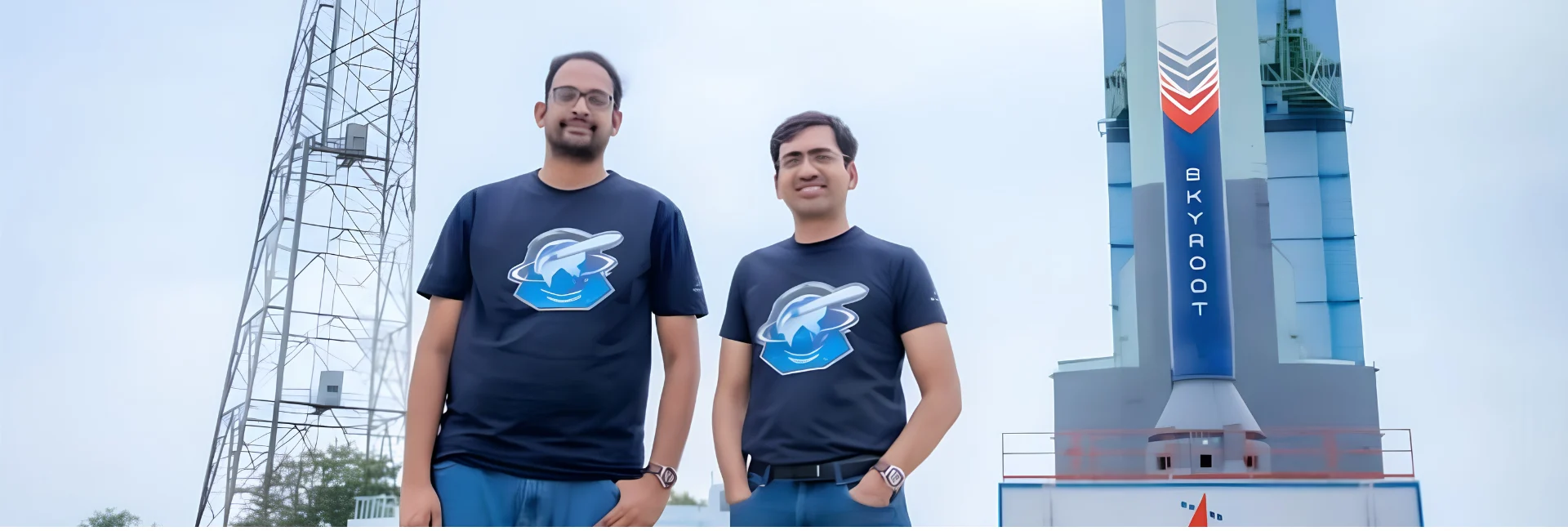
On July 18, Skyroot Aerospace made history when its Vikram-1 launch vehicle became the first privately developed Indian rocket to successfully reach orbit. The achievement placed India alongside the United States and China as the only countries where private companies have independently carried out orbital rocket launches, marking a major milestone for India’s growing commercial space sector.
As millions watched the countdown to Vikram-1’s launch on July 18, one of them was Prime Minister Narendra Modi.
Hours before liftoff, he called it “a historic new frontier for India’s space journey” and urged Indians, especially young people, to follow the mission. Minutes after the rocket successfully reached orbit, he personally congratulated the team behind it, describing the achievement as “a defining moment in India’s space journey” that would inspire youngsters “to dream bigger and innovate fearlessly.”
View this post on Instagram
The mission that created history
The rocket that soared into the sky from the Indian Space Research Organisation’s launch facility at Sriharikota was Vikram-1, developed by Hyderabad-based Skyroot Aerospace. In just 16 minutes, it reached Low Earth Orbit, making Skyroot the first Indian private company to achieve an orbital rocket launch. The success also placed India in an exclusive club with the United States and China, the only other countries where private companies have independently sent rockets into orbit.
For those unfamiliar with the complexities of spaceflight, the scale of the achievement is perhaps best explained by Skyroot co-founder and CEO Pawan Kumar Chandana himself. Reflecting on the mission, he noted in social media:
Reaching orbit on the maiden flight of a new launch vehicle is extraordinarily rare. Even SpaceX, which went on to redefine the global space industry—and continues to inspire us—reached orbit on its fourth attempt.
Pawan Kumar Chandana
For most people, the launch may have looked like another rocket disappearing into the sky. But its significance goes much further. It signals a new phase for India’s space programme, where private companies are no longer just supplying components or technology, rather building and launching rockets of their own. More importantly, Skyroot hopes to make access to space as simple as booking a cab, allowing customers to send satellites into precisely the orbit they need without waiting months or even years for a place on a larger rocket.
View this post on Instagram
When two ISRO engineers decided to take a leap
Six years before Vikram-1 lifted off from Sriharikota, Skyroot Aerospace existed only as an idea shared by two colleagues. The young engineers left secure careers at ISRO in 2018 to build a company at a time when India’s private space industry barely existed.
Pawan Kumar Chandana and Naga Bharath Daka had spent years working at the Indian Space Research Organisation (ISRO), gaining first-hand experience in India’s launch vehicle programme. Chandana, who holds BTech and MTech degrees in Mechanical Engineering from IIT Kharagpur, worked as a scientist at ISRO between 2012 and 2018. Daka, an IIT Madras graduate with BTech and MTech degrees in Electrical Engineering, worked as an avionics engineer at ISRO before moving to semiconductor company Xilinx, where he spent three years strengthening his expertise in advanced technologies.
In 2018, the two decided to leave stable careers and start something that, at the time, appeared highly ambitious. Chandana recalled while looking back at the company’s early years:
There was neither a private space-tech policy nor an environment to fund space ventures in India. But we believed in the potential of the space economy and India’s role in it.
Pawan Kumar Chandana
The bold vision they shared was to build launch vehicles in India that could compete globally and make access to space easier. Their timing proved remarkable. Just two years later, in 2020, the Government of India opened the space sector to private participation, allowing companies to build rockets and satellites while using ISRO’s launch facilities. The reforms triggered the emergence of more than 400 space startups, creating an ecosystem that barely existed when Skyroot was founded. Today, Skyroot has emerged as the country’s first space-tech unicorn, valued at over $1.1 billion.

Skyroot Aerospace Co-founders Naga Bharath Daka and Pawan Kumar Chandana (right)
What does ‘cab service to space’ actually mean?
When most people think of rockets, they picture astronauts heading to the Moon or satellites that make everyday services like GPS, communication and weather forecasting possible. But for the companies that build them, the biggest challenge is often getting those satellites into the right orbit—the path they follow around Earth to operate. Large rockets usually carry several satellites belonging to different customers. Because they operate on fixed schedules and predetermined destinations, satellite operators may have to wait months or even years for a launch that matches the orbit they need.
Skyroot wants to change that. Chandana often explains the idea through an everyday example. “If you want to just go to a friend’s house, you don’t need a train. You book a cab.” That, in essence, is Skyroot’s business model. Instead of waiting for space on a large launch vehicle, customers can book a dedicated mission that places a small satellite into its required orbit. The flexibility could prove valuable as the number of small satellites continues to grow worldwide.
Skyroot believes India can become an important player in meeting that demand. As Daka describes it,
At Skyroot, we are on a mission to build space launch vehicles of the future to meet the ever-growing satellite market requirements and to become a globally competitive commercial aerospace company in India.
Naga Bharath Daka
The satellites power many services people rely on every day, from weather forecasting and disaster management to agriculture, fisheries, navigation, internet connectivity and communications. As governments and businesses launch more of them, the demand for quicker and more customised launch services is expected to rise.
A mission named ‘Aagman’
The company’s first orbital mission was aptly named Aagman, the Sanskrit word for “arrival”. The name symbolised more than the arrival of a rocket in orbit. It represented the arrival of India’s private launch industry on the global stage.
Vikram-1 carried six payloads into Low Earth Orbit. Alongside satellites, including one from a German company, the mission carried scientific instruments such as an Earth observation camera and a robotic arm designed to explore technologies that could one day help remove space debris.
The flight also included two symbolic payloads that reflected Skyroot’s desire to honour India’s scientific heritage. One was Cosmic Bloom, a lotus crafted from laboratory-grown diamonds as an artistic tribute celebrating India’s creativity and humanity’s fascination with space.
The other was a tiny gold rocket carrying microscopic sculptures of three pioneers who helped shape India’s scientific journey—Nobel laureate Sir C. V. Raman, aerospace scientist and former President Dr A. P. J. Abdul Kalam, and Dr Vikram Sarabhai, regarded as the father of India’s space programme. Each sculpture was smaller than a grain of rice.
“We exist because of the Indian space programme,” Chandana has said. “We stand on the shoulders of our early visionaries.” The tribute, he explained, was Skyroot’s way of acknowledging the scientists whose work made today’s achievements possible.
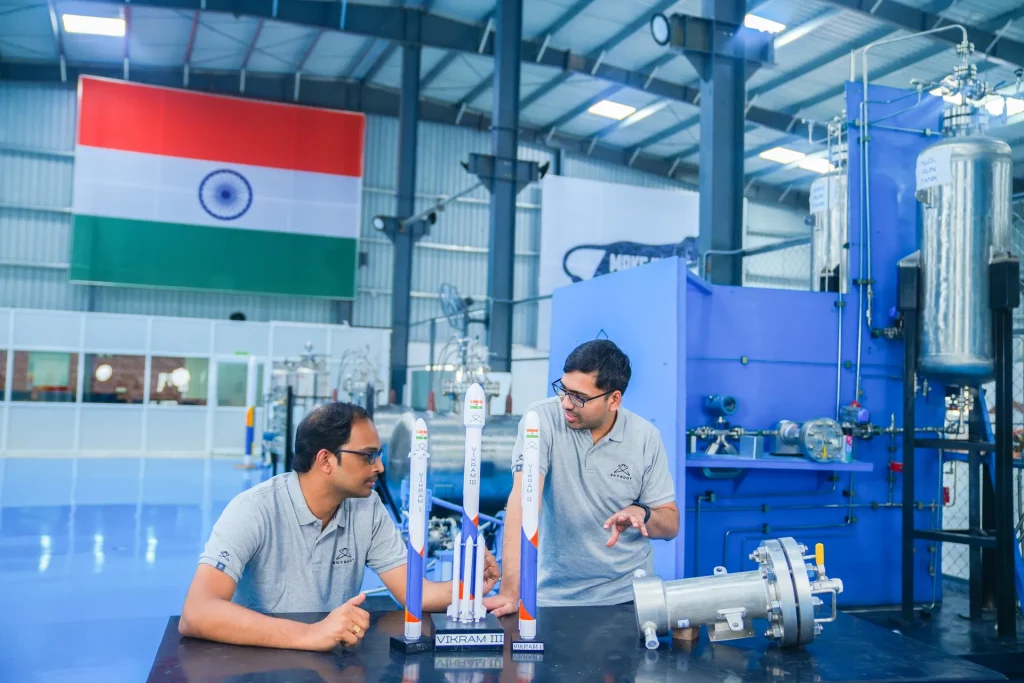
Skyroot Aerospace Co-founders Naga Bharath Daka and Pawan Kumar Chandana (right)
Built by a young team
While Vikram-1 has become the face of Skyroot’s success, Chandana believes the story belongs to the people behind it. “What a day. One for the history books,” he wrote after the launch, recalling the congratulatory call from Prime Minister Modi soon after Vikram-1 reached orbit.
He also highlighted something unusual about the team that built it:
More than 95 percent of people at Skyroot Aerospace never worked on any space mission before and their average age is 28. It’s just freshness, passion and grit that made them the scientists and engineers that launched a rocket to orbit on the very first attempt.
Pawan Kumar Chandana
For the Skyroot co-founders, the achievement demonstrated that experience, while valuable, is only one ingredient in innovation. A young team backed by strong engineering and a willingness to solve difficult problems could achieve what many considered unlikely.
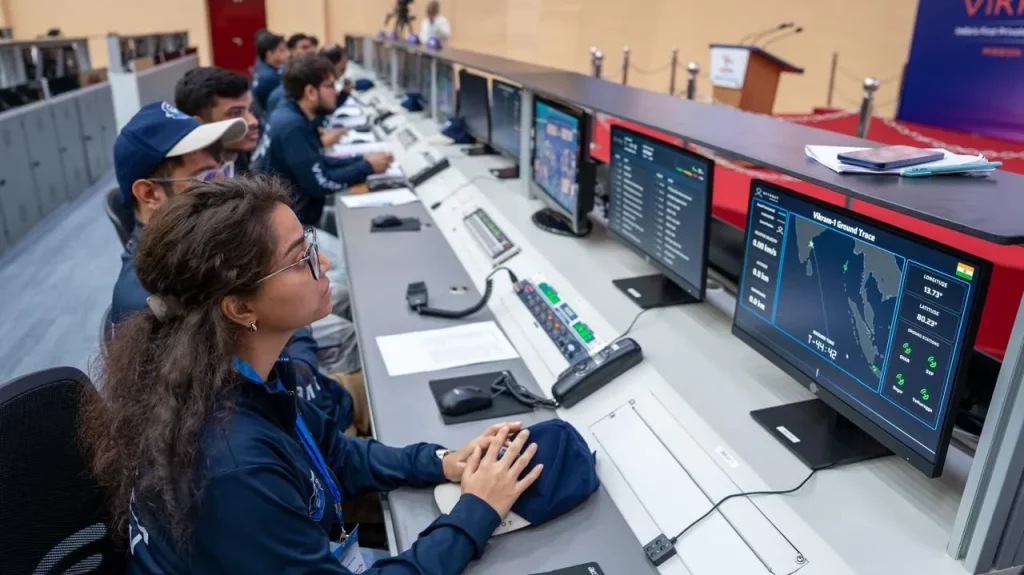
Members of the Skyroot Aerospace Team | Photo Credit: Pawan Kumar Chandana
A new chapter for India’s space ambitions
Skyroot’s journey is unfolding at a time when India’s space programme is entering one of its most ambitious phases. Following successful missions to the Moon, Mars and the Sun, ISRO is preparing for the Gaganyaan human spaceflight programme, a mission to Venus and the development of an Indian space station over the next decade.
Private companies are expected to play an increasingly important role alongside the national space agency. For Skyroot, however, the opportunity extends far beyond India.
The company plans another test mission before beginning commercial launches and says its Hyderabad facility has the capacity to build one rocket every month. While ISRO could become one of its customers, Chandana believes most of the market will come from overseas as demand for dedicated small-satellite launches continues to grow.
For two engineers who left secure government careers with little more than a belief in India’s future in commercial spaceflight, Vikram-1 is proof that an idea born before private space reforms, nurtured through years of engineering and realised by a young team, can help redefine India’s place in the global space economy.
As India looks towards a future that includes astronauts, planetary missions, and its own space station, Skyroot’s first journey to orbit suggests that the country’s next giant leap may increasingly be powered not only by its national space agency but also by homegrown private enterprises.
- Follow Pawan Kumar Chandana and Naga Bharath Daka on LinkedIn
ALSO READ: Vikram 3201: India’s home-grown ‘digital diamond’ in space tech

Share with





Written By: Amrita Priya