
November 17 2026
From American academia to African safari: The many worlds of Deborshi Barat

(Nov 17, 2026) From studying and teaching at leading US institutions to engaging with international law, human rights and public policy, Deborshi Barat’s journey spans continents and disciplines. An award-winning researcher, lawyer, actor and writer, he has also explored Bengali cinema and theatre. A journey through East Africa inspired his second novel, In Safari – A Love Story.
East Africa left an indelible impression on Deborshi Barat. Having travelled widely, it was the region’s untamed landscapes, diverse communities and cultural textures that stayed with him long after his visit. Years later, those experiences found their way into his second novel, Safari – A Love Story.
“The idea was to write a story in which travel would have a narrative and emotional purpose. It serves as a reminder that sometimes, the most transformative journey isn’t across the wilderness, but within,” says Deborshi, in conversation with The Global Indian.
It is a fitting creative pursuit for someone whose own life has crossed several worlds. A lawyer and public-policy advisor with a PhD from The Fletcher School at Tufts University, he has taught in the United States, worked on international legal and human-rights initiatives, earned recognition for his research on investment law and received awards for his writing on clean energy. Alongside this, he has acted in Bengali films and English-language theatre.

A safari into fiction
Safari – A Love Story follows Niharika Bose, whose carefully constructed life collapses when she catches her fiancé in bed with another woman. The betrayal sends her on an unexpected journey through East Africa, where unfamiliar landscapes and new relationships become part of her search for self-discovery.
The novel draws on Deborshi’s own experiences and subsequent research. He travelled to Kenya in 2011, around the period in which the story is set.
“Returning imaginatively to that period was part of the pleasure of writing it,” he says.
Travel, he believes, can unsettle familiar perspectives and reveal parts of ourselves that everyday routines keep hidden. Friendship is another central theme, particularly the bonds women develop across different stages of life.
Deborshi Barat
“I was interested in the way friendships form at different stages of life, how they are tested by time and changing circumstances, and how they can evolve without losing their significance.”
Female friendship offered an opportunity to explore intimacy, loyalty, independence and the quiet understanding that develops between people. “I wanted to approach these relationships with restraint and delicacy, allowing their complexities to emerge through the narrative.”
Based in New Delhi, Deborshi is a former Associate Professor at Jindal Global Law School. His debut novel, The Hunter of Pigeons, was published in 2014.

Law across borders
After studying at the National University of Juridical Sciences (NUJS), Kolkata, Deborshi began his legal career in capital markets, mergers and acquisitions, and corporate law.
“This gave me an early grounding in the transactional and commercial dimensions of legal practice,” he says. His work subsequently expanded into trade and economic advisory and global trade regimes. Today, his interests include data protection, artificial intelligence, clean energy and environmental, social and governance (ESG) matters.
The United States proved particularly formative. At The Fletcher School at Tufts University, he completed an MA in Law and Diplomacy and later returned for his PhD. He also pursued an LLM and cross-registered for Law and Politics at Harvard.
The academic exposure brought together international law, political economy, development, conflict resolution, international organisations and political theory.
“That combination was valuable because it encouraged me to approach legal questions in their wider institutional and geopolitical settings,” he says. His academic engagement across Boston and New York extended over roughly a decade, with teaching, research and other activities connected with Tufts, Harvard, Columbia, Dartmouth and the Horizon Academic Research Program.
At Tufts, he served as an Instructor in International Law. At Fletcher, he edited the Journal of Humanitarian Assistance and published with The Fletcher Forum of World Affairs. He also published with the Avon Global Center for Women and Justice at Cornell Law School. His teaching covered international law, arbitration, negotiation, American politics, globalisation and public policy. Among his participants were students, judges, diplomats and lawyers, including cohorts in the United States, China and Armenia.
He received the William and Joan Blue Scholarship and the Alfred Rubin Prize for International Law.
Beyond the classroom
Deborshi’s American years also took him beyond university campuses. He worked on mediation with MWI in Boston, human-rights advocacy and judicial-capacity-building with Femin Ihtihad, and collaborated with Transparency International on reparations for victims of grand corruption in international criminal proceedings.
He also participated in mock court proceedings in Poland.
These experiences connected his academic interests with practical questions of justice, institutional accountability and human rights. They also strengthened his belief in comparative perspectives. “A legal institution cannot always be understood by examining its text alone; one must consider its history, political setting, institutional culture and social reception.”
Research with impact
At The Fletcher School, Deborshi’s doctoral research examined the sociological legitimacy of dispute resolution in the international investment law regime. It earned him the Peter Ackerman Doctoral Dissertation Award.
Rather than concentrating solely on the legal design and procedures governing disputes between investors and states, his research examined how the people and institutions affected by these mechanisms perceive their legitimacy.
What makes a dispute-resolution system command confidence and acceptance beyond its formal legal standing? That was the central question. His writing on clean energy and sustainability brought further recognition. He received the Market Intelligence Thought Leadership Award from Legal 500 and Mondaq Thought Leadership Awards in the Energy and Natural Resources category.
His work examined subjects including green buildings and energy efficiency, connecting regulatory developments with the practical challenges of sustainable development.
“The transition to more sustainable forms of development depends on the interaction of policy ambition with practical implementation,” he says.
The actor and writer
There is another side to Deborshi that sits comfortably alongside his legal and academic pursuits: the performing arts.
Growing up in Kolkata, he attended St. Xavier’s Collegiate School before studying law at NUJS. Literature, debating, elocution and theatre attracted him beyond the classroom. His ambition, at one point, was to become a professional tennis player.
Acting eventually became a lasting pursuit. His theatre work has covered classical and modern drama, comedy, satire, absurdist writing, thrillers and improvisation. He has performed with groups including Theatrecian, The Red Curtain, Spotlight and Stagecraft. One of his recurring roles was Jerry in Theatrecian’s production of Edward Albee’s The Zoo Story, which became Kolkata’s longest-running English-language play.
His screen credits include Qaushiq Mukherjee’s (Q’s) Tasher Desh (2012), a Bengali psychedelic fantasy nominated for the Rome International Film Festival; the romantic comedy Ganesh Talkies (2013); and Anjan Dutt’s Ranjana Ami Ar Ashbona (2011), which received three National Film Awards.
Acting has also informed his writing.
Theatre requires an actor to look closely at motivation, gesture, silence, dialogue and the distance between what a character says and what that character may actually feel.
Deborshi Barat
That attention to human behaviour carries into his fiction, where relationships, emotional conflicts and the complexities of individual lives take centre stage.Deborshi is also a director of Theatrecian, an English-language theatre group recognised by BBC Four as India’s most prolific English-language theatre group.
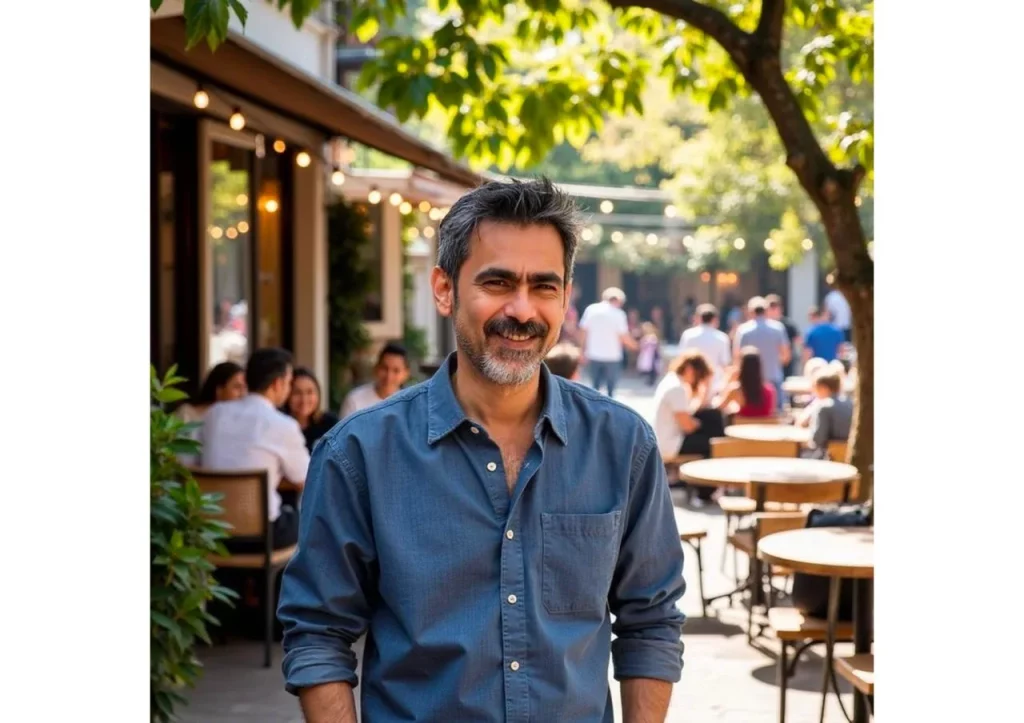
Many worlds, one journey
Looking ahead, Deborshi intends to continue working at the intersection of law, regulation, public policy and emerging technologies. Data protection, artificial intelligence, clean energy and ESG will remain important areas of engagement, given the questions they raise around governance, accountability and public interest.
He also plans to continue writing fiction alongside his legal, policy and international-affairs work.
Debating and public discussion remain part of his life, with regular participation at forums and institutions including the Calcutta Club, the Saturday Club, the Tollygunge Club and Rotary International.
From international law and academic research to cinema, theatre and fiction, Deborshi’s pursuits rarely fit into a single professional mould. And perhaps that is what makes his journey particularly interesting: the curiosity to keep moving between worlds, absorbing new perspectives and finding fresh ways to express them.
- Follow Deborshi Barat on LinkedIn
ALSO READ: Priyanka Pradhan: From ‘Tales from the Himalayas’ to ‘Wrong Turns Only’



Written By: Vikram Sharma
Priyanka Pradhan: From ‘Tales from the Himalayas’ to ‘Wrong Turns Only’

Written By: Vikram Sharma
Dr Arun Krishnan: The technologist bringing Indian history to life through fiction

Written By: Minal Nirmala Khona