


(Aug 29, 2026) For Shashank Madala, an Indian-American student from Robbinsville, New Jersey the idea for Kora began with a personal experience. His younger cousin, who lives in India, is autistic, and growing up, Shashank saw how difficult it could be for those around him to understand what his cousin was feeling.
“I started realizing how hard it could be for children with autism to interpret emotions and social cues,” Shashank tells The Global Indian. “That experience was a major inspiration behind Kora.”
At 15, he taught himself machine learning and began building an app to help caregivers and therapists make emotional cues easier for autistic children to understand. What started as a solo project has since developed into Kora. “Its an AI-powered assistive tool being used by more than 700 users through 25 therapy centres across 12 countries,” informs Shashank.
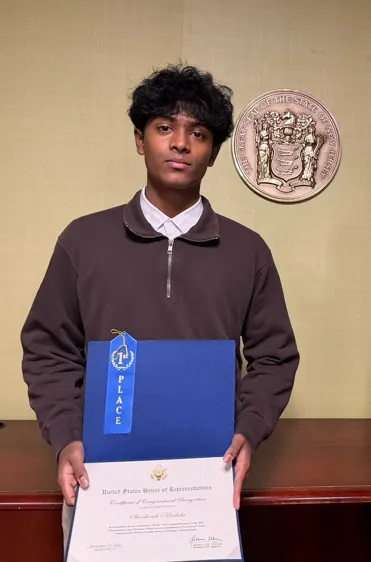
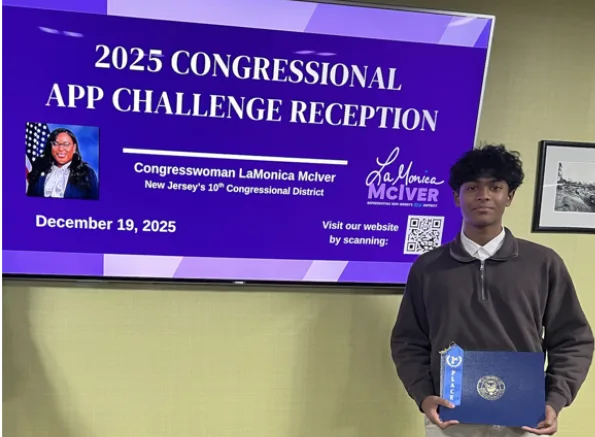
“The app has received about $7,000 in funding and won first place in the 2025 Congressional App Challenge for New Jersey’s 10th Congressional District. The recognition took Kora beyond the digital space. It was displayed at the US Capitol, while Representative LaMonica McIver presented Shashank with a Certificate of Congressional Recognition.”
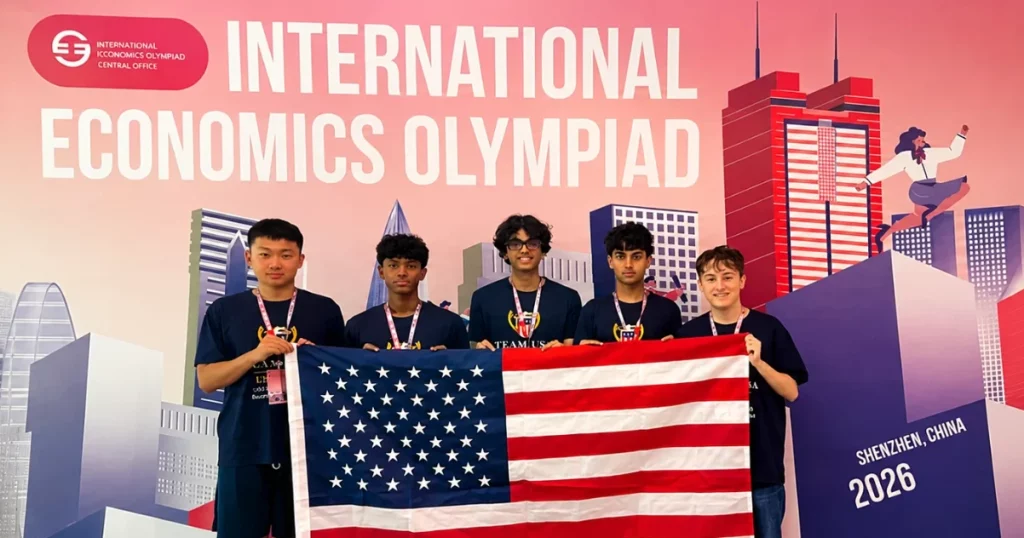
Alongside his interest in technology, Shashank who studies at Robbinsville High School has also developed a keen interest in economics, which in 2026 took him to the International Economics Olympiad in Shenzhen, where he represented the United States as one of five students selected nationwide.
From a personal problem to a solution
Shashanks says Kora uses artificial intelligence and computer vision to analyse facial expressions through a device’s camera and translate them into simpler emotional cues. The intention is to provide children with another way to practise recognising emotions and navigating social interactions.
For caregivers and therapists, the app is designed as an additional resource rather than a replacement for professional guidance.
“Kora is meant to support, not replace, the guidance of caregivers and professionals,” Shashank explains. “We have worked with therapists, caregivers and families to improve the platform based on real-world feedback.”
Shashank built the original version himself, developing the machine-learning pipeline, backend and user interface. As the project expanded, he brought in other developers and now leads a three-member development team working on the platform. “This summer, a Joint Legislative Resolution of the New Jersey Senate and General Assembly also cited me as Kora’s creator,” he mentions.
The numbers, however, matter more to him than the recognition. Kora is now being used through therapy centres and its wider user network, with plans to expand access to schools, caregivers and families.
From building Kora to representing Team USA in Economics Olympiad
Building Kora also changed the way Shashank thought about economics. “As I was building Kora, I started realizing that building useful technology was only part of the challenge,” he says. “I also wanted to understand whether families would use it, how it could remain affordable, and what helps an idea grow enough to reach the people who need it.”
That interest eventually led him to economics competitions. In 2026, Shashank represented the United States at the International Economics Olympiad in Shenzhen, China, after being selected as one of only five students nationwide.
It was a particularly significant year for Team USA, as it marked the country’s first in-person participation at the International Economics Olympiad. The American team placed sixth among 52 national teams in the International Business Case Competition.
For Shashank, the experience was as much about learning from others as competing. “Representing Team USA was both exciting and humbling,” he says. “Being one of five students selected nationwide and meeting students from more than 50 countries showed me how differently people can approach the same economic problem.”
The sixth-place finish in the business case competition was another highlight. “It reflected how much our team trusted and learned from one another,” he says.
Building with purpose
Kora is not Shashank’s only effort to use technology beyond the classroom. He also founded Lumin AI, an initiative focused on expanding access to AI education for students across different communities and countries.
Outside academics and technology, he plays varsity tennis and mentors younger students. He also makes time for friends and family, balancing a growing list of interests with life as a rising senior at Robbinsville High School.
His academic interests point in several directions: computer science, artificial intelligence, economics and entrepreneurship. Rather than choosing between technology and economics, he sees them as complementary fields. “In the future, I want to build technology companies that solve meaningful problems,” he says, pointing to accessibility, financial technology and education as areas that interest him.
For now, Kora remains the clearest expression of that ambition. Its beginnings were rooted in his family’s experience with autism, but its development has involved learning about machine learning, product design, users, funding and the economics of making technology accessible.
Shashank’s family originates from Andhra Pradesh, India, while he has grown up in Robbinsville, New Jersey. His work with Kora has similarly crossed borders, from the experience of a cousin in India to users and therapy centres in other countries.
“I am happiest when I am building something that can genuinely help people,” he says.
For a high school student, that may still be an early ambition. But with Kora, Shashank has already taken an idea from a personal observation to a working platform with users beyond his own community.
- Follow Shashank Madala on LinkedIn
ALSO READ: Shubham Banerjee: The young Indian-American innovator making braille affordable