


(Jul 5, 2026) When ten-year-old Saksham Sharma boarded a flight from Delhi to Australia with his engineer father and dancer mother, his family was doing what countless Indian migrants have done, leaving behind familiarity in search of greater opportunity. His parents believed Australia would give the family better opportunities to pursue dreams.
For Saksham, however, the move meant entering a classroom where he barely understood English. Over the next few years, he would change schools 13 times as his parents moved across Melbourne, Canberra and Sydney in search of stable work.
Today, that same boy is one of Australia’s most exciting young Indian-origin entertainers. Still in his mid-twenties, he has appeared opposite Oscar-nominated Hollywood star Liam Neeson in Ice Road: Vengeance, acted in Sahela, produced by Dev Patel’s production company, and become one of the youngest South Asians to executive produce and star in a Google and Screen Australia-backed YouTube series. He has also built a community of more than 117K subscribers on YouTube, and is touring Australia with his live magic show.

Saksham Sharma with his Hollywood co-stars in his debut movie, Ice Road: Venegeance
Learning to begin again
Born in Kanpur, Uttar Pradesh in India, Saksham spent part of his childhood in Delhi before migrating to Australia. The transition wasn’t easy. “I couldn’t speak English very well,” Saksham shared in a recent podcast. Although he excelled in subjects like mathematics, he struggled to understand teachers speaking rapidly in English. His school suggested he repeat a grade, but his mother insisted he understood the work and simply needed time to learn the language, and she was right.
As his parents searched for jobs, the family kept relocating. By graduation, Saksham had studied at 13 different schools. Instead of seeing those years as instability, he now views them as training for the entertainment industry. Constantly introducing himself to strangers taught him to adapt quickly, build connections and feel comfortable in unfamiliar environments.
The coin trick that changed everything
Magic entered his life through his mother. One day when he was in grade six, she showed him a simple disappearing coin trick. He performed it at school, and classmates were instantly fascinated.
“There was something about magic that I just couldn’t stop.” Without teachers or magic clubs, YouTube became his classroom. But he soon realised copying tricks would never make him stand out.
Watching legends in the field changed his perspective. “They think of the most impossible things and reverse engineer them to make them possible.” That philosophy shaped not only his magic but also his life. His parents and younger sister became his first audience, watching countless tricks fail before they finally worked.
“My parents and my sister saw a lot of my tricks go wrong before they ever went right,” he laughed. What fascinated him most wasn’t fooling people, it was seeing audiences of every age react with the same sense of wonder. “Whether I performed for an adult, an old man or a kid, the reaction was exactly the same.” For a boy still finding his place in a new country, magic became a language everyone understood.
View this post on Instagram
A television stage changes everything
Watching British illusionist Dynamo perform before packed arenas gave Saksham a dream to one day command a stage of his own. At 15, he won a school talent competition and A$1,000 in prize money. More importantly, he discovered that strangers appreciated something he had taught himself.
His mother encouraged him to audition for Australia’s Got Talent. Ironically, speaking to television hosts backstage proved more intimidating than performing before hundreds of people.
“I only knew how to deal with a crowd.” The moment he stepped onto the stage, the nerves disappeared. His audition went viral and earned widespread praise. Although he couldn’t continue because the next round clashed with his Year 12 English examination, the experience changed his confidence forever.
Watching himself on national television alongside his parents made the dream feel real. “That moment really made me feel like… maybe I can actually do this.”
Learning the business of entertainment
Like many Indian parents, Saksham’s family encouraged him to complete university alongside chasing his creative ambitions. He studied marketing at Macquarie University, believing it would help him understand the business behind entertainment.
During university, he secured internships with TikTok and Paramount Pictures. At TikTok, he learnt there is no guaranteed formula for viral success. “I made a video with my sister that got 100 million views, and I didn’t even think it was that good.”
At Paramount, he worked on campaigns for Top Gun: Maverick and Smile. Instead of limiting himself to marketing, he spoke with teams across publicity, sales and distribution to understand what made projects succeed.
He carefully noted everything he learnt. That notebook would soon become the foundation of the biggest opportunity of his career.

Creating his own opportunities
Despite impressive internships and growing recognition, meaningful acting roles remained scarce. Apart from a guest appearance on the long-running Australian drama Home & Away, Saksham found himself waiting for opportunities that rarely came.
So he decided to stop waiting. If nobody was willing to cast him, he would write and produce his own project. The decision meant learning screenwriting from scratch. Government funding applications required polished scripts, budgets and detailed production plans. These were the skills he had never been taught. He immersed himself in online masterclasses by leading filmmakers and writers, determined to bridge the gap himself.
The first application failed. So did the second. Then several more. By his own estimate, he faced at least six rejections before receiving the phone call that changed everything.
“I didn’t really think it through,” he recalled. “I just applied. What’s the worst that happens?” The call came while he was helping his mother at the childcare centre where she worked. Screen Australia informed him that his project had been selected for its prestigious Skip Ahead initiative.
Even then, his mother refused to celebrate until she saw the official paperwork. The project, Unknown Filter, received A$137,000 in funding from Google and Screen Australia, making the 20-year-old Saksham one of the youngest South Asian to executive produce and star in an original YouTube series backed by the programme.
Suddenly, he was no longer making videos alone in front of a camera. He was leading a professional production with a full crew, while his mother joined the team to oversee finances. “I’ve always gone into rooms with directors and producers with passion. If it’s my first time doing something, I tell them.”
The series was well received and brought national attention, although Saksham admits he rarely pauses to celebrate.
Magic became his passport to Hollywood
After graduating from Macquarie University, Saksham faced another crossroads. A secure career at Paramount Pictures was within reach, but he chose uncertainty instead, enrolling at the prestigious Lee Strasberg Theatre and Film Institute in Los Angeles.
Breaking into Hollywood without contacts seemed almost impossible. So once again, magic opened doors. Armed with little more than a deck of cards, Saksham began attending entertainment events, sometimes without invitations. At one Grammy after-party, he performed tricks for security guards until they let him in. Minutes later, he was performing for YouTube star David Dobrik and leaving with his phone number.

Saksham on the sets of Australia’s Got Talent when he was a grade 12 student
Another casual conversation while waiting in line introduced him to a Universal Studios executive, who later invited him mountain biking. What looked like fearless networking to others felt natural to him.
“I was never trying to hustle. Magic makes people happy, and that’s always been my goal.” By the end of his stay in Los Angeles, he had secured both an agent and a manager. Around the same time, he also added another international credit to his résumé with Sahela, produced by Dev Patel’s production company and written by Atika Chohan.
The midnight email
The audition for Ice Road: Vengeance followed a familiar pattern. Saksham submitted his self-tape, heard nothing for almost six months and assumed he had missed out. He accepted another acting project that was due to film at the same time.
Then, just after midnight, an email arrived. He had been cast opposite Liam Neeson. Only after receiving the full script did he realise how significant the role was, appearing in multiple scenes alongside one of Hollywood’s biggest action stars. Working with his acting coach, he spent weeks preparing emotional roadmaps for every scene before filming began at Melbourne’s Docklands Studios and later in Nepal.
Meeting Neeson for the first time immediately eased his nerves. Away from the cameras, the pair developed an easy friendship. Saksham taught Neeson a card trick, while the Oscar-nominated actor shared practical lessons on eye lines, camera positioning and performing under difficult lighting, the advices that no acting school could offer.
The friendship has continued beyond filming, with the two occasionally exchanging messages, often sharing videos of their dogs.
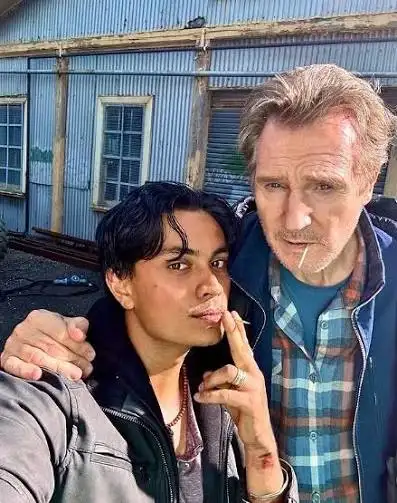
Saksham Sharma in his Hollywood debut movie with Oscar-nominated star Liam Neeson
Making the impossible possible
Today, Saksham’s career spans film, television, digital entertainment and live performance. His touring magic show blends illusion, storytelling and audience participation in a format he describes as closer to a concert than a traditional magic performance. Alongside the acting career, he is also developing original screenplays, hoping to tell stories that encourage young people, particularly those from migrant backgrounds to believe that ambition is worth pursuing.
For the boy who left Delhi, barely able to speak English in his new country, magic was never just about disappearing coins or impossible card tricks. It became a way of connecting with people, opening doors and creating opportunities where none seemed to exist.
ALSO READ: Raj Labade: The Indian-origin actor making his mark in Australia