


(Oct 25, 2026) When Lexington-based Rajarshi Mandal came across a New York Times video of fishermen weaving donated mosquito nets into fishing nets, it got him thinking about how a resource intended to save lives could be put to better use. The footage showed fishermen repurposing the nets because they were the only fishing mesh available. For Rajarshi, a 16-year-old student at Lexington High School in Massachusetts, it sparked a question. Could the mosquito nets distributed to prevent malaria be allocated more effectively to protect more people?
The question led him to develop a mathematical model of malaria transmission, accounting for factors that conventional distribution strategies can overlook. His research has now earned him a $50,000 scholarship as a 2026 Davidson Fellow in science. He is one of six Indian-American students among the 21 fellows who received the scholarship this year.
Titled Ordinary Differential Equation Modeling of Malaria Transmission Dynamics for Optimized ITN Allocation Strategies, his project explores how mathematics and computing can help public health organisations get more out of limited supplies of insecticide-treated nets.
“I made a simulation of how malaria actually spreads under these realistic conditions and used it to evaluate where each net has the largest effect. With the same number of nets, my approach prevented twice as many infections,” Rajarshi writes on the Davidson Institute’s website, describing his project.
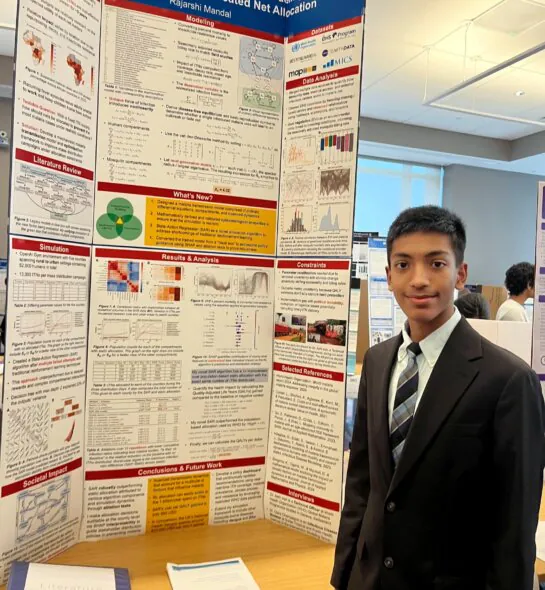
Making every mosquito net count
“About 200 million nets are distributed every year, so even small improvements in where they go can prevent a lot of illness,” Rajarshi explains.
Insecticide-treated nets are among the most cost-effective tools for preventing malaria, but supplies are limited. Distribution strategies often rely heavily on population figures without fully accounting for differences in transmission risks between communities.
Rajarshi identified three factors that could affect how well the nets work: mosquitoes developing resistance to insecticides, seasonal fluctuations in malaria transmission and nets gradually deteriorating over time.
He built a simulation that incorporates these variables and used it to evaluate different ways of allocating a fixed supply of nets. His approach prevented twice as many infections in the simulation as the existing allocation strategy used for comparison.
The result suggests that better allocation could improve malaria prevention without increasing the number of nets available. By identifying areas where each net could have the greatest impact, his approach could help health organisations make more informed distribution decisions.
The findings come from his simulation rather than a real-world trial. However, the scale of global net distribution makes the potential significant. Even incremental improvements could help prevent more infections when applied across millions of nets.
Why preventing malaria matters beyond mortality rates
For Rajarshi, the importance of malaria prevention extends beyond the risk of death.
“What surprised me most about malaria is how rarely it is fatal,” he writes. While the mortality rate he cites is around 0.2%, most infections can still mean weeks of fever and anaemia, with consequences for families, livelihoods and education.
A farmer who falls ill may miss the planting season. A shopkeeper may have to close a business. A student may miss school or stay home to care for a sick sibling.
These consequences helped shape the way Rajarshi approached his model. Preventing infections is not just about reducing severe illness. It is also about limiting the disruption malaria brings to everyday life.
His framework considers where cases could rise and weighs factors such as insecticide resistance, seasonal changes and the difficulty of reaching remote communities.

Conversations with experts also brought home the limitations of even a carefully designed model. Dr Seth Irish, a technical officer at the World Health Organization’s Global Malaria Programme, showed Rajarshi a photograph of a transport truck that had overturned on a road in the Democratic Republic of Congo, spilling its load of mosquito nets.
“It is impossible to account for every operational disruption, but I can help maximize the impact of the nets that do arrive,” Rajarshi writes. A mathematical model cannot prevent every supply-chain failure, but it can help organisations decide how to use the resources that reach them.
Overcoming challenges in developing his malaria model
Developing the model came with challenges. Rajarshi had to refine his approach when his initial method struggled to identify the most effective way to distribute mosquito nets. He also worked to ensure his simulation reflected how malaria persists in regions where the disease is endemic.
Through guidance from researchers and the Non Trivial Research Scholars Program, he learnt to test his assumptions, evaluate his findings and better understand the practical challenges of malaria prevention.
Davidson Fellows Scholarship: Recognising young researchers
Rajarshi has received a $50,000 Davidson Fellows Scholarship in the science category for 2026.
The programme recognises students aged 18 and under who have completed significant projects with the potential to benefit society. Awards span science, technology, engineering, mathematics, literature and music.
Run by the Davidson Institute, a nonprofit founded by Bob Davidson in 1999, the programme supports profoundly gifted young people and helps them develop their abilities. The institute also operates the Davidson Academy of Nevada.
The scholarship recognises Rajarshi’s application of advanced mathematical methods to a practical public health challenge. Rather than proposing an entirely new intervention, he has focused on improving how an existing, widely used malaria-prevention tool is distributed.

2026 Davidson Fellows with Bob Davidson
From computational biology to music and sport
A rising junior at Lexington High School, Rajarshi has pursued advanced mathematics and computing beyond his school’s curriculum. His interests include computational problems in health and biology, from brain signals to mosquito populations. He plans to study mathematics and computer science in college.
Outside academics, he plays the piano and has performed at Carnegie Hall twice. He is currently learning Franz Liszt’s technically demanding La Campanella. His other interests include volleyball, skiing, mountain biking and weightlifting. He also holds a black belt in karate and is teaching himself to beatbox.
In his malaria project, his interest in computational problem-solving has found a practical application. He is exploring how mathematical tools can help address a disease that continues to affect communities around the world.
With approximately 200 million insecticide-treated nets distributed annually, better allocation could make a meaningful difference. Rajarshi’s research offers a way to investigate how existing resources could prevent more infections, bringing mathematical modelling closer to the realities of public health.
- Connect with Rajarshi Mandal on LinkedIn
ALSO READ: Young innovator, big impact: Tanishka Aglave’s fight against crop disease