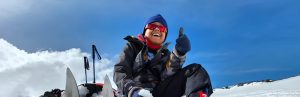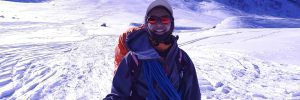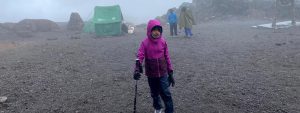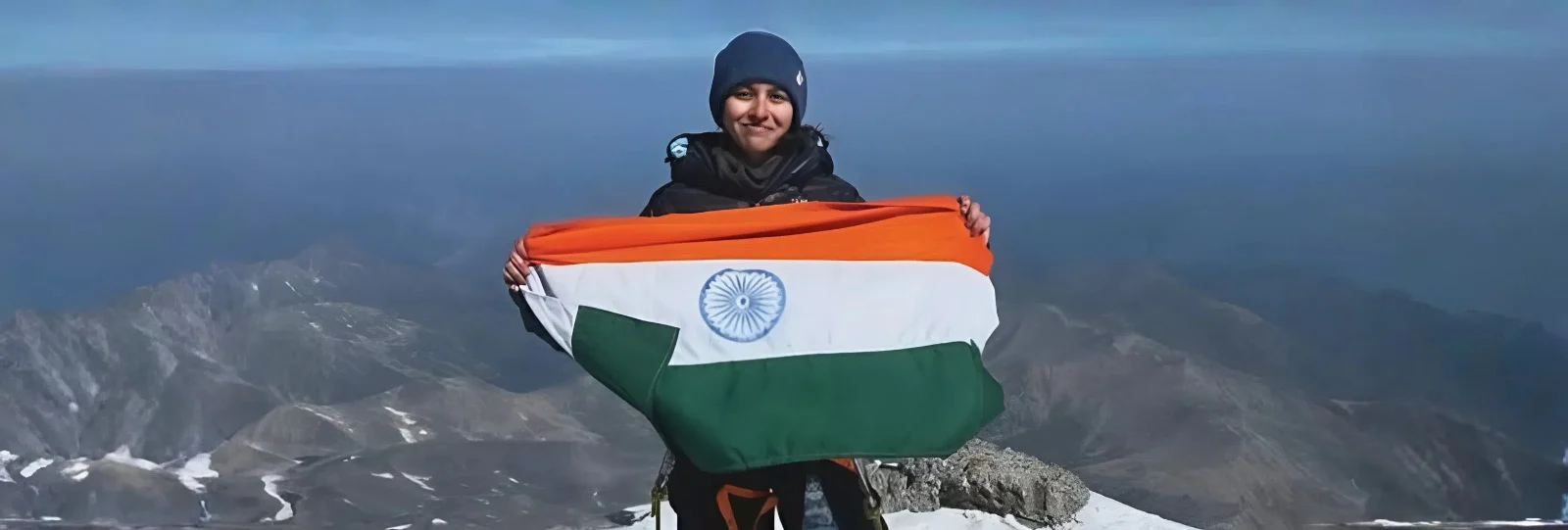


(Jun 6, 2026) Over the last few years, Saanika’s journey has taken her across some of the most iconic mountains in the world, including Mount Kilimanjaro (19,341 feet) in Tanzania, Mount Elbrus (18,510 feet) in Russia, Mount Aconcagua in Argentina (22,838 feet), and Mount Himlung Himal (7,126 metres) in Nepal. Conquering Mount Everest was the latest feather in her cap.
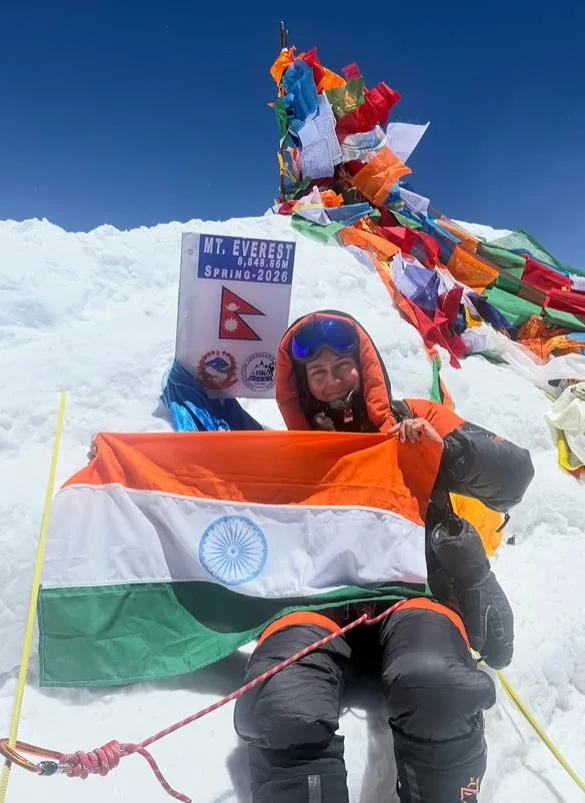
When young mountaineer Saanika Shah commenced her final ascent to the summit of Mount Everest in the early hours of May 20, the 12-hour journey to the top taught her lessons of a lifetime.
Having been stuck near the Hillary Step for almost three hours due to the massive traffic jam on the world’s highest peak, the freezing temperatures and unstable weather conditions gave her some anxious moments. When she finally resumed her onward journey, she spotted a frozen body along the route — the most emotional and frightening moment of her life.
Despite umpteen challenges during her nearly two-month expedition to Everest — including overcoming weakness and fatigue from her menstrual cycles twice — the gutsy youngster made it to the top of the world. “Everest changed me completely as a person. It taught me discipline, resilience, gratitude, and how powerful the human mind can become when driven by a dream,” smiles Saanika, in conversation with The Global Indian.
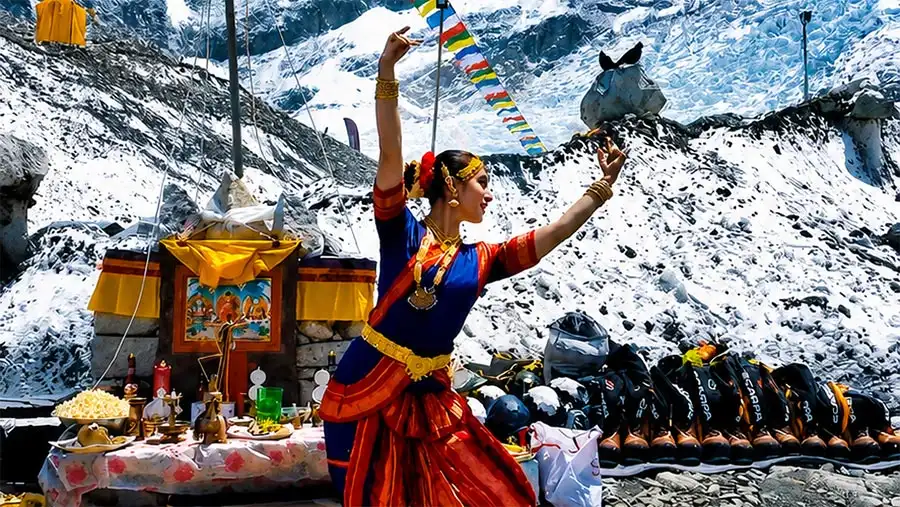
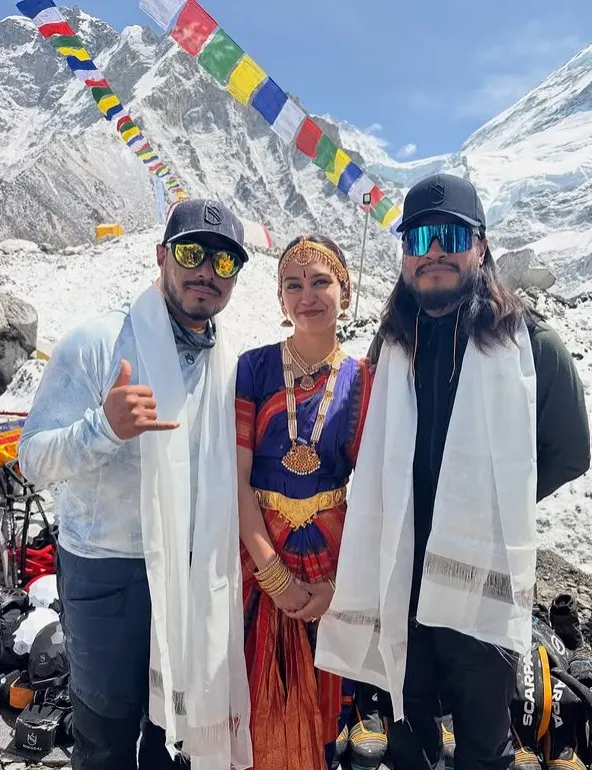
Interestingly, before she set out for Everest, Saanika invoked the blessings of Sagarmatha Devi, the mountain goddess, by performing Bharatanatyam at Everest Base Camp — perhaps the first such performance at an altitude of 5,300 metres.
Mount Everest
Mount Everest had been her dream for the past five years. “From the beginning of my mountaineering journey, every trek, climb, and training session was done with the goal of one day reaching Everest,” says the 22-year-old mountaineer, who had set 2026 as her target years ago.
She decided to prepare thoroughly and gain enough high-altitude experience before attempting to climb the world’s highest mountain. “I always believed Everest should be approached step by step, with patience and proper preparation,” says Saanika, whose birthday coincided with her Everest climb.
Technically demanding
Technically, she says Everest was extremely demanding, with sections involving rock, ice, and snow. “Every step required complete focus. This year, overcrowding on the mountain created long traffic jams as well.”
Another difficult part for Saanika was the descent. “I am very scared of heights, and seeing massive drops on both sides while descending in an exhausted state was mentally challenging.”
At that point, recalls Saanika, every single step mattered because her only goal was to return home safely to her family. “Seeing a frozen body made me realise how fragile human life can be in such extreme conditions.”
Since it is nearly a two-month-long expedition, both the body and mind are constantly under pressure, she says.
Prepping up
Her preparation happened gradually over the years. In 2023, she climbed 5,000-metre peaks, followed by 6,000-metre peaks in 2024, and then 7,000-metre expeditions, including Himlung Himal in Nepal.
The final six months before Everest were extremely intense, with training taking over completely. She would wake up at 3 am every day and go for long hikes that would continue till evening.
Consistency
On non-hiking days, she would go for runs or strength training in the morning, followed by another endurance session in the evening. “It was an intense lifestyle, but consistency was the biggest part of my preparation.”
Even rest days included some form of training. “Everest preparation was not just about physical fitness, but also about consistency and mental discipline — showing up every day even when exhausted.”
Her fitness routine revolved around endurance training, strength training, and long hiking sessions with weighted rucksacks. “Everest preparation was all about repeating the same things consistently until both the body and mind adapted to extreme conditions.”
It was a privilege to stand on the highest mountain in the world — something that once felt impossible. “The moment I saw the views from Everest Camp 2 and Camp 3, I realised those experiences were worth it,” says Saanika, describing it as one of the toughest experiences of her life.
Gratitude towards her coach
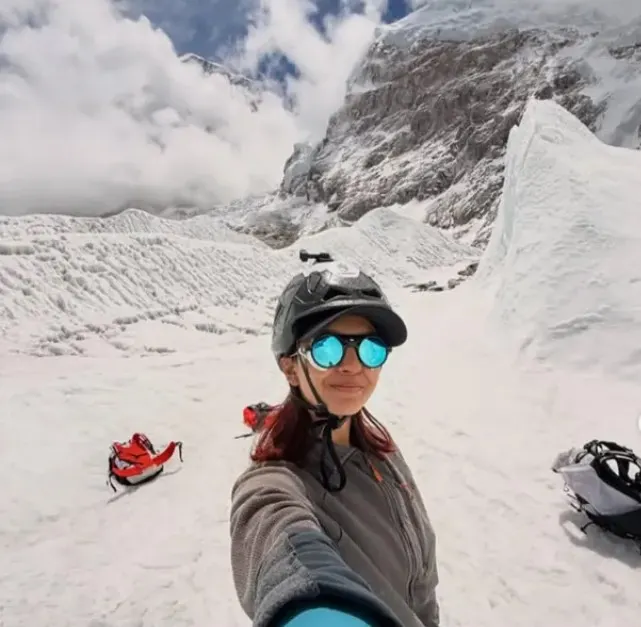
She credits her success to her coach Parth Upadhyay, who made her do long training hikes, sometimes without food or water, to prepare her body for real mountain conditions.
“On Everest, there are times when you climb continuously for hours without proper food or hydration, so this kind of training helped my body adapt physically and mentally,” says Saanika, who followed a balanced diet focusing on adequate protein, carbohydrates, and nutrients for muscle recovery after training.
At the same time, her coach believed in not being overly restrictive. After difficult hikes, there were days they would even eat burgers or vada pav. “His philosophy was that mountain conditions are unpredictable, and your body should be able to adapt to all kinds of food rather than only ‘perfect’ clean meals.”
Dance at base camp
Performing Bharatanatyam at base camp was not something spontaneous. “It was actually an idea my mother and I had spoken about for years,” says the passionate Bharatanatyam dancer, who started learning it at the age of four.
Her mother always told her that whenever she eventually went to Everest, she should offer a Bharatanatyam performance there as a tribute. “When I finally reached Base Camp, I knew I wanted to do it not as a performance, but as an offering and expression of devotion toward Sagarmatha Devi, the mountain goddess.”
View this post on Instagram
Puja ceremony
She performed the dance during the puja ceremony at Base Camp, a sacred tradition where climbers and Sherpas pray for safety and seek blessings from the mountain before the expedition begins.
“Even walking at Base Camp leaves you breathless because of the low oxygen levels, so dancing continuously for a few minutes on rocky terrain in traditional Bharatanatyam attire was physically very challenging,” says the dancer-mountaineer, who performed in freezing temperatures.
A unique moment
Most people there are dressed in heavy mountaineering gear, so seeing someone perform Bharatanatyam in full traditional costume against the backdrop of Everest became a very special moment for everyone present. For Saanika, it symbolised the coming together of the two worlds that define her most — Bharatanatyam and mountaineering.
“My Sherpas, teammates, and other climbers were fascinated — it was something very unique to witness at Everest Base Camp.”
Inspired by a movie
Saanika’s journey into mountaineering began on June 7, 2021 — a date she still remembers clearly. It was during the lockdown when she watched the film Everest, based on the true story of the 1996 Mount Everest disaster.
“That film completely changed something inside me. I was mesmerised by the world of mountaineering — the extreme conditions, the courage, the discipline, and the sheer power of the mountains.” For the first time in her life, she felt deeply connected to something she had never even considered before.
Growing up, the Shah family travelled a lot and Saanika always loved snow-covered mountains and nature. “But the idea of trekking or climbing professionally never crossed my mind until that moment. After watching Everest, I knew this was something I wanted to explore seriously.” From 2021 onwards, she began doing small treks in the Sahyadris, learning about hiking, endurance, survival, and mountain culture.
First trek
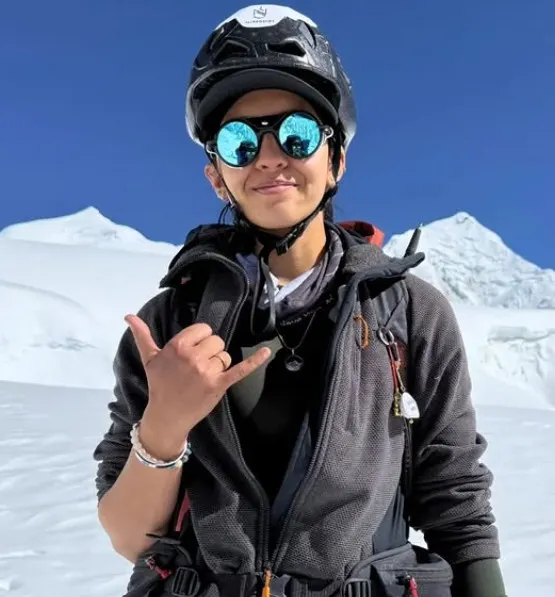
Her first-ever Himalayan trek was Patalsu Peak near Manali, at an altitude of approximately 13,900 feet. That climb became a turning point in her life. “The experience of walking through snow, pushing my body physically, and witnessing the mountains so closely made me realise that this was not just a hobby for me — it was something I truly wanted to pursue seriously.”
Kilimanjaro and Elbrus
More than trekking, Saanika realised she wanted to get into high-altitude mountaineering. She then climbed Mount Kilimanjaro in Tanzania, Africa’s highest peak, and Mount Elbrus in Russia, the highest mountain in Europe.
Both expeditions were life-changing in different ways. “Kilimanjaro taught me endurance and mental patience, while Elbrus introduced me to harsher alpine climbing conditions, snowstorms, and the technical realities of high-altitude climbing.”
Mount Aconcagua
Saanika also attempted Mount Aconcagua in Argentina, the highest mountain in South America at 6,961 metres (22,838 feet). Although she could not summit, the expedition became one of her biggest learning experiences.
“It taught me that mountaineering is not only about reaching the top, but also about respecting the mountain, understanding your limits, and growing through failures.”
In Nepal
One of the most special milestones in her climbing journey was Mount Himlung Himal in Nepal, a 7,126-metre peak. “Through this expedition, I became the youngest Indian and the first Indian woman to successfully climb the mountain.”
That achievement gave her immense confidence and strengthened her belief that age and background should never limit ambition. Apart from these international climbs, she undertook several expeditions across the Indian Himalayas and Nepal.
View this post on Instagram
Inspiration
Saanika’s biggest inspirations have always been world-renowned female mountaineers who achieved incredible things at a young age. “At the same time, my coach Parth Upadhyay has also been a huge inspiration in my life. There was once a time when I was only trying to connect with him for guidance, and today he is the person who trained me for Mount Everest.”
Mumbaikar
Born in Mumbai, Maharashtra, the 22-year-old was always extremely energetic and passionate about sports, performing arts, and physical activity.
Growing up, she played cricket seriously for nearly three years. “Sports were always a huge part of my personality and shaped my discipline and competitive spirit from a very young age,” says Saanika, who comes from a close-knit family of four — her parents and a younger sister, who is currently preparing for NEET.
Alongside sports, she was deeply connected to dance, music, and singing.
Bharatanatyam
She started learning Bharatanatyam at the age of four and continued training in it for almost 14 years. “Bharatanatyam became more than just a dance form for me — it taught me patience, discipline, expression, and emotional strength.”
Although her dance training slowed down during the lockdown, it still remains a very important part of her identity. “Bharatanatyam has shaped me deeply as a person, and performing arts continue to remain very close to my heart.”
Big dreams
At different stages of life, she dreamt of becoming a pilot, a psychologist, or even an architect. “I always had big dreams, but I took time figuring out exactly what I truly wanted from life,” says the dancer-mountaineer.
Along with mountaineering, acting and dance have always been a major part of Saanika’s life. She graduated from film school. “Theatre, acting, dance, and storytelling are things I deeply connect with creatively.”
One of her biggest dreams is to bring the world of mountaineering into Indian cinema and mainstream storytelling. “I want people to see the real side of the mountains — not just the beautiful pictures, but also the struggle, discipline, survival, and emotional journey behind every climb,” says Saanika, who would love to work in sports-based films, adventure storytelling, and projects that combine cinema with mountaineering.
Mountaineering and singing
At the same time, she intends to continue her mountaineering journey. “Climbing Everest is not the end for me — it is only the beginning of much bigger dreams ahead.”
Saanika loves watching films, listening to music, and singing. “Singing is something I genuinely enjoy and connect with emotionally,” adds Saanika.
- Follow Saanika Shah on Instagram
ALSO READ: Poorna Malavath: Indian mountaineer conquering the summits of seven continents