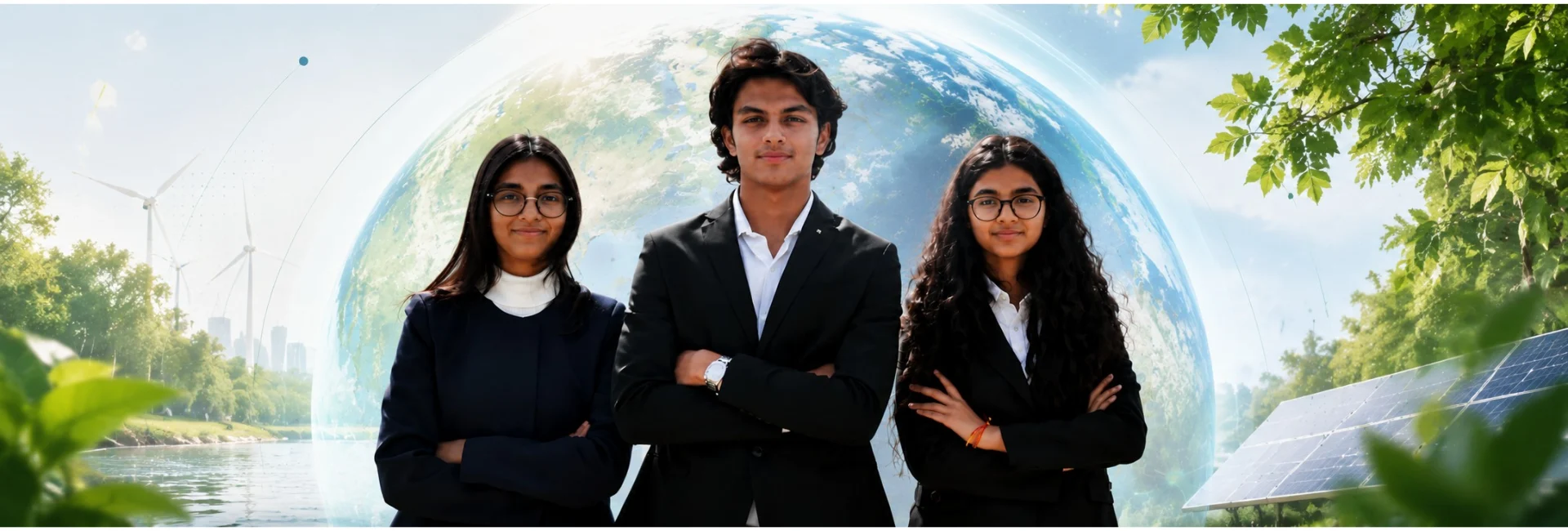


(May 22, 2026) Sixteen-year-olds Avyana Mehta, Vivaan Chhawchharia and Ariana Agarwal have been named Asia Winners of The Earth Prize 2026 for developing Plas-Stick, a solution that uses powder of waste tamarind seeds to bind microplastics into visible clumps that can be removed from water using a handheld magnet.
“We realised this was not merely a ‘science topic’, but an access problem,” the trio told The Global Indian, recalling the moment that sparked the idea for Plas-Stick.
The Earth Prize is one of the world’s largest environmental competition and ideas incubator for teenagers aged 13 to 19, organised by The Earth Foundation, a non profit organisation based in Geneva, Switzerland. It empowers young people through mentorship and a total funding pool of $100,000. Seven regional winners from North America, Africa, Asia, Central and South America, Oceania and Southeast Asia, Europe, and the Middle East have been announced, with each team receiving $12,500 to develop and implement their idea for real world impact. A public vote is open to determine the Global Winner on 29 May.
Avyana, Vivaan and Ariana’s innovation addresses one of the world’s fastest growing environmental concerns, microplastic contamination in drinking water. What began as a classroom discussion on environmental science has now evolved into a globally recognised clean water initiative reaching thousands of students across Rajasthan.
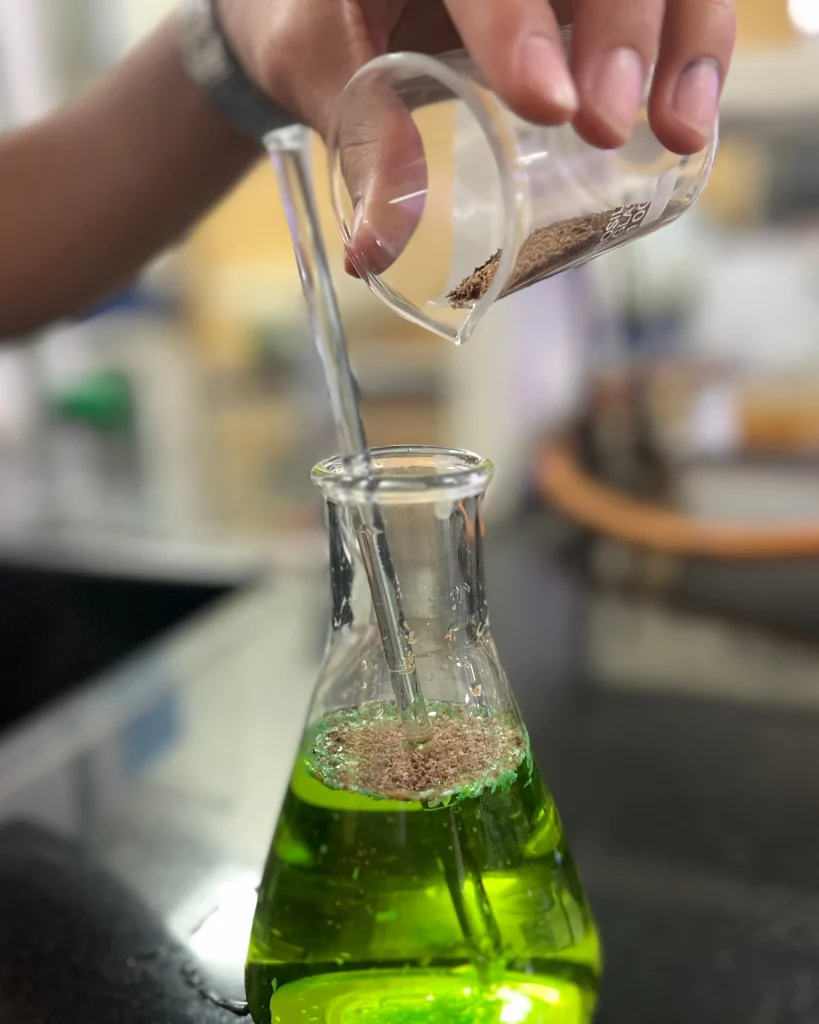
A demonstration of Plas-Stick: Tamarind-based powder added to water dyed green to show its dispersion
The people who saw it from the beginning
For the three students, one of the most emotional parts of winning the Earth Prize was seeing the reactions of the people who had witnessed the journey from its earliest stages.
Avyana said many around them were initially shocked because the project had started from such a small idea before gradually becoming something much larger. What made the moment especially meaningful for her was seeing people recognise how the solution could change conversations around potable water.
This project started from a very small idea and slowly but surely became something much bigger
Avyana Mehta
Vivaan described the reactions from teachers and family members as deeply emotional because they had seen Plas-Stick evolve from an uncertain early concept into an internationally recognised innovation.
My teachers and family were honestly very emotional and proud, because they had seen the project from its earliest stage.
Vivaan Chhawchharia
Ariana said their parents were extremely proud and excited to see them representing India on a global platform. She added that many teachers had followed the project closely from the beginning and had watched the trio balance school with months of research, testing, outreach, and presentations.
It felt so rewarding for them to see their children represent their nation on a global stage.
Ariana Agarwal
The moment that sparked the idea
The team first encountered microplastics through their environmental science and chemistry classes, but the issue became deeply personal during a visit to a rural school for an entirely separate project. There, they watched a child drinking from a shared water container, unaware that invisible microplastics could already be present in the water.
The trio knew the risks. He did not. That moment fundamentally shifted how they viewed the issue.
“We realised this was not merely a ‘science topic’, but an access problem,” they said. “That sparked the idea of Plas-Stick.” Instead of building expensive filtration systems dependent on advanced infrastructure, the students decided to create something rural communities could realistically access and use.
Why tamarind seeds?
The choice of tamarind seeds was deliberate rather than accidental. The team had already established a clear goal to develop a solution that was affordable, simple, and usable without expensive filters.
“We already knew the problem rural communities were facing and had a clear end goal,” they said. Their search eventually led them to tamarind seeds, often discarded as agricultural waste despite possessing natural binding properties. “What we needed was a material that was cheap and readily available enough to actually execute that idea,” they said. “Once we tested them, they became the base of Plas-Stick.”
Months of testing and failure
Turning the concept into a functioning solution required months of experimentation, setbacks, and repeated refinement. “It took us about three to four months to develop the first working version,” they said. “We started with a rough idea, then kept testing, failing, adjusting the material, and trying again.”
A major breakthrough came when the students cold emailed a materials scientist and IIT graduate for guidance. “We cold mailed a material scientist, an IIT graduate, who mentored us through the process, especially when we had to understand whether the chemistry was actually reliable,” they said.
That mentorship helped transform Plas-Stick from a classroom concept into a solution that could realistically be tested in water systems.
Validation from IIT Guwahati
As the project grew, scientific validation became just as important as the idea itself. Their mentorship journey eventually evolved into a collaboration connected to Indian Institute of Technology Guwahati.
“Our connection to IIT Guwahati began with a cold email,” they said. “We reached out to an IIT G graduate working in materials research, hoping for guidance on our early formulation.” The collaboration later resulted in a Letter of Endorsement from the Udgam Incubation Centre at IIT Guwahati, formally recognising Plas-Stick as a credible innovation.
A simple process for a complex problem
The students intentionally designed Plas-Stick to remain practical for communities with limited infrastructure. The powder is added to water and stirred evenly. Within about 30 minutes, the microplastic particles begin binding together into larger visible clumps that can then be extracted using a handheld magnet.
In the team’s words, the process is simple. “Add the powder, stir, wait, and remove the clumped microplastics.”
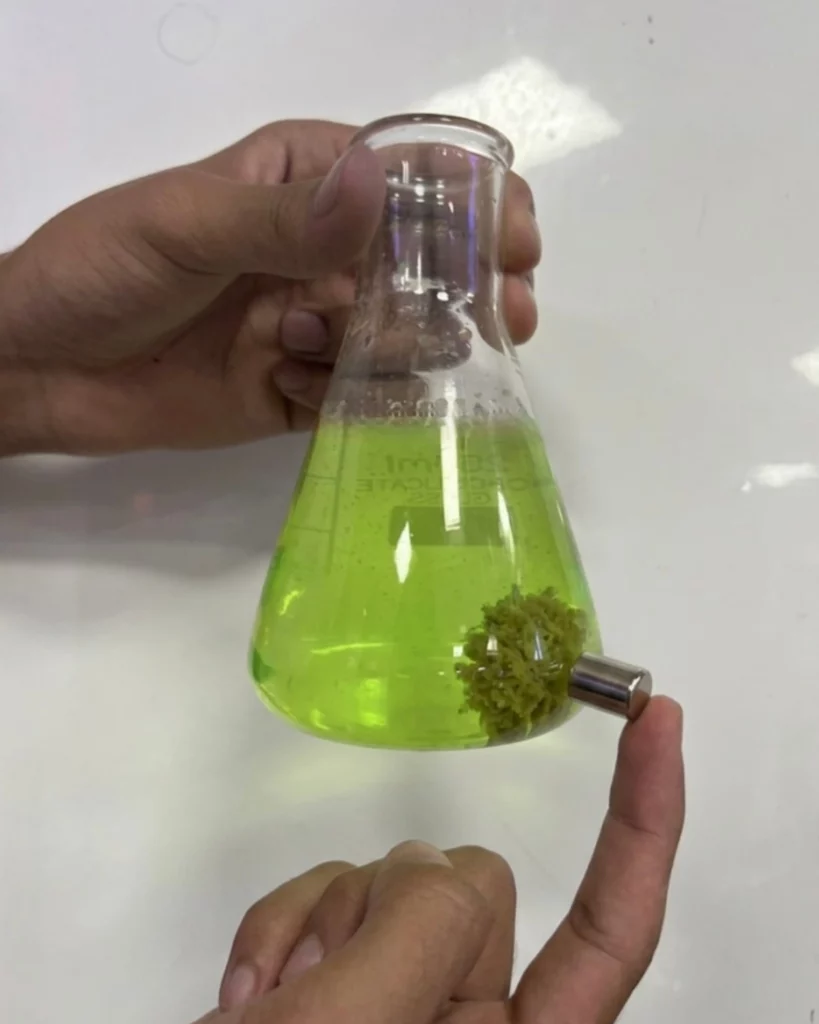
Demonstration: The handheld magnet drawing out clumped microplastics
Taking the idea beyond the laboratory
The project’s impact expanded through extensive grassroots outreach across schools in Rajasthan. The students began in Mahapura before gradually expanding into Jhunjhunu and Churu districts. Support from local leadership proved critical in helping communities trust the initiative.
“The turning point in each district was getting recognition from local leadership, the District Collector in Jhunjhunu and the Education Minister in Churu,” they said. “Once they backed us, schools became far more willing to open their doors.”
The team placed trust at the centre of every interaction. Students were shown live demonstrations where they could literally watch microplastic clumps being lifted from their drinking water. Community sessions with parents and teachers focused on explaining how the powder worked, why it was safe, and what happened to the recovered material afterwards.
“Each school then became a reference point for the next, and the outreach grew organically from there,” they said. So far, the students have educated nearly 8,000 students and teachers.
Hearing the news
When news of the Earth Prize win arrived, the students said it initially felt surreal. “Honestly, it didn’t fully sink in at first,” they said. “We had been working on Plas-Stick for so long, through formulation problems, school visits that required re explaining the process from scratch, and long nights revising the research paper, that winning felt almost abstract when we first heard.”
But their thoughts quickly shifted away from the prize itself and toward the communities they hoped to reach next. “The first thing we found ourselves talking about wasn’t the prize itself but the schools we’d been waiting to reach,” they said.
For the trio, the recognition represented possibility more than celebration. “The recognition matters enormously,” they said, “but what it really means for us is that the next set of deployment sites is no longer hypothetical.”
How they plan to use the prize money
The $12,500 prize funding will now support the expansion of Plas Stick beyond its current six pilot sites in Rajasthan. The first priority is independent third party microplastic validation, approximately $7,000 annually, across new geographies to confirm that the reported 90 percent removal efficiency remains consistent under different water conditions.
“This is what unlocks larger institutional and CSR partnerships,” the trio said. The second priority is establishing two decentralised micro production hubs at a combined cost of around $9,000. These hubs would allow the powder to be manufactured near deployment sites rather than shipped from a single location, reducing logistics costs and making each centre regionally self sufficient.
The remaining funding will support training kits, neodymium magnets, multilingual instruction charts, operator training, transport, and post treatment systems that safely route recovered microplastic aggregates to EcoRi for conversion into composite tiles and coasters.
By the end of 2026, the team hopes to expand from 8,000 users to nearly 40,000 users, while laying the groundwork for a larger 2027 expansion.
Life beyond Plas-Stick
Outside the project, all three students remain deeply engaged in sustainability, economics, leadership, and social impact initiatives.
Avyana runs an international non profit called Plastic2Build and hosts Sustainify360, a podcast focused on environmental science and sustainability conversations. Ariana explores the economics of sustainability through her initiative, the Informal Economy Index, and also manages sustainable finance for Biz for Her, a women’s empowerment platform. She said the work “helps me understand the complexities of the world.” Vivaan’s interests span golf, basketball, economics and finance research, Model United Nations, public speaking, and volunteering, where he enjoys connecting academic learning with community impact.
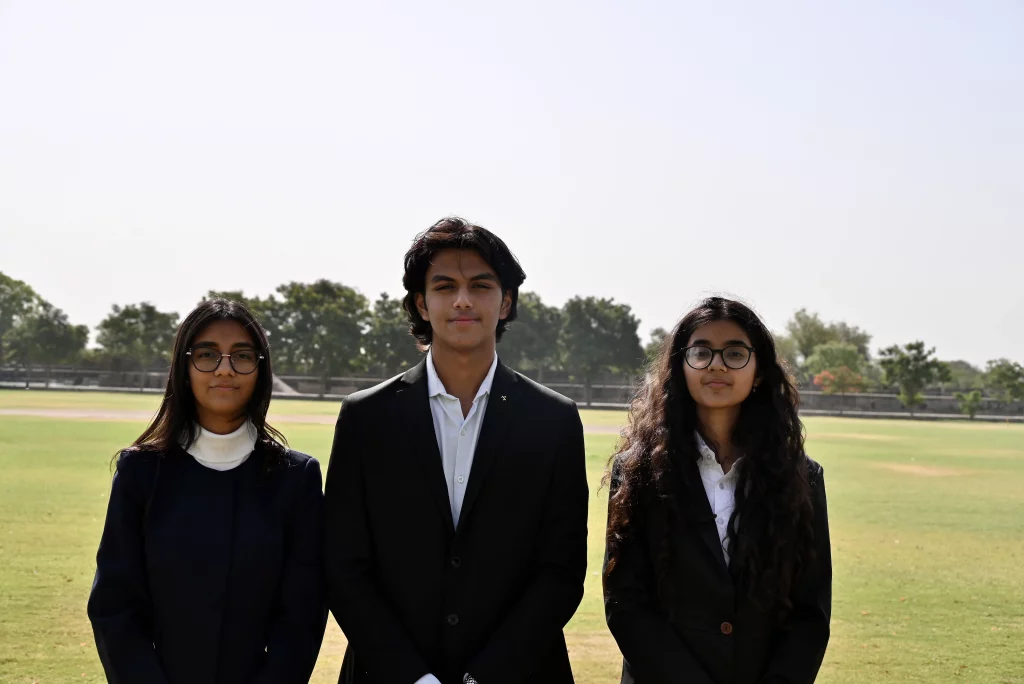
Team Plas-Stick: Avyana Mehta, Vivaan Chhawchharia, Ariana Agarwal
Looking toward the future
Even as Plas-Stick continues to grow, the students said the experience has already shaped how they see their futures. Avyana hopes to continue working in environmental science, policy making, and social governance, particularly in communities that are often overlooked in global sustainability conversations.
I see myself continuing to build initiatives which address social and environmental problems in communities that are usually ignored in global conversations.
Avyana Mehta
Vivaan hopes to study economics, finance, and sustainability before eventually working at the intersection of business and environmental impact.
In the future, I want to work on projects that use finance and entrepreneurship to make sustainable solutions scalable, especially for communities that usually get left behind.
Vivaan Chhawchharia
Ariana hopes to work at the intersection of green finance and economics. She said her experience with Plas-Stick showed her how innovative solutions often struggle to scale because of financial barriers, something she hopes to help address in rural communities in India and abroad.
I hope to bring that knowledge to other rural communities in India and abroad
Ariana Agarwal
What began with three teenagers questioning what might be hidden inside a glass of water has now become a scalable environmental innovation with the potential to reach tens of thousands of people, built not in a corporate laboratory, but from discarded tamarind seeds, persistence, and the belief that meaningful science should remain accessible to the communities that need it most.
- Follow Avyana Mehta, Vivaan Chhawchharia and Ariana Agarwal on LinkedIn
ALSO READ: A Thirst for Change: The Grey Water Project by Shreya Ramachandran