


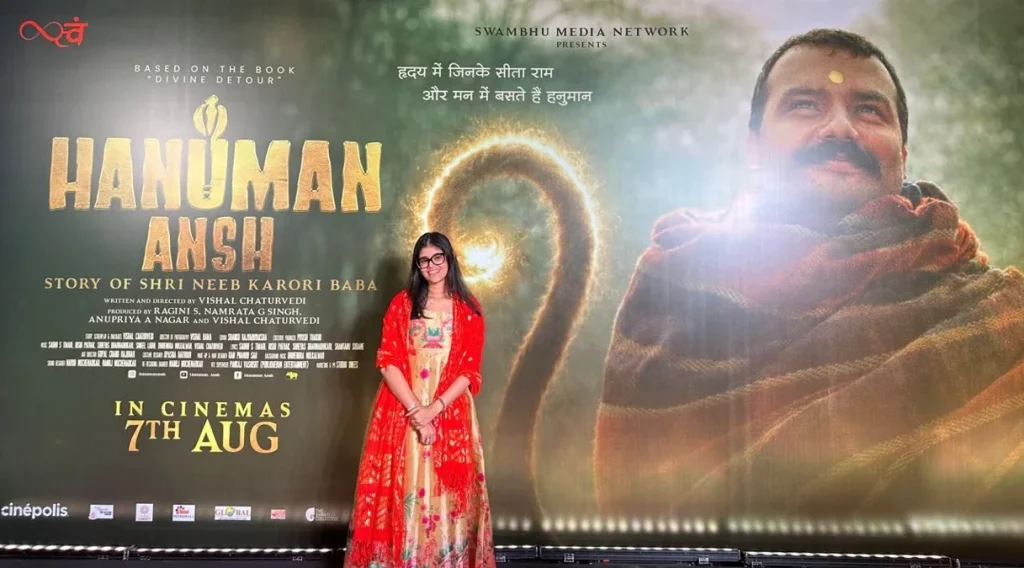
(Sep 6, 2026) The movie Hanuman Ansh, released pan-India and inspired by the life of Neem Karoli Baba, the revered mystic saint, did not begin as a conventional film project. During her final year at the University of Bath, while taking a module in investment banking, Anupriya Nagar came across an Economic Times article about the saint’s reported influence on Steve Jobs.
“During my final year is when I was doing this module investment in banking… and that’s when I came across an article in Economic Times which said that Neem Karoli Baba is actually the one who inspired Steve Jobs to go on and make Apple,” she recalled in a podcast with London-based entrepreneur and thought leader Dinis Guarda.
What followed eventually became Hanuman Ansh, her debut film, made on a shoestring budget of around ₹1.75–2 crore. Within 30 days of release, the film crossed the ₹100 crore mark in Indian net collections, turning a project that began with a university assignment and a newspaper article into one of the year’s most striking low-budget box-office successes and making Anupriya one of Indian cinema’s most unlikely breakout producers.
Now based between Mumbai and London, Anupriya sees the film’s success as less a business triumph than the fulfilment of what she describes as a calling. That sense of purpose extends to how she is taking Hanuman Ansh to younger audiences. Ahead of its release, the makers organised a special screening in Mumbai for underprivileged children and their parents from the Angel Xpress Foundation.
In the UK, Anupriya says she has reached more than 65 schools and universities as part of her effort to take the film’s message directly to young people. Before the release of the film the young producer also got an opportunity to speak at the House of Lords in the UK, where she shared her journey as an international student and filmmaker, encouraging young people to connect cultures.
View this post on Instagram
From economics to cinema
Born and raised in Mumbai, Anupriya grew up in what she calls the heart of Bollywood. She studied at Arya Vidya Mandir before pursuing a Bachelor of Science in Economics at the University of Bath between 2022 and 2025. Her coursework included advanced microeconomics and macroeconomics, econometrics, international trade, investment and trading, and development economics.
She was also an art collector from a young age, having shown work in her first group exhibition at 12, and went on to lead the art and dance societies at university while serving in outreach roles for Bath’s Women in Business Society.
Living in the UK sharpened rather than diluted her connection to India. She found a small Indian community temple in Bath and began attending during festivals such as Diwali and Holi. “You can take the girl out of India but not India out of the girl,” she remarked, describing how those visits became a kind of anchor during her academic years abroad.
From research to the film set
The Economic Times article led Anupriya into deeper research on Neem Karoli Baba, his reported connection with Steve Jobs and Kainchi Dham. Her research eventually brought her together with Namrata G Singh, Ragini Sona and writer-director Vishal Chaturvedi. The team spent about a year researching Baba’s life and legacy, visiting places associated with him and speaking to people who had known him.
Production took them to Chitrakoot, where the team undertook a 43-day recitation of the Hanuman Chalisa before filming. During production, Anupriya visited Kainchi Dham twice within two months. That deepened her connection to the project, while her role as producer extended to shaping its creative direction and tone. Hanuman Ansh was produced by Anupriya Nagar, Namrata G Singh, Ragini Sona and Vishal Chaturvedi under the Swambhu Media Network banner. The roughly ₹2 crore financing structure has not been publicly disclosed.
The team kept the visual treatment restrained, using VFX in only two or three scenes and choosing not to train AI systems on the film’s material.
The soundtrack features 10 original songs, including two chants by American vocalist Krishna Das. Early screenings for corporate professionals, teachers and children also reinforced Anupriya’s belief that the film’s emotional core could connect across generations. “They all have already choked up in the first ten minutes,” she says.
Reaching a generation raised on screens
Anupriya has been explicit that the film’s intended audience is not devotees alone but her own generation, including those younger than her.
“This film is not just about spirituality, but it also has something to do with teachings and the relationships between two friends, or a teacher and a student,” she says, describing the emotional core she wants audiences outside India to connect with as much as those within it.
That ambition has shaped her outreach. In India, the makers held a special Friendship Day screening in Mumbai on August 2 for underprivileged children and their parents from the Angel Xpress Foundation, ahead of the film’s theatrical release. The children responded to the film’s themes of humility, compassion and service, according to the organisers.
In the UK, Anupriya says she has reached more than 65 schools and universities, with the aim of speaking to young people “one on one”. She says she believes word of mouth, rather than social media, can carry the film further.
“It’s very easy to grasp the entire world just from one screen, but to actually reflect is becoming a difficult task for our generation,” she says.
For Anupriya, the film’s message of service and inner stillness also intersects with contemporary conversations around wellness and mental health. But her larger ambition is to make a spiritual story accessible to audiences who may not ordinarily approach it as devotional cinema.
That approach appears to have found an audience. The film opened with roughly 355 shows, but growing word of mouth led exhibitors to expand its footprint substantially. By the time it reached its later weeks, reports said its screen count had risen to around 1,500, with PVR INOX also adding shows as audience demand continued.
Its Indian net collections crossed ₹100 crore within 30 days of release, turning a modestly budgeted debut into an extraordinary theatrical success.
What comes after Hanuman Ansh
Hanuman Ansh is the first instalment of a planned trilogy, and Anupriya says she is already committed to the next two films over the coming two to three years.
Despite her economics training and the film’s striking commercial performance, she frames success in terms distinct from box-office numbers. “My entire focus actually is that if even there is one new person who knows about Baba who can at least take back one thing from the film, I think that is my return,” she says.
She adds that she is already being drawn towards further untold stories of Indian figures whose lives, she believes, deserve a wider audience. For someone whose journey into filmmaking began with a line in a newspaper article encountered during an investment banking module, the next story may once again begin with a life that she feels is waiting to be discovered.