November 10 2026
Suella Braverman: The Indian-origin British politician who says she is not English

(Nov 10, 2026) Born in Britain to parents of Indian heritage, Suella Braverman rose from a legal career to become a prominent politician, serving in senior positions in the Conservative Party, including as Home Secretary. Now a Reform UK MP, her views on immigration, citizenship and English identity have brought renewed attention to the family history and political journey behind her rise.
“As I’ve said before, I’m not English.”
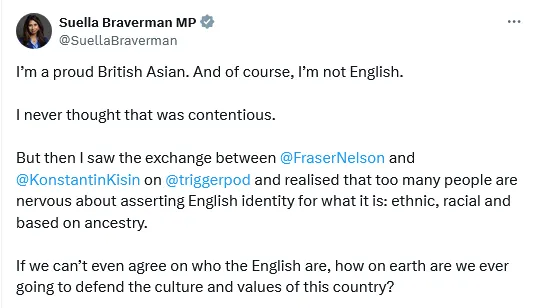
When Suella Braverman posted these words on X on September 22, 2026, she was revisiting a question that had become central to her public identity. The former British home secretary, who was born in England, speaks English, supports the England football team and says she loves the country and its people, nevertheless draws a distinction between being British and being English.
“I’m proud to be British,” she wrote, adding that her family and ancestors had a link to Britain spanning centuries. But, she insisted, “in no way are we English.”
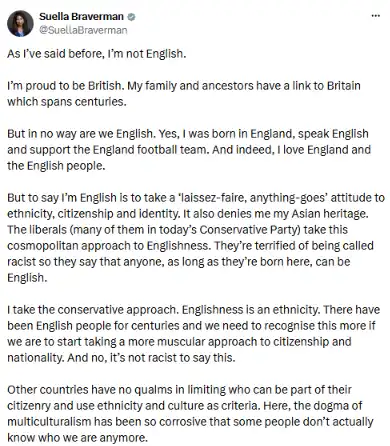
Braverman’s argument rests on her belief that Englishness is an ethnicity, rooted in ancestry and heritage rather than simply birthplace, language or citizenship. The remarks were a response to a video shared by former Conservative MP Jacob Rees-Mogg, who had argued that people could identify as English or British regardless of ethnicity. Braverman’s intervention, posted while she was a Reform UK MP, reopened a debate that she had first entered publicly in February 2025.
On October 1, 2026, she elaborated on her position on BBC Question Time. Asked about her English origins, she referred to her parents and grandparents having been born elsewhere. The discussion grew contentious when audience members and fellow panellist Oli Dugmore challenged her argument, with Dugmore describing its implications as racist. Braverman rejected the accusation, questioning how she could be racist against herself.
The debate brought into focus a politician whose views on immigration and national identity have long been among the defining features of her career. It also drew attention to a family history that began far beyond Britain’s shores.
From Indian roots to a British upbringing
Born Sue-Ellen Cassiana Fernandes on April 3, 1980, in Harrow, north-west London, Braverman grew up in Wembley. Her parents, Uma and Christie Fernandes, were both of Indian origin, though they arrived in Britain from different parts of the former British empire.
Her mother, Uma, came from a Hindu Tamil family in Mauritius. She moved to Britain in the 1960s and worked as a nurse in the National Health Service for decades. Her father, Christie, was of Goan Christian heritage and had migrated from Kenya. He worked for a housing association.
Braverman has often spoken about her parents’ experience of arriving in Britain with little and building their lives through work and community involvement. Her mother was also active in local politics, serving as a Conservative councillor in Brent for 16 years. Her father was involved in community campaigning.
The family’s experience of migration and settlement has featured prominently in Braverman’s own political narrative. She has presented her parents’ journey as one of legal migration, hard work and gratitude to Britain, while arguing that contemporary immigration should be governed by stricter rules.
My parents came here through legal and controlled migration.
Suella Braverman
Her upbringing was shaped by a strong Conservative outlook. Her mother’s political involvement brought Braverman into contact with the party from an early age, and she developed an interest in politics while still a student.
She attended Heathfield School in Pinner on a partial scholarship before moving to Queens’ College, Cambridge, to study law. At Cambridge, she became president of the university’s Conservative Association, an early indication of the political ambitions that would later take her to Westminster.
She subsequently pursued a master’s degree in European and French law at the University of Paris 1 Panthéon-Sorbonne, studying in France through a European exchange programme. She also qualified as a New York attorney.
A lawyer before Westminster
Braverman was called to the Bar in England in 2005. Her legal practice focused on public law and judicial review, including matters relating to planning, housing and immigration.
She served on the Attorney General’s Panel of Treasury Counsel from 2010 to 2015, representing government departments in legal proceedings. Her work included cases involving the Home Office, the Parole Board and the Ministry of Defence. The experience provided her with an understanding of government, legal institutions and the limits of executive power. These subjects would later become central to her political career, particularly her arguments over immigration enforcement and the role of the European Convention on Human Rights.
Her political ambitions, meanwhile, were not new. In 2005, she contested Leicester East as a Conservative candidate but lost to Labour’s Keith Vaz. A decade later, she entered Parliament.
Brexit and the rise of a Conservative lawmaker
Braverman was elected MP for Fareham in Hampshire in May 2015. She aligned herself with the Conservative Party’s strongly pro-Brexit wing, becoming associated with the European Research Group, a grouping of Conservative MPs advocating the United Kingdom’s departure from the European Union.
Her position on Brexit helped shape her political trajectory. She opposed Theresa May’s withdrawal agreement and was among the Conservative MPs who pressed for a more decisive break with the European Union.
In January 2018, she was appointed Parliamentary Under-Secretary of State at the Department for Exiting the European Union under May. The role placed her within the government’s Brexit machinery at a time when negotiations and parliamentary divisions were dominating British politics. She was subsequently appointed Attorney General for England and Wales in February 2020 under Boris Johnson. The appointment made her the government’s chief legal adviser and brought her into the Cabinet.
Braverman’s career also included a personal milestone. She married Rael Braverman in February 2018, and the couple have two children. In 2021, she remained a Cabinet minister while on maternity leave, following a change in parliamentary rules that allowed ministers to take maternity leave without relinquishing their positions. Her rise continued as the Conservative Party went through a succession of prime ministers and internal divisions.
The home secretary and the politics of immigration
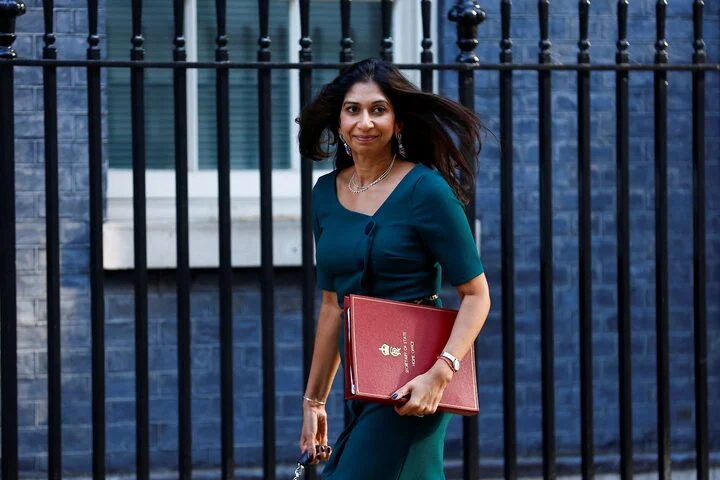
Braverman’s appointment as home secretary in September 2022, under Liz Truss, marked her arrival at one of the most powerful positions in British government. She retained the office under Rishi Sunak, returning to it in October 2022 after a brief resignation.
As home secretary, she placed immigration enforcement at the centre of her political agenda. She supported the government’s plan to send some asylum seekers arriving in the UK to Rwanda, a policy that faced legal challenges and widespread criticism. She also advocated stronger border controls and a more restrictive approach to asylum. Her rhetoric, particularly on migration, made her a prominent figure on the Conservative right.
Braverman’s time as Home Secretary included two significant departures from the role. In October 2022, she resigned from the Truss government after sending an official document from her personal email account to another Conservative MP, an action that went against ministerial rules. She returned to the Home Office under Rishi Sunak later that year.
In November 2023, Sunak removed her from the post following differences within the government over the handling of policing and protests. A letter she had written criticising the police response to pro-Palestinian demonstrations had not been cleared by Downing Street. Some of her comments on homelessness and migration had also drawn public criticism.
Her departure did not diminish her influence among Conservative MPs and voters who favoured a tougher approach to immigration. Instead, it reinforced her reputation as a politician willing to confront her own party over issues she considered fundamental.
A leadership contender and a party in crisis
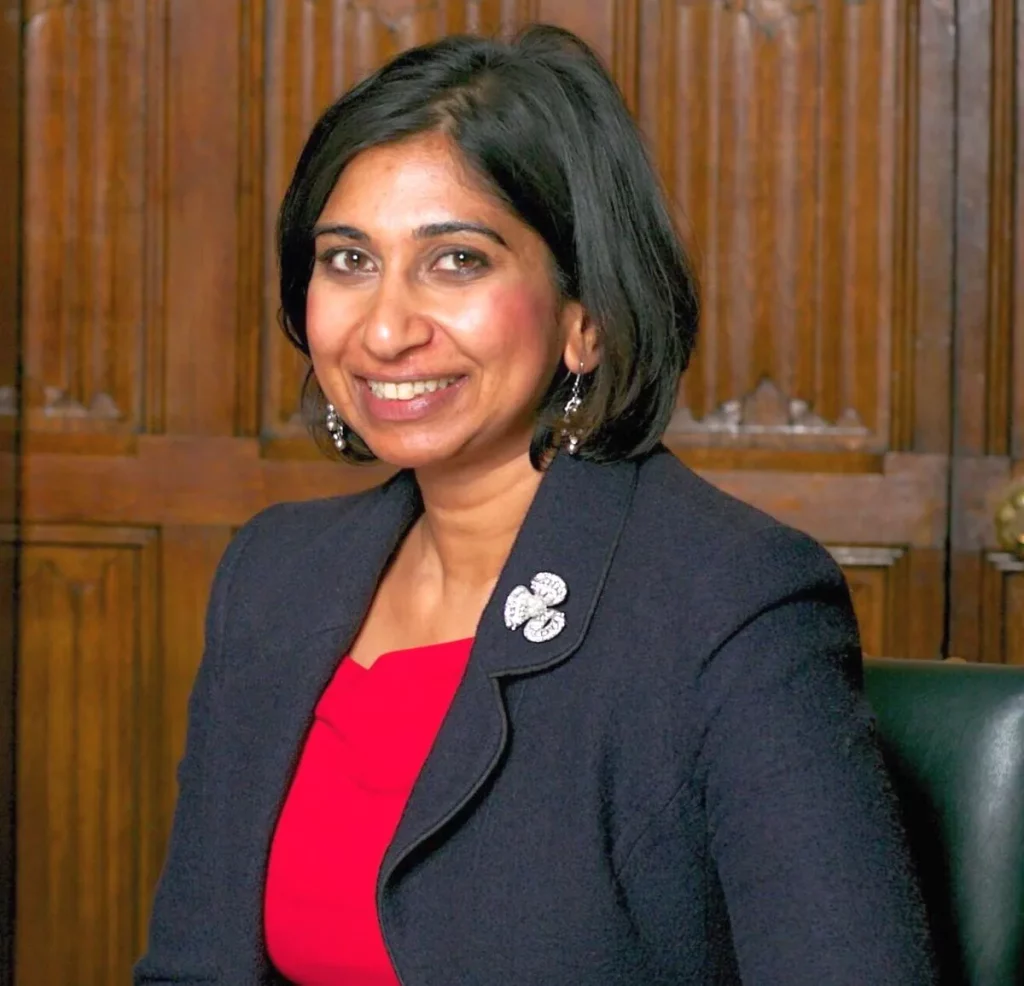
Braverman entered the Conservative leadership contest in July 2022, following Boris Johnson’s announcement that he would step down. She was eliminated in the second round of voting among Conservative MPs, later backing Liz Truss, who went on to become prime minister.
The contest gave Braverman a platform to articulate her positions on Brexit, immigration and the role of the state. It also established her as a potential future leadership figure within the party.
However, the Conservative Party’s electoral defeat in the 2024 general election and its subsequent internal divisions changed the political landscape. Braverman remained an MP, winning re-election in the newly configured Fareham and Waterlooville constituency. Her relationship with the party leadership increasingly became defined by disagreements over immigration, the European Convention on Human Rights and the government’s record.
From the Conservatives to Reform UK
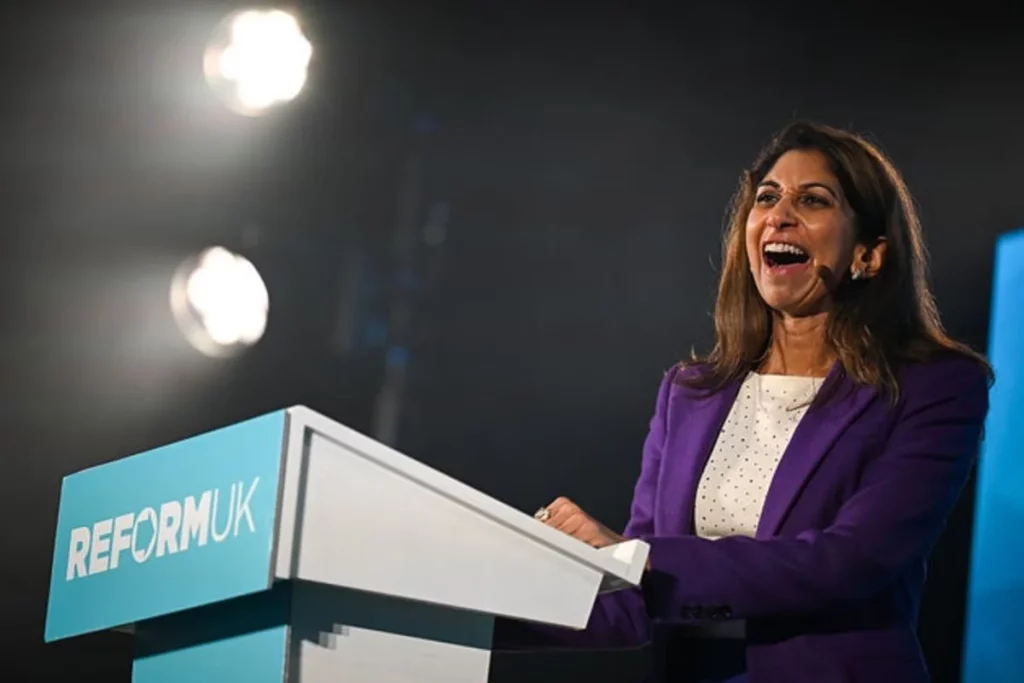
In January, 2026, Braverman left the Conservative Party and joined Reform UK, led by Nigel Farage.
She had been a Conservative for approximately three decades, but said she no longer trusted the party to deliver on its promises. At the announcement of her defection, she described herself as having been politically homeless for nearly two years. Braverman argued that the Conservatives had failed to address immigration and had broken promises on Brexit and border control. She said she had felt constrained within the party and believed Reform UK offered a more consistent political direction.
Her move followed other high-profile Conservative defections and added a former home secretary to Reform’s parliamentary ranks. She became the party’s spokesperson for Education, Skills and Equalities.
It does not matter where people start in life, what their parents did or how wealthy their family is—people can achieve their dreams and improve their life through their own endeavours, dedication and an attitude of service and community.
Suella Braverman
British, but not English
Braverman’s September 2026 statement on Englishness was not an isolated intervention. In February 2025, she had published an article titled I will never truly be English: here is why, arguing that English identity should be understood through ancestry, heritage and ethnicity.
The argument was controversial, particularly because Braverman herself was born and raised in England. Critics questioned whether her position excluded people of immigrant heritage from identifying as English, while Braverman maintained that she was describing her own identity and defending the distinctiveness of Englishness.
Her comments also drew attention to the distinction between British and English identity, a subject that has become increasingly prominent in political debates over migration and citizenship.
For Braverman, Britishness is a national identity she embraces, while Englishness is an ethnic identity she says she does not possess. Her position reflects her own understanding of her family history, though it has prompted wider questions about how national identity is defined in a country shaped by centuries of migration.
Her political journey has brought her from the legal profession to the highest levels of government, from the Conservative Party to Reform UK, and from Brexit debates to arguments over the meaning of Englishness.
At each stage, immigration and national identity have remained central to her politics. The September 2026 statement brought those themes together in a way that was both personal and political, placing her own heritage at the heart of a debate about who belongs in Britain.
For Braverman, the distinction between being British and being English is not merely a matter of terminology. It is a question of ancestry, identity and the relationship between a country and those who make it their home.
- Follow Suella Braverman on X and Facebook
- ALSO READ: Kanishka Narayan: The Bihar-born British MP helping shape the United Kingdom’s AI future



Written By: Amrita Priya