October 06 2026
Swami Sarvapriyananda: The monk Anthropic invited to discuss AI ethics

(Oct 6, 2026) The New York-based Hindu monk Swami Sarvapriyananda was invited by Anthropic to discuss AI ethics, morality and consciousness, bringing centuries-old questions from Vedanta into a conversation about the future of artificial intelligence.
Speaking at a public talk at Unity of Dallas, a spiritual centre in North Dallas, in June 2026, Swami Sarvapriyananda shared with the audience how he came to be invited to Anthropic‘s headquarters in San Francisco earlier this year. The video of the talk is being widely shared on social media, bringing attention to Anthropic’s outreach to religious thinkers on AI ethics.
The AI company had first contacted him for an online conversation before inviting him to its headquarters. Recalling the exchange, he said, “So online, I was interviewed, not for a job.” The audience laughed. He then recalled, “And then they said, ‘Would you be willing to come to our headquarters in San Francisco? We want to speak with you.’ I said, ‘All right, I’ll come.’”
What followed was a gathering, with Sarvapriyananda meeting theologians from different religions, counsellors and mental health professionals, as Anthropic explored questions around artificial intelligence, ethics and morality.
Much of what he saw and discussed remains confidential because he signed a non-disclosure agreement. But the encounter placed an Indian monk from the Ramakrishna Order in an unusual setting: a Silicon Valley company working at the frontier of artificial intelligence, trying to think through what increasingly capable machines could mean for humanity.
For Sarvapriyananda, the questions were not entirely unfamiliar. Much of his life’s work has centred on the nature of the self, consciousness and reality through the lens of Advaita Vedanta, the philosophical tradition within Hinduism that explores the relationship between the individual self and ultimate reality. These questions have also taken him into conversations with philosophers, scientists and academics in the US and beyond.
Now, they have brought him into a conversation about Claude, Anthropic’s artificial intelligence system.
View this post on Instagram
From Bhubaneswar to a life of renunciation
Long before Silicon Valley, Sarvapriyananda was known as Biswarup Mitra.
Born in Kolkata and raised in Bhubaneswar in a devout Bengali family, he grew up surrounded by the teachings of Sri Ramakrishna and Swami Vivekananda. His parents and grandparents were devotees of the Ramakrishna Order, and spirituality was therefore part of his early environment.
Yet becoming a monk was not his first ambition. At school in Bhubaneswar, he once wrote down two possible goals for his life: becoming a pilot and finding God.
I grew up, maybe the last generation before the internet and cable TV. And so I grew up reading a lot of books. And a lot of books in the house were literature written by Swami Vivekananda. And then what appealed to me was, is this really true, that god really does exist, self-realization is actually possible, and I can do it too? I really hoped it was true because I really wanted to do that.
Swami Sarvapriyananda
Years later, while speaking at Harvard Divinity School, he recalled how the order gradually reversed itself. “Number one, be a pilot, and number two, find God,” he told Harvard. “As I grew up, being a pilot became No. 2 and find God became No. 1, until only No. 1 remained.”
After school, he pursued higher education and completed an MBA from Xavier Institute of Management, Bhubaneswar. But at 23, he chose a very different path, joining the Ramakrishna Math and Mission in 1994.
His family initially objected to his decision to become a monk, but eventually accepted it. A decade after entering monastic life, he received sannyasa, the final stage of Hindu monastic initiation, in 2004.
Years of teaching before moving to the US
His life within the Ramakrishna Order was not confined to spiritual study.
Before moving to the US, Sarvapriyananda held a series of teaching and administrative responsibilities within the organisation. He served as an acharya, or teacher, at the monastic probationers’ training centre at Belur Math. He also served as vice principal of Deoghar Vidyapith Higher Secondary School, principal of the Shikshana Mandira teacher-training college at Belur Math and the first registrar of Vivekananda University.
Sarvapriyananda was not simply transmitting a set of religious beliefs. Much of his work involved teaching, interpreting philosophical texts and making complex ideas accessible to students and general audiences.
His particular field was Advaita Vedanta, with its sustained inquiry into the self, consciousness and the nature of reality. It was this intellectual and spiritual orientation that would later make him an interesting participant in conversations far beyond traditional religious settings.
So this is Advaita Vedanta at its heart. Not a path of believing something. Not a path of seeking extraordinary mystical experiences, but a path of spiritual, philosophical inquiry.
Swami Sarvapriyananda
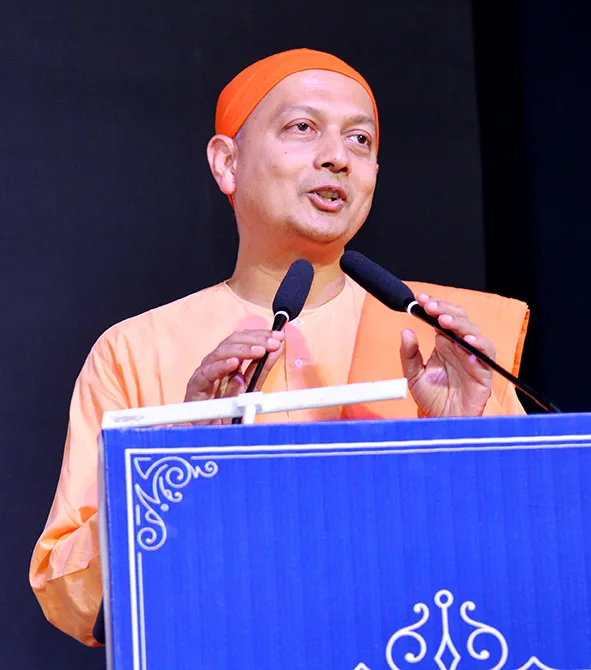
His American chapter began in Hollywood
I have lived in a monastery on the bank of the Ganga. I have lived teaching students in dorms and hostels. I have lived on mountain tops, actually, not literally in a cave, but in a hut, begging for my food, actually sleeping under a tree in the Himalayan mountainsides. And I have lived in Hollywood, Manhattan, and Harvard.
Swami Sarvapriyananda
His American chapter began in December 2015, when the Ramakrishna Order assigned him to the Vedanta Society of Southern California in Los Angeles, where he served as assistant minister for 13 months.
From Southern California, his next assignment took him across the country. In 2017, he became Minister and Spiritual Leader of the Vedanta Society of New York, one of the oldest Vedanta centres in the West and an institution founded by Swami Vivekananda in 1894. Swami Sarvapriyananda has held the position since then.
The move to New York also placed him at the intersection of spirituality, academia and public intellectual life. His talks on Vedanta began reaching audiences far beyond the society’s physical centre, helped by the internet. He has spoken at TEDx, Google and other public forums and participated in conversations with thinkers including David Chalmers and Sam Harris.
From the Upanishads to Harvard
In 2019, another unusual chapter followed. Sarvapriyananda became one of the first Hindu monastics to participate in a new residency programme at Harvard Divinity School. During the 2019-20 academic year, he was a Nagral Fellow, studying alongside other Hindu monastics and taking courses in philosophy, including Eastern and Western traditions.
Harvard’s account of his time there captured the unusual intersection of his traditional training and the academic environment. He studied the Upanishads while also engaging with Western philosophical questions, bringing the perspective of someone who had spent decades studying and practising the tradition rather than approaching it solely as an academic subject.
When Anthropic came calling
His interest in consciousness also made the relationship between Vedanta and contemporary debates about the mind and the technology particularly relevant. The questions he brings to that conversation are much older: What is consciousness? What makes an action ethical? And what should guide human beings when their technological power grows faster than their understanding of its consequences? That intersection became concrete in 2026.
Anthropic, the company behind Claude, began consulting religious and philosophical thinkers as it explored questions around the moral and spiritual behaviour of increasingly capable AI systems. The company held a two-day summit with around 15 Christian leaders at its San Francisco headquarters in March, according to reports at the time. Subsequent reporting described a broader outreach to religious and philosophical thinkers from different traditions.
Sarvapriyananda’s account of his own visit, shared publicly in June, provides a rare glimpse into that process from the perspective of a Hindu monk.
He said the group was shown some of Anthropic’s latest AI developments, including its highly capable Mythos system. Although he could not discuss details covered by the Non Disclosure Agreement, he described Anthropic’s researchers as simultaneously excited and alarmed by what the technology could do.
His impression was ultimately positive. “They’re all excited about it,” he said of the Anthropic team. “It’s wonderful. But they’re also alarmed at what is going to happen and what can happen, possibly.”
For Sarvapriyananda, the answer was not to reject technological progress but to insist on the need for ethics and guardrails. That position is particularly relevant to the Vedanta tradition’s emphasis on examining the consequences of human identification, desire and action rather than simply pursuing capability for its own sake.
A conversation about consciousness
The Anthropic encounter also sits within a much larger debate about whether increasingly sophisticated AI systems could ever possess something resembling consciousness.
Sarvapriyananda has spent years discussing consciousness from the perspective of Advaita Vedanta. His talks often return to the distinction between the mind and the awareness through which the mind is known.
That does not automatically provide an answer to whether a machine can become conscious. But it offers a philosophical framework for asking a question that technology companies can no longer easily avoid. The significance of his participation therefore goes beyond the fact that a Hindu monk visited a Silicon Valley AI company.
It represents an unusual meeting between two traditions of inquiry. One is relatively new and technological, built around machine learning and increasingly capable computational systems. The other reaches back to ancient Indian philosophical texts and asks what it means to be a conscious being.
There is no clear answer to what selfhood is in the case of today’s AI. But interestingly I don’t think there’s any clear answer to what selfhood is in the case of a human being either.
Swami Sarvapriyananda
An Indian philosophical voice in a new AI debate
For Sarvapriyananda, the journey from Bhubaneswar to New York was never a conventional international career trajectory.
He entered the Ramakrishna Order in India, spent years teaching and serving its institutions, came to the US as part of his monastic responsibilities, and eventually became the spiritual leader of one of the Order’s historic centres in New York. Along the way, his lectures on Vedanta found an international audience, while his engagement with universities and philosophers opened conversations between an ancient Indian philosophical tradition and contemporary intellectual life.
His invitation to Anthropic is another extension of that journey.
- Follow Swami Sarvapriyananda on Instagram
ALSO READ: Sunita Williams, Sadhguru & Kavya Manyapu: When science and spirituality shared the same orbit
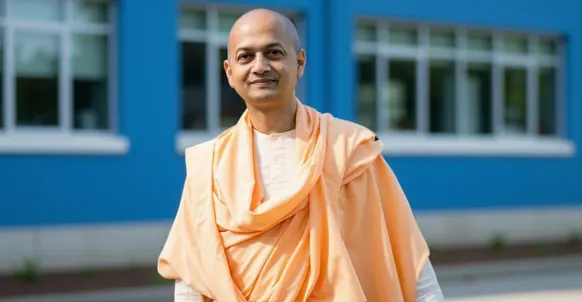
Swami Sarvapriyananda
| Born | Feb 10, 1971, Kolkata, India |
| Based | New York, USA |
| Studied | Xavier Institute of Management, Bhubaneshwar, India |
| Languages | English, Hindi, Bengali, Odia |
Signature work
Swami Sarvapriyananda is known for making Advaita Vedanta and the Upanishads accessible through public lectures and university talks, while bringing Vedantic perspectives to contemporary discussions on consciousness.
Idea
Making Advaita Vedanta and the Upanishads accessible to contemporary audiences through public lectures and conversations on consciousness, self and reality.
Network
Engages with academics, philosophers, scientists and technology thinkers through universities, public forums and his work with the Vedanta Society of New York.
Impact
Brings Vedantic perspectives into contemporary conversations on consciousness, AI ethics, morality and the implications of emerging technologies.
Inspired by Swami Sarvapriyananda 's journey?
Yours follows the same Hero's pattern — Separation, Initiation, Transformation, Return.
Share with


Written By: Vikram Sharma
Sunita Williams, Sadhguru & Kavya Manyapu: When science and spirituality shared the same orbit
Written By: Amrita Priya