
November 15 2026
Suresh Eriyat: From his father’s ghost stories to global animation acclaim
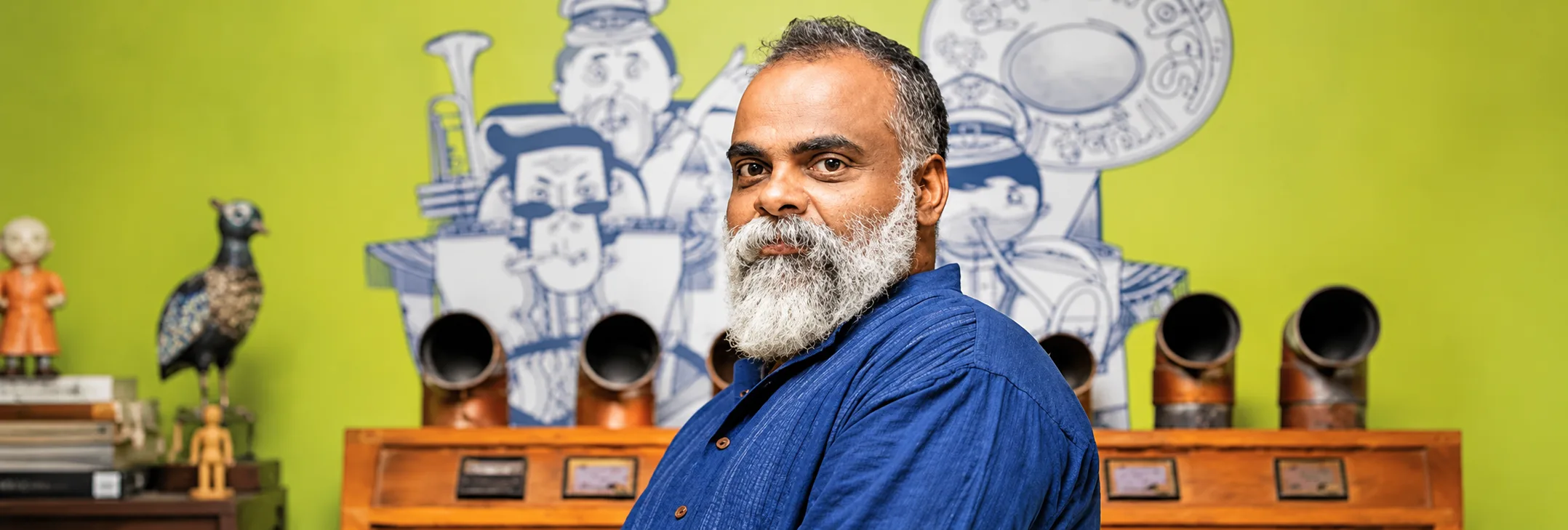
(Nov 15, 2026) From an unconventional childhood steeped in stories and music in Kerala to winning animation’s coveted Cristal Award at Annecy, filmmaker Suresh Eriyat has spent decades expanding the possibilities of Indian animation. Through original stories, indigenous crafts and distinctive visual storytelling, he has helped take Indian animation to a global audience.
Tripunithura, a town near Kochi in Kerala, has a temple every few hundred metres. Temple-hopping is a norm among the locals, with annual festivals bringing in a rich tapestry of folk art and classical performances. It was in this vibrant atmosphere that international award-winning animation filmmaker Suresh Eriyat spent his growing-up years.
“Looking back, I would say I had a rather peculiar childhood,” he shares with The Global Indian. “My father P N Panicker was an extraordinary storyteller and had several encounters with what he believed were ghosts! He would describe them with extraordinary detail – their shapes, sizes, the time and the exact locations where he had seen them. The way he narrated these incidents was so vivid that, as a child, I didn’t perceive them as stories. Rather, they were an extension of reality,” he adds.
His mother, a Hindi scholar, teacher and musician, too was an interesting influence. With singers like K J Yesudas having tremendous respect for her craft, she introduced Suresh to a different cultural and musical environment. “I learnt Carnatic music for many years thanks to her. Today, I realise how much of that early grounding in storytelling and musical foundation contributes to my films.”
View this post on Instagram
An accidental entry into animation
In 1991, Suresh secured admission into the prestigious National Institute of Design (NID), Ahmedabad, to study communication design. “My father used to take me to painting competitions and on one occasion, a stranger noticed my work and suggested I join NID,” he shares.
NID was a huge eye-opener for the director as it exposed him to different cultures, ideas, films and filmmakers, and completely expanded his understanding of visual storytelling and the possibilities of design.
His entry into the animation industry too was quite accidental. After graduating, the Kerala government had offered him an opportunity to set up something in Thiruvananthapuram. “However, by the time I completed my documentation and went back to accept the offer, the government had changed, and the offer was no longer valid. So, I had to come to Bombay in search of a job.”
He worked in a company for about a year before another unexpected opportunity came his way – to set up an animation division for the legendary Famous Studios in Mumbai. Here, he started Famous House of Animation in 1998, at a time when animation was not given much thought as an independent medium for storytelling, and went on to do some very interesting and path-breaking work.
Building India’s independent animation culture
With an aim to build an audience for independent animation in India and encourage young filmmakers to experiment, he established Studio Eeksaurus, with wife Nilima, in 2009.
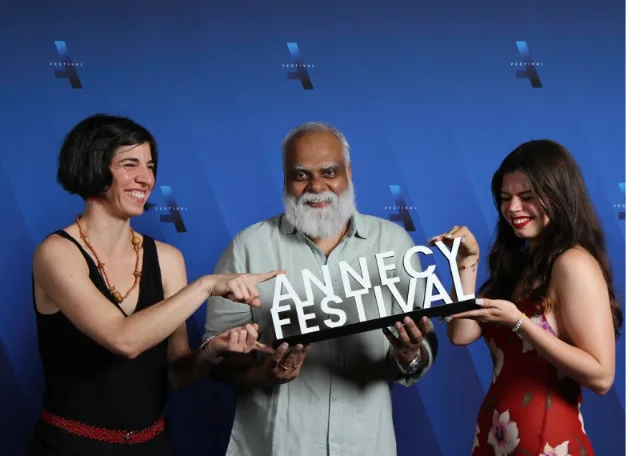
The studio earned international recognition when its film Fateline won the prestigious Cristal Award for a Commissioned Film at the Annecy International Animation Film Festival in 2015. Often described as the Cannes of animation, Annecy is among the world’s most prestigious animation festivals. The win was particularly significant as it marked the first time an Indian production had received the award.
“It was a prestigious win but very few people actually knew about the film festival. We had to call the press and explain what the award was,” he recalls with amusement.
A decade later, in 2025, the studio won another major recognition at Annecy, this time for the heartwarming film Desi Oon (Indian wool). It received the Jury Award for a Commissioned Film. A production that brought together actual wool and stop-motion technology, Desi Oon highlighted the struggles of shepherds and the irony of a country that throws away much of its own wool while importing it from elsewhere.
Suresh also helped bring six of his father’s ghost encounters to the screen through an animated film titled Kandittund! (Seen it!). “I interviewed him candidly on my phone, and we used those exact conversations to create the animated film,” he says.
Directed by Adithi Krishnadas and produced by Studio Eeksaurus, Kandittund! went on to win the National Film Award for Best Animation Film at the 69th National Film Awards, announced in 2023. His now 96-year-old father is immensely proud of the recognition.
Bringing the great Indian bustard’s story to life
Suresh Eriyat’s latest short film, The Godawan, brings together two stories of survival: that of the endangered great Indian bustard and the rare craft of Jaipur blue pottery. The film is part of a conservation initiative supported by Godawan. “The British gave the bird its name but it is also known as ‘godawan’ in Rajasthan,” he explains.
The bird has a slow reproductive cycle, with the female laying just one egg a year, points out Suresh. “Conservation efforts involve protecting the eggs, incubating them and raising the young birds before releasing them into their natural habitat.”
The idea of using Jaipur blue pottery came from the brand’s association with the craft. The team created ceramic pieces specifically for the film, using the distinctive visual style of blue pottery.
The stop-motion production took around eight months, with an estimated 15,000 hours of work. “On an average day, we could shoot only about two to three seconds of finished footage,” he says, describing the painstaking process of moving and photographing each element frame by frame.
Its music was also rooted in Rajasthan, with Suresh writing the lyrics in English first, which Harsukh Dayal then adapted into Rajasthani poetry, followed by music director Rajat Dholakia composing the melody.
How animation creates connections beyond borders
Suresh Eriyat’s travels to international film festivals have largely shaped his understanding of animation and its ability to connect people across cultures. One particularly memorable experience was a festival in Nikozi, a village in Georgia, organised by Bishop Isaiah.
Screenings take place at the Bishop’s Palace, a building that was bombed during the Georgian war in 2008 and later rebuilt by the local community. The region remains sensitive, with Russian-occupied territory just a few hundred metres away. “It is remarkable to see art being celebrated in a place where people continue to live with conflict and uncertainty,” says Suresh.
Another unusual experience was a festival organised by Ukrainian and Russian animation filmmakers on a ship. “I strongly believe that such festivals should continue to exist. Art should unite people, and it should help dissolve the barriers that separate us. When you share a creative space, differences and conflicts can take a back seat.”
India’s animation industry needs creative minds, not just skilled hands
While Indian artists and technicians are highly skilled and contribute significantly to international productions, the same quality of work isn’t visible in Indian projects. On being asked about this, Suresh says, “Our industry has become very good at developing skilled hands but not creative minds. We need people who can imagine, conceptualise and tell original stories, rather than simply execute someone else’s vision.”
He points to Japan and the global popularity of anime as an example of what can happen when a country develops a storytelling culture rooted in its own sensibilities.
We too have so many stories, cultures and traditions that could be explored through animation, but we haven’t fully tapped into that potential. We tend to fall back on mythology because it is familiar and commercially viable.
Suresh Eriyat
He also worries about the gradual disappearance of oral storytelling. His father, he says, belongs to one of the last generations of storytellers who passed on folklore and experiences through conversation. Growing up in a joint family, he listened to stories that fuelled his imagination. With the decline of joint families and fewer grandparents living with grandchildren, that culture of listening and sharing stories is weakening.
The future of Indian animation in the age of AI
Suresh and his team are currently working on several ideas. But first, he says, the country needs to build an audience willing to watch and pay for animation.
Imagine if 100 or even 30 million of the 1 billion+ people in India actively watched Indian animation. We need to create that kind of an appetite. People should want to watch it, enjoy it and be willing to pay for it.
Suresh Eriyat
This becomes particularly important at a time when artificial intelligence is beginning to change the nature of creative and technical work. “AI is not necessarily a great boon for India in this context. While it may be useful in certain areas, I am concerned about its impact on imagination-driven creative work.”
For him, the answer lies in encouraging people to imagine, conceptualise and create original work, rather than simply perform tasks that a machine may eventually be able to do.
“Countries such as France and Spain support artists through residencies and other opportunities. Investing in artists also supports a wider ecosystem of writers, artisans, craftspeople and technicians,” he concludes.
ALSO READ: Dreams in (stop) motion: Meet Neeraja Raj, the animation filmmaker making waves around the world


Written By: Darshana Ramdev

