
November 05 2026
Desi vs Desi in US Midterms: Democrats Ro Khanna, Pramila Jayapal defeat Republicans Ritesh Tandon and Nirav Sheth
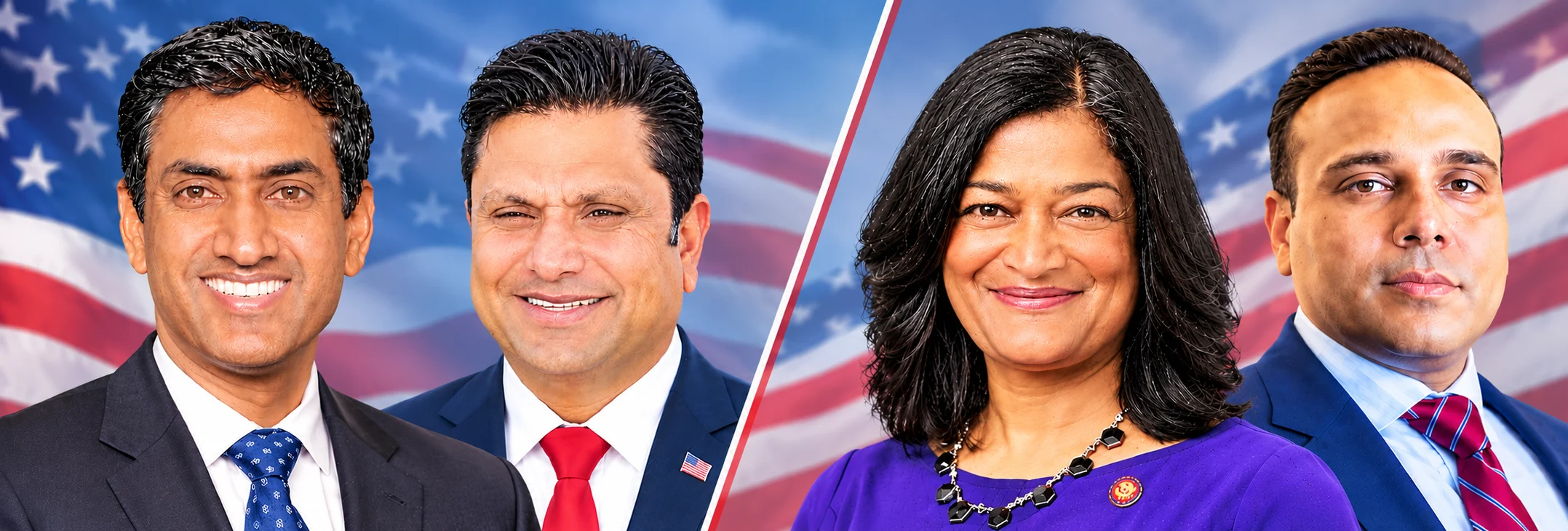
(Nov 5, 2026) Amid the wider 2026 US midterm contest, two races offered a distinctive twist. Indian-origin candidates from opposing parties went head-to-head for the same congressional seats in a rare desi vs desi electoral battle. Indian-American Democratic lawmakers Ro Khanna and Pramila Jayapal won re-election to the US House of Representatives, defeating Republican challengers Ritesh Tandon and Nirav Sheth, respectively. The results highlighted how people of Indian origin are making their presence felt across the political spectrum in the United States.
Democrats emerged with a stronger showing than Republicans in the 2026 US midterm elections, winning majorities in both chambers of Congress. But two congressional races stood out for a reason beyond party politics. They were a rare desi vs desi face-off, with Indian-origin candidates from opposing parties competing for the same seat.
At least 57 people of Indian origin were on the ballot as Americans voted on Tuesday, November 3. A tally released on the eve of the election counted one US Senate candidate, 11 House candidates, three candidates for statewide office, 36 for state legislatures and six for local posts. Midterm elections fall halfway through a US president’s four-year term. Voters elect all 435 members of the House of Representatives, about a third of the 100-member Senate, along with governors, state lawmakers and local officials.
Amid this nationwide electoral contest, two races brought Indian-origin candidates directly up against one another. In California’s Silicon Valley, Democratic Representative Ro Khanna faced Republican challenger Ritesh Tandon. In Seattle, Democratic Representative Pramila Jayapal went up against Nirav Sheth. Both incumbents won re-election, making the contests distinctive examples of Indian-origin candidates competing across party lines in American politics.
Ro Khanna defeats Ritesh Tandon in Silicon Valley
Democratic Representative Ro Khanna won re-election from California’s 17th Congressional District, defeating Republican challenger Ritesh Tandon. Khanna secured 70.9 percent of the vote against Tandon’s 29.1 percent, according to the available results.
The victory extends Khanna’s tenure representing the heart of Silicon Valley, one of the most influential technology hubs in the United States.
View this post on Instagram
Born in Philadelphia to Indian immigrant parents, Ro Khanna has built a political career around technology, American manufacturing, workers’ rights and progressive economic policies. A graduate of The University of Chicago and Yale Law School, he previously taught economics at Stanford University and served in the Obama administration as deputy assistant secretary of commerce.
Khanna has been a prominent voice in the Democratic Party’s progressive wing. His congressional priorities have included strengthening domestic manufacturing, investing in science and technology, expanding economic opportunities for working people and advocating for a more restrained US foreign policy.
His Republican challenger, Ritesh Tandon, brought a technology and business background to the contest. An engineer and entrepreneur, Tandon moved to the United States from India at the age of 28. He earned a master’s degree in computer engineering and an MBA from Santa Clara University and spent more than two decades in the technology sector before establishing his own company.
Ritesh Tandon’s campaign placed affordability at the centre of its agenda, calling for greater housing supply, lower costs for families and reduced government spending. He also advocated fair taxation and policies aimed at easing the financial pressures on working- and middle-class households.
The contest pitted an established progressive lawmaker against a Republican challenger whose campaign focused on economic concerns and the cost of living in the Bay Area. Khanna’s victory gave him another term in Congress, while Tandon’s challenge highlighted the growing presence of Indian-origin candidates across party lines in American electoral politics.
Pramila Jayapal defeats Nirav Sheth in Seattle
In Washington’s 7th Congressional District, Democratic Representative Pramila Jayapal secured another term in the US House, defeating Republican challenger Nirav Sheth. Jayapal received approximately 87.5 percent of the vote, while Sheth secured 12.1 percent.
First elected to Congress in 2016, Jayapal represents a district encompassing most of Seattle and surrounding communities. She is the first South Asian American woman elected to the US House of Representatives and has become a prominent figure in the Democratic Party’s progressive movement.
View this post on Instagram
Born in India, Pramila Jayapal moved to the United States at the age of 16 to attend Georgetown University. She later earned an MBA from Northwestern University and spent years working in public health, development and immigrant advocacy before entering electoral politics.
She founded OneAmerica, an immigrant-rights organisation in Washington State, and has championed issues including immigration reform, healthcare access, workers’ rights, affordable education and economic equality. Jayapal has served as chair of the Congressional Progressive Caucus and has been a leading advocate for Medicare for All and legislation aimed at addressing income inequality.
Her challenger, Nirav Sheth, brought a different professional and political background to the race. An Indian-origin Republican, Sheth earned an associate degree from the Government Polytechnic State Institute of Gujarat in Ahmedabad. He served in the US Marine Corps from 2011 to 2014 and has worked across business and other professional fields.
Sheth’s campaign focused on public safety, immigration enforcement, housing affordability and the cost of living. He also presented himself as a legal immigrant and small-business owner seeking to represent the district’s residents.
The result was a decisive victory for Jayapal, who retained her seat by a substantial margin. Her performance underscored the strong Democratic advantage in the Seattle-area district.
Two contests, one shared heritage
The Khanna-Tandon and Jayapal-Sheth races reflected a broader development in American politics where Indian-origin candidates are no longer confined to one party or a single political outlook.
While Khanna and Jayapal have established themselves as prominent Democratic lawmakers, Tandon and Sheth represented Republican challenges rooted in different priorities, from affordability and business concerns to public safety and immigration enforcement.
For Indian-American voters and the wider Indian diaspora, the contests offered a reminder that shared ancestry does not necessarily translate into shared political choices. In both California and Washington, voters returned the Democratic incumbents to Congress. The victories also reinforced the presence of Indian-origin lawmakers in the US political landscape, even as candidates of the same heritage continue to compete across party lines.
ALSO READ: 10 Indian-origin candidates to watch as US midterm results roll in



Written By: Amrita Priya
10 Indian-origin candidates to watch as US midterm results roll in

Written By: Amrita Priya
Nithya Raman: From India to Los Angeles, an urban planner’s journey into politics

Written By: Amrita Priya