
November 20 2026
Kiran Desai: The Indian-origin Booker-winning author exploring migration, identity and the search for home

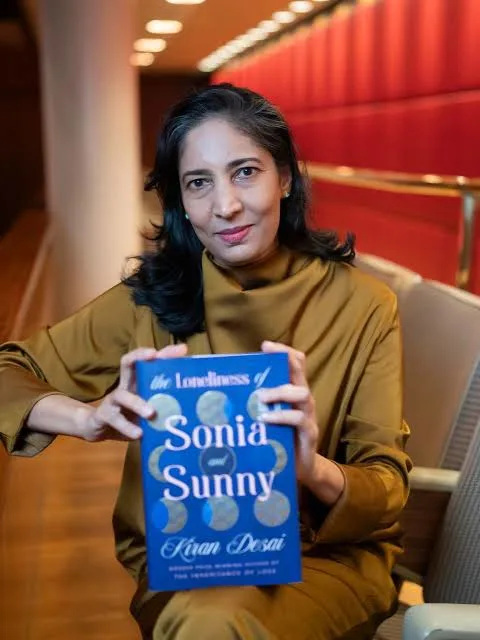
(Nov 20, 2026) At 35, Kiran Desai became one of the youngest women to win the Booker Prize, taking the honour in 2006 for The Inheritance of Loss. Her latest novel, The Loneliness of Sonia and Sunny, published in 2025 and shortlisted for the Booker Prize, brought her back into the literary spotlight with an exploration of migration, displacement and the search for belonging.
When Kiran Desai finally completed The Loneliness of Sonia and Sunny, nearly 20 years had passed since she began writing it. She had grown older, her hair had turned grey, and the manuscript had evolved through thousands of pages and years of reworking. Yet, for Kiran, the long journey was not simply a test of patience. It was an extraordinary period of immersion in the world she was creating.
“It took me 20 years to write this book,” she reflected during a conversation with Gyrith Ravn at the Louisiana Literature Festival in August 2026. Kiran described the experience as a privilege, explaining that writing had demanded an unusual degree of commitment.
I think what writers really want to do is to vanish into their work and to be part of it so deeply that your life doesn’t exist separately from your work.
Kiran Desai
Her words offer a glimpse into the discipline behind a literary career that has produced three novels, two of which have received international Booker recognition. They also reveal something of the themes that have remained central to her writing: the movement of people across borders, the instability of identity and the complicated relationship between an individual and the idea of home.
An early life across India and beyond
Born in Chandigarh in 1971, Kiran grew up in a family where literature, languages and multiple cultural influences were part of everyday life. Her mother, celebrated novelist Anita Desai, was already an established literary figure, while her family history offered her an unusually layered understanding of migration and belonging.
Her childhood was spent across different parts of India, including Delhi, Punjab and Mumbai. She attended Cathedral and John Connon School in Mumbai before leaving India at 16. She and her mother first moved to England, where they spent a year, before relocating to the United States.
The experience of moving between countries would become central to her literary imagination. But the idea of displacement had entered her family history long before her own migration.
During the Louisiana conversation, Kiran spoke at length about her grandparents and the journeys that had taken them across continents.
Her paternal grandfather came from Gujarat. Having learned English by studying a dictionary under a street lamp, he travelled to England, gained admission to Cambridge and eventually returned to India to serve in the Indian Civil Service under British rule. He later became a judge in colonial India.
Kiran was fascinated by the contradictions in his life. “I always wondered what it would have been like to be a judge dispensing justice under a fundamentally unjust colonial system,” she said. His journey also involved leaving behind familiar social and cultural conventions. He and his wife adapted to a different way of life, learning new customs and entering spaces that had previously been inaccessible to them.
Her maternal family had an equally complex history. Her maternal grandmother was German, while her maternal grandfather came from what is now Bangladesh. They met in Berlin in the 1920s before moving to India. With the outbreak of the Second World War, both found themselves separated from their original landscapes and building a new sense of home in India. Her mother grew up with several languages, including German, Bengali, English and Hindi.
“I inherited that bookshelf for which I am forever grateful,” Kiran said, referring to the diverse literary and cultural influences that became part of her upbringing. These family histories gave her an early understanding of how migration can alter a person’s relationship with identity, language and community. They would later find their way into her fiction.
Finding her literary voice
Kiran pursued creative writing at Bennington College and Hollins University before completing her education at Columbia University in New York, where she received an MFA in 1999.
Her literary debut came in 1998 with Hullabaloo in the Guava Orchard. The novel, which demonstrated her distinctive storytelling and humour, received the Betty Trask Award, given to outstanding first novels by Commonwealth writers under the age of 35.
It established her as a promising young literary voice, but her second novel would bring her international recognition. Published in 2006, The Inheritance of Loss explored the intersecting lives of people negotiating questions of identity, class, colonial history and migration. Set partly in the Himalayan foothills and partly among immigrant communities in New York, the novel examined the distance between the worlds people leave behind and the ones they attempt to build.
The book won the 2006 Man Booker Prize and the National Book Critics Circle Award for Fiction. At 35, Kiran became the youngest woman to win the Booker Prize at the time. The novel was subsequently translated into more than 40 languages, taking her exploration of displacement and cultural identity to readers across the world.
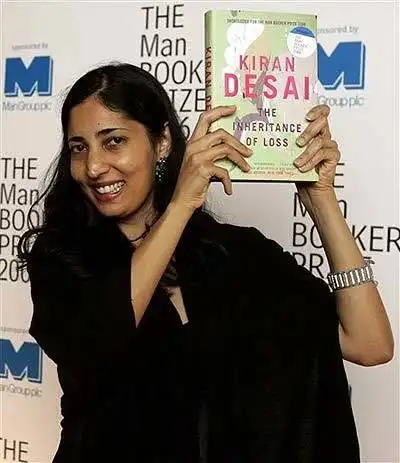
The success of The Inheritance of Loss established her as one of the most recognised Indian literary voices internationally. In 2009, she received the Columbia University Medal for Excellence. She was also awarded a Berlin Prize fellowship at the American Academy in Berlin in 2013 and received a John Simon Guggenheim Memorial Foundation Fellowship in 2013-14. In 2015, The Economic Times included her among its 20 most influential global Indian women.
Yet, rather than following a predictable publishing schedule after her Booker-winning novel, Kiran devoted nearly two decades to the making of her next book. She kept journals, gathered stories and developed characters, at one point accumulating around 5,000 pages of material before finding the shape of the novel. Much of this work unfolded in solitude, with writing becoming so central to her life that, as she later put it, she had merged her life and art almost completely.
Twenty years in the making
Kiran began working on The Loneliness of Sonia and Sunny more than two decades ago. In 2017, she spoke about developing a book concerned with power and a young Indian woman navigating India and the wider world. The novel eventually emerged in 2025, marking her return to fiction after almost two decades.
Shortlisted for the 2025 Booker Prize, it follows Sonia and Sunny through questions of love, identity, migration and the search for belonging. Its concerns extend across geographies and generations, examining how people negotiate their place in a world where familiar centres of identity are increasingly uncertain.
Kiran described the novel as an attempt to follow loneliness across different landscapes and generations. “I was following this theme of loneliness across geographies and through several generations,” she said.
The writing process was far from straightforward. She accumulated thousands of pages before showing the manuscript to anyone. Even after more than a decade, when she had a complete draft, the challenge was to transform an enormous collection of stories into the form of a novel. The process also led her to identify with the characters’ experience of artistic dedication. She compared herself to an ant, an earthworm or a bee, simply going about its work, transforming small fragments of real life into art. “Transposing a tiny bit of real life into artistic life,” she explained.
Her editors helped her navigate this process. But her first reader, as with her earlier work, was her mother. Kiran considers having a novelist for a mother an extraordinary privilege. Anita Desai understands many of the landscapes and experiences that inform her daughter’s writing and can often intuit what she is trying to express before she has found the words herself.
She’s (Anita Desai) not someone who will say it’s not ever going to work. She’s always who says that, you know, there’s too much to it for it to fail.
Kiran Desai
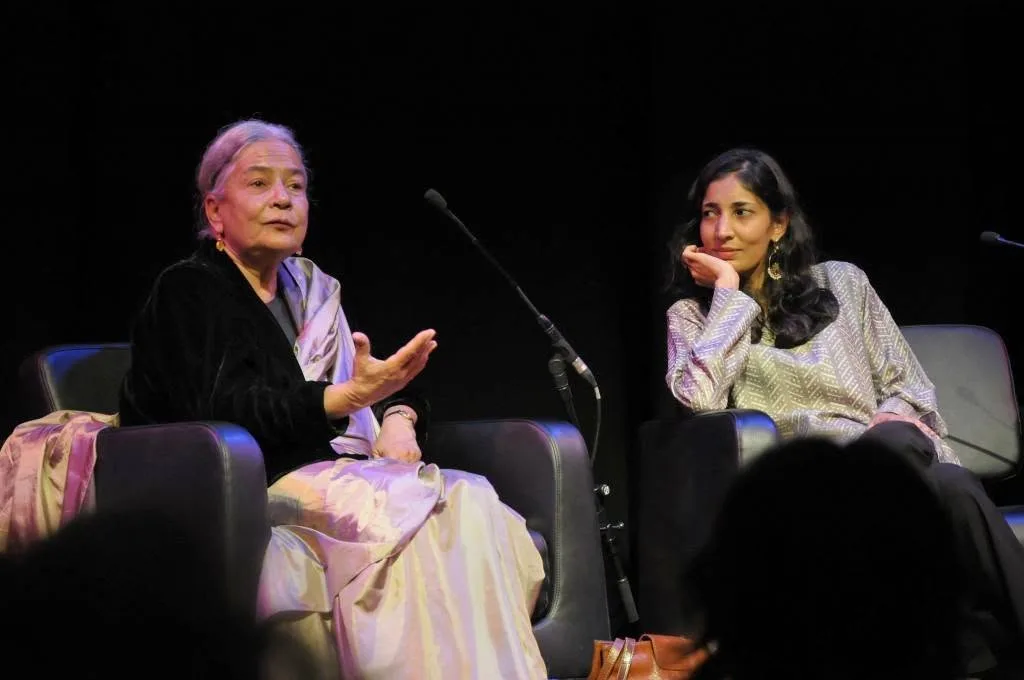
Award-winning authors and mother-daughter duo Anita and Kiran Desai
The search for home across borders
Migration is not merely a recurring backdrop in Kiran’s fiction. It is a way of examining how people construct and reconstruct their identities.
I write about migration and immigrant stories and stories that are naturally those of movement, of dissolving an old, deep-rooted sense of home.
Kiran Desai
For Kiran, the challenge was also to make the novel itself reflect this movement. She grew up reading Jane Austen and Charles Dickens, encountering the traditional Western novel as a familiar literary form. Yet she was equally conscious of India’s older oral storytelling traditions, in which stories travelled, were repeated and adapted to different landscapes.
“The novel is a western form, you know, and it came to India along with the British,” she observed.
India’s oral storytelling tradition offered her another way of thinking about narrative: one that was not confined to a single place or perspective. This interest informed her approach to The Loneliness of Sonia and Sunny. The characters move through a world in which their sense of self is continually changing, even as they seek love and a place to belong. She described this condition as “a deep-rooted homelessness”.
How long is it before you are allowed to belong?
Her understanding of borders and belonging also draws on her own childhood experiences. When she was around 13, her mother decided to move to the mountains, taking Kiran with her. They settled in Kalimpong, near Darjeeling, in a region marked by complex geographical and political histories.
At the time, the area was witnessing renewed demands for statehood and political autonomy among Indian Nepalis, many of whose communities had come to work on tea plantations during British rule.
For the young Kiran, it was an introduction to competing claims over land, identity and belonging. She began to understand that even within one’s own country, the question of who belongs to a particular landscape can be complicated by generations of migration. “How long is it before you are allowed to belong? How long is it when your language is accepted?” she recalled, describing the questions that emerged from her experience of that landscape.
The experience later informed her understanding of immigrant communities in the United States. In New York, she encountered people from different parts of the world working and living alongside one another, often in the basement kitchens of the city. The parallel between these seemingly distant settings became an important part of her literary imagination.
Who gets to tell the story?
Kiran’s exploration of migration extends beyond the personal experience of leaving one country and settling in another. Her work also examines the power structures that determine whose stories are heard, whose identities are accepted and who gets to define a community.
During the festival conversation, she reflected on how news and narratives change as they travel from one country to another.
“Who tells the news story, who controls the news, what stories are told, what stories are not told,” she asked. These questions are particularly relevant to The Loneliness of Sonia and Sunny, in which one of the central characters is a journalist. They also connect with the wider concerns of The Inheritance of Loss, where colonial histories, race, class and migration intersect.
Kiran pointed out that discussions about migration often focus on people moving from non-Western countries to the West. However, a significant proportion of global migration takes place between non-Western countries.
She cited the movement of people from Bangladesh to India and the plight of Rohingya refugees as examples of how displacement and the search for refuge transcend the conventional Western-centred narrative. She also drew attention to the fact that racism and anti-migrant sentiment are not confined to Western societies.
Her reflections bring another dimension to her writing: an interest in how national identities, political ideologies and social hierarchies influence people’s ability to find a place in the world.
The intimacy of human relationships
While questions of power, colonial history and migration form important strands of Kiran’s fiction, her latest novel also takes her into the intimate territory of human relationships.
For her, writing about two people meeting, falling in love or experiencing the end of a relationship can be more challenging than exploring large political themes. She described the vulnerability involved in writing about the conversations people have when they first meet, when love begins to fade or when they confront death.
We learn how to love and how to grieve because of art. It deepens our own experience and it gives us the words.
Kiran Desai
She believes fiction allows readers to understand emotions and experiences that they might otherwise struggle to articulate.
The literary works that inspired her while writing the novel included Leo Tolstoy’s Anna Karenina, Milan Kundera’s The Unbearable Lightness of Being, Yasunari Kawabata’s Snow Country and Gabriel García Márquez’s Love in the Time of Cholera. She also drew inspiration from Franz Kafka’s The Castle, with its themes of alienation and unrequited longing. These books represented the literary company in which she hoped her own novel would find a place.
For an author who has spent much of her life moving between cultures, languages and literary traditions, the aspiration is telling. Her writing seeks to connect experiences that may appear geographically distant but are emotionally familiar.
Kiran’s journey has taken her from an Indian childhood shaped by multiple family histories to an international literary career marked by some of the world’s most prestigious awards. Yet, across three novels, her central concerns have remained remarkably consistent. She continues to explore what happens when people leave behind familiar worlds, how they negotiate identities in unfamiliar places and whether belonging can ever be fully secured.
Perhaps that is also what makes her latest novel’s long journey so significant. Kiran spent nearly 20 years building a world around two characters searching for connection in a world without a fixed centre. In doing so, she returned to questions that have accompanied her own life and literary imagination for decades: what makes a place home, who gets to belong, and how do people find themselves when the worlds they know keep changing?
ALSO READ: Heart Lamp Wins Big: Banu Mushtaq becomes the first Kannada author to win the International Booker






Written By: Mallik Thatipalli