
November 08 2026
The light they carried: How indentured Indians took Diwali abroad and helped make it a public holiday
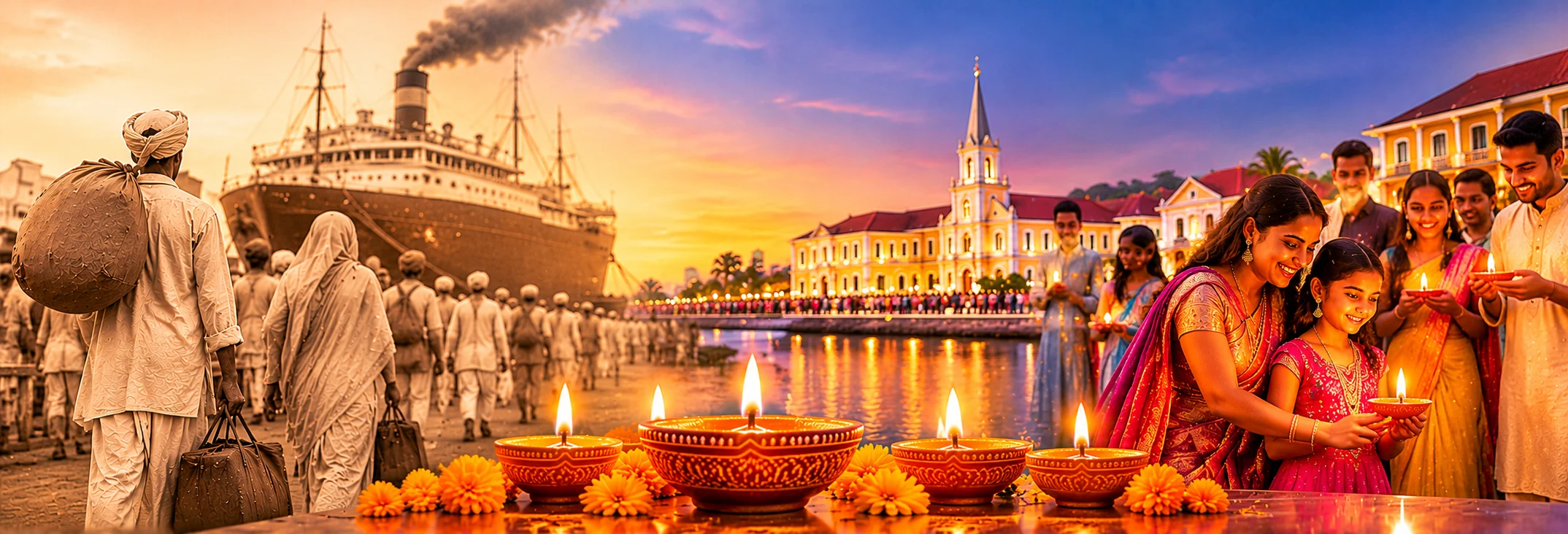
(Nov 8, 2026) As Diwali is celebrated across India today, the festival of lights is also being marked in Port Louis, Port of Spain, Georgetown, Paramaribo, Suva, Kuala Lumpur and Singapore. In each of these places, Diwali is a public holiday, and in most of them that recognition traces back to a single, painful chapter of history.
Between 1834 and 1917, more than a million Indians crossed the kala pani, the dreaded black waters, to work on sugar plantations in Britain’s colonies and those of other European powers, according to historians. The system began after Britain abolished slavery, when plantation owners needed a new supply of cheap labour. Indians signed contracts, or indentures, binding them to years of work for low pay. They called the contract girmit, their word for “agreement”.
Most never returned. They carried little with them, but they carried their festivals. The Global Indian explores how Diwali survived and flourished in seven countries where it is now a public holiday.
Mauritius, where indenture began
The indenture story starts on this Indian Ocean island. On 2 November 1834, the first 36 indentured labourers from India arrived in Mauritius, a moment that reshaped the island’s population and culture. Between 1834 and 1920, almost half a million followed. Today, about 68 percent of Mauritians are of Indian origin, according to UNESCO.
Their landing place in Port Louis, once called Coolie Ghat, was renamed Aapravasi Ghat in 1989 and became a UNESCO World Heritage Site in 2006. Every 2 November is now a public holiday honouring the girmityas, falling just six days before Diwali this year.
In Mauritius, where the festival is spelt Divali, it is a public holiday. In 2026, it falls on Sunday, 8 November, and listed in the country’s official public-holiday schedule.
View this post on Instagram
Trinidad and Tobago, home of Divali Nagar
Indians reached Trinidad aboard the ship Fatel Razack, which arrived on 30 May 1845 and marked the beginning of more than seven decades of indentured migration that lasted until 1917. Most came from present-day Uttar Pradesh and Bihar. Diwali, spelt Divali locally, became the flag-bearer of the Hindu festivals they brought.
For a century, the festival remained largely within the community, marked through religious functions attended mostly by Indo-Trinidadians. That changed in 1966, when Divali was declared a national holiday, four years after independence. In 1986, the National Council of Indian Culture (NCIC) organised the first Divali Nagar, a festival village that moved to its permanent site in Chaguanas in 1991.
Divali Nagar, roughly “the city of Divali”, has grown into one of the country’s best-known cultural events. The NCIC describes it as the largest Divali celebration outside India. The concept has also inspired similar celebrations elsewhere in the diaspora.
Guyana, where Diwali takes to the streets
The Caribbean’s indenture story began in British Guiana. On 5 May 1838, two ships, the Whitby and the Hesperus, landed at Plantation Highbury carrying the first Indian labourers. By the time the scheme ended in 1917, 238,909 Indians had arrived, making it the largest of Guyana’s immigration schemes.
Indo-Guyanese now make up almost 40 percent of the population and form the country’s largest ethnic group. Diwali is a public holiday under Guyana’s Public Holidays Act. Its best-known tradition is distinctly Guyanese: a pre-Diwali motorcade of illuminated floats through the streets of Georgetown. Organised by the Guyana Hindu Dharmic Sabha since 1974, it draws crowds of spectators from different communities.
The festival also travelled onward. Many Indo-Guyanese later emigrated to New York, where large communities live in Richmond Hill and Ozone Park in Queens, giving the festival a second diaspora home.
Suriname, where a giant diya lights the capital
Suriname’s Indians arrived under Dutch, not British, rule. The sailing ship Lalla Rookh left Calcutta on 26 February 1873 with 410 emigrants and reached Paramaribo 99 days later. Eleven did not survive the voyage. Until 1916, a total of 64 sailing ships and steamers carried Indians to Suriname. Their descendants, known as Hindustanis, blended the dialects their ancestors brought from India into a new language, Sarnami Hindustani.
Divali is a national holiday, which former President Chan Santokhi has described as a celebration of light shared by all Surinamese. Its signature attraction is the Suriname Dia, a giant lamp at Independence Square in Paramaribo. It is lit at the start of Divali celebrations, with Hindus and non-Hindus alike joining in and adding ghee to keep the flame burning.
The festival has grown into a national event. The Cultural Union of Suriname has organised the National Divali Celebration since 2006.
Fiji, the last stop of girmit
Fiji was the last major colony to bring indentured Indians. The first ship, the Leonidas, anchored at Levuka on 14 May 1879 after a 72-day voyage from Calcutta. By 1916, just over 60,000 Indians had arrived. Indo-Fijians still call their ancestors girmitiyas, from “agreement”.
Diwali became a public holiday in 1974, declared by Fiji’s first prime minister after independence, Ratu Sir Kamisese Mara. In 2023, the government added Girmit Day, commemorating the arrival of the Leonidas, as a holiday of its own.
Prime Minister Sitiveni Rabuka, who led a military coup in 1987 and later publicly apologised to Indo-Fijians, summed up the festival’s place in national life on Girmit Day in 2023. “The Girmityas gave Fiji the gift of Diwali,” he said, calling it a celebration that brings all Fijians together.
Malaysia, where Deepavali became a shared celebration
Malaysia’s Indian community grew from a different stream of labour migration. Many Indian workers came under indenture or, from the late 19th century, the kangany system, in which a trusted overseer recruited labourers, often whole families, for coffee and rubber estates. The system lasted until 1938, and about 90 percent of these labour migrants were Tamils.
Deepavali, as Malaysians call it, is a federal public holiday in every state except Sarawak. When the festival falls on a Sunday, a substitute holiday is observed on Monday in most states, though the arrangements vary by state.
One of its best-known customs is the open house, when Hindu families welcome friends and neighbours of every background into their homes. The tradition reflects the festival’s growing place in Malaysia’s multicultural public life, beyond the Indian community.
Singapore, a holiday older than the nation
Singapore’s Indian community has more varied roots than those of the sugar colonies. Merchants and traders came first, followed in the 19th century by labourers for plantations and the harbour, recruited under the indenture and kangany systems also used in Malaya. Deepavali’s official standing dates back to 1929, decades before Singapore became independent in 1965.
In 1968, when the government sought to reduce the number of public holidays, religious communities were asked to choose which festivals they wished to retain. Hindus had to choose between Thaipusam and Deepavali, and chose the latter. Deepavali remains Singapore’s only Hindu religious public holiday.
The festival’s best-known face is the Deepavali light-up of Little India, a tradition of more than 35 years that illuminates Serangoon Road in the weeks before the festival. In 2025, President Tharman Shanmugaratnam switched it on, calling it a shared multicultural occasion. It is a sign of how far the festival has moved from a community celebration to a national one.
The lamps that crossed the black waters
In none of these countries did Diwali become a public holiday by accident. For decades, indentured families kept the festival alive largely within their own communities. Official recognition came at different points in each country’s history, including after independence in Trinidad and Fiji, as these nations increasingly embraced the festivals of their Indian-origin citizens as part of their shared cultural life.
Along the way, each country gave Diwali a form of its own: a festival village in Trinidad, a motorcade in Guyana, a giant lamp in Paramaribo, open houses in Malaysia and a light-up in Singapore. The descendants of the girmitiyas did more than keep their ancestors’ festival alive. They made it part of the national calendar in the lands their ancestors were brought to work in.
This Diwali, as lamps are lit from Suva to Port of Spain, that journey is worth remembering.
ALSO READ: A city of lights in Trinidad: How Divali Nagar illuminates the Caribbean nation’s cultural soul



Written By: Vikram Sharma
Diwali 2025 sparks a global travel buzz, with searches for India up by 67 percent
Written By: Namrata Srivastava