

(December 8, 2025) Dr. Bala Subramaniam, Professor of Anaesthesia at Harvard Medical School and Director of the Harvard-affiliated Sadhguru Center for a Conscious Planet at Beth Israel Deaconess Medical Center, stands at a rare crossroads where cutting-edge medical science meets ancient yogic science. His work bridges cognition, compassion, and consciousness, uniting clinical rigour with spiritual inquiry. A leading voice in meditation research, he has raised over $35 million for neuroscience studies and collaborates with top U.S. institutions. His journey from a small Tamil Nadu village to Harvard, and from medical science to inner exploration reveals a life committed to reducing suffering through both science and spirituality.
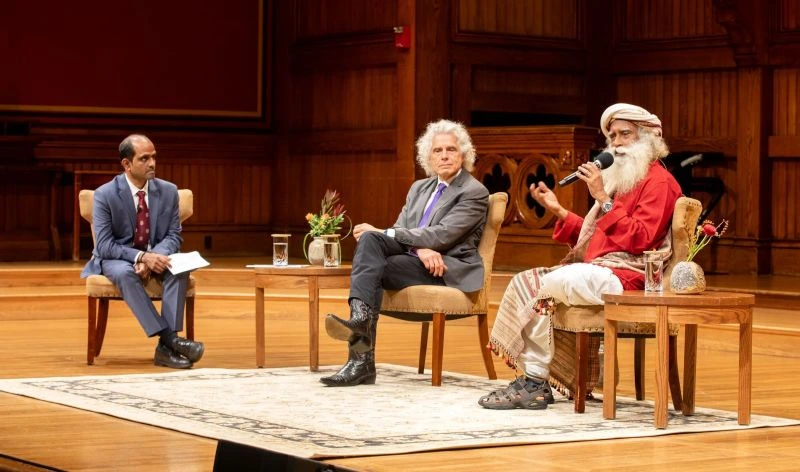
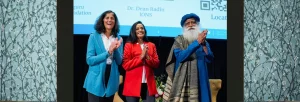
Dr. Bala Subramaniam moderating a conversation between Sadhguru and Canadian Cognitive Psychologist Steven Pinker
A moment of loss that opened the door to a new perspective
Back in 2009, when Dr. Bala’s wife lost her mother who was just 59, their home was plunged into grief and unanswered questions. A well-wisher suggested they listen to Sadhguru. When she participated in a program with him in 2011, she returned transformed—radiant, steady, and unmistakably changed. Witnessing that shift, Dr. Bala felt compelled to take the program himself. What followed, he says, was “a return to childhood—joyful, unburdened, alive.” It deepened this shift further, expanding his perception and opening dimensions of experience he had never encountered in scientific training.
“Science expands what we know. Spirituality expands who we are,” he reflects. Rather than choosing between the two, he began weaving them together as a bridge that would shape his life’s work of creating a future where consciousness, cognition, and compassion form the foundation of human flourishing. “My clinical research addresses brain fog after cardiac surgery. My spiritual research addresses consciousness itself. Both are about reducing suffering,” he remarks in a chat with Global Indian, capturing the unifying thread that now defines his worldview.
The program that altered his lens
Ever since the program with Sadhguru, Dr. Bala began noticing subtle energies in temples, experiencing profound shifts in meditation, and encountering phenomena that defied the boundaries of Western scientific training. “Awareness grew on me and I wanted to hang around him (Sadhguru). I wanted to see what he is about, to see the world through his eyes.” His journey through Shunya, Samyama, Kailash, and deeper inner practices recalibrated the trajectory of his career. Instead of separating science and spirituality, he committed to connecting them.
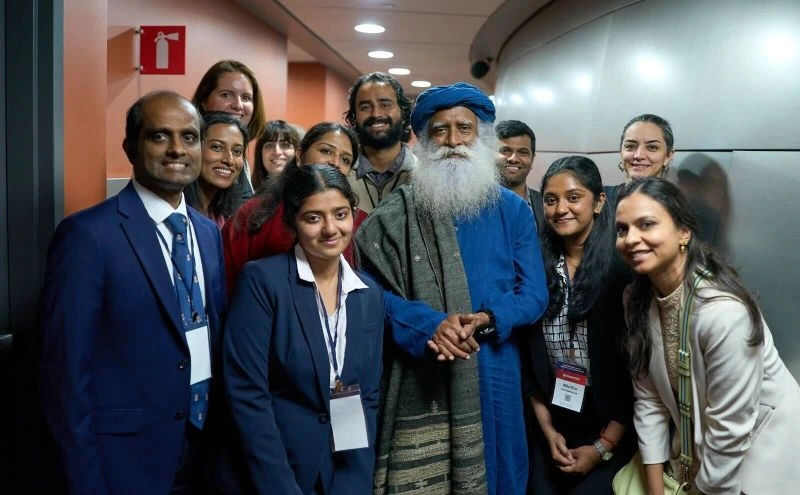
Dr Bala Subramaniam and other volunteers with Sadhguru at the 2025 Consciousness Conference
Meditation as measurable biology
In 2018, Dr. Bala and academic collaborators began rigorous meditation research. Their findings were striking: meditators showed younger brain age, higher functional connectivity, increased stage 3 deep sleep, elevated anandamide levels, and improved BDNF (Brain Derived Neurotrophic Factor). “It felt like we were uncovering the secondary effects that Sadhguru speaks of casually,” he says. In just six years, Dr. Bala helped raise over $35 million in NIH and philanthropic funding for meditation neuroscience. His team now collaborates with MGH, Brigham and Women’s, UCLA, UCI, Pittsburgh, Montefiore, and Yale.
A global voice for conscious exploration
At the Sadhguru Center, Dr. Bala convenes conversations that unite astrophysicists, neurologists, meditation masters, and astronauts. A recent dialogue between Commander Sunita Williams and Sadhguru explored the “overview effect” of seeing Earth from space. “When she looked at the planet without borders, she recognized our shared humanity,” he says. Meditation, he notes, gives a similar separation from identity, and a cosmic perspective. “As we explore space, we must do it consciously. Human beings cannot export conflict to other planets.” The Center now offers free or subsidized yoga and meditation programs to patients with Parkinson’s, cancer, neurodegenerative disorders, vertigo, and pregnancy challenges.
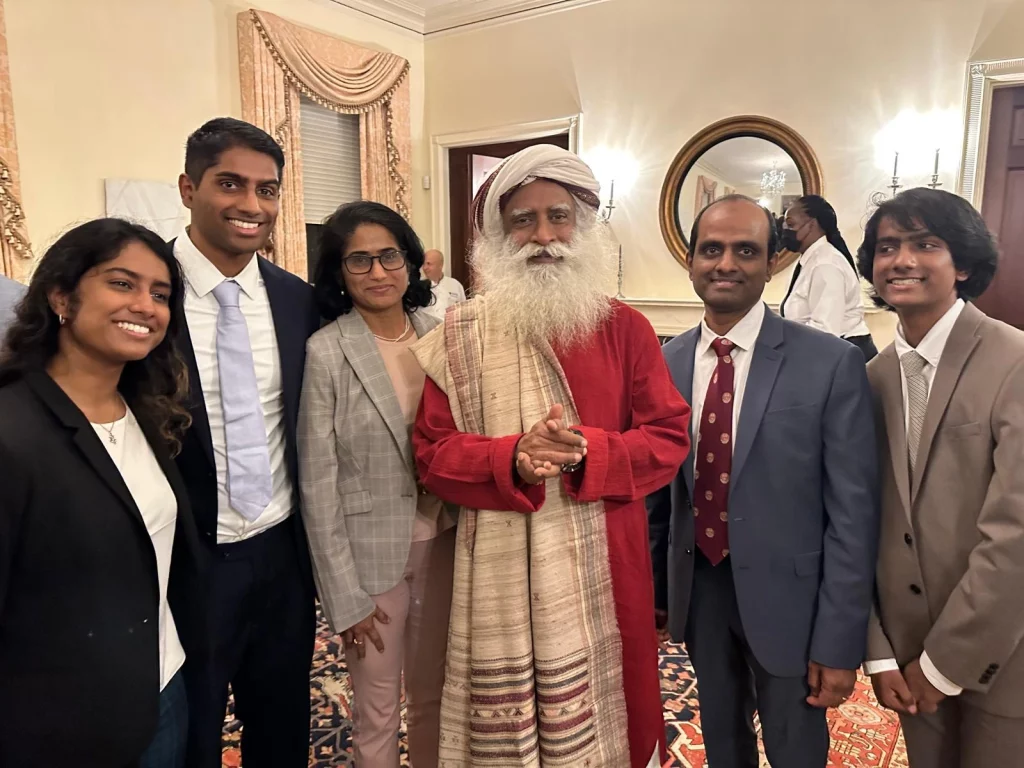
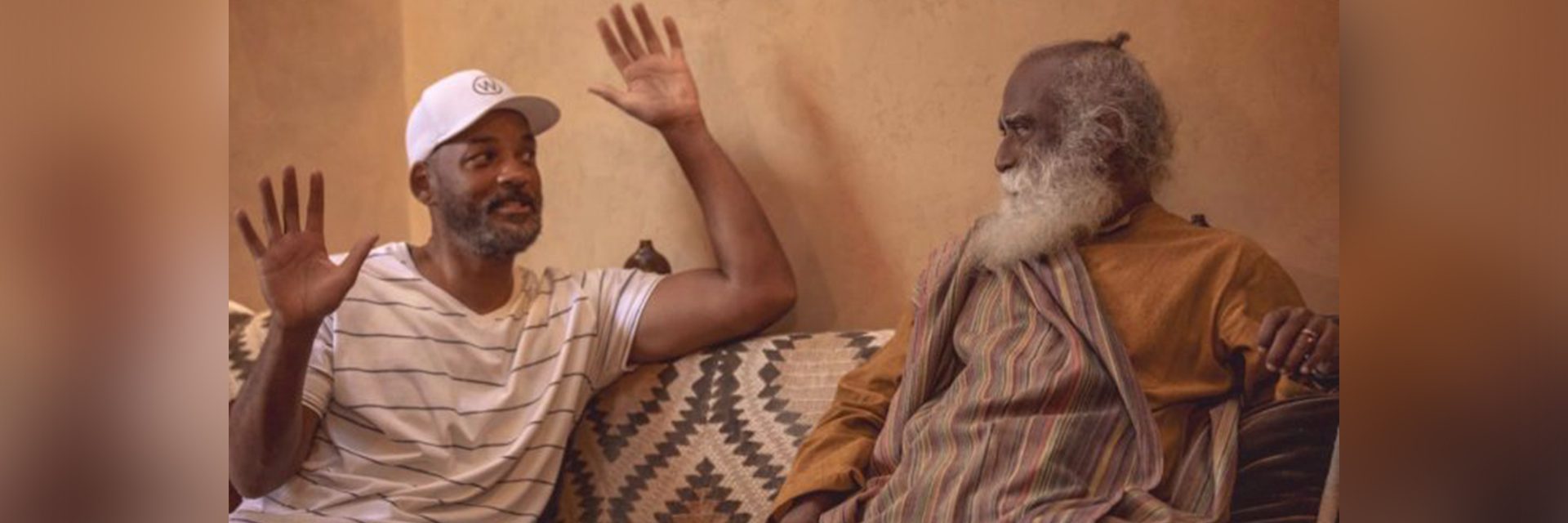
Dr Bala Subramaniam and his family with Sadhguru
Roots in scarcity; Richness in love
Born the youngest of four siblings in Marakkanam, a small village between Pondicherry and Chennai, Dr. Bala Subramaniam grew up in a low-income household rich in love, discipline, and devotion. “We were a low-income family, but we were rich in love,” he recalls. His childhood involved cold showers, temple visits, and ashram routines but no pressure. “I was always playful, always outdoors,” he smiles. His tipping point arrived in the 11th grade at Petit Seminaire Higher Secondary School, where he was suddenly surrounded by brilliant classmates. “That school changed the arc of my life. I saw what academic excellence looked like.”
AIIMS to Ireland
Dr. Bala prepared for medical entrance exams with his friend, Dr. Mukesh Porwal, and both secured admission to Jawaharlal Institute of Postgraduate Medical Education and Research (JIPMER). In 1993, he boarded his first-ever long-distance train to New Delhi to join AIIMS, where he completed his residency and registrar years. He fell in love with anaesthesiology, guided by a mentor who urged him to pursue a clinician-scientist career in the U.S. But before America came a detour to Northern Ireland. During a nine-month stint in 1999, an offhand remark from a senior consultant praising his English as a relic of British occupation, scarred him deeply. “I decided that if I ever leave India again, it will be to the U.S. Humans look for differences; geography changes the labels, but the instinct is the same,” he remarks.
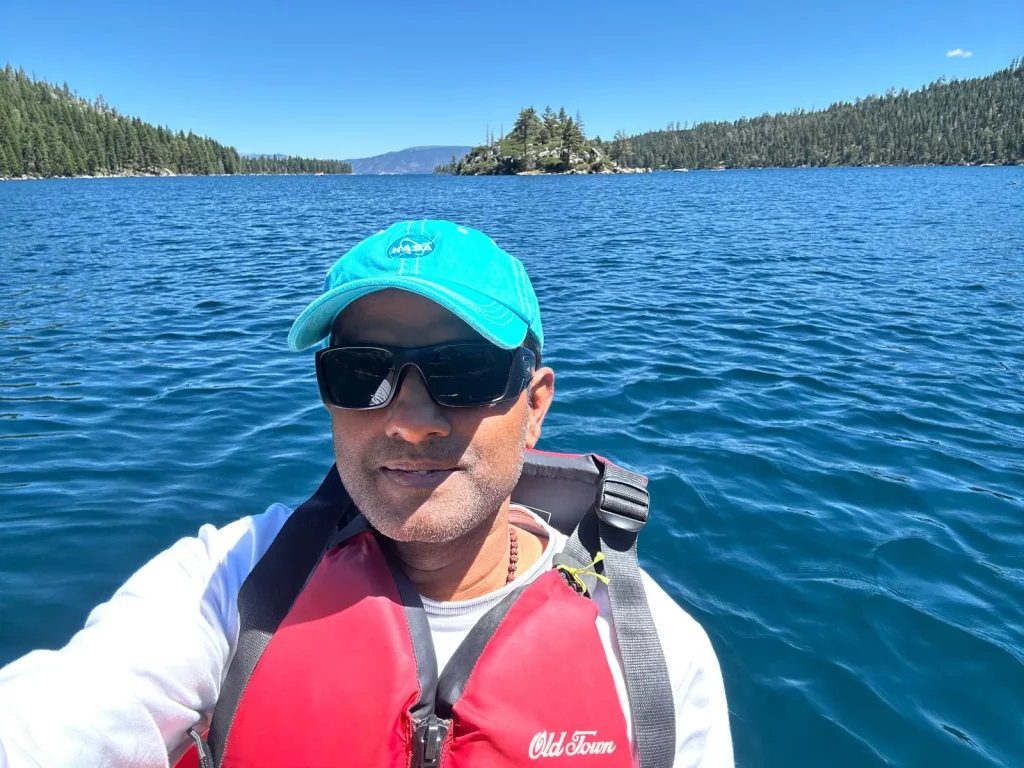
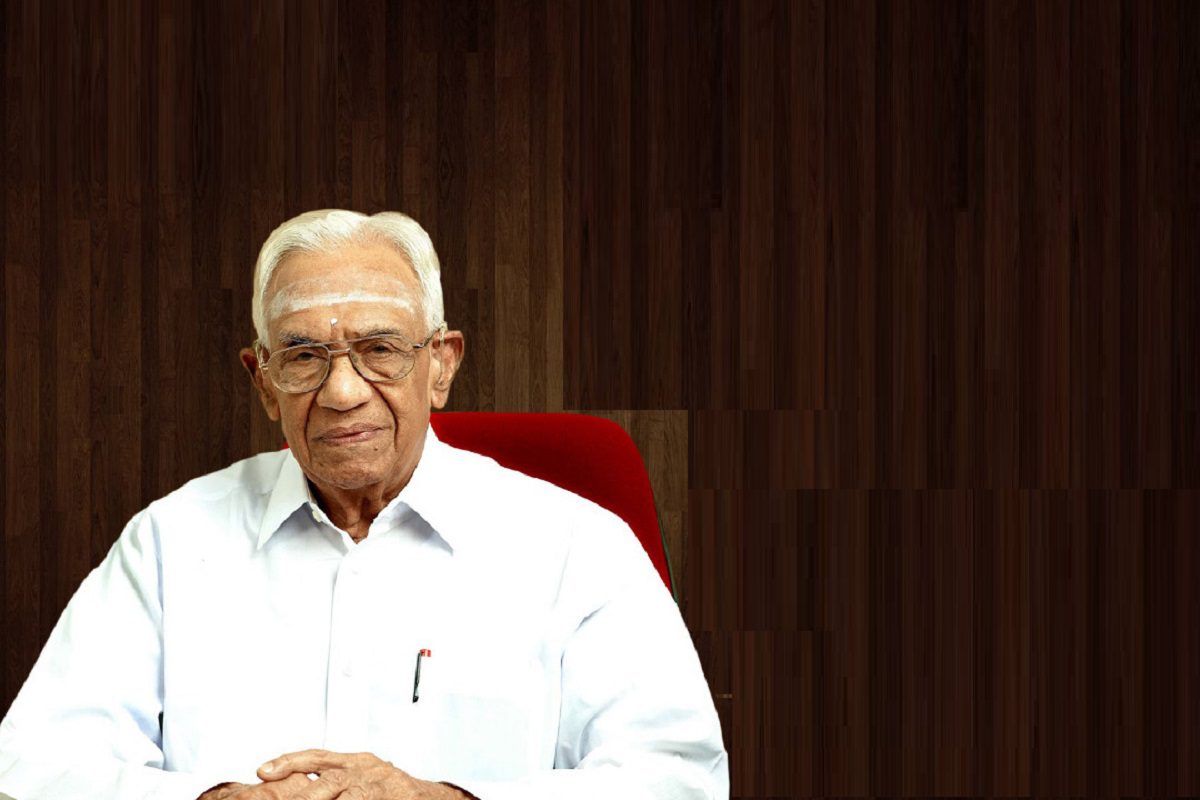
Dr Bala Subramaniam
The leap to Harvard
When Dr. Bala and his AIIMS colleagues began their U.S. journey, money was painfully scarce. After working a year in the U.S. to save just enough, they traveled to Thailand and Singapore for their USMLE exams. “Later, we bought a $400 Greyhound bus pass that allowed unlimited travel for a month. We slept on buses and changed into interview clothes in bus station restrooms,” he says. He often ate free food at hospitals after interviews. Eventually, he secured a spot at Beth Israel Deaconess Medical Center, Harvard Medical School.
Harvard and Beyond
In 2000, Dr. Bala restarted residency in Boston. Cultural integration was slow, humor slipped past him, and accents collided in operating rooms. “But they respected my work ethic. They saw I was clinically sharp.” Step by step, he climbed. In 2004, he specialized in cardiac anaesthesia; in 2007, he completed an MPH at Harvard. By 2019, he became a Full Professor—one of just three clinician-scientist professors in his department, and later received the Ellison C. “Jeep” Pierce Endowed Chair. “The Chair gives me freedom to pursue the science I believe in,” he mentions.
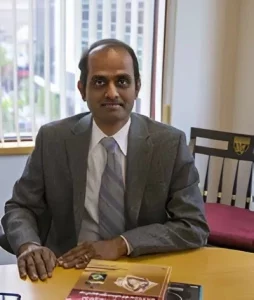
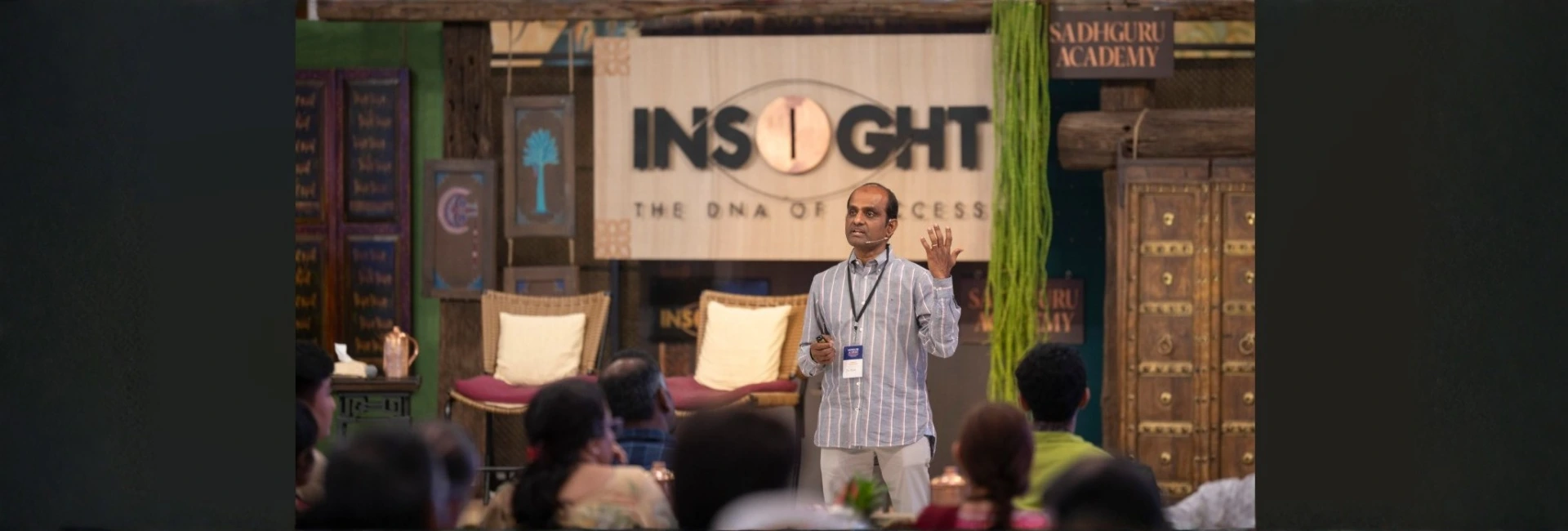
Dr Bala Subramaniam in Office
Where neuroscience meets yoga
Today, Dr. Bala explores how brain imaging and cognitive science illuminate states of awareness and how they link to contemplative practices. He frames cognition and compassion not as separate traits but as deeply connected as our states of consciousness shape our capacity for compassion. Emerging studies show that yoga and meditation produce measurable biological shifts, including changes in inflammation markers and other physiological correlates. “These practices build a bridge from subjective experience to objective biology,” says the NIH-funded researcher.
The Next Frontier—Inner Intelligence
Dr. Bala believes the next revolution in healthcare will arise not from artificial intelligence but from inner intelligence. “Yoga’s eight limbs mirror modern science,” he says, mapping each limb to cognitive and physiological processes. “Western science studies the brain. Yoga studies the experiencer. These are complementary, not contradictory.”
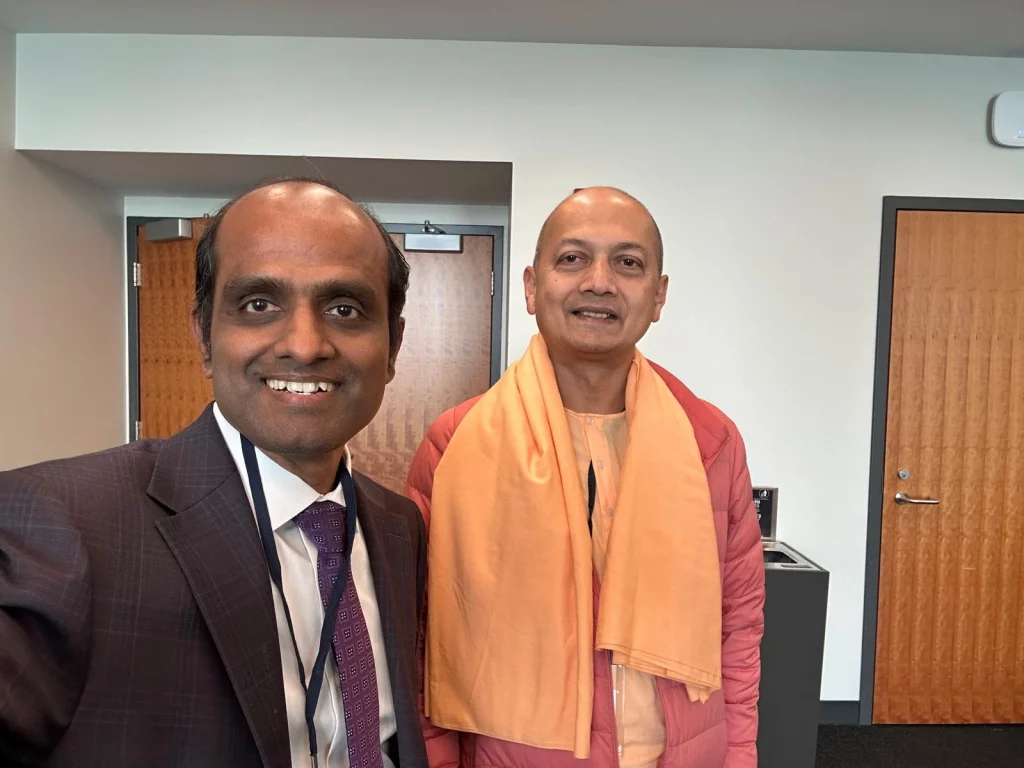
A life anchored in practice
His daily routine is disciplined: asleep by 10:30 pm, awake at 4 am without an alarm, practicing Surya Kriya, Yogasanas, and Shakti Chalana Kriya. He meditates twice daily, walks 10,000 steps, eats a light brunch, and enjoys home-cooked dinner. “I play pickleball on weekends, love movies and American football,” he laughs, crediting his family for everything. “Life is now joyful and utterly precious. I am grateful for this individual experience of consciousness,” he says, adding that his life goal is simple: to become a better human being every day.
ALSO READ: Sunita Williams, Sadhguru & Kavya Manyapu: When science and spirituality shared the same orbit