


(April 5, 2026) Devinder Oberoi came to the Netherlands with an engineering degree and a corporate career ahead of her. What she did not plan was that nearly two decades in Europe would slowly, steadily draw her toward the stove. The country got under her skin, its approach to food, to dining, to the ritual of a well-considered meal, and by the time she opened Amsterdam City Farm Tasting Room, the only surprise was that it had taken this long.
Today, she channels that long, winding journey into Amsterdam City Farm Tasting Room, a cosy, chef-led dining space where the flavours of her Indian upbringing meet the refinement of her European years, in an experience that feels less like a meal and more like an evening in someone’s home.
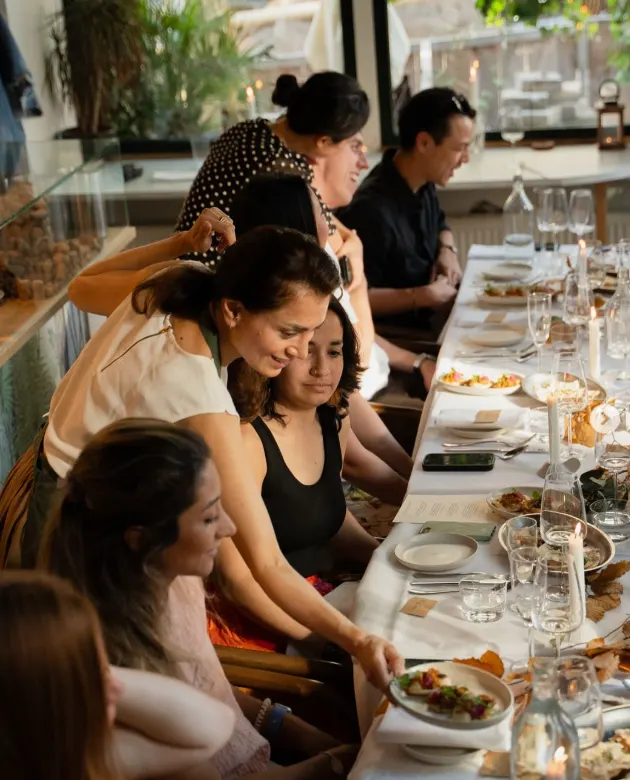
Devinder on a busy day at the Amsterdam City Farm Tasting Room
Where it all began
Devinder grew up in a home where the kitchen was the emotional centre of the house. Her earliest memories are of sitting beside her mother and grandmother whom she calls Bibi, watching dishes take shape, tasting as they developed, and understanding food as a form of care and expression. “Alongside this, I had three strong passions growing up: food, sports, and animals, and in many ways, these continue to shape who I am even today,” she tells The Global Indian.
She studied engineering, and her professional life began in the corporate world after she moved to Europe. Living there for nearly two decades exposed her to different cultures, ways of thinking, and a more structured approach to dining. Through all of it, cooking was a constant. “It was never something I left behind, but something I continued to explore, practise, and develop. What I do today is really a reflection of that journey, bringing together the way I grew up cooking with the way I experienced food in Europe,” she recalls.
Learning by doing, not by training
Her culinary path was shaped more by lived experience than by formal schooling or restaurant kitchens. Growing up, she learned by observing, gradually building her own understanding of flavour, balance, and technique. Much of that early cooking happened over charcoal, with seasonal produce straight from a vegetable garden that the family tended with care. “That way of working with ingredients has stayed with me,” she says.
Living in Europe added another important layer. It brought an exposure to a more refined and structured approach to dining, where the pacing of a meal, the presentation of a dish, and the overall arc of an evening carry as much weight as the food itself. Over years of cooking, experimenting, and refining her sensibility outside any professional framework, she eventually built the confidence to bring her own concept to life.
How Amsterdam became the right place
The idea for her restaurant was a long time in the making. Amsterdam City Farm began not with a dining room but with an alcohol-free craft ginger beer, based on a family recipe passed down from her grandmother and rooted in freshness, fermentation, and a more considered approach to what we consume. The tasting room came later, as a natural extension of that same philosophy.
“When I moved to Amsterdam, I realised that even in an urban environment, it is possible to stay connected to seasonality and local sourcing,” she explains. “Over time, I found myself wanting to bring two worlds together — the way I grew up cooking and the way I experienced food in Europe. I also knew I wanted to present Indian cuisine differently, not in a traditional format, but through a more contemporary expression influenced by different cultures.”
She runs the space alongside Tim, her partner in both life and the restaurant. He focuses on the guest experience while she leads the kitchen, but both are present throughout each service. “That allows the experience to feel intimate, natural, and connected,” she says.
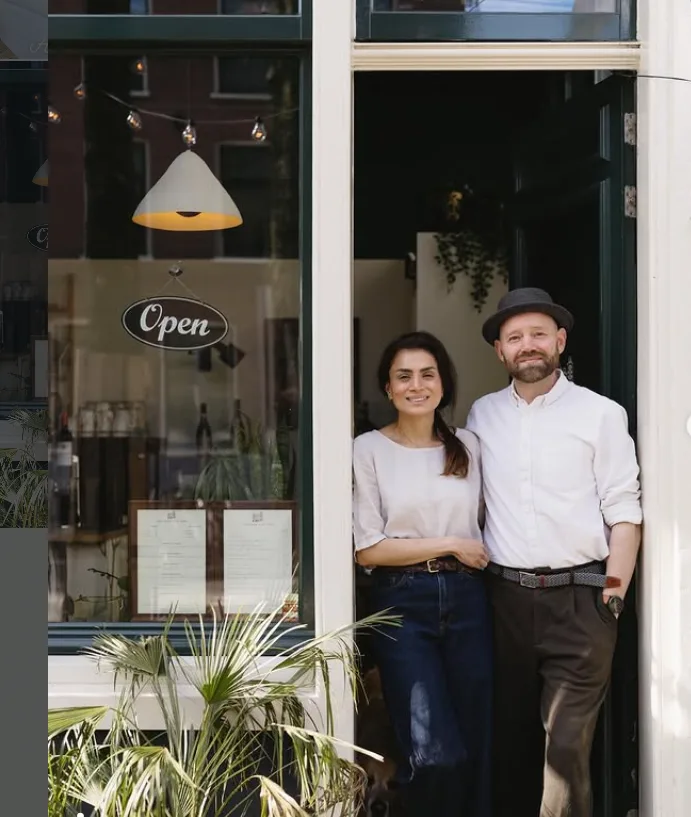
Devinder and Tim
Cooking with the seasons, not against them
With just 16 to 20 guests per service, Amsterdam City Farm Tasting Room operates at a pace that is deliberate by design. The menu changes frequently, shaped by what is in season and available from local markets and trusted suppliers. “This allows the menu to evolve continuously, rather than being fixed,” Devinder says.
Running a vegetable-led menu brings its own discipline. Without meat as a default anchor, every element on the plate must contribute to flavour, texture, and balance. “It pushes us to be more thoughtful and precise in how we build each dish,” she notes. Waste, too, is managed through intention — because the tasting menu format allows for careful planning, ingredients are used with purpose rather than convenience.
“For me, sustainability is less about making a statement and more about making consistent, conscious decisions every day in how we source, cook, and serve,” she adds.
Telling stories through the menu
The tasting menu format is central to the experience Devinder wants to create. Rather than offering choices, she guides guests through a sequence of courses that unfold gradually, each building on the previous one. Stories often accompany the food — the memory behind a dish, the region it draws from, the seasonal ingredient that prompted it.
“This helps guests understand not just what they are eating, but why the dish exists in the way it does,” she says. The drinks are woven into this narrative with equal care — from wines by smaller producers to pairings built around their own ginger beer. Everything is designed to complement the food and complete the arc of the evening.
Presenting progressive Indian cuisine through a seasonal tasting menu with pairings remains relatively uncommon in the Netherlands. “I felt there was space for this,” she says. “It is about showing a different side of Indian cuisine — one that is not limited by expectation but allows space for evolution, refinement, and cross-cultural influence.”

King Oyster at Amsterdam City Farm Tasting Room
What comes next
Running her own restaurant, Devinder admits, is a different kind of work entirely. “Before this, I spent many years in the corporate world, where work is structured and shared across teams. Here, every decision — from the menu to the smallest detail in the guest experience — is something we are directly involved in,” she says.
Expansion, in the conventional sense, is not the goal. “The idea has always been to keep the space intimate and personal. Being closely involved in every detail is an important part of the experience we offer, and that is something we would like to preserve,” she explains.
In the longer term, there is a more personal vision quietly taking shape — a small farmhouse setting where they grow their own produce and host a handful of guests in a fully immersive way. “It is still a thought for the future,” she says, “but it reflects the same intention: staying close to the ingredients and the experience.”
- Follow Devinder Oberoi on Instagram
ALSO READ: Bonding Over Biryani: How King Charles III celebrated Asma Khan’s culinary and charitable legacy