
June 03 2026
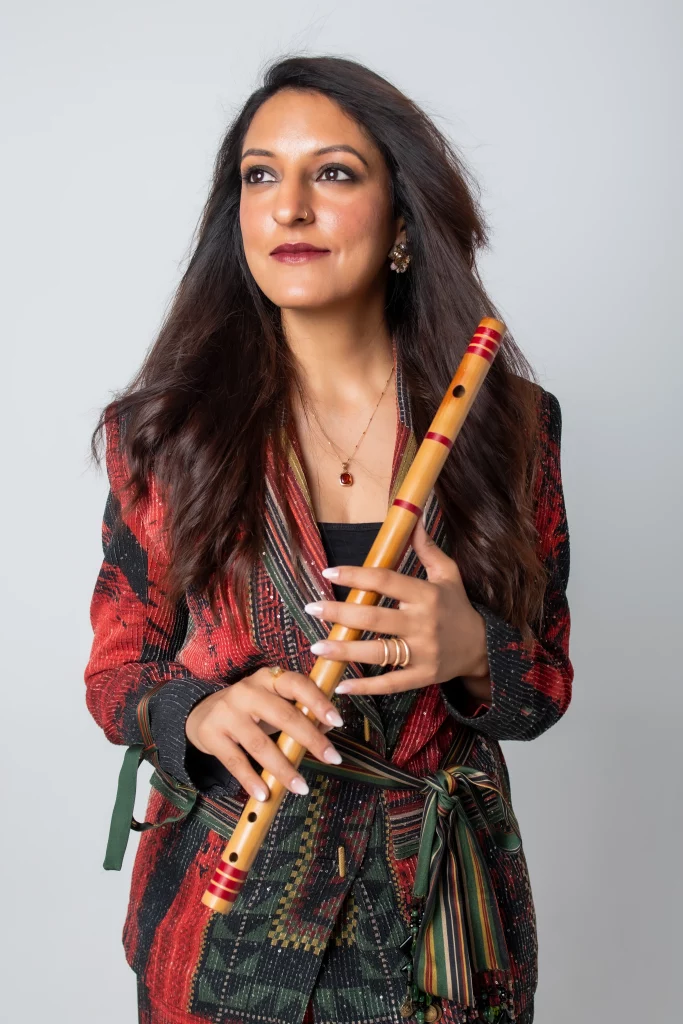
Rasika Shekar: Indian-origin flautist, singer and composer bridging cultures through music

(Jun 3, 2026) Rasika Shekhar is an Indian-origin flautist and vocalist whose collaborations with artists such as John McLaughlin and Amit Trivedi have taken her from film soundtracks like 2 States and Kill Dil to the Marvel series Ms. Marvel. She was also part of the Grammy-winning album Divine Tides.
Born in Dubai, shaped by New Jersey, and deeply rooted in Indian classical traditions, Rasika Shekar has spent years creating music that spans across borders, genres, and cultures. Whether collaborating with musical legends or performing for audiences in countries which are unfamiliar with Indian sounds, the globally-acclaimed flautist and vocalist is quietly moulding the contemporary Indian music landscape in her own distinct way.
Today, as she balances life between India and the United States while embracing a new chapter of motherhood, Rasika finds herself reflecting not only on music, but also on the importance of creating art that relies on honesty rather than algorithms or trends.

An early musical awakening
Although she grew up surrounded by Carnatic traditions, she didn’t give much thought to a career in music. “Music always held a very strong place in my mind and heart though,” she reflects thoughtfully in a chat with The Global Indian.
Her aunt Vaishali Shankar trained her in vocals, while her grandmother Gowri Ramakrishnan, too, came from a strong classical background. Yet it was the city of Dubai that broadened her ears. “It exposes you to so many cultures without even trying,” she reveals. “Your ears are constantly picking up different sounds.”
At the age of 12, her family shifted to New Jersey in the United States: a shift that would deeply shape both her worldview and her music. Instead of moving away from Indian classical traditions, Rasika found herself becoming even more immersed in them. “There was this beautiful community in the US that was incredibly passionate about Carnatic music. So strangely, moving to America actually made me dig deeper into Indian classical music,” she elaborates.
When the flute found her
At the same time, New York City opened up an entirely different world. Jazz clubs, experimental music spaces, concerts, and collaborations exposed her to sounds far beyond traditional classical frameworks. “That access was incredible,” she highlights.
Ironically, Rasika believes the flute chose her long before she consciously chose it. One of her earliest memories involves discovering a flute lying in the balcony of her apartment in Dubai.

Curious, she picked it up and instinctively began playing around with it. Years later, when the family moved to the US and searched for a classical teacher, the first teacher they found happened to be a flute instructor. “When I look back now, it feels like all these tiny moments somehow pieced themselves together,” she laughs. “Like the universe was quietly sending signals.”
Though music increasingly became central to her identity, Rasika initially followed a more conventional academic path. Like many Indian-origin students growing up abroad, she assumed she would eventually become either a doctor or engineer. Fascinated by mathematics and problem-solving, she pursued chemical engineering at Rutgers University. “I genuinely enjoyed engineering. But somewhere along the way, life had other plans,” she muses.
Collaborations across cultures
Music slowly pulled her back in. During college, she began performing more actively and soon landed an extraordinary opportunity — touring with legendary ghazal maestro Ghulam Ali as a vocalist. What began as a chance performance evolved into years of touring and learning alongside one of South Asia’s most revered musicians.
Soon after, Rasika moved increasingly between India and the US, immersing herself in Hindustani and Carnatic traditions while collaborating with a new generation of Indian musicians. Her meeting with the celebrated trio Shankar Mahadevan, Ehsaan Noorani, and Loy Mendonsa became another major turning point. Impressed by her voice and artistry, the trio invited her to sing for films and tour internationally with them.
Over the years, Rasika has worked with several artists across genres such as John McLaughlin and Amit Trivedi showcasing her musical prowess in movies like ‘2 States’, ‘Kill Dill’ and the mini-series ‘Ms. Marvel’. She was also part of the Grammy-winning album named ‘Divine Tides’. Yet, she faced several challenges as a global Indian musician. For years, Indian musicians abroad often found themselves “exoticized”, she explains. “I never wanted to create music just to fit or break a category.”
Sounds without boundaries
Instead, Rasika focused on building an honest musical language that reflected her own emotional experiences. Her work naturally began blending Carnatic influences with jazz, Hindustani, Sufi, blues, and contemporary sounds — not as a strategy, but as a genuine reflection of her life across cultures.
That openness eventually led her to Berklee College of Music in Valencia, Spain, where she pursued a master’s degree that expanded her artistic vocabulary even further. Berklee’s flexible structure allowed her to continue exploring Indian classical traditions while simultaneously engaging with global musical forms. “Berklee helped me unlock my voice,” she notes.
The years since have brought performances across continents, collaborations with globally renowned artists, and increasingly experimental projects. One particularly memorable experience took place in Tunisia, where Rasika performed before an audience that had never heard Indian classical music before. “Watching people emotionally connect to music despite not understanding the form was incredibly powerful,” she recalls.

More recently, she collaborated with acclaimed pianist and composer Chad Lawson on a wellness-focused musical project that explored calmness, stillness, and emotional healing through sound. The collaboration, she points out, unfolded organically through improvisation and mutual respect. “It felt like walking into a blank canvas,” she says and adds, “Those spontaneous collaborations are sometimes the most magical.”
Giving back through music
Even amid international performances and collaborations, Rasika remains deeply invested in mentorship and access to music education. During her visits to Chennai, she spends time at orphanages, singing with children and thinking about ways to help them explore music beyond casual exposure. “Music teaches resilience, persistence, discipline,” she informs. “Even if someone never becomes a professional musician, learning music shapes you in powerful ways.”
Now a new mother to a two-month-old daughter, Rasika admits life has slowed down in unexpected ways. Sleep schedules are chaotic, days blur together, and studio plans now revolve around baby naps. Yet she describes the experience with visible joy. “So many things have started shifting in my mind. It’s a completely new phase,” she exclaims.
At the same time, she finds herself increasingly hopeful about the future of music itself. In an age dominated by short-form content and endless scrolling, Rasika believes audiences are slowly beginning to crave depth again. “I think people are starting to return to music in a deeper way,” she says. “I see audiences putting their phones away at concerts and just wanting to be present.”
For an artist who has spent years chasing emotional truth rather than trends, that shift feels deeply meaningful. “I think people are finally ready for the meal again, not just bite-sized information,” she sums up.
ALSO READ: Aditya Prakash: Making Karnatik music cool, one concert at a time
Rasika Shekar
| Born | 4 April, 1989, Dubai |
| Based | New York, USA | Mumbai, India |
| Studied | Bachelor's, Rutgers University, USA | Master's, Berklee College of Music, Spain |
| Languages | English, Tamil, Hindi |
Signature work
Known for blending Carnatic traditions with global musical styles, the Indian-origin flautist and singer has performed across continents and collaborated with acclaimed musicians. Her body of work includes the Marvel series Ms. Marvel, the films 2 States and Kill Dil, and the Grammy-winning album Divine Tides.
Idea
Building an authentic musical language that blends Indian classical traditions with global influences.
Network
Collaborating with internationally acclaimed artists including John McLaughlin, Amit Trivedi, A. R. Rahman, Ricky Kej, Shankar Mahadevan, Ehsaan Noorani, Loy Mendonsa, Ghulam Ali, and Chad Lawson, while performing across multiple continents.
Impact
Taking Indian classical influences to global audiences through performances and award-winning projects.
Giving back
Promotes access to music education by engaging with children at orphanages and advocating for the role of music in building resilience, discipline, and personal growth.
Inspired by Rasika Shekar 's journey?
Yours follows the same Hero's pattern — Separation, Initiation, Transformation, Return.

Share with



Written By: Vikram Sharma

Excellent writing on a flute player and singer: her diction is not anglicised. Her Hindi is spot on.