


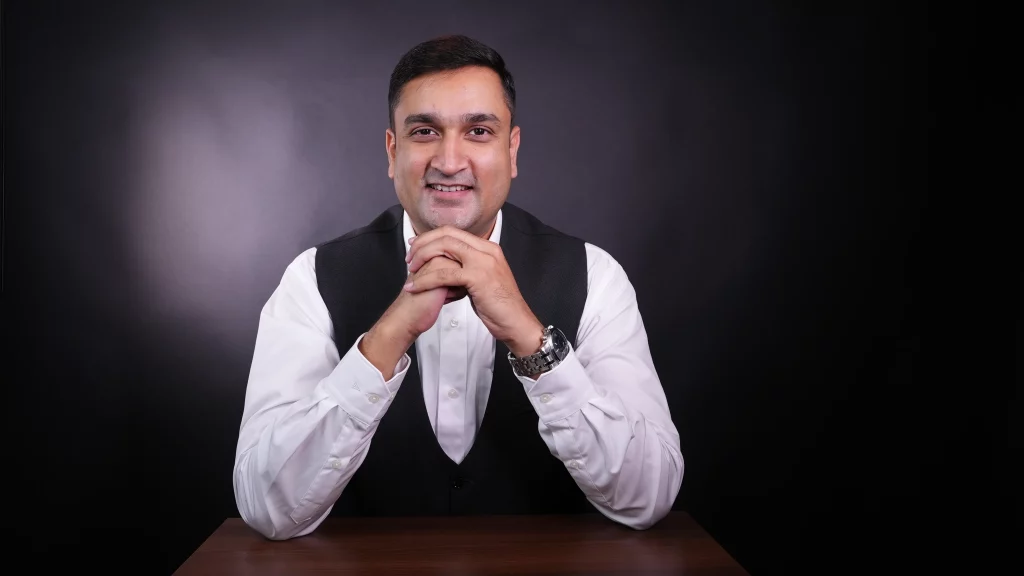
(Jun 6, 2026) Splitting his time between Dubai and Bengaluru, handwriting analysis coach Imran Baig believes that a single glance at one’s handwriting can reveal up to 128 aspects of personality and offer insights into overall health and well-being. He has spent more than 22 years helping people understand behavioural patterns and make better decisions through handwriting analysis and graphotherapy. What began as curiosity eventually evolved into a profession centred on self-awareness and personal transformation.
For Imran Baig, understanding people proved far more compelling than understanding machines. Although he graduated in computer applications, he realised very early that his interests lay elsewhere and chose not to pursue a conventional technology career. Instead, he found his calling in understanding human behaviour.
“For the last 22 years, I have been practising handwriting analysis and graphotherapy. What started as curiosity slowly became my life’s purpose. Today, as a handwriting analysis coach, I am committed to empowering people through what I call the ‘education of the self’ by helping them understand their patterns, emotions, behaviours and potential through handwriting analysis,” says Baig in a chat with The Global Indian.
Over the years, he has built a practice that serves students, professionals, executives and homemakers, helping them gain greater self-awareness through their handwriting.
Curiosity became a calling
Baig traces his interest in understanding people back to his college years. Even then, he found himself asking questions that had little to do with technology.
“We know how to operate a laptop or a refrigerator, but we don’t understand why people behave the way they do, why they get angry, emotionally shut down or react differently to situations,” he says. That curiosity led him to explore body language, neuro-linguistic programming (NLP) and several other approaches to understanding behaviour. Among all of them, handwriting analysis stood out.
“Among all of them, handwriting analysis stood out as the most accurate and the easiest way to decode human behaviour. As I started practising it, people deeply resonated with the accuracy of the insights,” he says.
One interaction, in particular, strengthened his belief in the discipline. During a talk at a Rotary Club, Baig happened to analyse the handwriting of a woman who was going through emotional turmoil. Their subsequent conversation, he says, helped her recognise patterns of self-sabotage and reconnect with herself. “That moment inspired me to dedicate my life to sharing this knowledge with the world,” he says.
Looking beyond words on paper
According to Baig, handwriting is far more than a mechanical act or simply a way of putting words on paper. “Every stroke we make is guided by the brain, emotions, habits, conditioning and subconscious patterns. Every time you pick up a pen, your brain is orchestrating an enormously complex neurological process, and what comes out on that page is essentially a printout of your inner world,” he explains.
He says that elements such as the size of letters, writing pressure, spacing between words and the angle of strokes provide clues about behavioural tendencies and emotional patterns.
“What graphology does is give us a language to decode those expressions. A person who writes with heavy pressure isn’t just pressing hard. They often carry emotional intensity and strong convictions. Someone whose words drift upward on an unlined page tends to be an optimist, someone who rises toward possibility,” he says.
What fascinates him most is that handwriting often reveals aspects of a person that even verbal communication may hide. “People can carefully choose their words, but their writing movement tends to express their authentic inner patterns more naturally.”
Patterns that emerge over time
After analysing handwriting samples across different age groups and professions, Baig says certain themes tend to appear repeatedly.
“Over the years, I have observed certain recurring emotional and behavioural patterns reflected through handwriting. Anxiety, self-doubt, emotional suppression, impatience, perfectionism, sensitivity and a strong need for validation are among the most common traits I encounter,” he explains.
However, he stresses that graphology is not about putting people into boxes. “It helps identify patterns and tendencies that can support greater self-awareness, emotional healing and personal growth,” he says. “What moves me most is when I see a discrepancy — someone whose words say confidence but whose handwriting whispers otherwise. That gap between the presented self and the felt self is where the most meaningful conversations begin.”
Using handwriting as a tool for change
Beyond analysis, Baig also works with graphotherapy, which involves consciously modifying handwriting patterns.
“Handwriting is not only an outcome of personality; it can also become a tool to influence and reshape behavioural patterns. When we consciously change the strokes in our handwriting with consistency and awareness, we begin stimulating new neural and emotional responses in the brain,” he says.
He recalls introducing a simple exercise to individuals struggling with confidence by changing the placement of the T-bar. “Over weeks, with consistent practice, many of them began to report a subtle but real shift in how they carried themselves. It sounds almost too simple. But the brain responds to repetition and pattern, and when you repeatedly inscribe a more empowered self on the page, you begin to internalise that identity,” he explains.
Why handwriting still matters in a digital age
In an era dominated by keyboards and screens, Baig believes handwriting has lost none of its significance. “I think the digital age has made handwriting more relevant, not less. Precisely because we now live so much of our lives in a frictionless, typed, backspace-friendly world, the act of putting pen to paper has become one of the last truly raw, unedited forms of human expression left to us,” he says.
“Typing is largely uniform and impersonal, whereas handwriting remains deeply individual and emotionally expressive.” Even today, he believes handwriting continues to reveal authenticity, emotional state and cognitive patterns.
“In many ways, its importance has increased because genuine human expression has become rarer in fast-paced digital communication,” he adds.
View this post on Instagram
Responding to scepticism
Working at the intersection of behavioural observation and self-development means encountering scepticism, something Baig views as both natural and healthy.
“I always encourage people to approach graphology with curiosity rather than blind belief. My work is not about making exaggerated claims or predicting someone’s destiny. It is about behavioural observation, pattern recognition and self-awareness,” he says.
Over the years, he says, he has seen handwriting analysis help individuals understand themselves better, improve relationships, strengthen confidence and identify subconscious blocks they were previously unaware of.
“A practice that cannot withstand scrutiny does not deserve trust, and I have no interest in asking anyone to believe something simply on faith,” he says. For Baig, intellectual fairness is important. “The same rigour people apply in questioning graphology should also be applied in examining the evidence,” he says.
Understanding the human story
More than two decades in the field have deepened Baig’s empathy towards people. He believes that behind every behaviour lies an emotional story, a conditioning pattern or an unmet need.
More than anything, he says, the journey has reinforced the importance of self-understanding. “We have all become extraordinarily skilled at managing how we are perceived. Handwriting cuts beneath that. It doesn’t ask for your curated self. It takes what is actually there,” he says.
“What moves me, after all these years, is the consistency of the human longing I encounter — to be seen, to be understood and to believe that one is fundamentally worthy.” For Baig, handwriting analysis has become much more than a profession. It is a way of helping people understand themselves better and, in the process, navigate life with greater awareness.
“More than anything, handwriting analysis has reminded me that education of self is the most divine education one can have,” he signs off.