
November 25 2026
Lakshmipriya Devi and the Manipuri film that made BAFTA history

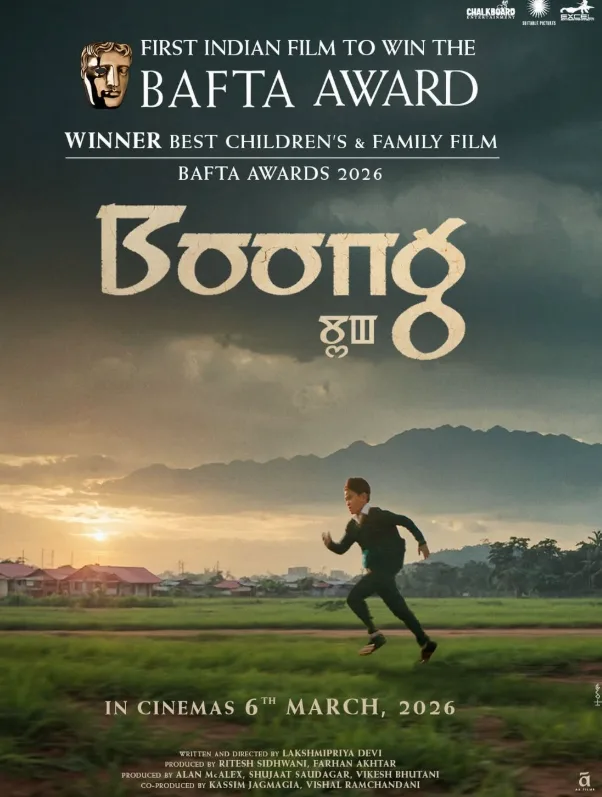
(Nov 25, 2026) This year, Lakshmipriya Devi’s Meitei-language drama Boong won Best Children’s & Family Film at the awards of the British Academy of Film and Television Arts (BAFTA), among the most prestigious honours in world cinema. It became the first Indian film to take the award. Since then, the film has returned to Indian cinemas, done strong business at the box office and picked up further festival honours abroad.
Lakshmipriya Devi never set out to make Boong. The Imphal-born filmmaker wrote the story, she has said, “like a diary”, as a way of putting her Manipur childhood on paper and getting it “out of my system, like a closure”. She did not expect it to be filmed. Once it was, she assumed it would be her first and last film.
In February 2026, that private diary took Best Children’s & Family Film at the British Academy Film Awards, the first Indian film to win the award. It finished ahead of Disney’s Lilo & Stitch and Zootopia 2.
Nine months on, the win remains a landmark for Manipuri cinema. How a small Meitei-language film travelled from a filmmaker’s notebook to a London stage is a story worth telling slowly.
This is a film about this boy who wants to get a really special gift for his mother. And he thinks that by bringing his father back from this border town where he works — the border of Myanmar and India, that would be the most special gift. So it is his journey and how the journey transforms him.
Lakshmipriya Devi
From Imphal to Mumbai’s film sets
Lakshmipriya grew up in Imphal. Her aunt was M.K. Binodini Devi, the writer, social activist and filmmaker who was born a princess.
Cinema was not the plan. Lakshmipriya describes her career as a series of happy accidents. She recalls that when she changed course, the first thing she did was sell her MBA preparation books.
From the early 2000s she worked in Hindi cinema as an assistant director, much of it on Excel Entertainment productions. Her credits include Lakshya, Luck by Chance, Talaash and PK, and she was first assistant director on the series A Suitable Boy. Excel’s Farhan Akhtar and Ritesh Sidhwani would later back her debut as producers.
A diary that became a script
Boong follows a schoolboy in the Manipur valley known as Boong. He wants to give his mother a truly special gift. He decides the best present would be to bring home his father, who works in a town on the India-Myanmar border. The search upends the world he knows, but it leaves him with a gift of another kind.
I never thought this would become a film in the first place. Personal memories, like folk tales, my grandmother’s tales as well… I was writing like a diary. It became a script, and then sent it to a friend who budgeted it and it became a movie.
Lakshmipriya Devi
Believing it would be her only film, she first tried to say everything. She told The Hollywood Reporter India that her early drafts carried curfews, violence and strong political undertones, until she accepted that she was writing a children’s film. The finished film looks at identity, displacement and belonging through a child’s eyes, with warmth and humour. Its theme, Lakshmipriya says, is closure: “You have to close something to start a new beginning.”
Made in Manipur, with Manipur
Lakshmipriya approached the film as a memory of the Manipur she grew up in. Villages today are less remote than the ones she remembered, so she travelled through four or five districts to find locations that matched them.
She found her lead, Gugun Kipgen, almost by chance. A distant relative had come in to interview for a production job, and Lakshmipriya put the interview aside to ask whether she knew a child who might suit the part. The cast also includes Bala Hijam, Angom Sanamatum, Vikram Kochhar, Nemetia Ngangbam, Jenny Khurai and Hamom Sadananda. Tanay Satam shot the film and Shreyas Beltangdy edited it.
The cast and crew came from different communities in Manipur. Lakshmipriya has said they kept a spirit of community after the state’s ethnic conflict began. She told the Hindustan Times that seeing Kukis and Meiteis work together, and watch the film together, was her greatest reward.
Finishing it was hard. Lakshmipriya has said she broke down whenever she watched the footage, which slowed post-production. It took a couple of months before she could look at the material objectively.
From Toronto to the Royal Festival Hall
Boong had its world premiere in the Discovery section of the Toronto International Film Festival in September 2024. Later that year it won Best Youth Film at the Asia Pacific Screen Awards. In 2025 the Indian Film Festival of Melbourne chose it as its Spotlight Film, and it opened in select Indian cities in September 2025.
At the 79th BAFTAs, its nomination for Best Children’s & Family Film put it up against Lilo & Stitch, Zootopia 2 and the French film Arco. In February 2026, at London’s Royal Festival Hall, it won.
Lakshmipriya went on stage with producers Farhan Akhtar, Ritesh Sidhwani and Alan McAlex. In her speech she described the film as coming from a deeply troubled place. She spoke of forgiveness as the one superpower no conflict should be strong enough to destroy. Asked later how the win felt, she answered in one word: “Amazing.”
What the award changed
Lakshmipriya is clear-eyed about what a prize like this is for. Films like hers, she told in an interview, “barely have a space anywhere, whether it is in India or outside”. A major award, in her words, is “literally like the ventilator… so the film gets a chance to survive”.
The months since February have put that idea to the test. Excel Entertainment re-released Boong in Indian cinemas in March 2026. By mid-March, PTI reported that it had become the first Manipuri film to cross ₹1 crore at the box office, and the makers have since called it the highest-grossing Manipuri film to date. It has also kept collecting festival honours, including Best Feature Film at the South Asian Film, Literary and Cultural Festival in Washington DC, where Gugun Kipgen was named Best Young Talent.
Reaching wider audiences matters to her. The film had a brief streaming run on MUBI during its festival circuit. Lakshmipriya says she is leaving its wider release to the producers. She is clear, though, that the film is not “a secret that we are going to lock up in the vaults of some Reserve Bank of India”. As she puts it, “We want it to be widely seen.”
Labels, voice and the politics of home
Lakshmipriya is wary of the boxes she gets put in. At a press conference ahead of the film’s post-BAFTA release in India, she spoke about often being labelled a woman director or a filmmaker from the Northeast. She also credited the pandemic and social media with helping films from northeastern India reach audiences beyond the region.
On politics, she is careful. She calls herself a “small fry” when asked what filmmakers should say in public, and leaves that to each individual. But she rejects the idea that politics only means elections. “Even inside the family is a power equation,” she told in an interview, adding that “when you don’t have a voice, that is political”.
That view was formed at home. She has recalled that at the age of 10, her heart would pound at every knock on the front door. “You cannot separate what is happening outside your home with what is happening inside,” she says. In a small place where everyone knows everyone, she adds, news travels quickly and becomes personal.
What comes next
Lakshmipriya speaks cautiously about what comes next. She still describes Boong as the film she thought would be her last, and says she will make another only if she finds a story she truly wants to tell.
She accepts that the BAFTA may change how the industry sees her. “People will maybe say, okay, she could maybe tell a decent story,” she said. “The perception about me could change, who knows? But more than me, it’s a big thing for the film.”
The bigger meaning, for her, lies beyond her own career. Speaking to PTI in March, she called the award a reminder to the world of a place called Manipur. For a story that began as a diary no one was meant to read, that may be its most lasting achievement.
ALSO READ: Suresh Eriyat: From his father’s ghost stories to global animation acclaim


Written By: Deepa Natarajan Lobo
Nandita Chakraborty: Indo-Australian filmmaker bringing migration, memory and food to ‘Shared Table’

Written By: Deepa Natarajan Lobo