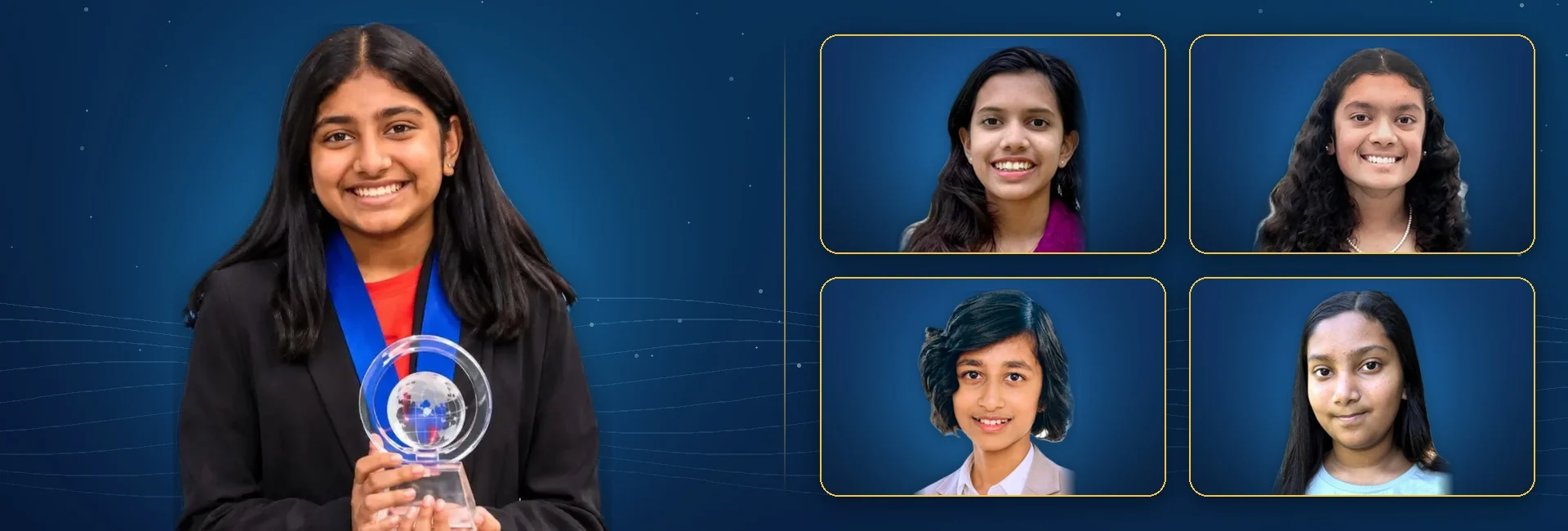


(Oct 18, 2026) Thirteen-year-old Raji Doshi has won America’s Top Young Scientist title for developing a system that explores how algae and a naturally occurring mineral could help reduce ocean acidification. Her victory at the 2026 3M Young Scientist Challenge also marks a strong showing by Indian-origin students in the United States, with all three top finishers of Indian origin and five of the ten finalists reported to be from the community.
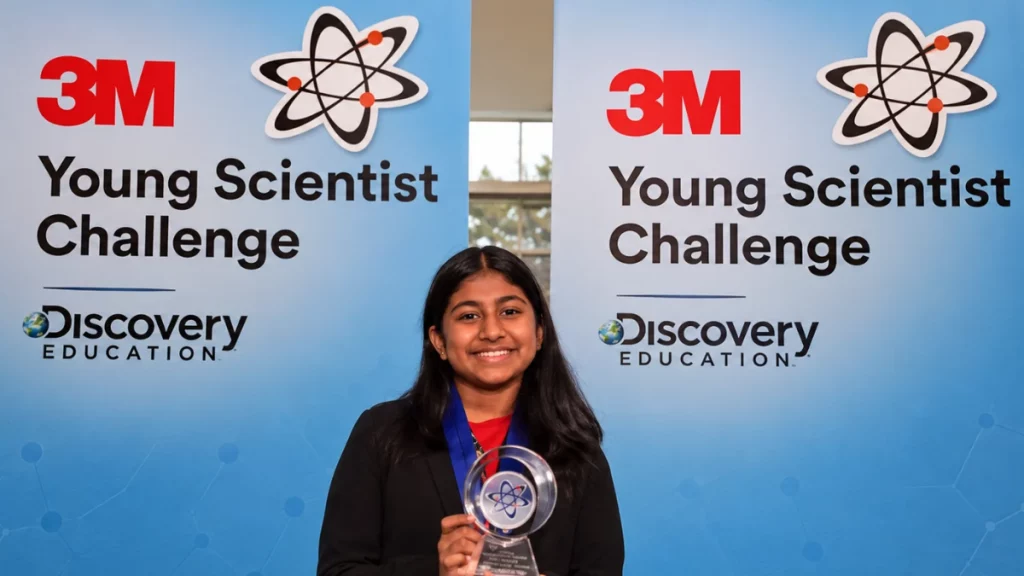
An eighth grader from Farmington, Connecticut, Raji won the $25,000 grand prize for ALKACORE, her experimental algae-and-aragonite system designed to help reduce carbon dioxide in seawater and counter rising acidity. The results were announced by 3M and Discovery Education in a press release on October 14, following the final events at 3M’s global headquarters in St. Paul, Minnesota, on October 12 and 13.
Now in its 19th year, the Young Scientist Challenge is run by 3M in partnership with Discovery Education, an education technology company, giving students opportunities to develop real-world solutions with guidance from professional scientists.
Raji’s win was accompanied by second place for Aaisha Asif and third place for Sharvi Mahajan, making the top three entirely Indian-origin. Their projects address three very different challenges: ocean acidification, environmentally friendlier adhesives and technology that could help detect driver fatigue.
For Raji, the path to the competition began not in a laboratory, but on the shores of Long Island Sound, where collecting seashells was one of her favourite pastimes.
From collecting seashells to investigating ocean acidification
“I’ve always loved walking on the Long Island Sound and collecting shells. It’s kind of one of my happy places,” Raji told in an interview with WSFB 3 before the competition finals.
Over time, she began noticing holes in some of the shells. Curious about what was happening, she researched the problem and learnt how increasingly acidic seawater can affect marine organisms.
“I knew I wanted to do something real about it,” she said. Her concern pointed her towards a problem that is less visible than plastic waste on beaches but has serious implications for marine ecosystems. The oceans absorb a substantial amount of the carbon dioxide released into the atmosphere. Although this helps limit the amount of the greenhouse gas remaining in the air, it also changes the chemistry of seawater.
When carbon dioxide dissolves in seawater, it triggers chemical reactions that lower the water’s pH, making it more acidic. This process is known as ocean acidification. It can make it harder for marine organisms such as oysters, clams and some plankton to build and maintain their shells and other calcium carbonate structures. Corals can also be affected.
Raji who studies at the Talcott Mountain Acdemy explained the problem in the interview, mentioning, “The ocean has been absorbing carbon dioxide at an alarming rate. It’s absorbed almost a third of the carbon dioxide that we put out into the air,” she said. “So, this makes it more acidic. And acidic water actually dissolves shells.”
She also described why she felt a responsibility to act: “Our ocean has been protecting us by absorbing this carbon dioxide. And I’ve always wanted to protect our oceans back.”
How algae and crushed shells could help
Raji’s project, titled Engineering a Novel Durable Algae-Aragonite Alkalinity System to Reduce CO2-Driven Ocean Acidification, investigates whether combining algae cultivation with aragonite could help counter changes in seawater chemistry.
Aragonite is a naturally occurring mineral made of calcium carbonate, the same chemical compound found in seashells and coral skeletons. It can help buffer changes in water chemistry, making seawater more resistant to shifts in acidity. In simple terms, the idea is to encourage algae to grow while using aragonite to help maintain a more favourable chemical balance in the water. Raji investigated whether combining the two could reduce dissolved carbon dioxide and increase alkalinity.
The project is called ALKACORE. Its potential appeal lies in exploring a system based on naturally occurring materials that might eventually offer a practical, relatively low-cost approach to coastal acidification.
4,000 measurements and a result that stood out
Developing the project involved sustained experimentation, much of it carried out at home.
During the television interview, Raji’s father, Kamal, said she had taken close to 4,000 measurements over 42 days. Raji described the work as a process of comparing water samples under different conditions, including a control group and samples treated with aragonite.
Her work earned her a place among the ten national finalists, each of whom was paired with a 3M scientist for one-on-one mentoring. Raji worked with Deborah Isabelle, a product engineering specialist at 3M, who guided her as she developed her idea towards a prototype.
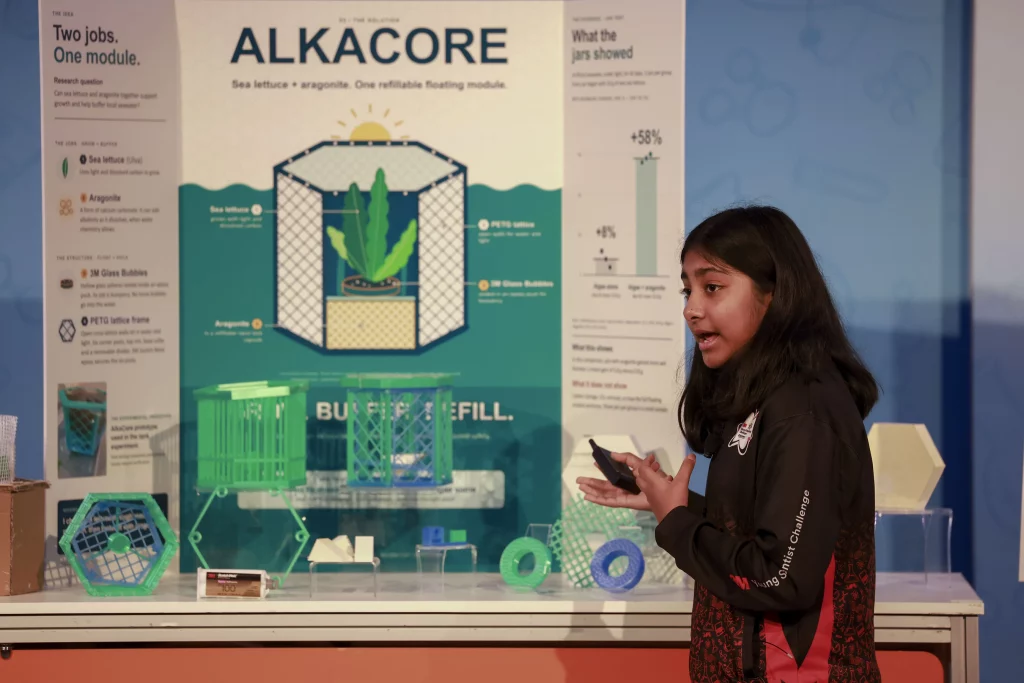
Raji Doshi at YSC presentation | Image Credit: 3M
Parents who helped turn curiosity into research
Raji’s interest in the natural world developed through family trips to Long Island Sound. She told WSFB 3 that her parents encouraged both her and her sibling to explore science, technology, engineering and mathematics, commonly grouped under the acronym STEM.
“Ever since I was little, they’ve been taking me to the Long Island Sound and I’ve been walking along the beach,” she said. “My parents have always encouraged it. And so, when I became interested in this, they helped me pursue my passion.” Her parents helped source materials and arrange the collection of seawater using a water pump.
What is the 3M Young Scientist Challenge?
3M, it is a global science and technology company that applies research and engineering to practical problems. Its work spans areas including workplace safety, healthcare, adhesives, materials science and industrial technologies.
The 3M Young Scientist Challenge, organised with Discovery Education, is a national science competition for middle school students in the United States. Now in its 19th year, it invites young people to identify an everyday or real-world problem and develop a scientific or technological response.
Ten finalists are selected to develop their projects further, working individually with 3M scientists over the summer. They receive guidance as they refine their ideas and build prototypes, and are assessed on scientific understanding, creativity, communication, ingenuity, research and the application of STEM principles.
The 2026 finalists, aged 11 to 14, presented their projects at 3M’s headquarters in Minnesota on October 12 and 13. The competition recognises not just an interesting concept, but a student’s ability to investigate a problem and apply scientific thinking to a possible solution.
Aaisha Asif takes second place with a mussel-inspired adhesive
Aaisha Asif, a seventh grader at Pine View School in Sarasota, Florida, finished second in the 2026 3M Young Scientist Challenge.
Her project explores an adhesive inspired by mussels, which attach themselves firmly to surfaces in wet environments. It uses natural proteins and iron-based crosslinkers to create strong bonds, with the aim of offering an alternative to conventional glues that may release volatile organic compounds.
These compounds can contribute to air pollution and, depending on the substance and level of exposure, may affect human health. Aaisha’s research explores whether nature-inspired materials could help reduce some of the environmental drawbacks of conventional adhesives. She hopes to become an environmental scientist.
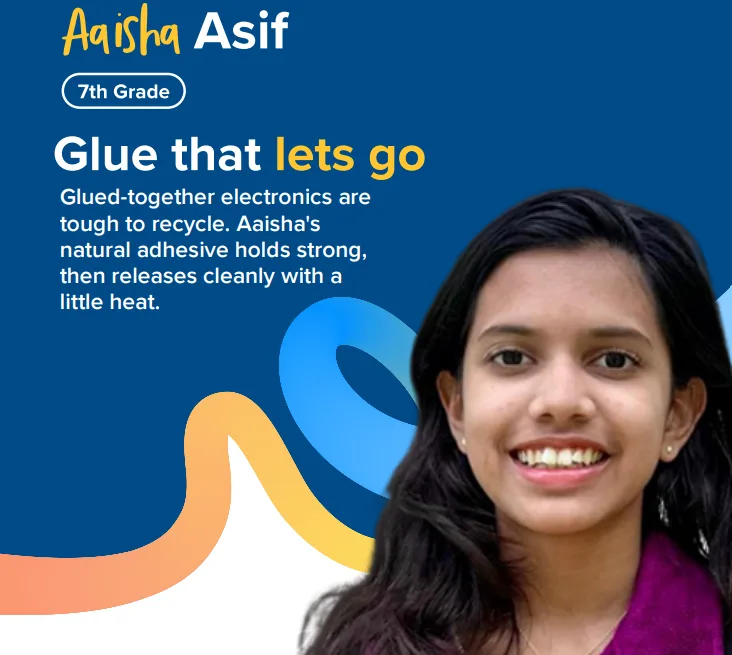
Aisha Asif | Image Credit: Discovery Education
Sharvi Mahajan takes third place with a brain-signal system to detect fatigue
Third-place finisher Sharvi Mahajan, a ninth grader at Westview High School in San Diego, California, developed NeuroDrive Alert, a system that combines brain-signal monitoring with machine learning to track fatigue and predict microsleep.
Microsleep is a brief, unintended episode of sleep that can occur when a person is severely tired. For a driver, even a short lapse in awareness can have serious consequences.
Sharvi’s project uses electroencephalography, or EEG, which measures electrical activity in the brain, alongside machine-learning techniques to identify patterns associated with fatigue. The aim is to anticipate microsleep and provide a warning, with possible applications in driving and other activities where alertness is essential.
She hopes to become a computational neuroscientist and establish a company developing artificial intelligence models for neuroscience.
The three winning projects apply scientific investigation to distinct challenges, from ocean acidification and sustainable materials to fatigue detection and road safety.
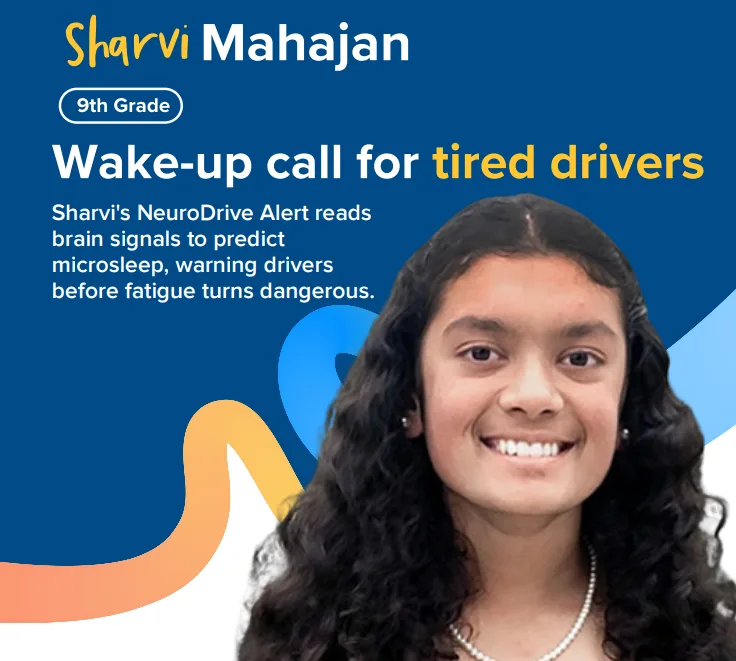
Sharvi Mahajan | Image Credit: Discovery Education
Arika Kundu and Naboshree Santra explore environmental solutions
Arika Kundu and Naboshree Santra, two other Indian-origin students among the ten finalists, also focused on environmental challenges.
Arika, an eighth grader from Shorewood, Minnesota, developed LIGNEX, a project investigating how agricultural waste, including peanut shells, could absorb pesticide residues from fresh produce. The idea explores a potential use for discarded plant materials while addressing concerns about chemical residues on food. Arika was also named Minnesota’s State Merit winner and hopes to become an astrobiologist working in computational biology.
Naboshree, a seventh grader from Oviedo, Florida, developed biodegradable “soilshade balls” designed to reduce evaporation and help soil retain moisture. The project addresses a challenge for farmers in drought-prone areas, where conserving soil moisture can be important for crop growth.
At 11, Naboshree was the youngest finalist when the group was announced. The other finalists were Ahmed Abdelsalam of Cambridge, Massachusetts; Aiden Jo of Houston, Texas; Roy Kim of Beaverton, Oregon; Millie Pradawong of Fairfax, Virginia; and Abigail Stein of Nashville, Tennessee.
Indian-origin students accounted for half of the ten finalists. Raji, Aaisha and Sharvi also claimed all three top positions.
Future plans
When asked about her ambitions, Raji did not limit herself to laboratory research on Earth. “I actually want to become an aerospace engineer for NASA, helping build tools to watch over our oceans from space,” she said in her interview with WFSB 3.
For now, her achievement is a winning project that began with a simple question about holes in seashells. Her experiments with algae and aragonite have opened up a line of inquiry into ocean acidification, while the 2026 3M Young Scientist Challenge has recognised her ability to turn curiosity into research.
ALSO READ: Sirish Subash earns ‘America’s Top Young Scientist’ title in the 3M Young Scientist Challenge 2024