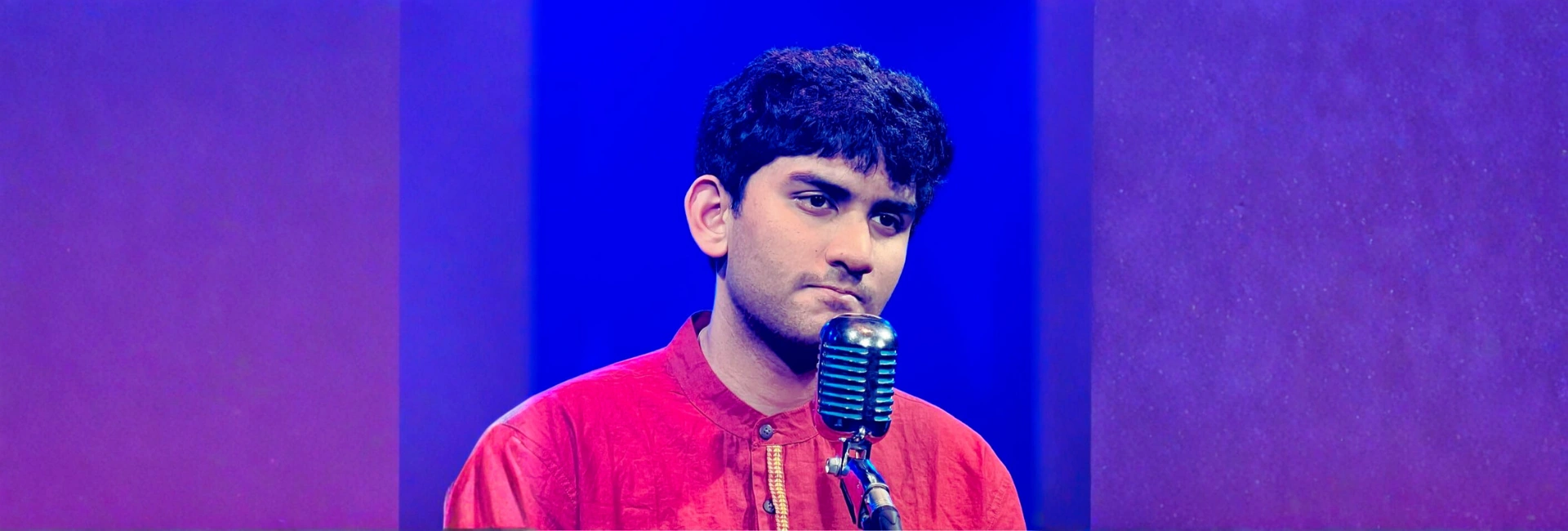


(March 24, 2026) In New York, where the pace of life rarely slows, Navaneeth Unnikrishnan, known as Nav to friends,, moves between two worlds with ease. The 21-year-old has recently completed his bachelor’s degree in data science from New York University. Classical music has been part of his life since early childhood.
Nav has grown into an established artist, performing on multiple stages in the United States and India. He has also built a strong online following, where listeners are drawn to the charm of his nuanced analyses delivered in an American accent, paired with authentic, deeply rooted vocal performances.
Early notes and lasting roots
Born in Phoenix, Arizona, to parents who migrated from Kerala, Nav’s journey into music began almost before memory. As an infant, he responded instinctively to sound, tapping and humming along to whatever played around him. His parents, recognizing that early spark, chose to give it direction. By the age of four, he had begun formal training in Hindustani classical music under Dr. Vijay Sri Sharma, laying the foundation for what would become a lifelong pursuit. That early training has since expanded into both Hindustani and Carnatic systems.
“Navaneeth began singing almost as soon as he started speaking, around one and a half years old. Though he never formally learned the keyboard or piano, he could play songs on a keyboard from a very young age. By the time he was two, he could recall thousands of Indian songs across Malayalam, Hindi, and Tamil,” his father, Unni Vadakkan, tells Global Indian.
A home shaped by migration and music
“I noticed that even when he was two, he would sing full songs, including the interludes and even the musical background,” recalls his father, who moved to the United States in 1998 to pursue a PhD at Purdue University. “We are not trained musicians, just listeners, so he was constantly exposed to music—whether during long drives or while watching television at home.”
His father went on to build a career across companies such as TCS, Intel, Qualcomm, Amazon, and Microsoft, and is currently with Marvell Technology. Navaneeth’s mother, Priya, works as a paediatrician, and he has a younger brother, Anirudh.
Two systems, one sensibility
Nav describes Indian classical music as an ocean—vast, layered, and impossible to fully master. The more he has learned, the more expansive it has seemed. His decision to study both Hindustani and Carnatic traditions stemmed from a desire not just to perform, but to understand and absorb different musical languages and the ideas they carry.
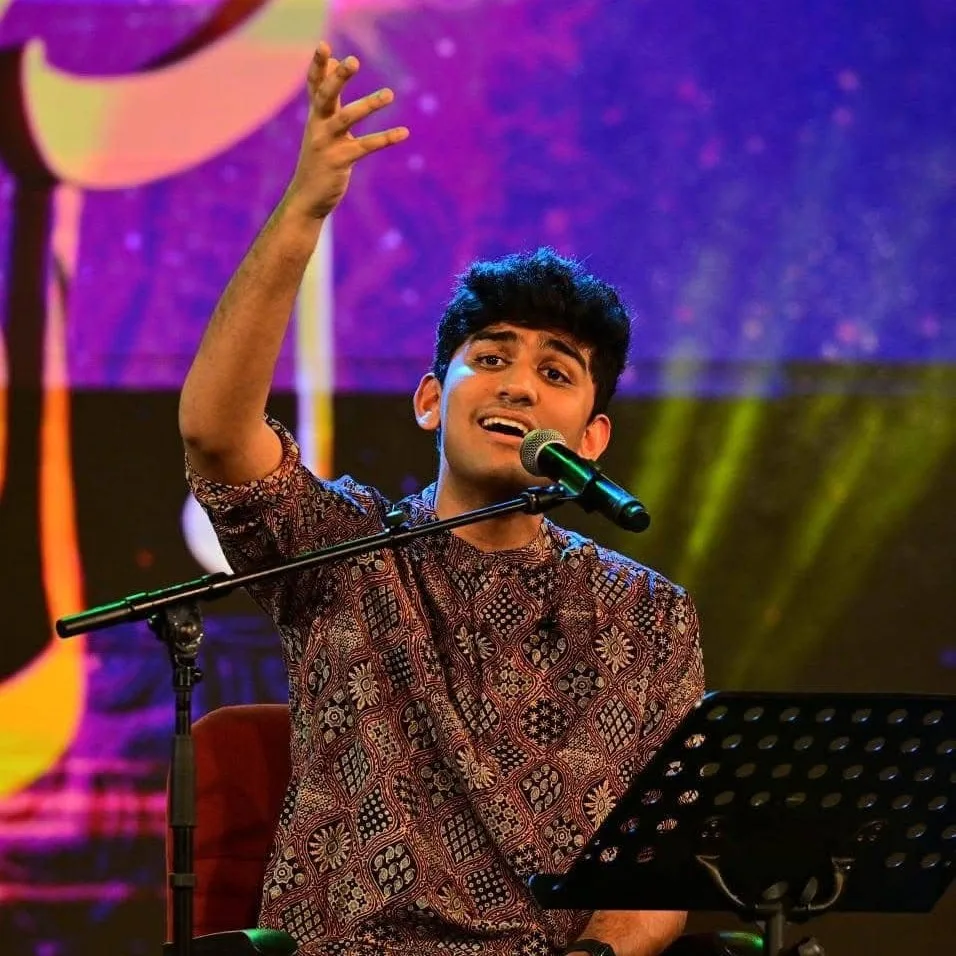
He sees ragas as living frameworks rather than rigid structures. “If the notes form a canvas, then stylistic nuances like gamakas in Carnatic music and meends in Hindustani become the brushstrokes that define expression,” he says. “The same note, approached differently, can evoke entirely different emotions—intensity in one system, longing in another.”
For Nav, the distinction is as much emotional as it is technical. Hindustani music offers a sense of spaciousness and introspection, while Carnatic music appeals through its rhythmic precision and structural clarity. Together, they form a complementary whole, like two languages sharing a common root.
From ragas to reels
It is this layered understanding that has found resonance online. Nav’s social media presence has grown steadily, driven by short, thoughtful videos that unpack the classical foundations of Malayalam film songs. His focus often turns to composers like Devarajan Master and M. S. Baburaj, whose work subtly bridges classical and popular traditions.
In these videos, Nav breaks down melodies with clarity and care, tracing their roots to specific ragas, explaining how compositions stretch or reshape classical contours, and revealing details that casual listeners might miss. His approach is understated but effective, turning familiar songs into entry points for deeper musical appreciation.
Rather than simplifying classical music, he reframes it, showing how it already exists within everyday listening. The result is a growing audience that sees him not just as a performer, but as an interpreter.
View this post on Instagram
For his extraordinary talent, he was conferred the Swaralaya Devarajan Master Award last year, joining a distinguished list of past recipients that includes stalwarts such as Dr. K. J. Yesudas, the legendary playback singer; S. P. Balasubrahmanyam, one of India’s most prolific and celebrated vocalists; Ravindra Jain, the acclaimed composer and lyricist; M. Jayachandran, the noted contemporary music director; and Usha Khanna, one of Hindi cinema’s pioneering women composers.
Tradition, curiosity, and crossovers
Nav’s musical influences extend far beyond the classical canon. His listening moves fluidly across genres, from Tyagaraja kritis to contemporary hip-hop, from Malayalam film music to global jazz traditions. He is particularly drawn to unexpected parallels—like a pentatonic phrase in Ethiopian jazz echoing the raga Mohanam, or Western harmonic ideas woven into Indian film compositions.
This openness feeds into his own creative work. At student recitals in New York, he performs original pieces that blend classical motifs with contemporary structures like R&B. Yet his intention is not to modernize classical music, but to highlight its inherent adaptability and its ability to evolve without losing its core.
Learning beyond the classroom
Despite the accessibility of online resources, Nav remains deeply committed to traditional modes of learning. For him, the presence of a guru is irreplaceable—someone who can guide not just technique, but meaning. Music, as he sees it, is not about reproducing notes accurately, but about understanding the emotion and intention behind them.
Listening, too, plays a central role in his growth. He spends hours comparing renditions of the same composition, observing how different artists interpret the same musical idea. Through this, he has come to see music as a continuum—an ever-evolving conversation shaped by individual voices.
Improvisation and live dialogue
What excites Nav most is improvisation, and the unpredictable, fleeting magic of live performance. Whether it is the slow unfolding of a Hindustani alap or the intricate variations of a Carnatic neraval, he is drawn to the spontaneity of the moment.
He often reflects on classic jugalbandis, where musicians engage in playful, responsive exchanges. These performances, he believes, capture the essence of music as dialogue, where structure provides a framework, but expression remains fluid.
Democratizing the classical
Nav is particularly interested in how classical music has moved beyond traditional spaces. He points to the golden era of Indian film music as a key moment of transformation, when composers like Devarajan Master, M. S. Baburaj, Ilaiyaraaja, and Madan Mohan brought ragas into everyday life.
Film songs, carried through radio and cinema, made classical ideas accessible to wider audiences, embedding them in daily routines and shared cultural memory. In many ways, Nav’s own work continues that process, translating complex musical ideas into formats suited for a digital generation.
Where technology meets devotion
Technology, rather than replacing tradition, has become a tool for extending it. Nav uses digital platforms to attend lessons, analyze archival recordings, and build a personal catalogue of ragas and compositions. One of his long-term ambitions is to create an interactive platform that maps the relationship between classical ragas and their film adaptations, allowing users to experience how a single musical idea evolves across contexts.
Always a student
For all his achievements, Nav remains grounded in a simple philosophy: to stay curious. He resists the idea of mastery, viewing music instead as a lifelong process of learning and listening.
In Navaneeth Unnikrishnan’s world, music is not a fixed tradition but a living, breathing form—one that travels, adapts, and renews itself with every interpretation. Like the ragas he studies, his journey remains open-ended: structured yet spontaneous, rooted yet always in motion.
ALSO READ: Ten U.S. concerts and a glowing report card: Rahul Vellal celebrates a milestone 2025