



(March 20, 2026) At Fashion Art Toronto (FAT), Canada’s longest-running fashion week, a collection built on Gujarat’s GI-tagged textiles highlighted how craft travels. In the November 2025 edition of the festival, Bandhani from Jamnagar, Tangaliya from Surendranagar, along with Ajrakh, Bhujodi weaves, and Rabari embroidery from Kutch, moved through contemporary silhouettes that brought a distinct sense of Gujarat while remaining comfortable in a Canadian context.
The collection, Culture Crossroads, was a reflection of lived movement between geographies, identities, and design languages. Behind it is Aditya Mehta, founder of Ahmedabad-based label Mannmaya, who navigates fashion through two parallel frameworks of academia and practice.
Connecting with Global Indian, Aditya Mehta, the designer, social entrepreneur, and Assistant Professor of Fashion Design at the century-old GLS University, says, “The response to the collection was very encouraging in Canada, especially for the way Indian textiles and traditional craftsmanship were interpreted in contemporary silhouettes.”
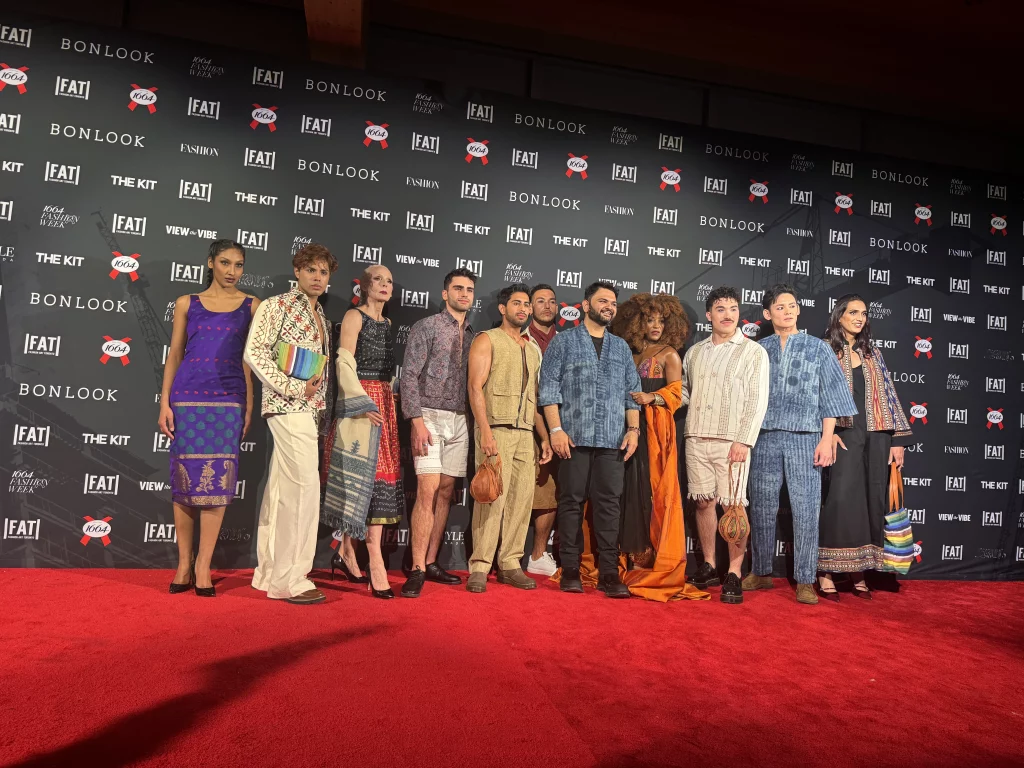
Aditya Mehta with models at Fashion Art Toronto
The making of Mannmaya
Aditya’s entrepreneurial journey began before his career in academia. “Initially, I worked as a freelance designer, helping other designers develop collections, particularly using tie-dye techniques,” he says. He also created custom garments and home décor products, experimenting with textiles long before formalising a brand.
At the beginning, he considered naming it Tie-Dye Affair, but the scope soon outgrew the name. In 2021, the label was branded as Mannmaya, a deeply personal choice, derived from his parents’ names, Manhar and Maya.
Today, Mannmaya operates differently from conventional fashion labels. There is no large in-house team or industrial production line. “We work with a small collaborative network of tailors, dyers, and craftsperson depending on the project,” he explains.
Textiles are sourced directly from craft clusters, Ajrakh from Kutch, Bandhani from Jamnagar, Tangaliya from Surendranagar, ensuring both authenticity and traceability. In many cases, the brand also repurposes existing materials. “We have also repurposed old sarees and home linen and converted them into garments.” It is a model that resists speed and scale, choosing instead to work with what already exists.
From computer science to couture
Aditya’s entry into fashion was neither immediate nor linear. His undergraduate degree was in Computer Science Engineering, a field far removed from the tactile, intuitive nature of textiles. Yet, the shift was deliberate.
His design education began formally at NIFT Mumbai, where he pursued his Master’s in Design. The exposure to structured design thinking and industry practice shaped his approach, but it was his continued engagement beyond formal education that expanded it further.
In 2017, he completed a non-credit certification from Parsons School of Design, a globally recognised institution whose digital programmes bring international perspectives into local contexts. The course, Fashion Industry Essentials, introduced him to industry frameworks, assignments, and case-based learning that complemented his academic training in India.
“It had well-known instructors and practical modules,” he says, pointing to the way such global exposure helped him situate his own work within a broader fashion ecosystem. His doctoral research, focused on Gen Z and evolving modes of fashion communication, reflects the same duality that defines his journey. It is a balance between tradition and contemporary cultural shifts.
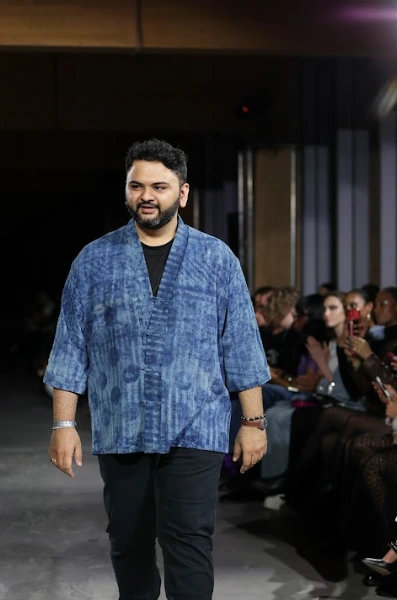
Growing up with detail
Aditya was born and raised in Gujarat, moving across cities due to his father’s transferable role in the judiciary. The constant change of environment did not disrupt his interests; it sharpened them. “As a child, I was quite introverted, but I was always deeply drawn to art and craft activities,” he recalls.
There was no single moment of realisation that led him to fashion. Instead, it was built through observation. Watching his mother dress, paying attention to how sarees, jewellery, and accessories came together, introduced him early to the language of styling. At the same time, popular culture offered a different lens.
“I admired how Aishwarya Rai represented India on international platforms,” he says. “Seeing that global presence sparked my curiosity about fashion.” These influences did not immediately translate into a career choice, but they stayed, resurfacing later when he began to explore design more seriously.
Moving to Canada, then returning back
He had secured permanent residency through the Express Entry system, a process he navigated independently. “I did not have relatives in Canada and had to navigate the initial phase largely on my own,” he says, recalling the early months of settling into a new environment.
He moved to Canada in December 2023 and immersed himself in the city’s art and cultural landscape for the next six months. “I had always aspired to experience life in a North American country,” he says.
Yet, his return to India was equally intentional. “Completing my doctoral work was an important priority, so I chose to come back.” Rather than viewing it as a departure, he treats it as a continuum, maintaining creative and professional ties with Canada while remaining rooted in India.
Culture crossroads on an international stage
The collection he presented at Fashion Art Toronto in November 2025 emerged directly from this lived experience. “Culture Crossroads is deeply personal,” he says. “It comes from the experience of carrying one culture while growing into another.”
Across ten looks, the collection did not attempt to replicate traditional garments. Instead, it translated textile techniques into silhouettes informed by global street style. The emphasis was not on preserving form, but on retaining essence.
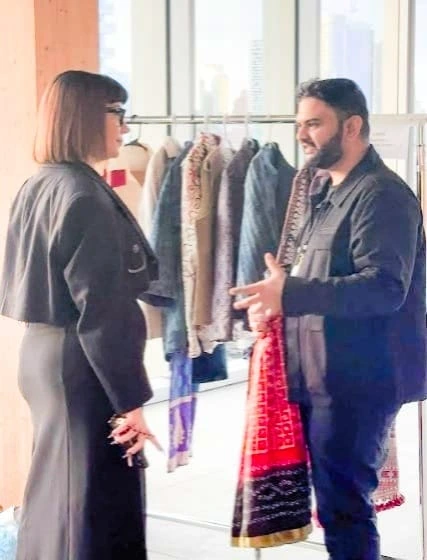
During his week-long visit to Toronto for the showcase, preparations were precise and contained. “We conducted model fittings and trials before the runway presentation.” The response, he notes, was shaped by interpretation rather than spectacle. GI-tagged textiles from Gujarat were not positioned as heritage artefacts, but as adaptable, evolving materials, and were received with strong appreciation.
Academia and design: A two-way exchange
For Aditya, academia is not separate from design, rather central to it. “Academia remains my primary focus,” he says. Teaching keeps him engaged with new ideas, research, and emerging perspectives.
Field visits to craft clusters with students form an important part of this engagement, offering direct interaction with artisans. “In that sense, the two roles complement each other.” His academic work informs his design processes, while Mannmaya becomes a space to translate those ideas into tangible outcomes.
As Design Elective Coordinator and Co-Coordinator for Accessories and Jewellery Design, he also contributes to curriculum development and interdisciplinary frameworks, shaping how design is taught, not just practised. “My academic work informs my design processes, while Mannmaya allows me to translate those ideas into practice.” His doctoral research on Gen Z, fashion communication, and media consumption further feeds into this cycle, shaping how he approaches both design and pedagogy.
Slow fashion as a deliberate choice
At a time when scalability often defines success, Mannmaya is growing differently. “Mannmaya is intentionally growing at a slow and thoughtful pace,” Aditya says. The focus is on limited pieces rather than mass production, garments that retain the integrity of the textiles they are built from. This approach is not framed as resistance, but as alignment.
“We focus on working with textiles artisans have already produced rather than developing new ones from scratch.” It allows the brand to remain connected to craft ecosystems without imposing additional pressure on them.
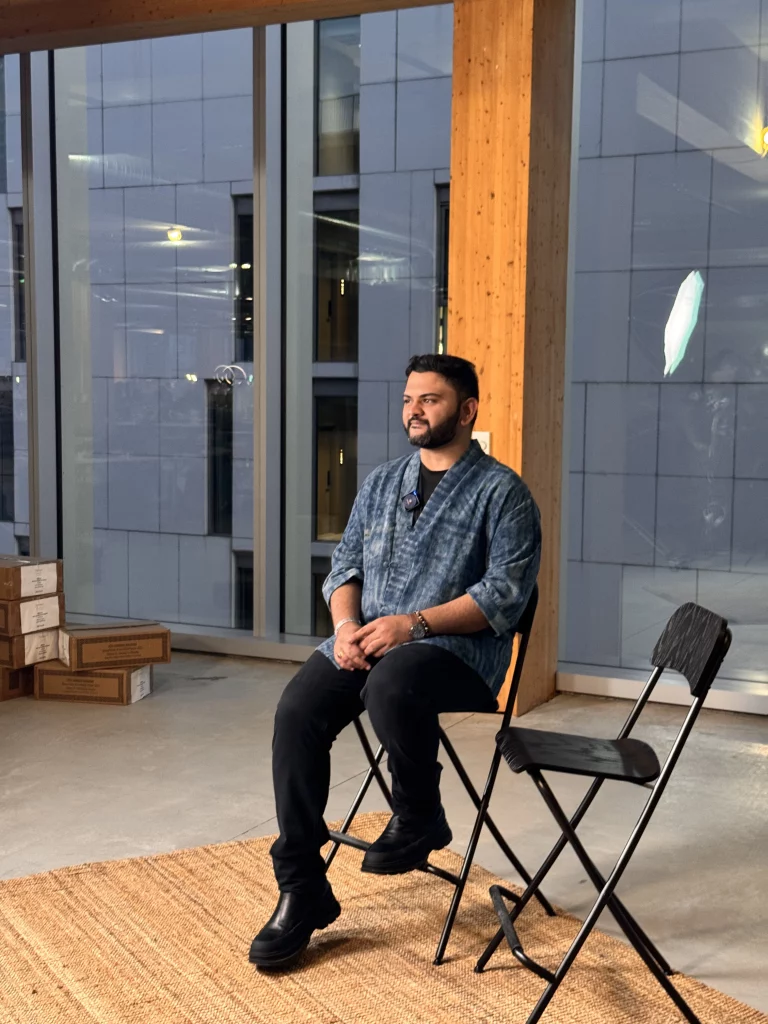
Expanding the conversation, not just the brand
Looking ahead, Aditya’s ambitions for Mannmaya are measured. “The aim is to introduce these textile crafts to international audiences and gradually expand the brand’s presence in global fashion spaces.” Canada, in this context, becomes more than a market. It begins to function as a working ground, where Indian textiles are not just displayed, but tested, adapted, and recontextualised.
His approach to creating for broader audiences, without disconnecting from where it began, informs both his classroom and his collections.
ALSO READ: Nishant Malhotra: Reviving GI-tagged textile heritage and celebrating artisans with WeaverStory



Very good 👍 👍 👍 👍 👍 Be a prograsive …