
April 14 2026
Yoga at Work: India’s ancient practice in modern global workplaces

(April 14, 2026) It usually starts with a meeting invite — “Mindfulness session. 20 minutes.” A while later, a group of professionals shut down their laptops, silence their phones and gather inside a glass-walled conference room. The rush pauses, deadlines fade and shoulders soften.
The scene is playing out in offices across the world. Today, over 300 million people practise yoga globally — a number that has grown exponentially in the last decade. The global yoga market, valued at approximately $63.82 billion in 2025, is projected to reach $119.69 billion by 2034, according to industry estimates. What began in the ashrams of ancient India is now a booming global industry — and increasingly, a fixture of corporate life in the West.
Across offices in New York, London, Singapore and beyond, yoga sits between strategy meetings and sales calls, positioned as a solution to stress, burnout and the constant pressure to perform. In the United States alone, more than 34 million people practise yoga regularly — more than those who go jogging — while North America now accounts for a third of the global market.
But as companies invest in yoga to improve focus and productivity, something more complex is unfolding. A practice over 5,000 years old, rooted in philosophy and self-inquiry, is being reshaped into a tool for performance.
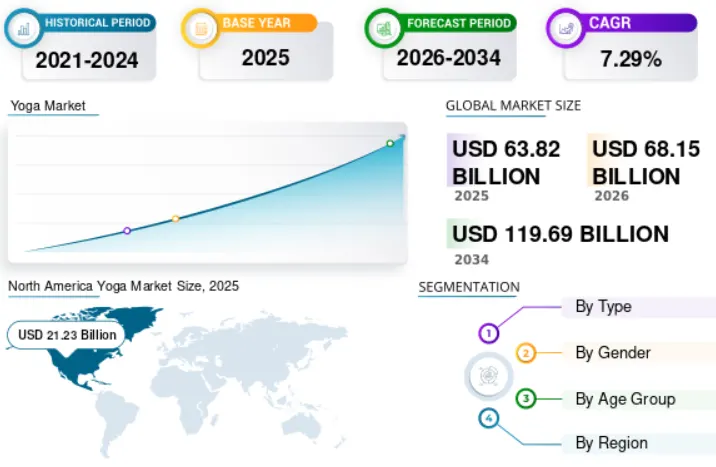
Source: Fortune Business Insights
Yoga leaves the ashram
“Long before yoga entered boardrooms, it belonged to a very different space. Quiet, disciplined, inward,” says yoga and fitness trainer Payal Gidwani Tiwari, who counts Kareena Kapoor Khan, Saif Ali Khan, Rani Mukerji and Jacqueline Fernandes among her clients.
Speaking to Global Indian, Payal says yoga was practised in ashrams, in solitude — in environments that encouraged stillness rather than stimulation. “It was not designed to help you meet deadlines. It was meant to help you understand yourself,” says the founder of Yoga Studio, Bandra and Cosmic Fusion.”Asana is only one part. Pranayama prepares the mind for meditation, which itself is about awareness.”
The science backs It
There is hard evidence behind the corporate appeal. A systematic review and meta-analysis published in the Journal of Functional Morphology and Kinesiology found that workplace yoga interventions were significantly more effective than workplaces offering no such initiative in reducing perceived stress among employees.
“Breath slows the nervous system, movement releases physical tension, meditation sharpens focus,” says Payal. Employees report feeling calmer, teams function better. “Productivity improves, almost as a side effect,” says the author of Body Goddess. It is a compelling business case — and companies are listening.
India’s soft power in global workplaces
Accessibility has played a major role in yoga’s global rise. The Asia-Pacific region — including India, its birthplace — still leads the market, driven by cultural roots and initiatives like International Yoga Day. Yet the West has emerged as its most enthusiastic commercial adopter.
In offices across New York, London, Singapore and beyond, this soft power now plays out in quieter, everyday ways — in 20-minute mindfulness sessions, post-work yoga classes and corporate wellness programs that draw, directly or indirectly, from Indian traditions.
What travels globally, however, is often a simplified version — the poses, the breathing, the calming effect. The philosophy, context and depth are harder to export.
In many ways, this is also the story of India’s soft power: a deeply philosophical practice reshaped across cultures to meet modern needs, even as Indian teachers and practitioners continue to influence its evolution worldwide. Workplaces, says Vasundhara Talware, are not misusing yoga as much as adapting it. “Western corporate culture has taken what it needs — stress relief, focus, emotional regulation. These are real needs.” But in doing so, it is also redefining the practice itself.
Opportunity and dilution
For Vasundhara Talware, the conversation begins much earlier. “There was a time when yoga was not accessible to everyone. Readiness mattered — the body had to be prepared, the mind stable enough to hold what yoga brings.”
She sees the corporate shift as both opportunity and dilution. “Yoga is not a quick fix, it is a gradual unfolding. You begin with the body. The breath deepens the practice. Then comes meditation. Alongside all this is philosophy, which anchors the experience.”
Without that foundation, she warns, practice becomes superficial. “Yoga is not just about becoming fitter or calmer. It is about becoming aware — understanding who you are.”
The corporate trap
In corporate settings, that depth is often missing. Time is limited, attention is fragmented, and sessions are designed to be efficient. “It is a quick reset before the next task,” says Vasundhara. “But yoga is meant to make you wiser, not just calmer.”
The deeper tension is this: coping is not the same as questioning. When yoga helps you cope, you function better within the same system. But when it encourages questioning, it shifts something deeper.
Why am I stressed? What am I chasing? What is enough?
“That version of yoga does not always sit comfortably in corporate environments,” she says. “Awareness can disrupt priorities and alter how success is defined.”
What gets prioritised, then, are visible outcomes — reduced stress, better sleep, improved productivity. What gets sidelined is philosophical depth: self-inquiry, detachment, awareness beyond performance. “This isn’t always intentional,” she adds. “It’s structural. Corporate systems are designed to optimise output, not question themselves.”
The power of the pause
And yet, something interesting is happening. Even in simplified form, yoga carries a certain quality — a pause, a moment of stillness in an otherwise relentless day. For many professionals, that pause is unfamiliar.
But over time, it expands. A few minutes become a habit, which becomes awareness.
“Once introduced, awareness doesn’t easily disappear,” says Vasundhara. “That’s where corporate yoga, despite its limitations, becomes significant. A moment can lead to something deeper — gradually.”
Who really benefits
Employees gain tools to manage stress and maintain focus. Employers gain a workforce that is more balanced, productive and less prone to burnout. “It is a mutually beneficial arrangement,” says Vasundhara Talware.
But the balance is delicate. If yoga is used only to help employees cope without addressing the underlying causes of their stress, it risks becoming a support system for the same cycle. “If it encourages even a small degree of awareness, however, it has the potential to shift that cycle — not dramatically, not immediately, but gradually.”
What stands out is the scale and international reach of yoga’s journey. A practice that originated in India — designed to quiet the mind and dissolve the ego — has grown into a multi-billion-dollar global industry, embraced across cultures, geographies and workplaces worldwide.
Its presence today reflects both adaptation and endurance: an Indian tradition that has travelled across borders, evolved with changing needs, and continues to offer moments of pause and awareness — whether in ashrams or inside glass-walled conference rooms.
ALSO READ: Siddhaa Akshar: The spiritual messenger bringing Himalayan wisdom to millions worldwide

Share with



Written By: Vikram Sharma
Pandita Indrani Rampersad: Preserving Sanatana Dharma, reviving Ram Lila, and empowering Caribbean PIOs


Written By: Amrita Priya