


(December 2, 2025) When the world shut down in 2020, the support systems that normally helped sustain women’s unpaid labour like the schools, childcare, and community networks vanished overnight, making them shoulder an impossible load. Mothers juggled toddlers and Zoom calls, elders and deadlines, grocery lines and homework tabs. Many left the workforce entirely. The numbers told a brutal story, but for Reshma Saujani, the activist, entrepreneur, and founder of Girls Who Code, the crisis was a reckoning. “Women have been crushed in the pandemic. Because the care structure is broken, many had to supplement their paid labour with unpaid labour,” she remarked in an interview during that time. For someone whose life’s work had focused on expanding opportunities from coding classrooms to congressional races, the pandemic illuminated a deep and stubborn inequality that societies depend on mothers, yet rarely count their labour.
As a response, Saujani launched the Marshall Plan for Moms, later renamed Moms First. Its a nationwide push for paid leave in the US, affordable childcare, direct payments for unpaid labour, and a culture that doesn’t punish motherhood. “We can’t lose 30 years of progress in nine months,” she warned.
Long before the pandemic exposed these fractures, Saujani had spent more than a decade building movements for women’s and girls’ economic empowerment through Girls Who Code. The crisis simply expanded her battlefield from the gender gap in tech to the structural supports mothers need to survive. Today she stands as not only a movement-builder and bestselling author but also the host of My So-Called Midlife with Lemonada Media, her 2024 podcast that surged into Apple’s Top 10, and was named one of the year’s best new shows by TIME.
She has recently announced a feature documentary on American motherhood, slated for release around Mother’s Day 2026. It is being produced by Emmy-nominated Culture House Media, Tan France’s French Tuck Media, and Moms First, and would blend investigative reporting, archival footage, and firsthand stories from mothers in the US.
View this post on Instagram
At the center of impact
Saujani’s influence extends far beyond the organizations she founded. She serves on the boards of Girls Who Code, Harvard University’s Board of Overseers, the Economic Club of New York, the International Rescue Committee, mParticle, TechNYC, and the Interfaith Alliance. She also co-chaired the World Economic Forum’s first Global Futures Council on the Future of the Care Economy.
Armed with degrees from the University of Illinois, Harvard’s Kennedy School , and Yale Law School, she has been honoured with recognitions like Fortune’s World’s Greatest Leaders, Fortune 40 Under 40, WSJ Magazine Innovators of the Year, Forbes’ Most Powerful Women Changing the World, InStyle’s Women of Impact, and Fast Company’s 100 Most Creative People. She also holds the Harold W. McGraw, Jr. Prize in Education.
Daughter of refugees
Saujani’s story begins long before the headlines or the TED stage. It begins with her Indian-origin parents fleeing Uganda during Ugandan military officer and politician Idi Amin’s expulsions and rebuilding their lives in Chicago. That history shaped her worldview. “Because the United States saved my parents’ lives, I wanted a life of service,” she said in an interview.
From tech education to gender equality
Saujani’s evolution into a leading voice on gender equity is as dynamic as the crises she confronts. Her 2023 Smith College commencement address on imposter syndrome has been viewed over 18 million times, while her TED Talk, “Teach girls bravery, not perfection,” has surpassed 54 million views, cementing her influence on how women and girls understand confidence, failure, and opportunity.
A New York Times bestselling author of PAY UP, Brave, Not Perfect, and the Girls Who Code book series, Saujani consistently pushes for a world where opportunity is universal, invisible labour is valued, and systemic burdens are named and dismantled. Before she became synonymous with tech inclusion and motherhood advocacy, she began her career as an attorney and Democratic organizer, eventually entering the political arena in 2010 as the first Indian American woman to run for U.S. Congress.
View this post on Instagram
Building Girls Who Code
Reshma Saujani had quit her corporate job to run for Congress. “I lost spectacularly. But when I woke up the next morning, I thought, ‘I’m not broken.’” It was failure that opened the next door.That loss forced her to ask: what else have I been too afraid to try? The answer became Girls Who Code, the groundbreaking movement to close the gender gap in tech. While campaigning, she had visited public schools and witnessed the near-total absence of girls in computing classes. Girls Who Code emerged as her solution, and later, her most influential achievement. “Coding teaches you to fail. It builds bravery,” she once remarked.
Supercharging girls for the future
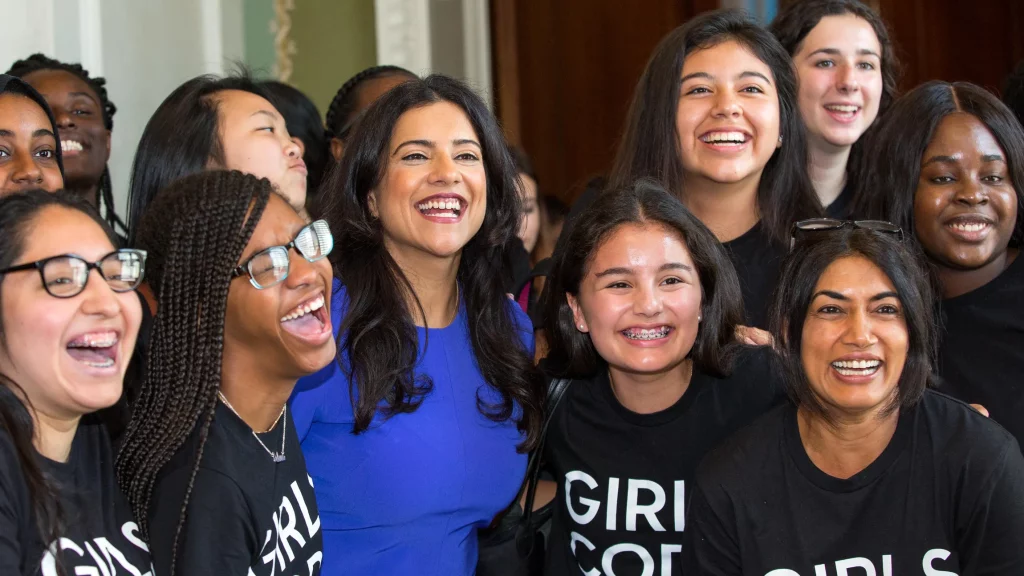
Girls Who Code is now a global force reshaping the tech talent pipeline. Through its Summer Immersion Program, campus curriculum, after-school clubs, College Loops, and bestselling books, the organization brings computer science education to girls and young women around the world. With programs across the U.S., Canada, India, and the U.K., more than 500,000 girls have already moved through its programs.
In recent years, the organization has expanded even more boldly into artificial intelligence. Girls Who Code has developed an AI curriculum expected to reach more than 200,000 students in the United States, launched two AI-focused programs, and added a Data Science course. Students are using AI to build financial literacy tools, make original music, and pursue real-world innovation.
When care collapsed
The pandemic, however, revealed another crisis. “Globally, women started leaving the labour force because it was untenable,” Saujani recalled. The December 2020 jobs report confirmed her worst fears: “Only women, especially women of colour, lost their jobs.” Many were forced out due to the collapse of childcare, school closures, and mounting unpaid work.
She turned to the mothers in her parent-teacher association. These were the people who understood the crisis most intimately. Their needs were simple and urgent: cash, paid leave, childcare, and retraining. That list became the foundation for what would evolve into Moms First.
Moms First: Rewriting the rules of work
What began as the Marshall Plan for Moms has grown into Moms First, a movement of more than one million mothers and supporters pushing for a care system that works. Saujani has worked with congressional leaders to introduce federal legislation, helped establish New York City’s Marshall Plan for Moms Task Force, and launched PaidLeave.ai in 2023 to help parents access benefits they’re already entitled to.
Even as she advocates inside policy rooms, she continues to challenge cultural norms through bold public campaigns. In the post-pandemic labour market, Saujani sees a rare shift in leverage. “Women have a lot of bargaining power,” she says but only if they understand what to ask for. At the top of her list is structural flexibility and predictability, especially after a period when “many of us had to hide our children because it seemed like a lack of commitment to the job.”
Equally urgent, she argues, is affordable childcare: “If we’re providing public education, we should provide public childcare too. We should pay for that as a society.” And for real gender equity, she insists, the burden cannot fall solely on women; companies must also reset expectations for men. “Tie performance reviews and salary compensation to whether the men in their offices take paternity leave. It helps change the gender roles at home.”
View this post on Instagram
The courage to try, fail, and begin again
For all her policies and programs, Saujani returns again and again to one idea that failure is not fatal. “We give up even before we try,” she says. Losing her congressional race, something she had dreamed of since she was a child, did not break her. “Losing that race inspired me to start Girls Who Code.” If the pandemic taught women anything, she argues, it is the coexistence of fragility and resilience. “The systems holding women up may be weak, but the women themselves are not.”
Fighting for a fairer future
From refugee roots to politics, from a career in finance to classrooms full of first-time coders, Saujani’s journey mirrors the evolution of America’s conversations about gender, work, and opportunity. “Let’s not take another 50 or 100 years to make progress in gender equality,” she remarked. And if her work proves anything, it’s that real change begins the moment we refuse to wait any longer. Saujani lives in New York City with her husband and their two sons.
ALSO READ: Time 100 trailblazers Manjusha Kulkarni and Priyamvada Natarajan named Great Immigrants of 2025