
April 25 2026
Pianist Rekesh Chauhan: From international stages to royal audiences in the UK
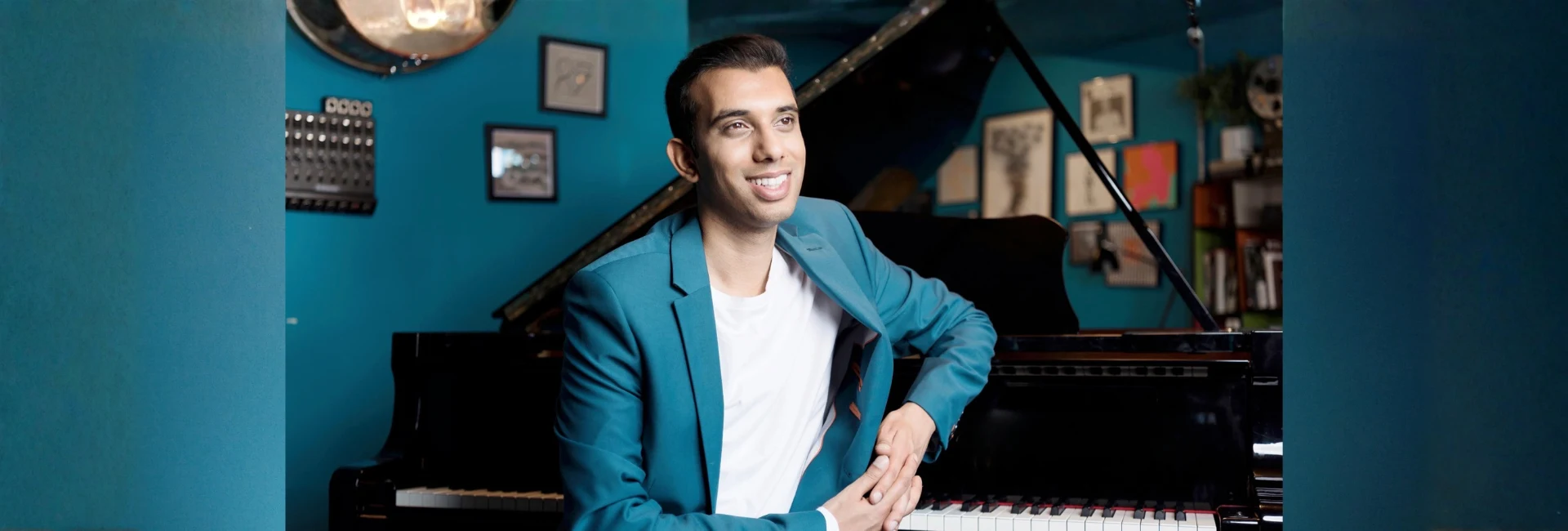
(April 25, 2026) When the British-Indian pianist and composer Rekesh Chauhan brought his ‘Commonwealth Symphony’ to Westminster Abbey, a historic church in London known for royal ceremonies and national events, it marked the culmination of a journey defined by musical fusion and recognition on international stages.
Commissioned by the Queen Elizabeth II Commonwealth Trust and performed with the City of Birmingham Symphony Orchestra, the musician’s ‘Commonwealth Symphony’ is a cross-cultural composition that brings together musical influences from across the 56 Commonwealth nations, reflecting a shared identity through sound. Performed before King Charles III and Queen Camilla, the work highlighted the growing presence of Indian-origin artists on UK’s cultural landscape.
“It truly felt like a family singing a song together,” he tells The Global Indian in a chat, referring to the musicians from across the Commonwealth who came together from diverse traditions, and collaborated as one collective ensemble.
Awards, fusion and social impact
A multi-award-winning artist, Rekesh Chauhan is known for blending Eastern and Western styles, a signature that has taken him to prestigious venues across the UK and beyond. His work has earned him the British Empire Medal in 2023, along with honours such as the NIAA Young Musician of the Year and Alumnus of the Year by the University of Leicester.
Beyond performance, Chauhan has consistently used music as a tool for social impact, contributing to initiatives with the British Asian Trust and championing wider access to the arts. In 2022, he was appointed an ambassador for Future Talent, a music charity established by HRH The Duchess of Kent and Nicholas Robinson, where he supports young musicians from underrepresented backgrounds.

Rekesh Chauhan after being honoured with the British Empire Medal (BEM)
The making of the musician
A key inflection point came early in his career when he performed at Birmingham Symphony Hall, one of the UK’s premier concert venues known for its world-class acoustics, at the age of 21. It was a milestone that marked his transition from an emerging performer to a recognised artist.
This was followed by the release of a solo album recorded live at the venue, further establishing his presence on larger stages. Performances at spaces such as the Royal Albert Hall, an iconic concert hall that has hosted some of the world’s most celebrated artists, expanded his reach, placing him firmly within the UK performance circuit.
Breaking out of the mould
One of the toughest parts of Chauhan’s early journey was creating music that didn’t fit into a single category in an industry that often depends on clear labels. “Drawing from classical, jazz, Indian, and contemporary influences, my music existed in a space that was difficult to define, and at times, just as difficult for others to comprehend.”
In the beginning, this unclarity worked against him as his music didn’t always align with conventional expectations of a genre or format. But instead of adapting his work to fit those boundaries, Chauhan chose to stay with that uncertainty and carve out a space that was entirely his own.
View this post on Instagram
Creative collaborations
Over the years, Chauhan has collaborated with artists such as Rahat Fateh Ali Khan, Talvin Singh and Shankar Mahadevan. These are the experiences that he describes as “deeply formative”, not only because they altered his direction, but also because they expanded the way he listens.
For him, collaboration goes beyond sound and is rooted in people and their journeys. “It’s not just about the music, but what you learn from that person’s journey. Everyone has their own path, and collaboration is about being part of that and creating music that reflects where they are,” he says. That shared understanding, he believes, is what ultimately shapes the outcome.
Across borders and traditions
Chauhan’s work has taken him to multiple countries and performance spaces, each shaping his approach in different ways. In cities like Milan, he has seen audiences engage deeply with Indian classical traditions, while in Rajasthan, he encountered a willingness among local musicians to reinterpret familiar forms in new contexts.
According to him, these experiences reflect a broader shift in how music travels — no longer bound by geography, but shaped by interaction and exchange. “There is a lot of interest in the possibilities of collaboration between world musical styles,” he notes, pointing to a growing openness among both artists and audiences.
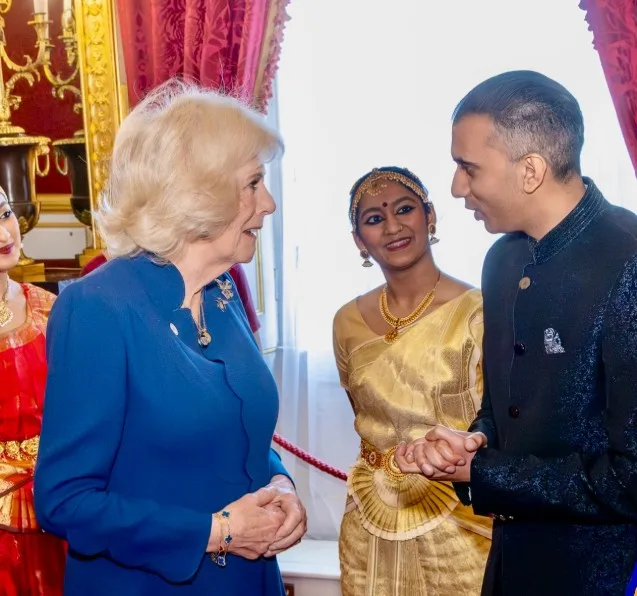
Rekesh Chauhan with Queen Camilla at St. James’s Palace during a reception hosted by the Royal Commonwealth Society for The Queen’s Commonwealth Essay Competition
The Commonwealth Symphony moment
The premiere of the ‘Commonwealth Symphony’ in March stands among Rekesh Chauhan’s most defining milestones. Conceived as a work that brings together musical influences from across Commonwealth nations, the composition reflects both his artistic philosophy and his cross-cultural identity.
Performed at Westminster Abbey, the piece carried both artistic and symbolic significance, placing Indian-influenced composition within one of Britain’s most historic institutions, and highlighting a shift from adaptation to contribution in cultural exchange.
Music with a purpose
Beyond the stage, Rekesh Chauhan has been involved in large-scale cultural and philanthropic initiatives. One such project, ‘Neelam’s Story’, created for the British Asian Trust, used music and dance to tell the story of a mental health beneficiary and reached more than one million people.
A live version of the production was later performed at St James’s Palace for Queen Camilla during The Queen’s Commonwealth Essay Competition reception. As an ambassador for Future Talent, he has been involved in supporting young musicians from low-income backgrounds by creating access to opportunities in music.

Rekesh Chauhan at James Watt Primary School, UK as part of his philanthropic initiatives
What lies ahead
Going forward, Rekesh Chauhan is preparing for a large-scale performance at London’s Queen Elizabeth Hall, a leading contemporary music venue within the Southbank Centre known for hosting experimental and cross-genre performances, bringing together multiple strands of his work into a single production. “This will be a large-scale production bringing together artists and musical productions I have worked with over the years on a scale like I’ve never attempted before,” he reveals.
What lies ahead is a deepening of his practice, as Chauhan continues to build on a sound that has always drawn from many worlds while remaining distinctly his own.
ALSO READ: On a high note: Maestro Debashish Chaudhuri is a shining star in the music world

Share with



Written By: Vikram Sharma
Raising the bar: The remarkable journey of record-breaking pianist TS Satish Kumar

Written By: Amrita Priya
Charu Suri: The Indian pianist and composer making jazz raga popular globally

Written By: Bindu Gopal Rao