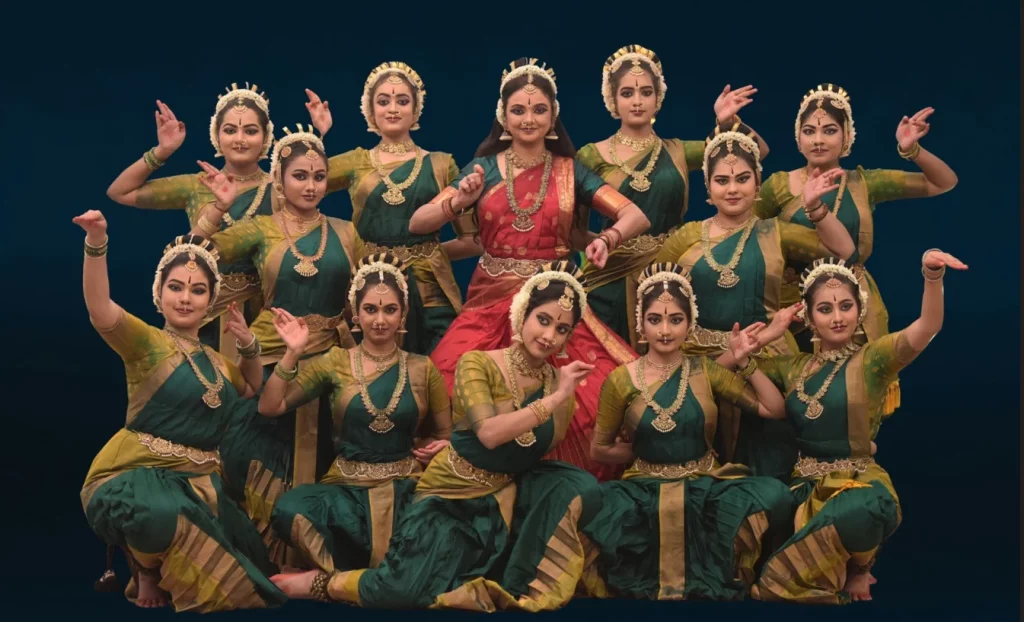


(March 5, 2026) A few years ago, on the day of her sold-out performance in France, renowned Indian classical dancer Deepika Reddy was down with a 104-degree fever. It was a hectic tour — performing 21 shows at a stretch across France — which had taken a toll on her. But when the curtains at the auditorium rose, Deepika delivered a mesmerising performance despite being unwell. The loud round of applause from the audience said it all.
So last month, when her name figured on the list of Padma Shri awardees, memories from her entire journey — both the good and the challenging ones — flashed across her mind, bringing a smile to her face.
“There are no shortcuts in art. Only sadhana, patience, and relentless hard work matter. When you dedicate yourself sincerely, your efforts are always recognised, sooner or later,” smiles Deepika Reddy, an exponent of the Kuchipudi art form, in conversation with Global Indian.
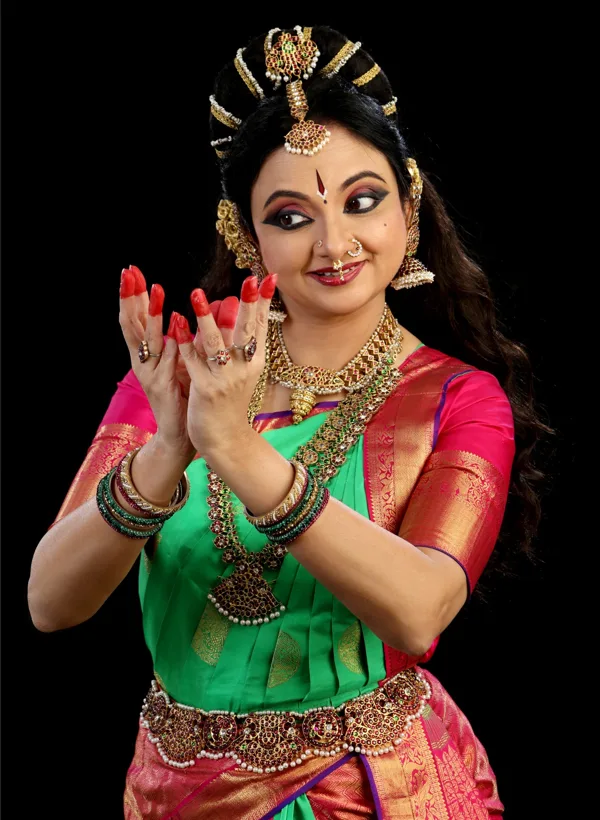
Having started dancing at the age of six, Deepika’s incredible performances over the last five decades have left audiences spellbound across the world. Her extraordinary contribution to Indian classical dance earned her the Padma Shri, the nation’s fourth-highest civilian honour.
Never chased awards
Deepika says a civilian honour like the Padma Shri is something every artiste dreams of, and to be recognised for decades of contribution felt incredibly fulfilling. “I never worked with awards in mind, so I did not expect it. I have always believed in simply doing my work sincerely and taking one step at a time.”
Describing it as an overwhelming moment, the renowned dancer says she was deeply humbled and almost at a loss for words. “When the announcement came, it felt surreal. I was filled with gratitude more than anything else.”
She says the honour did not belong to her alone. “It is because of the unwavering support of my parents, especially my mother who has always been my rock, and my gurus — particularly Guru Vempati Chinna Satyam garu — who shaped me and inspired me to strive for excellence.”
A special memory in Turkey
Among her many performances abroad, Deepika fondly recalls one particularly touching memory from Turkey, where she performed with her troupe for the first time in 2007. In 2017, she returned for her second performance.
“After the performance, when I mentioned that I had come back to Turkey after 10 years, a few people in the audience raised their hands and said they had attended my earlier show as well. I was deeply moved,” recalls Deepika, pointing out how art can leave a lasting impact.
A moving experience in Sri Lanka
Sri Lanka was another unforgettable experience. She was conducting a lecture-demonstration during a very tense period of war.
“After the program, someone came up to me and said that my production on peace had given them a sense of calm and hope,” says Deepika, who has also performed at the Festival of India in Berlin, the Bolshoi Theatre in Russia, and festivals in Bangkok and South Korea. “Performing across the world has been one of the greatest blessings of my journey. Each stage, each country, and each audience has taught me something new.”
Representing India on the global stage
Deepika says whenever she performs abroad as a cultural ambassador of India, the responsibility becomes even greater. “We are judged not only for our performance, but also for our behaviour, discipline, and the dignity with which we conduct ourselves,” says the renowned dancer, who always reminds her students that “how we carry ourselves offstage is just as important as what we present onstage.”
Over the years, she has also been invited to formal banquets hosted by ambassadors and consuls general of various countries. “These interactions are always enriching, as we exchange ideas, speak about Indian culture, and see how deeply our art form resonates with people from completely different backgrounds.”
A divine moment in Ayodhya
Deepika says performing across India often brings deeply spiritual experiences. “Ayodhya was profoundly divine. I went with my daughter and my 81-year-old mother.” Watching her mother, Radhika Reddy — once a dancer herself — perform a few movements in front of the idol was incredibly emotional for Deepika. “It felt like three generations connected through dance and devotion.”
At the Maha Kumbh
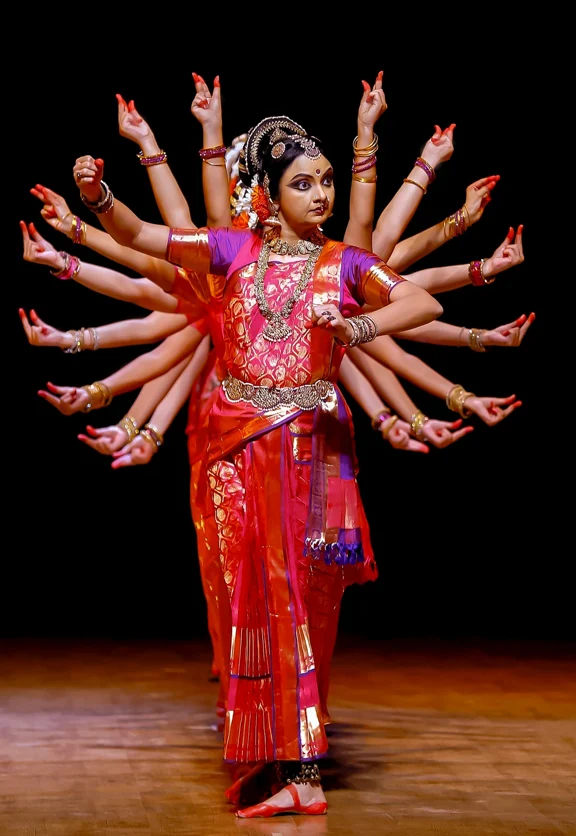
At the Maha Kumbh last year, Deepika and her troupe presented Gangavatarana (descent of Ganga). “Witnessing thousands of devotees, feeling the collective faith, and taking a dip in the Ganga was overwhelming. It wasn’t just a performance — it was a spiritual experience that I will always cherish.”
A doctor’s prediction
Born in Hyderabad, Deepika’s connection with dance feels almost destined. “At the time of my birth, the doctor predicted that I would grow up to be a dancer. She might have sensed it instinctively — or perhaps it was because my mother herself was a classical dancer.”
Roots in an illustrious family
Deepika comes from an illustrious family deeply rooted in public service, culture, and excellence across diverse fields. Her grandfather, N. Ramachandra Reddy, was a freedom fighter who actively participated in the Vande Mataram Movement. He later served as a four-time minister in the erstwhile Andhra Pradesh government.
Deepika’s father, V.R. Reddy, was Chairman of the Bar Council of India, Advocate General of composite Andhra Pradesh, and Additional Solicitor General of India. Her mother, Radhika Reddy, was a Bharatanatyam dancer who performed at many prestigious venues. Notably, she played the lead role of Chitrangadha in Rabindranath Tagore’s ballet at the inauguration of Ravindra Bharathi in 1961.
“It was her passion for classical arts that left a lasting impression on me,” says Deepika, who completed her Intermediate from Kasturba Gandhi Junior College and later graduated from St. Francis College for Women. She later completed a Postgraduate Diploma in Travel and Tourism.
The beginning
Dance fascinated her from a very young age. Seeing her interest and commitment, her mother enrolled Deepika under the guidance of Guru Sumathi Kaushal, marking the formal beginning of her Kuchipudi training.
A milestone: Rangapravesam
She had her Rangapravesam in 1976, which remains a very special milestone in her life. One of the honoured guests that day was legendary actor Akkineni Nageswara Rao. “He blessed me and said that I had the talent to become a torchbearer of the Kuchipudi art form.”
Deepika’s parents were understandably nervous about her debut, especially the Tarangam, where she had to dance on the rim of a brass plate while balancing a pot filled with water on her head. “I never had stage fear. From the very beginning, the stage felt like home.”
The turning point
The turning point came when Deepika witnessed Guru Vempati Chinna Satyam’s Srinivasa Kalyanam. “His choreography and the grandeur of his presentation left me spellbound. I wanted to learn under him.”
But she could not pursue it then, as her parents wanted her to focus on education. It was only after marriage that her husband, Shyam Gopal, an industrialist, and her mother-in-law encouraged her to follow her heart. She then approached Guru Vempati Chinna Satyam garu. “Initially, he was reluctant because I was married and living in another city, but when he saw my grit, sincerity, and determination, he relented,” says Deepika, describing the training under him as transformative.
A love for choreography
Deepika also loves choreography. Once the theme is decided, she spends considerable time doing in-depth research — reading, observing, discussing with scholars or experts, and clarifying every doubt.
“When we present something on stage, we must do justice to the subject both artistically and intellectually,” says Deepika, who also collaborates closely with musicians.
View this post on Instagram
Inspired by An Inconvenient Truth
Each theme brings a very different creative journey. “Mythological productions have a certain grandeur, while social or contemporary themes require a different sensitivity and approach.”
For instance, she created Prakrithi Rakshathi Rakshithaha, inspired by Al Gore’s An Inconvenient Truth, focusing on environmental awareness and sustainability. “It was meaningful to use classical dance as a medium to talk about such a relevant global issue,” says Deepika, who has also choreographed productions celebrating India’s weaves, handicrafts, temples, and tourist destinations, showcasing cultural heritage through movement.
Performing with a legend
Once, Deepika received a call from Saswati Sen ji, a senior disciple of Pandit Birju Maharaj ji, inviting her to choreograph Sishira Ritu, the winter segment in a ballet. “It was an incredibly humbling and surreal moment — life had come full circle once again,” says the renowned dancer, who performed at prestigious festivals abroad along with the legend.
Preparing for the stage
For her, every performance begins much before she steps on stage. “The first thing I consider is the profile of the audience — whether they are connoisseurs of classical dance, students, international viewers, or a mixed gathering.”
Based on this, she carefully curates the repertoire. Sometimes a solo performance works best; sometimes group presentations, and at other times dance dramas communicate more effectively. “A lot of thought goes into this selection because a performance should connect with the audience while still maintaining artistic integrity.”
Discipline and flexibility
Deepika had to work consciously on her flexibility. She spends hours strengthening her body and improving stamina. “Over the years, I have realised that talent alone is never enough — the body also needs constant conditioning and discipline.”
The Importance of Teamwork
Teamwork is another aspect vital to performances. “I encourage my students to come up with suggestions. If a student suggests a movement that works better, I include it. This also helps them feel involved and responsible for the production.”
During rehearsals, she constantly reminds them to be aware of the entire group — the spacing, synchronisation, and coordination. “It is never about one dancer; it is about the collective ensemble.”
Deepanjali: Passing on the legacy
In 2000, Deepika founded Deepanjali with the goal of preserving and passing on the art of Kuchipudi dance. Since then, she has trained hundreds of students, many of whom have gone on to perform nationally and internationally. She has also trained socially and economically disadvantaged children.
“My training sessions are holistic. For me, teaching dance is not just about steps, technique, or choreography — it is about shaping the individual as a whole,” says Deepika, whose daughter Shloka, an accomplished Kuchipudi dancer herself, trains at Deepanjali. Since many of her students are lawyers, doctors, engineers, and other professionals — even college-going girls — she schedules rehearsals after working hours. “The training is rigorous.”