


(January 28, 2026) Renowned gastroenterologist Dr G.V. Rao has received numerous honours over a career spanning decades. But news of his receiving the Padma Shri, the nation’s fourth-highest civilian honour, was especially gratifying for the soft-spoken doctor. “While the other awards over the years have recognized my skill or the patient outcomes, or professional milestones, this honour feels different because it reflects a lifetime of intent,” smiles Dr GV Rao, Director of Hyderabad-based Asian Institute of Gastroenterology (AIG), in conversation with Global Indian.
He is among the 45 unsung heroes in India and among the seven in his home state of Telangana to be honoured with the Padma Shri in 2026.
A living legend in gastroenterology
For Dr GV Rao, regarded as the “living legend” in the world of gastroenterology, the Padma Shri is not a culmination of his journey, but a marker along the road. “I still have many miles to go,” says Dr Rao, who has been flooded with congratulatory messages from his colleagues, friends and well-wishers.

Having specialised in laparoscopy and GI surgery at many prestigious hospitals overseas, including St Mark’s and King’s College, London, he says the honour validates a broader philosophy of medicine. “It suggests that excellence and empathy are not opposing forces, that innovation and affordability can coexist, and that a doctor’s responsibility extends beyond individual patients to society at large,” says Dr Rao, who has performed over 12,000 surgeries and 16,000 endoscopies.
Touching lives beyond the operating room
A leader in his field, basic science research is a crucial area of interest for Dr Rao, who was always keen on developing indigenous research pathways, techniques and technologies that can help clinicians treat patients in a more cost-effective yet efficacious way.
“This honour suggests that the work has relevance beyond operating rooms and academic circles and that it has touched lives, systems and communities in a way that matters at a national level,” says the renowned gastroenterologist, the first to perform a trans-oral endoscopic appendectomy and who has been involved in the development of a macro-encapsulation device for diabetes.
Dr Rao feels recognition creates a moment when people are willing to listen more closely. “I hope to use that attention to amplify conversations around preventive healthcare, early diagnosis, and the need to bring advanced care closer to underserved populations,” says the renowned gastroenterologist.
Innovation with purpose
He also sees the honour as an opportunity to advocate for innovation, particularly technology and AI that genuinely reduce cost, improve reach, and support doctors rather than replace them. “Technology, data and AI can help us here, not by distancing care, but by personalising it and making it proactive rather than reactive,” says Dr Rao, who closely follows the advent of newer technologies in the form of artificial intelligence and machine learning. “It is fascinating and opens up opportunities for us to work on from the clinical standpoint.”
He sees immense potential in developing a sub-specialty which can be a hybrid of AI and GI surgery, where surgeons will get trained on AI models which, in turn, will further develop essential surgical practices with the data points coming from the surgeons’ usage.
A Hyderabad boy with global roots
Born into a middle-class Hyderabad family with one sister and three brothers, he tried to get admission to a medical school at the age of 16 but was too young to qualify. “I went to court and got the clearance. In the meantime, I enrolled in a veterinary college for a month as I did not want to waste a year. If the court had ruled differently, I would have been a vet,” smiles Dr Rao.
His early schooling was at Vivekananda School, but his father, G Murahari, who was a civil engineer working in the Electricity Board, wanted to give his children the best education despite the financial constraints. Subsequently, he got admitted to the Hyderabad Public School, Ramanathpur, which he says was both a cultural and academic shock to him.
“My father insisted on English literature as the first option, which was tougher than math or science,” he says. As a result, he scored poorly in the first year. “But then, that’s the beauty of an institution like HPS which instilled language skills, be it oratory or written. Imagine Thomas Hardy’s Far From the Madding Crowd as a non-detail book!” recalls Dr Rao, who, within one year, was able to grasp enough English in order to top the class. At school, he played tennis and hockey, but it was swimming that has been a constant in his life since the schooling days.

A father’s ambition, a son’s calling
It was primarily his father’s ambition and his influence that kept Dr GV Rao motivated to become a doctor. After his MBBS from Osmania Medical College, Hyderabad, he was keen on getting into general surgery. “I went on to do my Master’s from Bangalore and was lucky to get trained under Prof Vittal who shaped me as a skilled surgeon,” informs the doctor.
Back then, surgical gastroenterology as a specialty had just started in Chennai, and Dr Rao began to work under Prof Natesan Rangabashyam, the doyen who envisioned surgical gastroenterology as a specialty and started MCh Surgical Gastroenterology.
When he returned to Hyderabad, Dr Rao was offered a government posting in his father’s hometown. But it was more of a primary health centre with not much work for a surgeon. “My father was very happy about my job and posting, but I resigned within three days of my joining, without his knowledge. When he came to know about this later, he did not talk to me for nearly six months,” says Dr Rao. Those were the days when a government job meant career security.
The Chung influence
During his specialisation in laparoscopy and GI surgery at St Mark’s and King’s College, London, he was trained under Prof Sydney Chung for basic laparoscopy. “Once, I went for a workshop in Hong Kong where Prof Chung showcased laparoscopic cholecystectomy in the morning, and by evening, that very patient walked into the auditorium. That entire thing was an awe-inspiring moment,” recalls Dr Rao, who then stayed back to learn laparoscopy from Prof Chung.
The birth of AIG
Dr Rao’s inclination towards a minimally invasive approach in surgery got him interested in following Dr D Nageshwar Reddy (Chairman of AIG) and his work in endoscopy. The rest is history. “We started a morning and evening practice at Medinova Hospital and slowly moved towards creating our own space.”
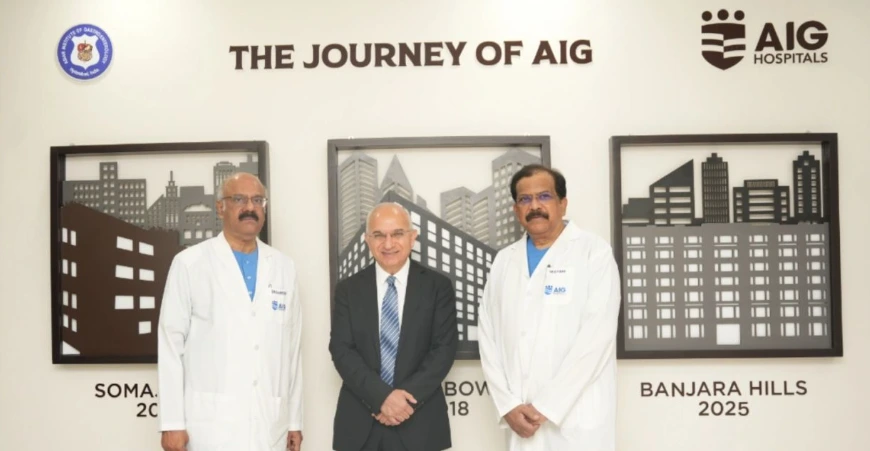
Left to right: Dr D Nageshwar Reddy (Chairman of AIG), Professor Emad El-Omar (Professor of Medicine at the St George and Sutherland Clinical Campuses, UNSW Australia), and Dr GV Rao
Another interesting case that actually helped both Dr Reddy and Dr GV Rao transform their services was when a popular Chief Minister’s spouse approached them. The patient underwent laparoscopic cholecystectomy and subsequently developed septic shock because of an impacted CBD stone. An urgent ERCP was to be done.
“We were contacted and airlifted to attend to the patient at midnight. We managed to save the patient and, as a result, the Chief Minister offered us a place in his state to start a full-scale practice,” says Dr Rao. However, they did not want to move out of Hyderabad. “The CM then ensured that we got a place in Hyderabad to start our independent institution. That’s how Asian Institute of Gastroenterology got its first proper building in the year 2004.”
A breakthrough on the global stage
Describing the first two years (2003–04) as the most dramatic in his career, Dr Rao beams with pride when he says that they performed the first endoscopic appendectomy in the world. This evolved into Natural Orifice Transluminal Endoscopic Surgery or scarless surgery.
Dr Rao was asked to present this data at a major gastroenterology meeting in the USA after being primed about a possible negative response from the attendees, as had happened when the first-ever laparoscopic cholecystectomy was showcased earlier at similar meetings.“The presentation went flawless, but the standing ovation of 4,000-plus audience members is unbelievable to this day.”
Back then, the first 50 laparoscopic cholecystectomies were done at midnight because of the non-availability of an endoscopy camera. “It was a kind of innovation at that time, where we used to leverage an endoscopic camera with an adapter to fix it on the laparoscopic instrument to do the surgeries. Surgeons these days won’t even be able to imagine something of that sort,” he explains.
The silent crisis that worries him most
What concerns Dr Rao deeply today is the silent burden of chronic disease — conditions like diabetes, fatty liver disease, cardiovascular diseases, obesity and cancers that often go undetected until they become advanced. “These are not merely clinical problems; they reflect how we live, eat, work and age as a society.”
What deserves far greater public attention is the idea that healthcare should begin much earlier, through prevention, early detection and sustained engagement, rather than at the point of crisis, points out Dr Rao.
Equally important, he says, is ensuring that advances in medicine and technology reach beyond city centres, so that geography or income does not determine health outcomes.
Redefining fulfilment
For Dr Rao, it is no longer just performing a complex surgery, though that remains close to his heart. “Today, the greatest fulfilment comes from seeing young surgeons grow, watching institutions function independently of individuals, and seeing patients benefit from systems that were designed thoughtfully.”
Increasingly, he says, fulfilment also comes from building bridges between clinical medicine, research and technology, where innovation is not about complexity but about making care safer, more precise and more accessible. “Building something that outlives you is a very different kind of satisfaction.”
“After all these years, I still get calls at midnight for some emergency. But my experiences have taught me to stay composed even in the most demanding situations,” smiles Dr Rao.

Sci-fi, surgery and a love for biryani
The doctor loves watching science fiction movies, and some of them do get featured in his clinical presentations too. “From The Matrix, Terminator to Avatar, I try and catch up with all the latest sci-fi movies, and they do keep me hooked,” says Dr Rao, who, by his own admission, has a soft corner for Hyderabadi biryani but does not overindulge.
Dr Rao says it would be worth it if all the experience and practical knowledge that he acquired can be used to influence medical teaching, practice and community work. “Consulting government agencies with a science-based approach would be something that I would be delighted to contribute to,” he says of the road ahead.
Medicine as a privilege, not a profession
He says each day offers an opportunity to learn, to teach, to improve systems and to serve. “Medicine is a privilege which allows you to touch lives at their most vulnerable moments. When that privilege is combined with responsibility, humility and vision, it becomes deeply fulfilling. That sense of purpose is what continues to drive me every morning.”
- Follow Dr GV Rao on LinkedIn
ALSO READ: Indian-American Padma awardees 2026: Global careers, national commitment

Great life journey and satisfied profession,recognised for DR.B C ROY award and PADMA SHRI by GOVT. OF INDIA. PROUD OF YOU DR G V RAO garu