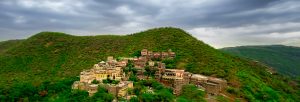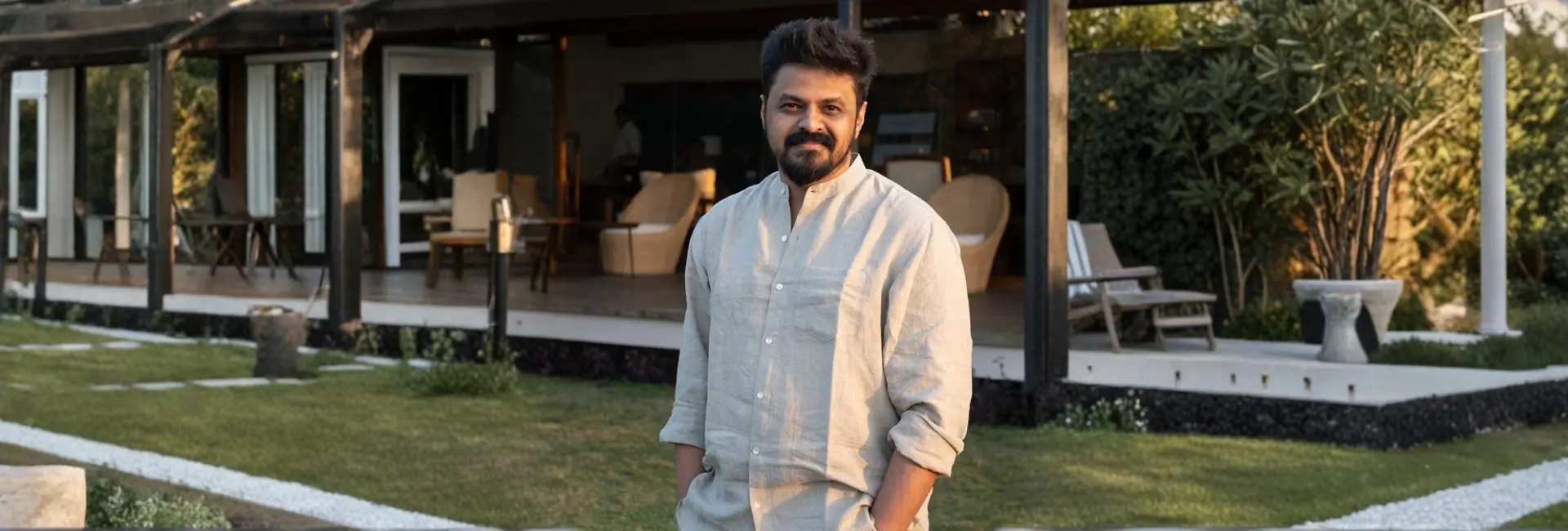


(January 17, 2026) While developing Woods At Sasan, a retreat in Gujarat’s Gir region, entrepreneur Maulik Bhagat did so on a mango orchard without cutting a single tree, designing pathways to follow the orchard’s natural layout. Every element, from materials to spatial experience, was shaped to create natural immersion and honour the land’s ecology. Combined with the use of organic materials and local artisans, this integration with nature defines what makes the project distinct.
Built in and around eight acres of an old mango orchard with 280 trees, Woods At Sasan is a modern retreat in the woods that continues to function as a living ecosystem. The land supports a wide variety of birds, insects, and small animals, allowing biodiversity to thrive alongside human presence rather than be displaced by it. The retreat has been built entirely without cement, using locally sourced, non-toxic, reclaimed, and reusable materials to minimise concrete use and significantly reduce the project’s carbon footprint.
Set on the edge of Gir (Gir Forest National Park), in western India’s Saurashtra–Kathiawar peninsula, Woods At Sasan sits within one of the country’s most ecologically significant landscapes. Gir is globally known as the last natural habitat of the endangered Asiatic lion, making it a unique ecosystem of dry deciduous forests and grasslands that also support leopards, deer, hyenas, reptiles, and hundreds of bird species. Yet beyond its wildlife identity, the region carries a layered history of agrarian life, craft traditions, and bio-regional knowledge that is often overshadowed by safari-led tourism.
For Maulik Bhagat, Founder of 1000 Island Hotels & Resorts, the decision to build here was deliberate. Gir, he felt, was being visited, but not truly experienced. “A good hotel can open doors to a destination. It shapes how people experience a place, how communities thrive, and how nature is respected,” he tells Global Indian, sharing the intention behind the nature-soaked project.
Coming from a renowned family in Gujarat, Maulik grew up observing enterprise not merely as profit-making, but as a long-term responsibility towards people, land, and continuity. That grounding explains the scale, patience, and conviction with which Woods At Sasan has been built, not as a quick hospitality venture, but as a long-term commitment to the place.
View this post on Instagram
A systems thinker finds his medium
Maulik’s journey into hospitality began at a later stage in his career. Trained as a software engineer, he spent his early professional years building digital systems. It was an experience that shaped how he understands the world. Systems, he learned, determine outcomes, and should always be designed with empathy and context.
Over time, his interests expanded across technology, education, healing sciences, Ayurveda, mythology, and social enterprise. While these pursuits may appear diverse, they were united by the single thread of understanding how human wellbeing, community resilience, and environmental health intersect rather than exist in silos.
“For me, enterprise, whether commercial or community-driven, is a vehicle to create long-term social and environmental value when it is designed thoughtfully,” Maulik explains. This belief would eventually lead him to hospitality.
Seeing Gir through a global lens
The clarity behind Woods At Sasan was sharpened through travel. As Maulik visited destinations such as Singapore, Maldives, Mauritius, and Malaysia, he observed how hotels often functioned as gateways, connecting guests to culture, ecology, and local identity. It raised a difficult question. Why were travellers crossing continents to experience thoughtfully designed nature destinations, while Gir, home to a species found nowhere else in the wild, remained peripheral in global imagination?
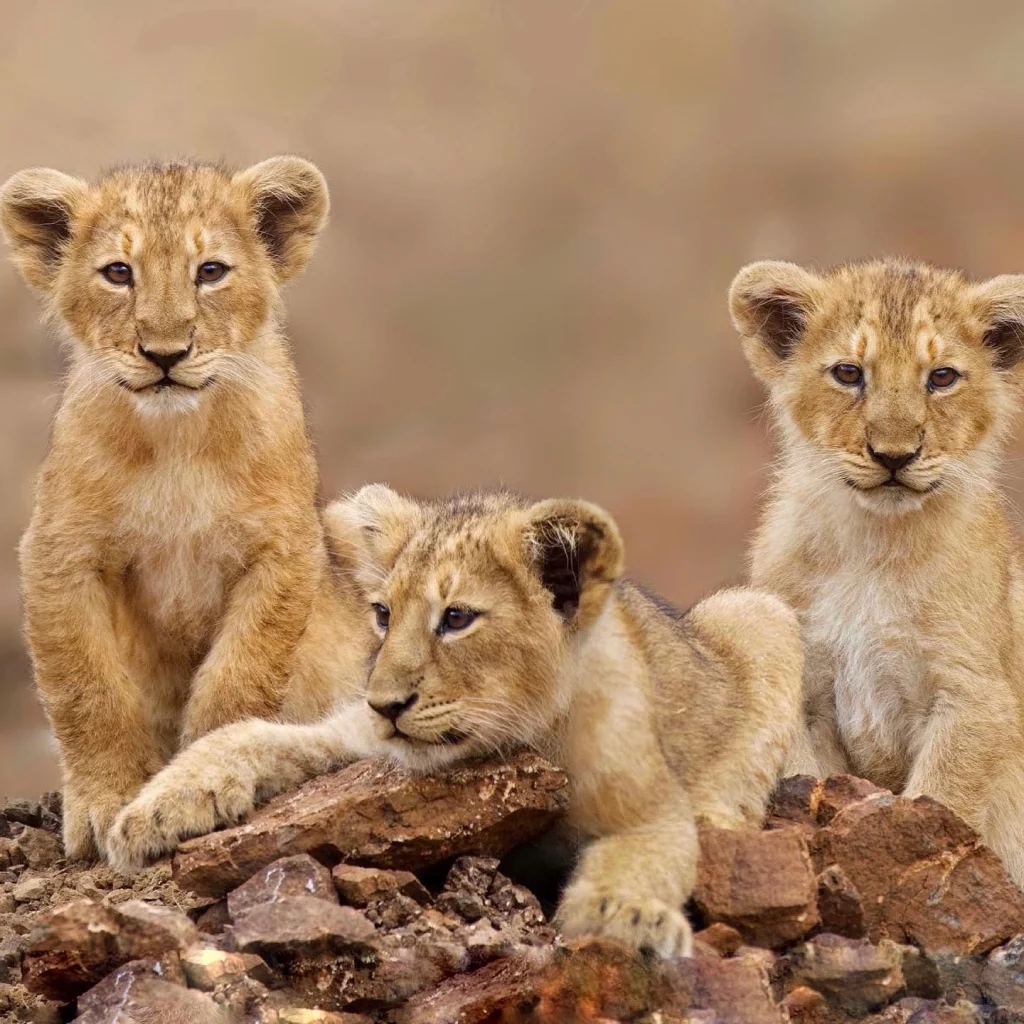
Cubs at Gir | Photo Credit: Woods At Sasan
“That’s when it struck me,” recalls the Gujarat native who grew up in Ahmedabad. “Why are people travelling across continents to see lions, while Gir, where the Asiatic lion actually lives, does not get the dignity and positioning it deserves?” The answer, he realised, was not scale or spectacle, but intent. Hospitality could become a way to reframe Gir, not just as a stopover, but as a place of meaning, care, and connection.
Building with, not over, the land
Woods At Sasan was co-designed with architect Maria Portella, introduced to Maulik through a trusted personal connection. From the outset, the collaboration resisted formula. There was no fixed design brief, rather a shared willingness to ask difficult questions and let the land guide decisions.
“From the very first conversation, she didn’t ask about style or drawings,” Maulik says. “She focused on the ‘why’ of the project. If an idea is real, it survives that questioning.”
Construction unfolded slowly and deliberately, and was aligned with biophilic design which is an architectural philosophy that seeks to reconnect people with nature by integrating natural materials, light, landscape, and ecological processes into built environments.
Thirty-two local artisans played a central role, shaping the project through lived knowledge and skill. Challenges like sourcing Tangadra stone and repeatedly reworking roofing systems became part of the process rather than setbacks. “Challenges were never obstacles,” Maulik reflects. “They were opportunities to stay true to the mission.”
View this post on Instagram
Hospitality as social architecture
For Maulik Bhagat, Woods At Sasan is not a hotel in the conventional sense. It is a form of social architecture and an ecosystem that brings together farmers, artisans, designers, therapists, and guests. “A hotel is not just a place to stay,” he says. “It’s a space where someone spends 24 uninterrupted hours of their life—eating, sleeping, resting, reflecting. That carries responsibility.”
At Woods At Sasan, wellbeing is approached holistically. The experience is intentionally slow, designed around rest, natural immersion, and reflection, rather than rigid programming or performative luxury. “Hospitality has the power to touch lives,” Maulik adds. “It leaves an impression, and a shift in how you feel and interact.”
Moving beyond sustainability
While sustainability has become an industry standard, Maulik believes it no longer goes far enough. Minimising harm, he argues, is only the starting point. “Sustainability asks us to reduce damage,” he says. “Regeneration asks us to create a positive impact.”
This thinking now extends beyond hospitality. Maulik is developing three food-forest-based projects focused on residential, social, and communal living. Rooted in indigenous planting systems and local seed knowledge, these landscapes are designed to restore biodiversity, rebuild soil health, and strengthen local food systems over time. “The food forest is not about yield,” he explains. “It’s about intergenerational stewardship, and placing time and care in service of the land rather than immediate returns.”
An enduring impact
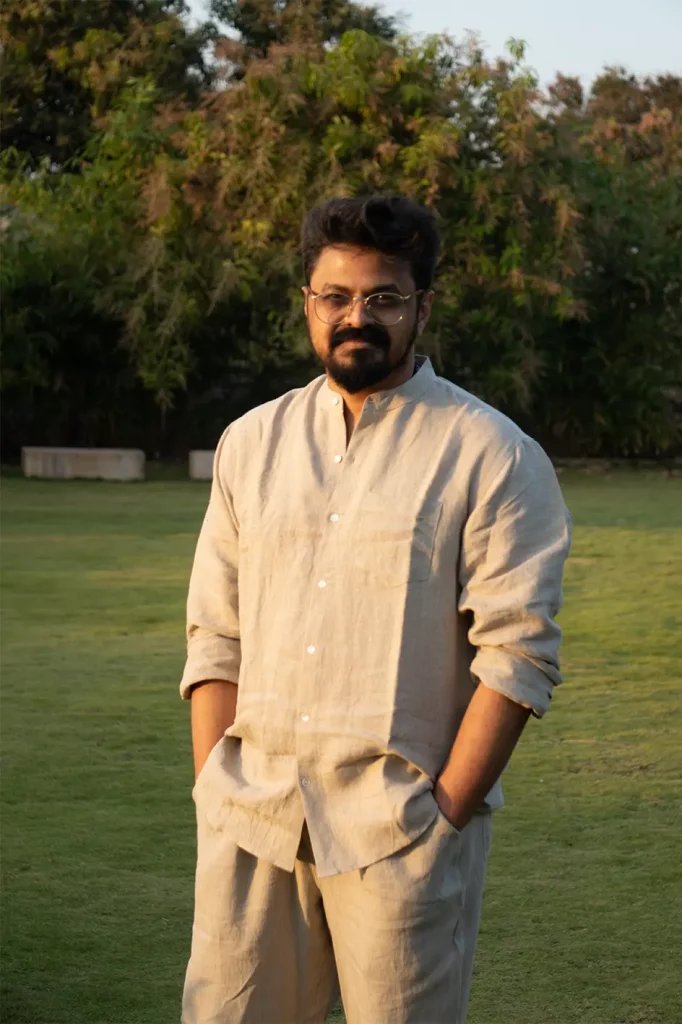
Maulik Bhagat does not frame his work as disruptive or revolutionary. Its strength lies in restraint and choosing alignment over scale, and patience over speed. “If we offer something beautiful to a guest but it comes at the cost of the soil, the farmers, or the ecosystem,” he says, “then the experience is incomplete.”
At Woods At Sasan, impact is not announced loudly. It is embedded in stone, shade, soil, and time, inviting guests to experience Gir not as a destination to consume, but as a place to encounter with care. “When hospitality is practiced with honesty,” Maulik reflects, “it becomes a force for good.”
- Follow Maulik Bhagat on LinkedIn
- For more details, visit Woods At Sasan’s website, Instagram, and Facebook
ALSO READ: How Suyash Keshari is reimagining wildlife tourism through conservation and community