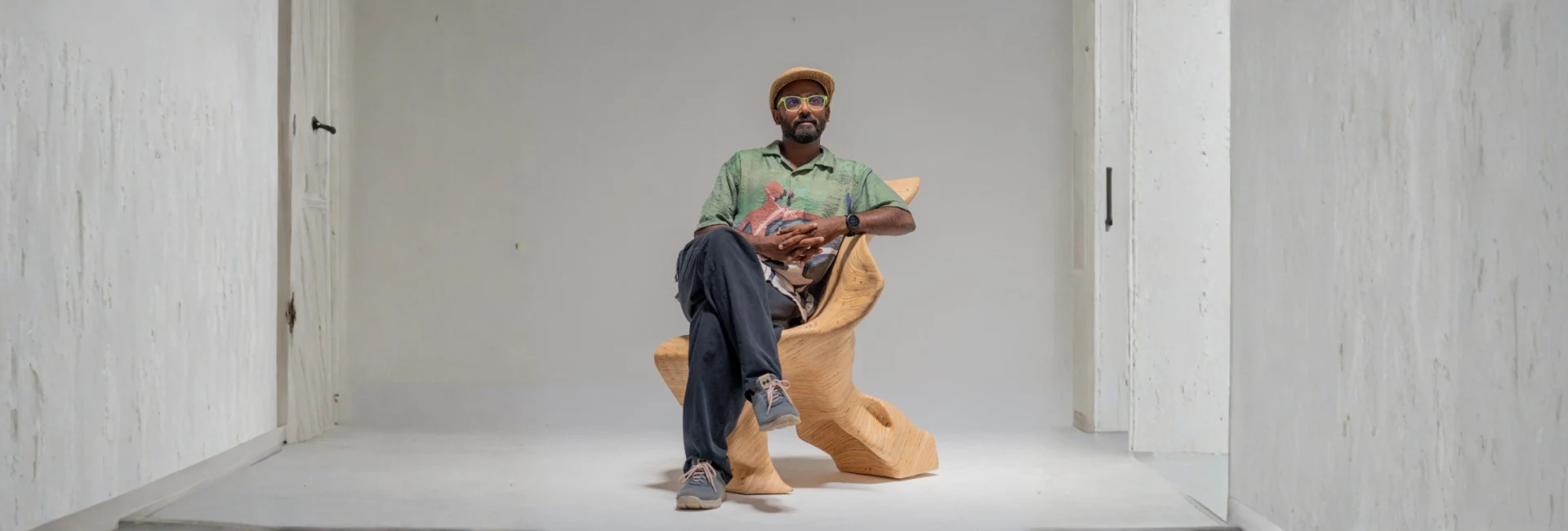


(February 18, 2026) On a one-acre farm in Chilkur village on the outskirts of Hyderabad, far from the curated buzz of gallery circuits and the performative glare of art openings, Harsha Durugadda lives and works out of a repurposed shipping container he custom-designed himself. The structure sits amid trees, open skies, and sculptures that rise from the earth like meditative sentinels. His work and his phenomenal talent has ensured that no list in the country featuring emerging artists is without his name.
The young sculptor has steadily built an international reputation. In 2022–23, he received the Emerging Artist – South Asia award instituted by The Arts Family (TAF), London. His work was auctioned at Sotheby’s in New York in 2021 in collaboration with Burning Man. Earlier, he won the prestigious Rio Tinto Sculpture Award in Australia (2017) and the Biafarin Award in Germany (2018). His sculptures have been widely exhibited across the world.
Back home, however, the reception is quieter. “Yes, I won a big award, but it didn’t make much of a difference in India,” he says with an easy smile. “My work isn’t figurative or easily decipherable. It’s very personal. It captures tactile emotions and complex ideas into visual art, which isn’t much understood, at least in India.”
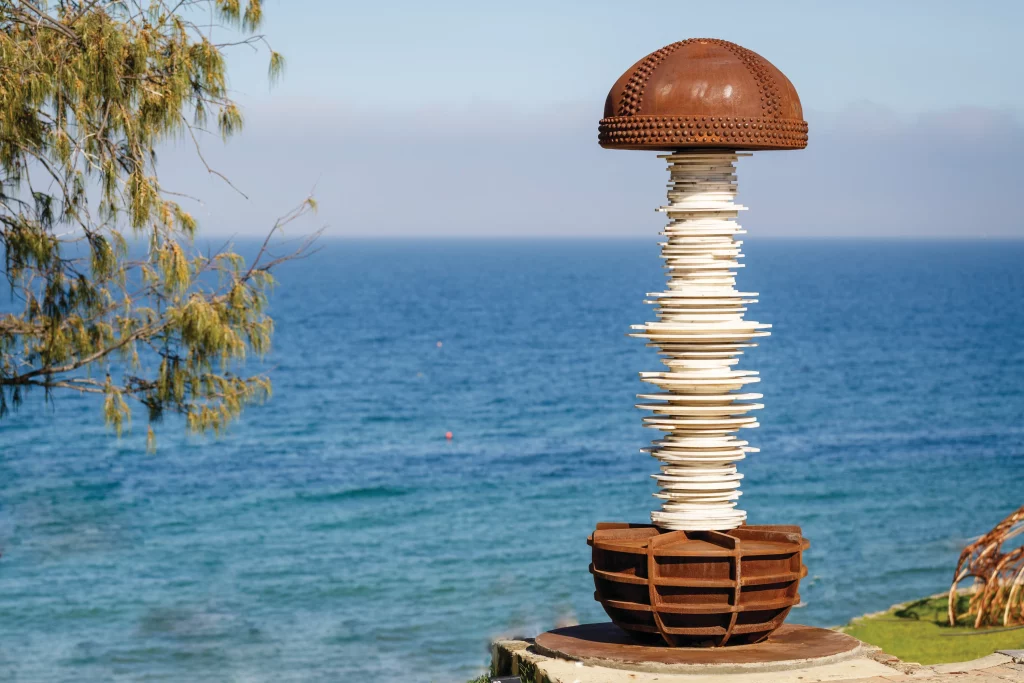
Column of Sound | Sculpture by the Sea | Cottesloe 2017
A childhood in stone and sea
Harsha comes from a storied lineage of sculptors. His forefathers belonged to Allagadda, near Kurnool, a village famed for its idol-making traditions. His father, Hariprasad Achari, is a national award–winning sculptor whose works influenced the 37-year-old from a young age.
“My childhood was filled with creativity and life experiences,” Harsha recalls. “I was brought up in a stone sculptor’s guild where we come from generations of stone sculptors. I grew up in my father’s sculpture studio and was required to assist whenever possible.” The studio was his playground and classroom. He began with menial jobs but was encouraged to explore freely. “My father would bribe me to make a clay sculpture just so I could go and play with friends,” he laughs.
There was no pressure to top academic charts. “I was encouraged to just pass and be more creative, which I guess took off the pressure.” That freedom allowed his imagination to flourish. He painted everywhere: even his ceiling fan, which he now cherishes as an early relic of artistic rebellion.
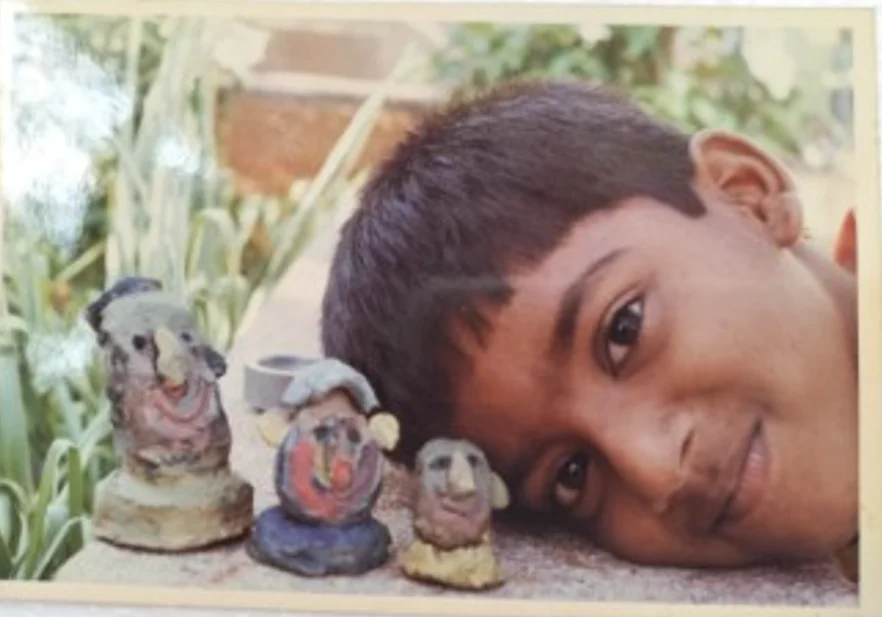
Harsha during his childhood
Growing up in Visakhapatnam, the ocean became his silent companion. “I remember sneaking out at 4:00 am with a camera and heading to the beach to photograph the sunrise. I would record long time-lapse videos. That was the most exciting part of my childhood.”
He had access to a vast home library filled with books on art and philosophy, opening up new worlds of inquiry. A formative moment came during a visit to the Triennale exhibition in New Delhi. “I witnessed an installation made with plastic waste and water. I still remember it vividly. It moved me and has stayed with me ever since.” That encounter planted a seed that art could be immersive, conceptual, and transformative.
From maquette to monument
Harsha’s first solo show came remarkably early, at the age of 12 in 2002, at Abburi Kala Kendra. Even then, he experimented with unusual materials like grease. But it was in 2016, with his solo show Whirling Out in New Delhi, that his professional journey gained momentum.
One of his early landmark works, Column of Sound, reflects his fascination with translating the intangible. “I love music,” he explains. “So I took the visual pattern of a sound wave, a spectrogram, and turned it into a two-foot-tall sculpture.” The piece explores the visual dynamism of audio waves, freezing vibration into form.
Another work, Mirage, is a meditation on illusion — a sculptural inquiry into perception and what we believe we see. “I create non-functional art, so it’s a happy accident that people like it,” he says. “My ideas are a lot about perspective and how one sees and visualizes objects around us. It is all about resilience.”
View this post on Instagram
His installations are monumental: often requiring three months to complete and heavy machinery to assemble. The process begins with a maquette, a small model to explore proportion, material, and structural logic. “Large sculpture entails structural understanding, material understanding and logistical know-how,” he explains.
He works across mediums: steel, marble, and stone, navigating their distinct personalities to bring them into dialogue. Selecting stone alone can mean travelling to quarries in Rajasthan or Andhra Pradesh. “It is a long, enduring workflow from the initial maquette to the final sculpture.”
The farm in Chilkur provides both space and solace. Surrounded by ecology, he finds inspiration in everything from the symmetrical beauty of a wasp’s nest to the philosophy of permaculture. “It is easy to mount my sculptures here,” he says, gesturing to the open land. But more than practicality, the farm nurtures perspective.
He is as comfortable discussing structural engineering as he is contemplating the metaphysics of nature. This ability to draw beauty from both logic and life makes him a holistic artist. “Physically and mentally, sculpting is a tough ask,” he reflects. “It takes a whole village to bring a piece: from the people helping me to a gallery. It is not an independent profession. But when your work speaks in different tones to the people visiting a gallery, it’s worth all the effort.”
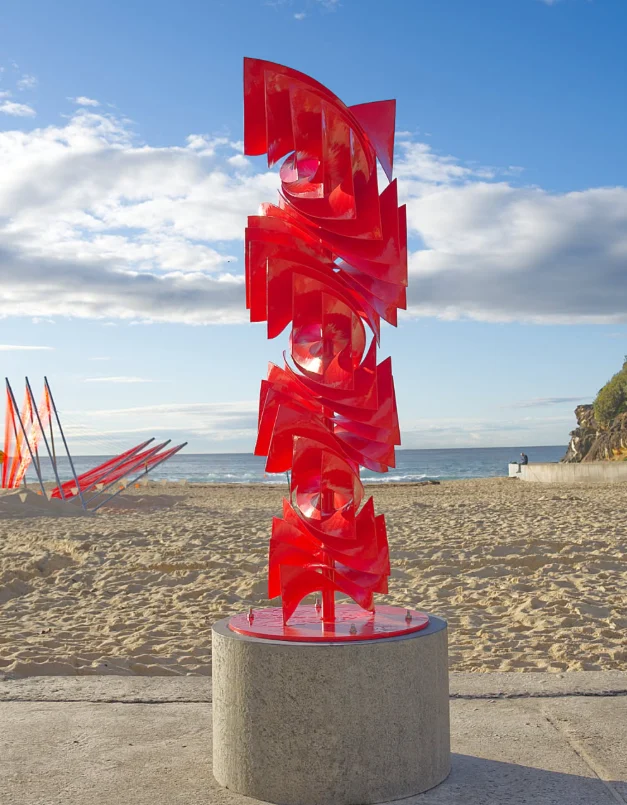
Harsh Durruguda’s work displayed in Australia
Global recognition, grounded spirit
The turning points in Harsha’s career have come steadily. Winning the Rio Tinto Sculpture Award in 2017 in Australia placed him alongside some of the world’s finest sculptors. The Biafarin Award in Germany in 2018 further cemented his global credentials. His inclusion in a Sotheby’s auction in New York in collaboration with Burning Man marked a rare crossover between conceptual art and mainstream recognition.
The TAF Emerging Artist – South Asia award (2022–23) was another milestone, affirming his presence on the international stage. Yet, acclaim has not altered his quiet rhythm of living.
He consciously distances himself from the “razzmatazz” of the art world. His home (the custom-designed container) reflects that ethos: functional, adaptive, self-made. It mirrors his art practice: repurposing, reimagining, reinterpreting. Harsha’s sculptures are not meant to decorate; they are meant to provoke. They do not offer immediate comfort but invite contemplation. They ask viewers to slow down, to reconsider perspective, to engage with resilience.
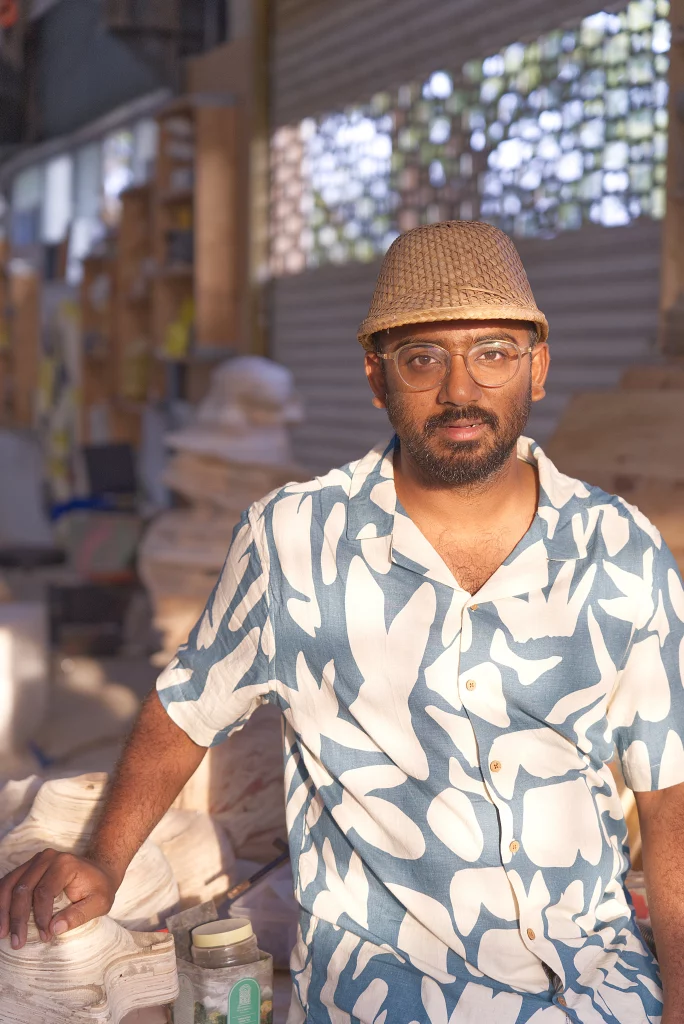
After a five-year break from solo exhibitions, he is now working on a new body of work for an upcoming solo show. There are also discussions underway for a significant exhibition in Milan in 2027. “I just want to keep creating and sharing my work with the world,” he says simply.
In a time when visibility often equals value, Harsha Durugadda represents a different kind of artistic journey, one rooted in lineage yet global in reach, deeply personal yet universally resonant. From the sculptors’ guilds of Allagadda to Sotheby’s in New York, from a child painting ceiling fans to an artist commanding steel and stone, his trajectory is both organic and extraordinary.
On his Chilkur farm, amid rising forms of marble and metal, Harsha continues to carve silence into substance, transforming invisible ideas into enduring monuments of thought.
- Follow Harsha Durugadda on Instagram
ALSO READ: Naresh Kumar Kumawat: Sculpting India’s spirit for the world