


(March 27, 2026) He was born in London, raised in Amritsar, schooled in Delhi and North Carolina, and ended up in Boise, Idaho in the United States, building a body of work that has rewritten the rules of modern computing. The journey of Gurtej Sandhu, Principal Fellow and Vice President at Micron Technology, is remarkable. The record he holds even more so.
With over 2,211 patents worldwide and 1,432 in the United States alone, Sandhu has surpassed Thomas Edison’s legendary patent record to become the world’s seventh most prolific inventor. The man who lit up the world with a light bulb held 1,093 US patents. Sandhu passed that number years ago and has not stopped. Yet ask him about it and he is more likely to talk about the importance of staying curious than to dwell on any personal milestone. That humility, colleagues say, is entirely genuine.
I don’t do patents for the sake of patents. People usually tell me how many I have, but I was trying to solve problems. As part of solving problems, corporations try to protect their IP, and then the company decides to file those patents. That turns into a patent. So the patent is an output of an activity — the work I need to do at Micron.
Gurtej Sandhu
“We all have this capability to find a creative solution. It has no bearing on what your education is, what your background is, who you are,” he said in a TEDx talk that has since drawn wide attention.
A family built on learning
Sandhu’s appetite for knowledge was shaped early. Both his parents were PhD graduates from the University of London and had returned to India, where his father taught chemistry at Guru Nanak Dev University in Amritsar. Growing up in a home where intellectual curiosity was the norm, the young Sandhu absorbed an ethic of inquiry that has never left him.
When it came to choosing a field, his father offered a deliberate nudge away from the obvious. “My father told me not to pursue Chemistry,” Sandhu recalled during a lecture in 2025, “because he wanted me to find my own vision, my purpose.” And find it he did.
Gurtej Sandhu earned a master’s degree in physics from Guru Nanak Dev University, followed by a Master of Technology in electrical engineering from the Indian Institute of Technology, Delhi. He then crossed the Atlantic for a PhD in physics at the University of North Carolina at Chapel Hill, graduating in 1990, the same year he joined Micron Technology in Boise, Idaho. He has been there with the organisation for more than 35 years, now.
Making chips smaller, faster, cheaper
When Sandhu arrived at Micron in 1990, fresh out of his doctoral programme, he had offers from established names like Texas Instruments. He chose Micron, then a far smaller company, drawn by the scope it offered for hands-on invention. It proved to be the right call.
Think of a memory chip as an extraordinarily tiny filing cabinet. The smaller you can make it without losing anything stored inside, the more powerful and affordable the devices it goes into. Sandhu’s life work has been finding ways to keep making those filing cabinets smaller, more reliable, and cheaper to produce, decade after decade.
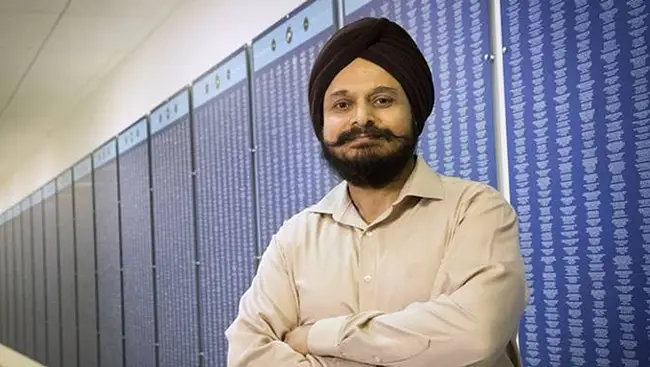
Gurtej Sandhu standing behind a list of Micron’s patents on display, a few years back
Micron, as a company, has the highest index of number of patents per employee. So Micron is known and recognised as a very creative company over the years, especially for a company which started so small and little-known in Boise, Idaho.
Gurtej Sandhu
Sandhu’s early breakthrough involved developing a way to coat microchips with titanium without exposing them to oxygen, which would otherwise ruin them. At the time, he did not think it was a particularly big deal. Today, most memory-chip makers in the world use the process. That pattern of foundational innovation that the wider industry eventually adopts has defined his career. Speaking to IEEE Spectrum, he put it plainly mentioning, “A lot of the innovations at Micron were in processes and techniques to enable new materials and complex structures. And many of them were quietly adopted in the memory space long before anybody else in the industry had heard of them.”
The result is that his inventions are embedded in the devices billions of people use every day, from smartphones and laptops to cameras and data centres powering artificial intelligence.
More patents than Edison, and still counting
Numbers can numb. But consider that Edison, whose name has been synonymous with invention for over a century, held 1,093 US patents. Sandhu has surpassed that figure by more than 300 and keeps going. His most cited patent alone has been referenced over 1,200 times by companies including Samsung and Huawei, a quiet measure of just how foundational his work has become across the global industry.
He is also quick to note that the patent record tells only part of the story. Many of the most significant breakthroughs in chip manufacturing, he has pointed out, never appear in any public filing at all. They are retained as trade secrets, invisible to the world but embedded in every device that relies on modern memory.
Recognition, long in coming
The honours have accumulated steadily. In 2018, Sandhu received the IEEE Andrew S. Grove Award, among the most prestigious in semiconductor engineering, for contributions that enabled the extreme scaling of memory chips. He is a Fellow of the IEEE and a Distinguished Alumnus of IIT Delhi.
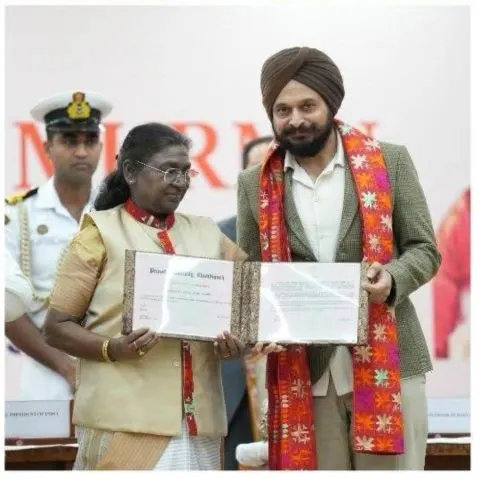
Gurtej Sandhu was conferred the Vigyan Ratna Award by President Droupadi Murmu
In March 2025, at a convocation ceremony, the President of India Droupadi Murmu presented him with the Vigyan Ratna Award for his significant contributions to science, connecting his journey from a university campus in Amritsar to laboratories that have shaped the modern world. He was honoured with the Distinguished Alumnus Award from IIT Delhi in 2023 for his exceptional contributions to semiconductor technology, specifically atomic layer deposition, and his corporate leadership.
Everyone is an inventor, he genuinely believes it
For all his technical achievement, what strikes those who have heard Sandhu speak is how insistently he frames innovation not as the province of experts but as a basic human impulse, something everyone carries.
Necessity is the mother of invention. When we are faced with a certain sticky situation, we all have this capability to find a creative solution out of it. It has no bearing on what your education is, what your background is, who you are.
Gurtej Sandhu
He backs the point with examples ranging from everyday street-side ingenuity to the exponential growth of computing, drawing a line from a bicycle loaded with bricks to the smartphones in our pockets.
On artificial intelligence, he argues that fear is less useful than governance. “Maybe the way to answer that problem is to put rules and standards in place so that the ethics of AI are actually slightly better than ours.” The point is serious. Technology, in his view, is never inherently good or bad. The choices about how to use it belong to society, not to scientists alone. “Technology can do a lot of good if we will let it. It’s our decision. We are all innovators.”
Still seeking
Sandhu plays basketball and table tennis, supports educational philanthropies, and has spent over fifteen years mentoring engineering students at Boise State University, contributing to the launch of its PhD programme in Materials Science and Engineering. He is known among colleagues for an investment in younger engineers that goes well beyond the perfunctory.
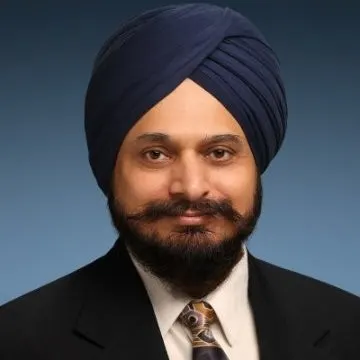
What has not changed, from the boy in Amritsar asking large questions about the universe to the inventor who holds more US patents than anyone before him from the Indian subcontinent, is the underlying posture. “Stay open, stay curious, explore it,” he has said. For a man who has already rewritten the record books, it reads less like advice and more like a personal code, still very much in use.
His breakthroughs that changed computing forever
- The titanium shield — Developed a coating for microchips now used as standard practice across the memory chip industry worldwide
- Smaller and faster — Pioneered a technique that reduced the space between components on a chip, enabling more to fit and making devices smaller and faster
- Making technology affordable — Contributed to driving down the cost of storing data so dramatically that what once cost millions now costs dollars
- The 3D chip — Helped develop memory chips that stack storage layers like floors in a building, multiplying capacity without increasing size
- DNA as a hard drive — Published research on storing digital data inside DNA molecules, a technology that could redefine data storage entirely
- AI ready memory — Is driving research into memory chips that work more intelligently alongside processors to meet the demands of artificial intelligence
Follow Gurtej Sandhu on LinkedIn