March 11 2026
From rural Odisha to global walls: Sidd Panda’s MagicDecor story

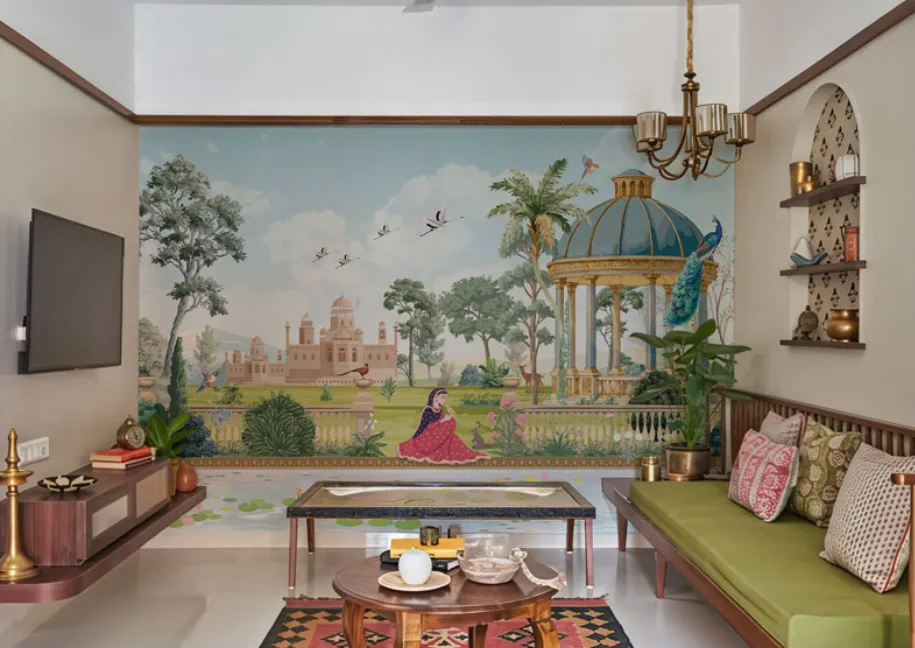
(March 11, 2026) Walls, Sidd Panda believes, are the most overlooked canvases in a home. “Walls are the largest surfaces in any living space,” he says. “Yet most homes treat them as an afterthought.” That simple insight led him to build MagicDecor, a tech-enabled personalised wall décor platform that has grown into a zero-inventory, fully customised operation serving customers in more than 100 cities across India and the United States, with hotel projects in the Maldives.
With more than 500 international orders, MagicDecor today operates at a global scale. Yet some of its most memorable deliveries have taken the team to places far removed from urban design studios. In one early project, Sidd Panda’s team delivered wallpaper to a school perched atop a mountain in a remote Indian region with no motorable road. “Our team walked over five kilometres carrying materials to complete the project,” he recalls. “That delivery wasn’t just about wallpaper. It was about commitment.”
Building against the odds
Bootstrapped through its early years and launched weeks before the pandemic shut the world down, MagicDecor survived COVID, built proprietary visualisation tools, developed its own installation network, and went on to raise ₹5.10 crore from Pidilite Ventures, the strategic investment arm of Pidilite Industries. The backing was more than capital; it was validation from a legacy brand deeply embedded in India’s home improvement ecosystem.
Before MagicDecor, Sidd had already built Printview from a college hostel room with ₹15,000, scaling it to ₹1 crore ARR (annual recurring revenue), an early signal that ideas born in smaller cities could travel far. Today, MagicDecor has handled over 500 international orders, decorated hotels in the Maldives, and designed walls in more than 100 homes in the United States. But the story begins far from funding decks and design algorithms.

The making of an entrepreneur
Sidd Panda grew up in a village in Kendrapara district, Odisha: a place shaped by cyclones, uncertain farming incomes, and generational resilience.
“My family and the legacy of my ancestors were my biggest influence,” he says. “I grew up listening to stories of my great-grandmother, who was widowed at a very young age. She started a business selling mangoes and goods to distant villages. From having no home to owning multiple lands, she built the foundation for future generations,” Sidd shares with Global Indian.
His father, Bijaya Panda, began life in farming but quickly realised the limitations of agriculture in a cyclone-prone coastal region. At 18, he left for Delhi as a day labourer, learned plumbing, worked abroad in Libya and Gulf countries, and eventually returned to start his own business in the 1990s.
“My father understood early that he couldn’t build his dreams by staying where he was,” Sidd reflects. “That courage to move, adapt and rebuild, that’s something I carry.”
His mother, Saraswati Panda, anchored the household, ensuring stability and support. His brother, Avisekha Panda, would later become his co-founder and backbone of operations at MagicDecor. Entrepreneurship, in many ways, was less a career choice and more a generational continuation.
A turning point in Singapore
MagicDecor’s idea came from identifying a clear market gap. Options available for wallpapers were either generic low-quality prints or expensive imported ones with long waiting periods. The aspiration existed, but access did not.
A turning point came when Sidd visited an HP Centre of Excellence in Singapore and witnessed large-format printing capabilities firsthand. “It struck me immediately that custom, premium wall décor could redefine how people personalise their homes.” MagicDecor was conceived as a tech-enabled, design-led platform that would handle design, custom manufacturing, delivery and installation, without holding inventory.
View this post on Instagram
When COVID hit
“Revenue stopped. Supply chains froze. The easy choice would have been to pause or walk away,” he says. “Instead, we rebuilt from the inside out.”
During lockdown, the team strengthened technology, developed wall visualisation tools, and refined their manufacturing model. By the time demand returned, they were leaner and structurally stronger. “That period taught me that adversity is a filter. It separates businesses built on foundations from those built on momentum.”
One of their biggest structural challenges was manufacturing. India’s décor ecosystem was built for bulk production, thousands of identical units. MagicDecor needed the opposite: every order was different. “We eventually had to build much of it ourselves, from print technology to a trained installation network,” he says.
Bhubaneswar to the world: Rethinking geography
Unlike most startups chasing metro validation, Sidd chose to build from Bhubaneswar. “Operating from here gives you clarity,” he says. “You’re not distracted by what everyone else is doing.”
Costs are lower, talent is accessible, and focus is sharper. But perception remains a hurdle. “There’s an assumption that if you’re serious, you’ll be in a metro. We’ve had to work harder in certain rooms to be taken seriously.” Yet customers across 100+ cities don’t ask about office location. They care about product, experience, and promise.
Innovation, sustainability and staying ahead
MagicDecor differentiates itself through specialisation. “We sell wall décor. We think about it constantly. In a market full of generalists, focus is our advantage.” The company uses data to anticipate trends, tracking behaviour across cities and categories while observing global aspiration shifts on platforms like Pinterest and Instagram.
Technology drives the edge. Their visualisation tools allow customers to see designs on their actual walls before ordering. The team is now investing in AI-led design intelligence that personalises recommendations based on space and preference.
Interestingly, Sidd’s passion for AI goes beyond business. “I’ve built my own research lab at home,” he says. “Did the DIY assembly and built my own AI system.” Sustainability is built structurally into the model. The zero-inventory approach means no overproduction and minimal waste. Materials and printing technologies are selected to reduce environmental impact wherever possible. “Sustainability isn’t performative for us. It’s operational.”
Funding, recognition and the road ahead
MagicDecor raised ₹5.10 crore from Pidilite Ventures, a partnership Sidd describes as deeply strategic. “When a brand that understands Indian homes and surfaces believes in what you’re building, it tells you something important.”
Earlier, Printview had earned international invitations to speak at forums in Israel and Singapore, early proof that innovation from Bhubaneswar could command global attention.
Today, ambition is bigger than wallpaper. “We want personalised décor to become the default way people design spaces,” Sidd says. “Right now, we’re known as a wallpaper brand. But the vision is a comprehensive surface and spatial design platform.”
Geographically, global expansion is on the horizon. As Indian manufacturing matures and global demand for personalised interiors grows, he wants MagicDecor to represent a new generation of Indian design brands worldwide.
On a personal level, Sidd is not chasing short-term scale. “I’m focused on building something enduring. A brand that empowers creativity and becomes part of how people tell their stories through their spaces.”
When passion becomes profession
Ask the young entrepreneur about his passion outside of work and he responds, “I love playing Table tennis but over the years I have developed a passion to do research on various topics be it technology or AI. I have built my own research Lab for AI, did the DIY assembly of the device and built my own AI system. Somehow my passion and profession are so much blended together that I never felt like pursuing any hobby to reset myself. Be it my love for machines, or the love for technology.”
From a village shaped by storms to decorating homes across continents, Sidd Panda’s journey is less about walls, and more about foundation.
ALSO READ: National Startup Award and a deeper calling: Yosha Gupta’s MeMeraki story
Share with