


(March 21, 2026) Dr Samatha Tulla’s journey into medicine was driven largely by curiosity about diagnosis. The idea that a physician could investigate symptoms, identify the root cause of illness, and help someone recover fascinated her.
Eventually, it drew her towards internal medicine — where understanding complex systems and solving diagnostic puzzles forms the core of everyday work. Her pursuit of knowledge has taken her across continents, from advanced training in the United States to longevity research at Singapore’s National University, deepening her commitment to a medicine that is predictive, preventive, and deeply personal. “Health optimisation is possible at any stage of life — whether someone already has a disease, is at risk of developing one, or simply wants to perform better physically and mentally,” says Dr Samatha, Internal Medicine Physician and co-founder of PMX Health, in a chat with Global Indian.
With certifications from renowned institutions across the world, Dr Samatha’s practice is centred on helping individuals not only manage and prevent chronic conditions, but also optimise their overall health.
A powerful approach
At PMX Health, prevention is at the core of everything they do. “Real care isn’t rushed — a 10-minute consultation can’t capture the complexity of your health,” she says, adding that she believes in taking time to understand an individual’s genetics, lifestyle, and unique needs — “because no two people are the same.”
Dr Samatha and her team’s approach is simple but powerful: patient-centric, root-cause medicine. “Instead of focusing only on treating symptoms, we try to understand the deeper biological and lifestyle factors affecting an individual’s health,” she says, guided by the belief that health should never stop anyone from embracing the joys and opportunities that come their way.
Her work focuses on analysing multiple dimensions of health, including lifestyle habits, sleep patterns, nutrition, physical activity, strength training, environmental toxin exposure, genetic predispositions, and metabolic biomarkers.
Living better, living longer
Dr Samatha says the moment someone decides their health can improve, there is usually something meaningful that can be done. “Living longer also means living better. For too long, healthcare has been reactive — stepping in only when things go wrong.”
Even as technology transforms medicine, Dr Samatha ensures that expertise guides every decision. “With cutting-edge tools and data-driven insights, we make healthcare personal, proactive, and precise. True longevity isn’t about counting time — it’s about making every moment count.”
Training at the American Academy
After completing her postgraduate medical training, Dr Samatha continued pursuing education across multiple disciplines to understand why chronic diseases develop in the first place. She undertook advanced training in functional and metabolic medicine through the American Academy of Anti-Aging Medicine (A4M) and the Metabolic Medical Institute. “This programme expanded my understanding of systems biology, metabolic health, and the interaction between lifestyle, genetics, and chronic disease.”
Longevity course in Singapore
Dr Samatha attended an intensive Healthy Longevity course at the National University of Singapore, where global experts discussed ageing biology, preventive medicine, and longevity science. Designed for healthcare professionals seeking evidence-based insights into the hallmarks of ageing, gerodiagnostics, and gerotherapeutics, the course brings together scientists, clinicians, regulators, and industry innovators from various countries to discuss cutting-edge topics.
“This experience broadened my perspective on how healthcare systems can move from disease treatment to health-span optimisation,” says Dr Samatha. Participants deliberate on specialised areas such as cardiac and oral geromedicine, practical applications in longevity clinic setup, and ethical practice, and also get an exclusive guided tour of the NUS Healthy Longevity Clinic.
Learning genomics online from Harvard
When the COVID-19 pandemic restricted travel, Dr Samatha used that period to continue learning online. One of the courses she completed was in genetic testing and sequencing from Harvard Medical School, which deepened her understanding of genomics and personalised medicine.
She says these global educational experiences shaped her approach as a physician. “They reinforced the idea that health is influenced by multiple layers — genetics, environment, lifestyle, sleep, nutrition, toxins, and social behaviour.”
Speaking at global events
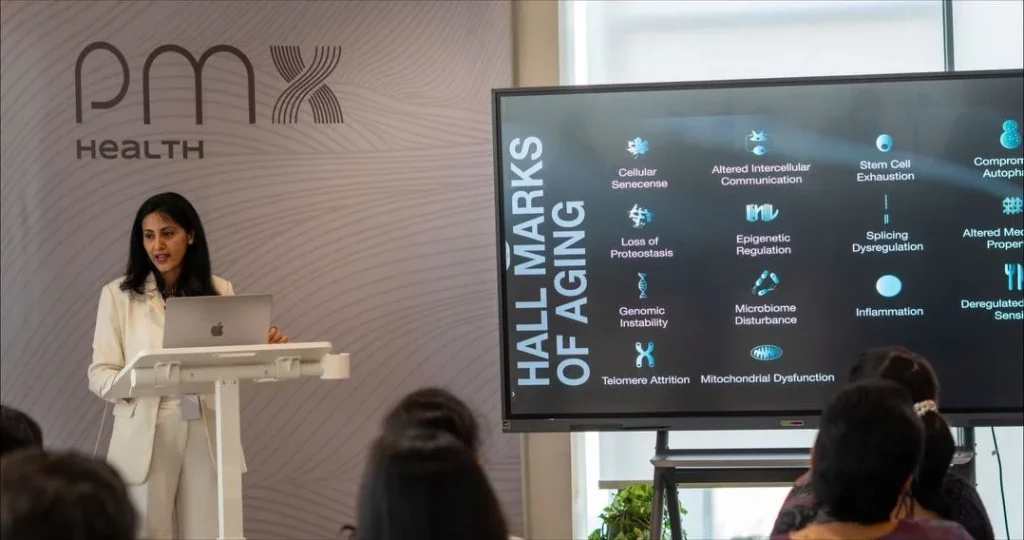
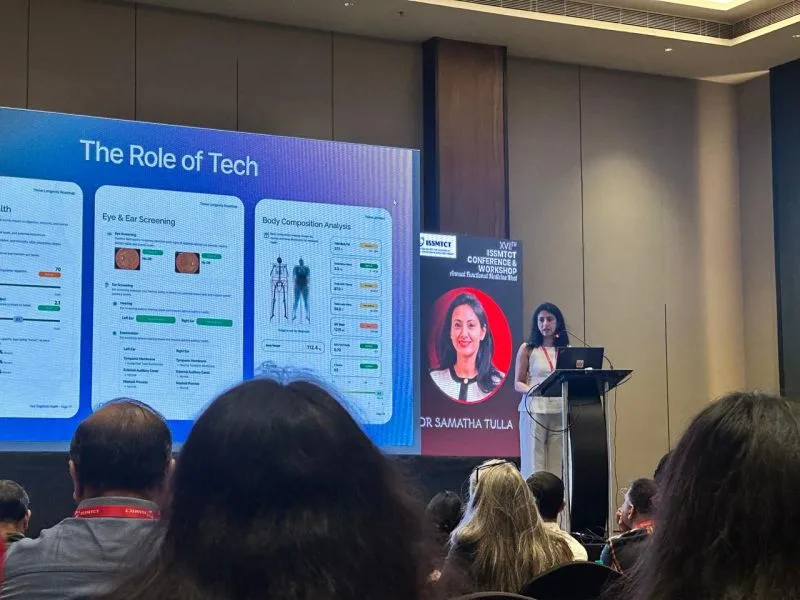
Besides her regular work, Dr Samatha has spoken at various conferences and summits, including the Global AI Summit 2024 (AI in Healthcare), the 9th IASRM World Congress, IIT Hyderabad on the role of AI in metabolomics and preventive health, the AIG Hospitals Conference on AI in personalised health, and the IISC Healthcare Summit 2025.
“These platforms provided opportunities to discuss the intersection of technology, precision medicine, and preventive healthcare, and to explore how AI and advanced diagnostics can transform the future of medicine.”
Roots in Telangana
Born in Injapur village in Rangareddy district, near Hyderabad, Dr Samatha grew up in a joint family, which she considers one of the greatest blessings of her childhood. “My grandparents, cousins, and extended family were always around, and those early years were filled with shared routines, celebrations, and collective experiences,” recalls Dr Samatha, who attended a school near Dilsukhnagar in Hyderabad.
As a child, she was punctual and disciplined — someone who would leave for school on time, return on time, and attend tuitions regularly. She performed consistently well academically and often ranked among the top students in her class. “However, school for me was never only about academics. I loved extracurricular activities, especially dance.”
A love for the stage
During her school years, Dr Samatha learned Bharatanatyam and Kuchipudi for about three years. “Though it wasn’t formal professional training, those experiences gave me confidence in performing on stage,” she says. She eagerly participated in annual day celebrations, stage programmes, and sports events, including throwball and badminton.
“Looking back, what I loved most was the sense of community and participation — being part of groups, collaborating, performing, and celebrating together,” she says. Those childhood experiences shaped her into someone curious, communicative, and always engaged with people around her.
A personal turning point
At one stage of her career, Dr Samatha explored medical oncology. “That experience was important because it helped me understand where my deeper interest truly lay,” she says. She soon realised that while treating advanced disease is critical, her true calling was preventive and root-cause medicine — helping people avoid chronic disease before it progresses.
This shift was also influenced by her own personal health struggles. “I had not been taking care of my own health optimally.” That experience became a turning point, leading her to explore lifestyle medicine, nutrition, sleep, stress management, and metabolic health much more deeply.
Challenging cases
In medicine, some of the most meaningful learning happens through difficult cases. Two conditions that have been particularly complex in Dr Samatha’s practice are Chronic Gut Disorders (IBS) and Fibromyalgia and Chronic Inflammatory Response Syndrome.
She says these conditions illustrate why personalised medicine is essential. “Gut health can be influenced by microbiome imbalance, food intolerances, stress, sleep disturbances, and metabolic factors. Managing such cases requires ongoing collaboration between the patient and physician.”
Fibromyalgia and Chronic Inflammatory Response Syndrome, she adds, are difficult “not because patients are unwilling to change, but because implementing the required lifestyle and nutritional adjustments can be demanding.” The key challenge often lies in long-term adherence to the strategies needed for improvement.
India and personalised medicine
So where does India stand in terms of personalised medicine compared to the West?
“Healthcare systems globally are still structured around treating disease after it appears rather than preventing it. In India, most individuals spend money only after a disease is diagnosed — such as diabetes, heart disease, or cancer.” She believes personalised medicine becomes more affordable when it shifts toward risk prediction and early detection. “Studies from organisations like the World Economic Forum show that every dollar invested in prevention saves multiple dollars in chronic disease treatment over time,” she says. Dr Samatha also shares health education through Instagram and YouTube, particularly in regional languages.
Staying balanced
At PMX Health, Dr Samatha’s role is demanding, but she makes a conscious effort to maintain balance — wrapping up work on time when possible and unwinding with the team. “On some days we work out together, share healthy recipes, and keep each other accountable for staying healthy.” Her day typically starts with a team meeting where they align on priorities, review new releases on their platform, and incorporate clinical inputs and protocols.
The road ahead
Dr Samatha’s long-term goal is to make preventive and personalised healthcare accessible to more people, not just a small segment of the population. “Through our work at PMX Health, we are developing systems that integrate multiple layers of health data — biomarkers, genetics, lifestyle information, and clinical insights — to help individuals understand their health risks earlier and take meaningful action.” She also plans to contribute to training and mentoring physicians interested in preventive and longevity medicine.
Building a longevity ecosystem
Another important focus is building a comprehensive longevity ecosystem that combines diagnostics, clinical expertise, lifestyle interventions, and digital tools. “The idea is to create a platform where individuals can track their health markers over time, understand their metabolic and genetic risks, and receive personalised nutrition and lifestyle guidance.”
Her future plan is to focus on studying metabolic health and ageing patterns in Indian populations, integrating genomics, metabolomics, and lifestyle data, and developing predictive models for chronic disease prevention.
Family time
When not working, Dr Samatha enjoys travelling, spending time with family, celebrating festivals, and being around children — moments that help her stay grounded and connected to what truly matters. “I’m also deeply passionate about teaching and communicating health science in ways that make it accessible to a wider audience,” she signs off.
ALSO READ: From the UK to Harvard: Dr Varsha Reddy Pulimi bringing global dermatology practices to Hyderabad