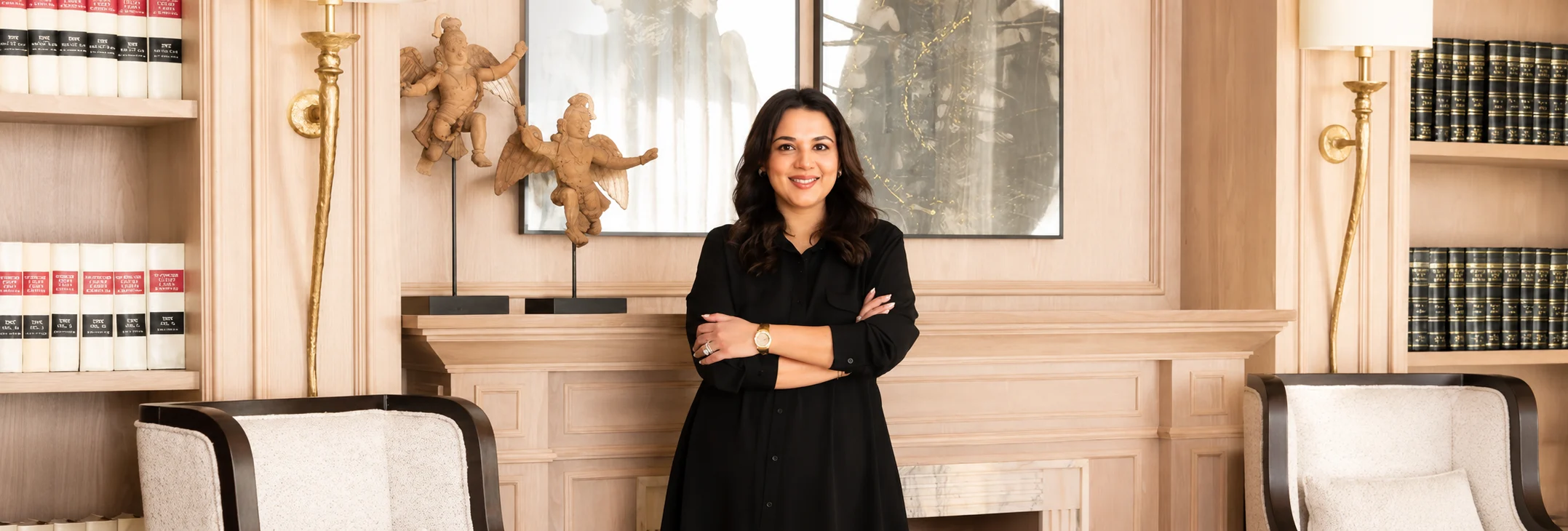


(May 18, 2026) It was in Milan amid ateliers, design studios, and the quiet hum of one of the world’s most influential creative capitals, that designer Disha Subramanium, who began her career in the legal field before moving into design, found herself reimagining her future. She had arrived at the prestigious Istituto Marangoni with curiosity, but left with conviction.
“Being in Milan changed how I saw everything,” she says. “Design wasn’t just about making spaces look good: it was about creating an experience, a story,” she tells The Global Indian.
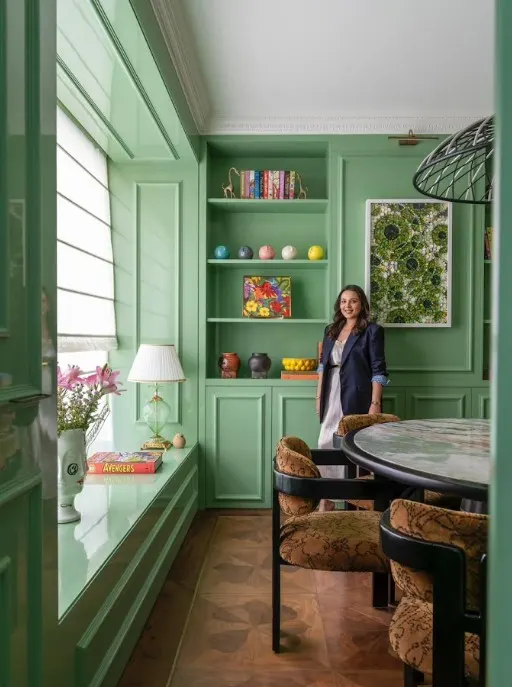
The 35-year-old took the entrepreneurial leap to establish her own design practice after pursuing a design course at Istituto Marangoni in Milan, determined to create spaces that break away from cookie-cutter aesthetics. Over the years, Disha has redefined homes through projects that blend global influences with Indian soul: whether it’s transforming compact urban apartments into layered, personality-driven sanctuaries, or reimagining traditional homes with bold colour, texture, and narrative-led design. “Every space has a story waiting to be told,” she says. “My role is to uncover that story and bring it to life in a way that feels deeply personal.”
That exposure to global design thinking, combined with a deep-rooted appreciation for Indian aesthetics, would go on to define her signature style, one that is bold, layered, and unapologetically individual. Today, Disha is steadily carving a niche for herself in India’s evolving design landscape, creating spaces that blur the lines between art, functionality, and storytelling.
A leap of faith
Disha’s journey into interior design is anything but linear. Beginning her career in law, she was on a path that promised stability and structure. Yet, beneath that surface lay a growing creative restlessness. “There was always this pull towards something more expressive,” she reflects. “Law gave me discipline, but design gave me freedom.”
The decision to pivot was not impulsive—it was a calculated leap of faith. Moving to Milan to study design marked not just a career shift, but a personal transformation. Immersed in a city where creativity is woven into everyday life, she found herself questioning conventions and embracing experimentation.
“At Marangoni, you’re constantly pushed to think beyond the obvious,” she says. “You’re not just designing for a client, you’re designing for emotion, for memory.”
That mindset continues to inform her work today. Rather than adhering to trends or formulas, Disha approaches each project as a blank canvas, one that demands originality, risk-taking, and a willingness to challenge the expected.
Spaces with soul
If there is one thread that runs consistently through Disha’s work, it is her commitment to individuality. In an industry often driven by fleeting trends and Pinterest-perfect aesthetics, her approach stands apart. “I don’t believe in cookie-cutter design,” she says. “Every home should feel like an extension of the people who live in it.”
This philosophy translates into spaces that are deeply personal and richly layered. Whether it’s the interplay of textures, the careful curation of furniture, or the use of colour in unexpected ways, each element is chosen with intention.
Her aesthetic is often described as eclectic, but it is far from chaotic. Instead, it is a carefully orchestrated balance of contrasts: modern and traditional, minimal and maximal, global and local.
“I like to bring in elements that surprise people,” she explains. “Sometimes clients come in with a very fixed idea of what their home should look like. My role is to gently push those boundaries and show them what’s possible.” This willingness to experiment has made her spaces not just visually striking, but emotionally engaging. They invite interaction, curiosity, and, above all, a sense of belonging.
Global inspirations, Indian roots
While Milan shaped her design sensibility, the design maven’s work remains deeply connected to India. Her travels across cultures have given her a wide lens, but it is her appreciation for Indian art and heritage that grounds her practice. “I’m constantly inspired by Indio, the colours, the craftsmanship, the stories,” she says. “There’s so much richness here, and I think we’re only beginning to explore its potential in contemporary design.”
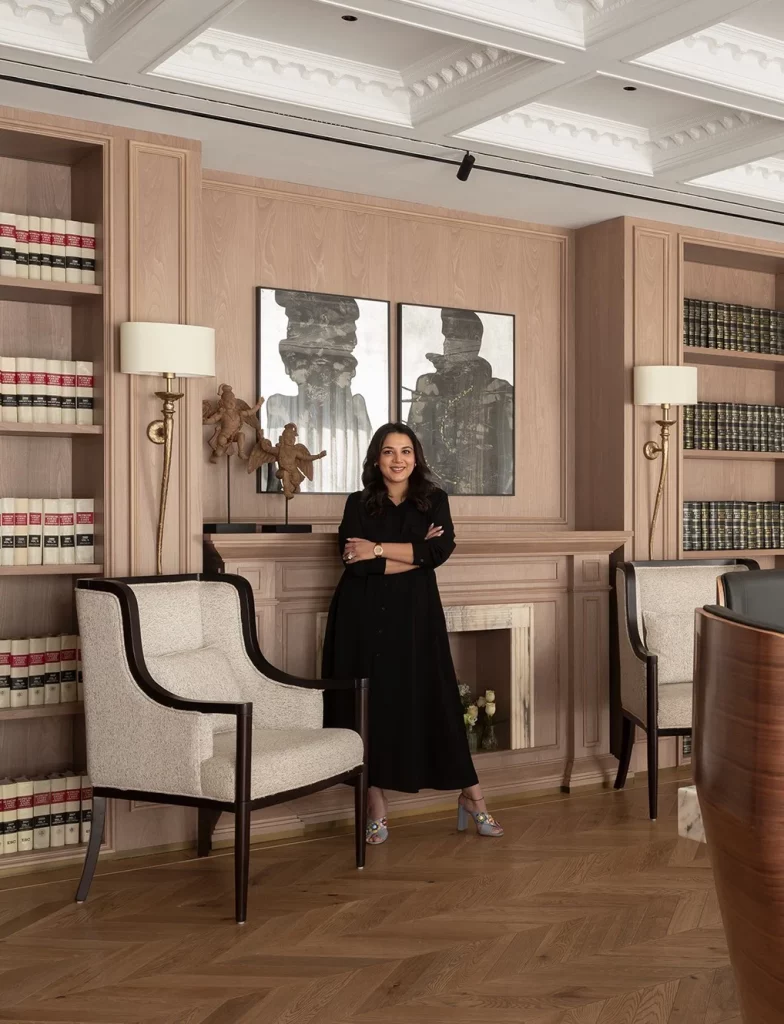
This fusion of global and local influences is evident in her projects. A handcrafted Indian textile might find its place alongside a modern European light fixture; a traditional motif might be reinterpreted in a contemporary context.
For Disha, this blending is not about juxtaposition: it is about harmony. “It’s about creating something that feels cohesive, even when it draws from different worlds,” she explains.
Her attention to detail plays a crucial role here. From sourcing unique décor pieces to handpicking furnishings, she is involved in every aspect of the process.
“I like to be part of every step, from the first sketch to the final reveal,” she says. “It ensures that the vision stays intact.” This hands-on approach not only guarantees quality but also allows her to create spaces that feel authentic and lived-in, rather than staged or superficial.
In one project, she transformed a conventional apartment into a vibrant, layered home by introducing unexpected colour palettes, statement furniture, and art-led focal points. In another, she reimagined a neutral space by weaving in handcrafted elements and global accents, creating a balance between minimalism and warmth.
“I like to push boundaries,” she admits. “Sometimes clients don’t initially see the vision: but when it all comes together, it changes how they experience their home.”
Storytelling through space
At the heart of Disha’s work lies a simple yet powerful idea: design is storytelling.
“Every space has a story to tell,” she says. “It’s about capturing the energy, aspirations, and personality of the people who inhabit it.”
This narrative-driven approach transforms her projects into more than just interiors—they become experiences. A living room might evoke warmth and nostalgia; a bedroom might offer calm and introspection. Each space is designed to resonate on an emotional level.
Her process reflects this philosophy. It begins with understanding the client—not just their requirements, but their lifestyle, their preferences, their memories. From there, the design evolves organically, shaped by both structure and intuition.
“There’s always a dialogue between control and spontaneity,” she explains. “You plan certain elements, but you also allow the space to guide you.” This balance is what gives her work its distinctive character. It is neither rigid nor random, but somewhere in between: fluid, dynamic, and deeply human.
Beyond her own projects, Disha is also contributing to the larger design conversation in India. As a mentor to young designers, she encourages them to embrace individuality and think beyond conventional boundaries.
“The industry is changing, and that’s exciting,” she says. “There’s more openness now to experimentation, to bold ideas. But we also need to stay rooted: to understand where we come from.”
View this post on Instagram
Redefining design in India
As Disha continues to build her body of work, her vision extends beyond individual projects. She is part of a new generation of designers who are redefining what Indian interiors can be: moving away from formulaic approaches and towards more expressive, personalised spaces.
“I want people to see design differently,” she says. “Not as something intimidating or exclusive, but as something that can truly enhance the way we live.”
Her work reflects this belief. It invites homeowners to step out of their comfort zones, to embrace colour, texture, and creativity in ways they may not have considered before.
At the same time, it remains grounded in practicality. “A space has to function well,” she notes. “It’s not just about aesthetics—it’s about how it feels to live there.”
This balance between beauty and usability is what defines her approach. It is also what makes her work resonate with a growing audience that values authenticity over trends.
Looking ahead, Disha is focused on expanding her creative horizons: exploring new materials, new collaborations, and new ways of storytelling through design.
“I’m still learning, still evolving,” she says. “That’s the beauty of this field, there’s always something new to discover.”
From the structured world of law to the fluid, expressive realm of design, her journey is a testament to the power of following one’s instincts. And in every space she creates, there is a quiet reminder of that journey: a story of risk, reinvention, and the courage to imagine differently.
ALSO READ: From Madhuri Dixit’s home to ‘The Hungry Caterpillar’: Apoorva Shroff’s evolving design story