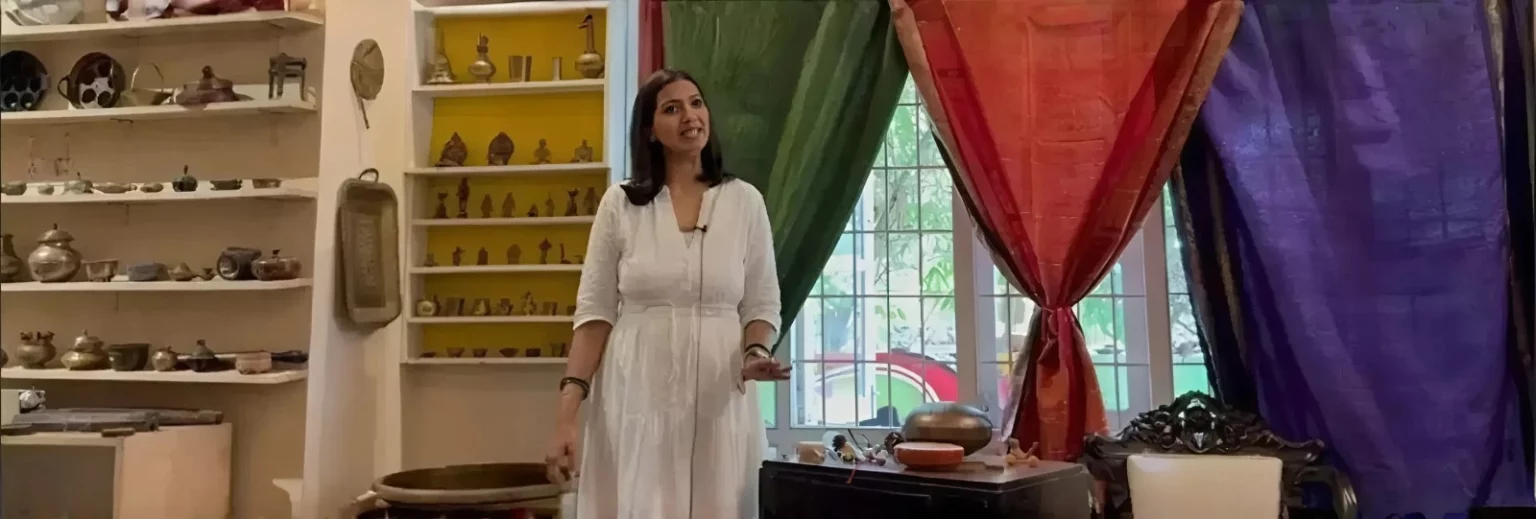


(January 6, 2026) Back in 2008, Deepa Kiran had a kidney malfunction. Doctors put her on steroids, 80 tablets a day for five months straight. But a full recovery eluded her. Soon, despair led to a moment of epiphany. She decided to hold a summer camp for children, a full three weeks of music and dance, art and craft, love and laughter and above all, storytelling.
When she went for her medical check-up after the camp, her medical condition had improved drastically. Doctors even stopped her medication, which made her realise that working with children and storytelling was integral to her well-being. “Ever since, I never gave up on storytelling and storytelling never gave up on me,” smiles Deepa Kiran, a professional storyteller and educationist, in a chat with Global Indian.
For more than a decade, Deepa’s musical storytelling, inspired by the stories and oral storytelling traditions of India, has appealed to audiences worldwide. As the founder of Story Arts Foundation, she has also worked with close to 1,00,000 teachers globally, growing the art of storytelling and using it as a pedagogical tool for learning and development of language, communication skills, critical thinking and socio-emotional intelligence. Her life story is equally gripping.
The first performance
Deepa’s first public performance as a storyteller was in 2009 at Scholastic Publications’ 90th anniversary celebrations in Hyderabad. “The audience comprised more than 500 children, teachers and parents. It was very well received and boosted my confidence,” says Deepa, who again performed in 2010 at the Saptaparni Art Centre, Hyderabad. Work grew slowly by word of mouth. She began receiving multiple invitations from across Hyderabad, other cities, and literary and cultural festivals like Kala Ghoda Mumbai, Hyderabad Literature Festival, Lamakaan, OSS – Our Sacred Space, and more.
Getting inspired in Singapore
In 2011, Deepa became curious to witness world-class storytelling. With her savings, she travelled to the Singapore International Storytelling Festival as an audience member. “I loved it. Having witnessed such amazing and inspiring work, I realised I too had the potential, competency and confidence to hold ground on a stage like that, if the opportunity arose.” In Singapore, she happened to meet one Kala, who connected her with her friend Eric in Chennai. “After returning to India, when I performed at the international storytelling festival that he organised, the senior storytellers from Australia and Germany recognised my talent and encouraged me,” Deepa mentions.
‘Meera Bai’ in Iran
In 2016, Iran had an open call for storytellers from around the world. They selected 10 storytellers based on the audition storytelling video submitted. “My story of Meera Bai was selected and, contrary to common beliefs, they actually appreciated the story of Meera and her bhakti for Lord Krishna, which I performed at a public governmental event,” says Deepa, who was the first professional storyteller invited from India to the festival, then in its 19th edition. “It was truly historic for me. They actually had the 10 flags of the participating nations on the stage. And when I narrated the story, the Indian flag was projected on the huge screen behind me,” recalls Deepa, describing it as an apt beginning of her international journey.
Taking her craft to multiple countries
Thereafter, Deepa travelled far and wide with her stories. Next was Vietnam. “This festival was in its infancy and we storytellers, about 30 of us from around the world, could contribute to building it. It was really joyful to realise that even schoolchildren in Vietnam were familiar with India.” While performing at the Austrian Festival, Deepa learnt absolute precision in timing her stories and how to engage with an audience in a unique venue like a three-tier opera house setting. Her trip to South Africa for a unique project of the University of South Africa took her to municipal schools, libraries and conference halls in the Pretoria district. “India and South Africa do have connections and despite the language differences, being able to reach the audience with simple English, an engaging plot and a mix of acting and music was initially scary but, in the end, very satisfying.”
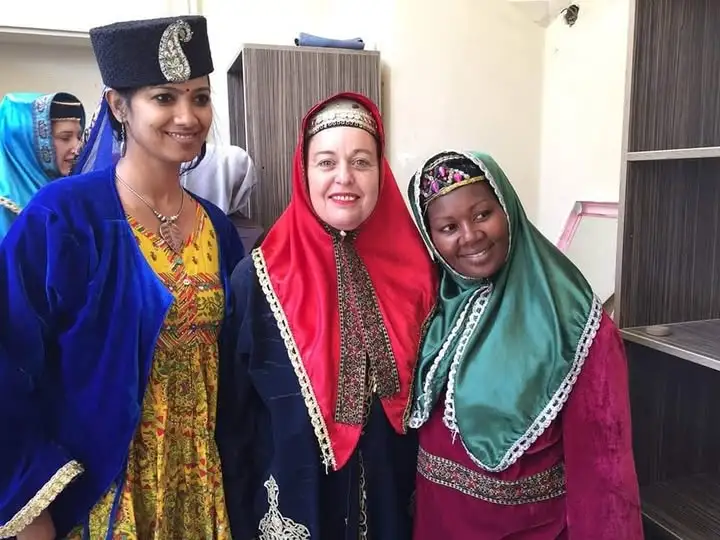
Storytellers Deepa Kiran (India), Marion Kenny (Scotland) with Wangari Grace (Tehran, Iran )
At one pre-school, she learnt to tell key words of her story in the Swahili language. “I chose a very visual story, The Monkeys and the Cap-Seller, which the children could enjoy just by watching.” Deepa then undertook a three-city tour of Jakarta, Yogyakarta and Surabaya. “I learnt to sing my storytelling welcome song in Indonesian Bahasa. Indonesians love India, have a great fascination for Indian songs and a great sense of humour, so we bonded really well,” says Deepa, who also visited Thailand among other countries.
Stories of Indian culture
“People would often ask me why I wouldn’t tell a Snow White or a Cinderella. I would tell them they already knew those stories and I enjoy telling the stories from my land.” She believes the world recognises sincere intentions and good contributions, and reciprocates them. “It may not be in the way we expect or imagine, but the reciprocation happens in the long journey of life,” feels Deepa, who is also a resource person with the Ministry of Culture, Government of India.
Early years
Deepa’s upbringing was richly diverse. She was born in Kolkata, West Bengal, while her mother tongue is Tamil. Her mother’s grandparents moved there for work in pre-independence times from Kerala. They belonged to a community of Tamils who had migrated 500 years ago to Kerala from Tamil Nadu. “In Kolkata, my mother studied in a Hindi-medium school. My father’s family was based in Chennai, but my father was working for IBM in Kolkata as a computer hardware engineer in the 1970s.” Deepa grew up in a household where everyone spoke at least four languages and seamlessly switched from one to another according to context, speaking each in its native form. “This was my reality: family conversations in Tamil, Malayalam, Bengali, Hindi and English, and celebrations of festivals from all the states whose languages we spoke.”
Experience of living in 13 states of India
Deepa lived in 13 states in India before moving to Chennai. She studied at Boston School, Nandanam, then DAV School, Gopalapuram in Chennai, St Joseph’s in Bangalore and St Ann’s in Hyderabad. All through her education, she was a fairly above-average academic student. Performing on stage for dance, drama, speeches and debates was an integral part of her school life. Later, she did her BSc in Nutrition and Clinical Dietetics.
Switching career choices
Deepa joined the NCC Air Wing as she had an adventurous spirit and wanted to fly planes. She won the Best Cadet of Andhra Pradesh, Best Glider Pilot of Andhra Pradesh and Guard of Honour at the National Republic Day parade in New Delhi for the Prime Minister, President and Chief of Defence Forces. “However, lack of proper career counselling in the field of nutrition and clinical dietetics after BSc, and unique rules of entry in the Air Force for pilots meant eventually giving up both career paths—nutrition and dietetics, and aviation,” she remarks.
View this post on Instagram
Early professional choices, All India Radio and an academic turn
In the 1990s, Hyderabad was witnessing the IT boom. Deepa was familiar with and good at computer science. “I joined a course for learning coding and received a 100 percent scholarship through an exam.” Alongside, she joined All India Radio as a compere for Yuvavani English, hosted music shows, interviews and film reviews, produced radio documentaries and acted in radio drama. In 1999, she did Alice in Wonderland audio storytelling series for All India Radio. Deepa went on to top the All India entrance exam for the Master’s in English Literature course at the Central University of Hyderabad, receiving a Gold Medalist scholarship with a fee waiver. Between 2000 and 2008, she taught in Kendriya Vidyalaya government schools as an English teacher for Grades 11 and 12 in Hyderabad, Jammu and Kashmir and Maharashtra. She also did a postgraduate specialisation in the teaching of English and foreign languages and went on to earn a PhD from IIT Madras.
Becoming a storyteller
Initially, Deepa lacked a conscious awareness that she wanted to be a storyteller and that she was deeply passionate about pursuing the field of education. However, she started narrating stories to draw students’ interest towards English, especially those who otherwise seemed disinterested. This gradually led her to storytelling. In 2011, she joined a publishing house and got trained as a teacher trainer. “I learnt the skills of training teachers. Soon, I created my own programs integrating my three core strengths: the art of storytelling, using storytelling for teaching English and training teachers,” says Deepa, whose video lessons for national television received a National Award from the Government of India. Several schools like DPS, DAV, Jain Group, Ecole Mondiale Mumbai, British School Delhi and Oakridge International Hyderabad, as well as publishing houses, began inviting her to train their teachers or perform for children. This was the start of her storytelling journey that took her places.
Story Arts Foundation
Deepa founded the Story Arts Foundation in 2017. “It was a strange journey as I hadn’t started off with the intention of starting a trust of my own,” says Deepa, who is drawn to working with communities and individuals with lesser access to resources and opportunities. She ended up taking up projects with NGOs in the field of education, especially those located in rural areas. Even the Telangana state government approached her to train about 1,000 teachers. “Based on the positive response, more such teacher training followed, and later 15-day residential programs for students, which were also extremely well received.”
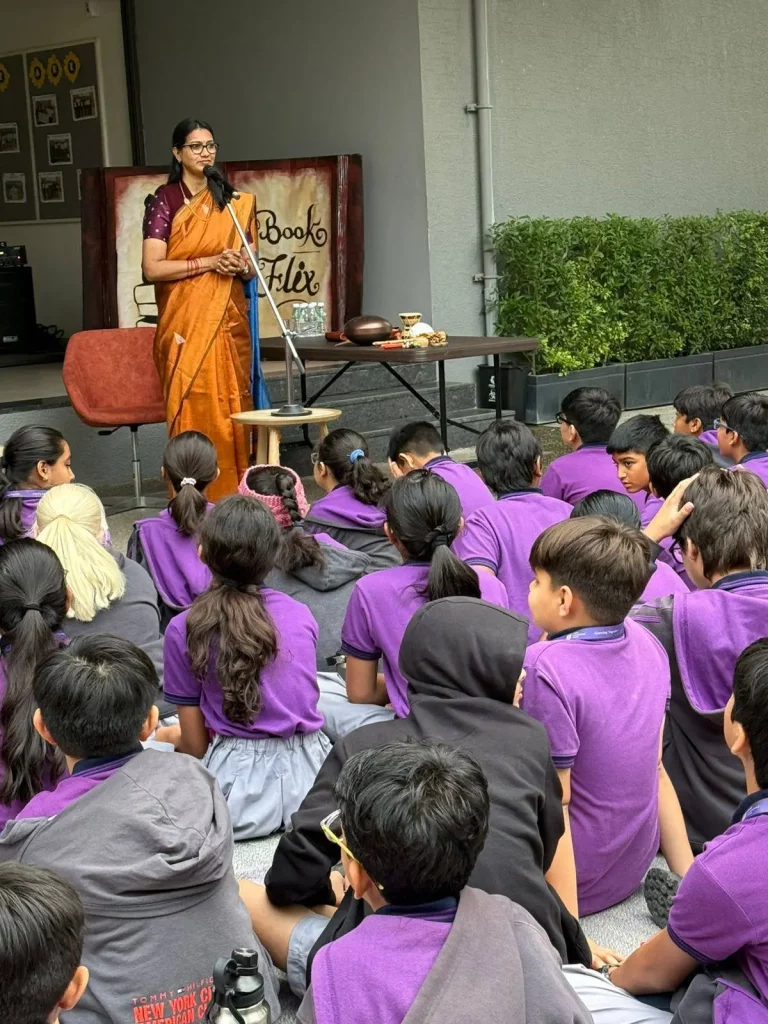
Azim Premji Foundation
Later, when the Azim Premji Foundation invited Deepa as a resource person for Summer School ELI, where 30 child-education NGO staff from across India were invited to the TISS Hyderabad campus for training, the network stayed connected. Several other projects came her way, including a ‘Train the Trainer’ program for Bal Aanganwadi schools in Sangareddy district in Telangana and a three-year training program for the Central Tibetan Administration and teachers of pre-schools.
Leveraging the art of storytelling for betterment
From a health crisis that forced her inward to a vocation that carried her across continents, Deepa Kiran’s journey is all about the quiet power of stories. In classrooms, festivals and community spaces, her work continues to affirm that storytelling is not just an art form, but a way of healing, connecting and making meaning across cultures.
ALSO READ: Remembering Piyush Pandey: The adman who gave Indian advertising its indigenous voice