


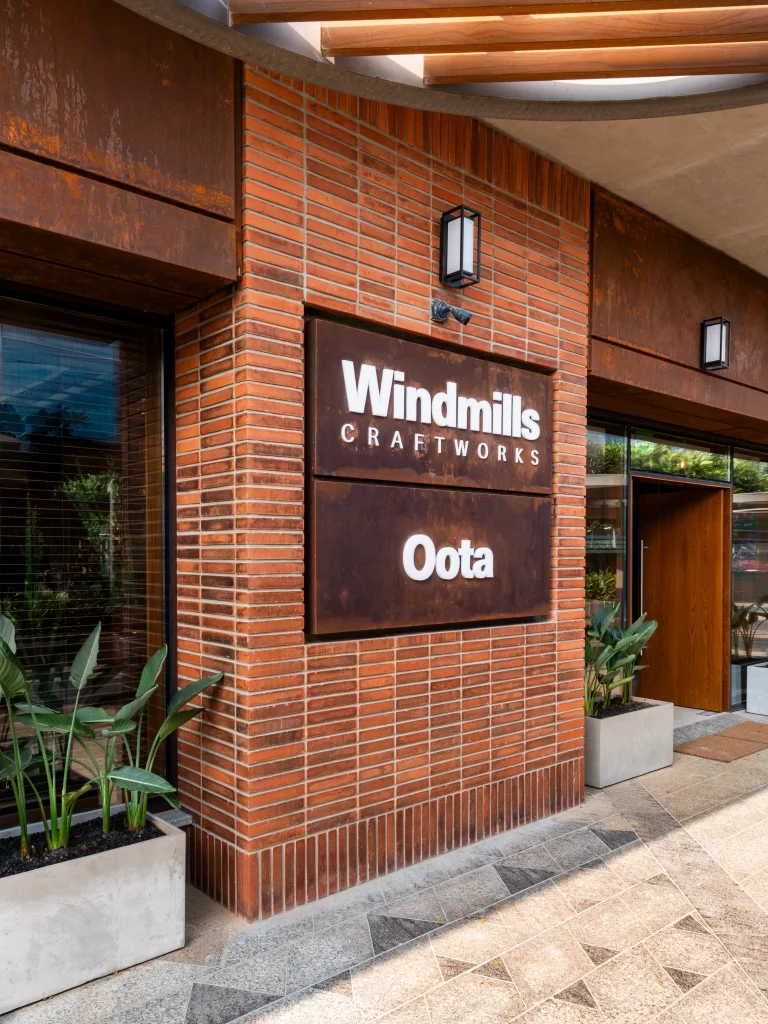
(February 9, 2026) On a balmy January evening in Hyderabad’s Knowledge City, Windmills Craftworks opened with a live gypsy jazz performance by the Stéphane Wrembel Trio, a Paris-based ensemble known for its gypsy jazz repertoire and international performances. Founded by Kamal Sagar, the culture-led hospitality space will soon introduce Oota — meaning shared meal in Kannada — a restaurant focused on regional cuisines.
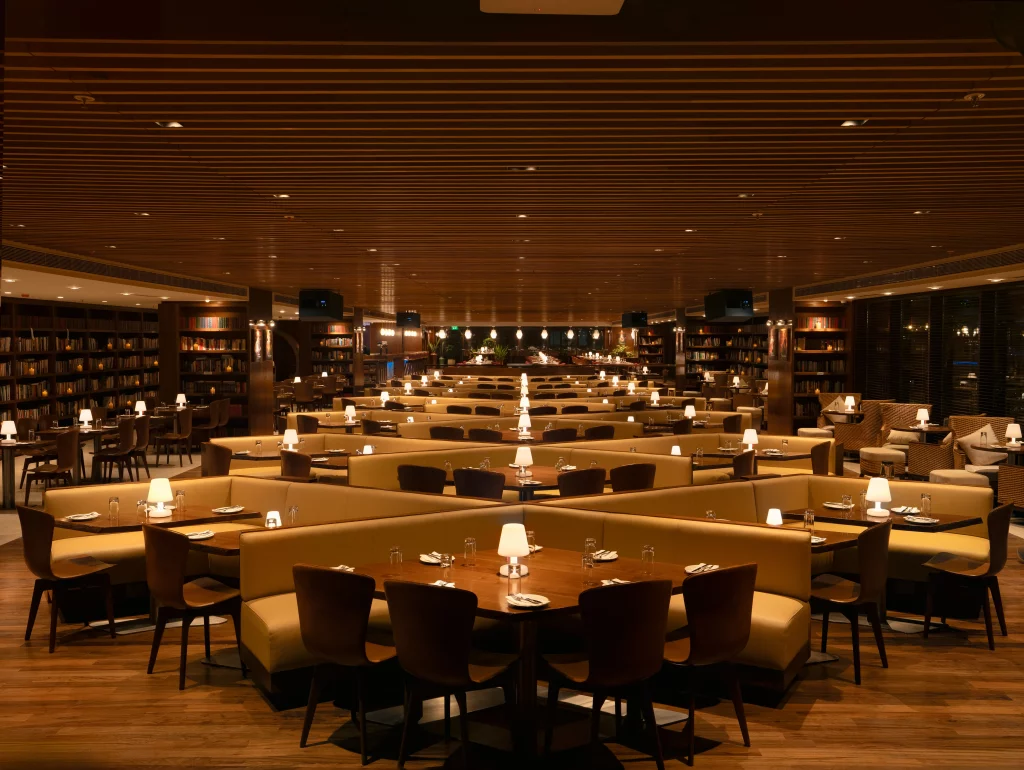
Books line the walls, and W-shaped seating curves around the stage. The space is designed as much for listening as for dining. Together, it offers an early insight into the way its creator thinks about design, experience, and intent.
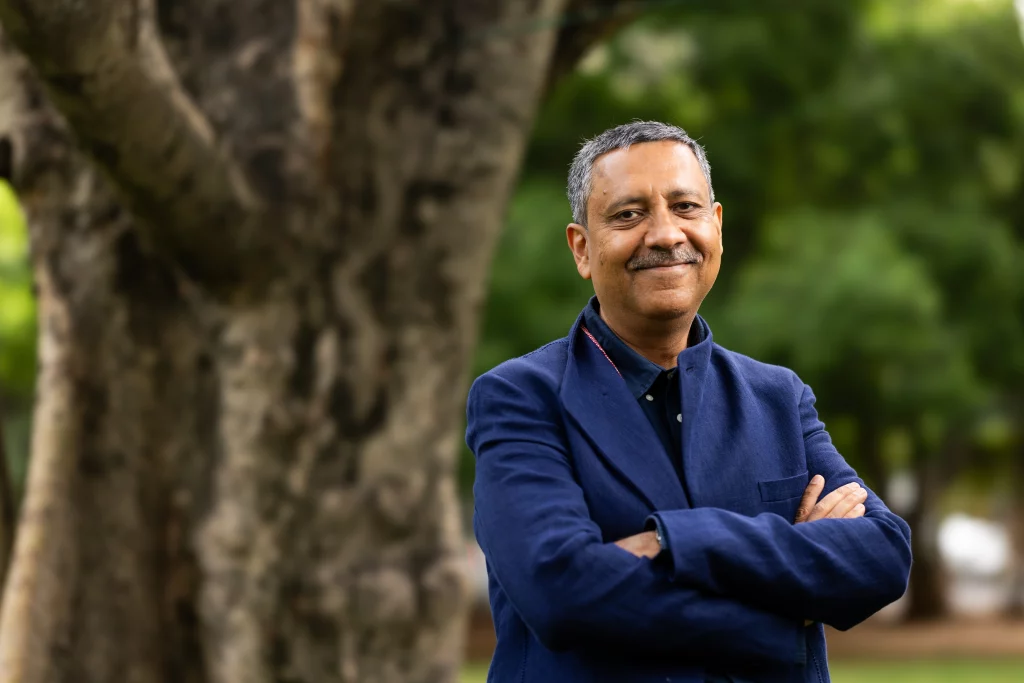
Kamal Sagar, an IIT Kharagpur–trained architect who has spent decades building homes and cultural spaces across India and the United States, does not separate design from lived experience. As the founder of Total Environment and Windmills Craftworks, his work spans real estate, architecture, music, and food — all tied together by a consistent philosophy: spaces must be designed with responsibility, restraint, and long-term intent.
The Hyderabad outpost follows Windmills’ earlier successes in Bengaluru and Dallas, but this expansion is not driven by scale alone. “I was born into a family of music, thanks to my father’s collection,” Sagar tells Global Indian. “Over time, I realised how much extraordinary music exists but remains unheard. Windmills was created to give that music a home.”
Oota, housed within the space, is the result of more than two years of research into the food traditions of Telangana, Andhra Pradesh, and Hyderabad — a reminder that for Sagar, whether designing a home, a concert venue, or a dining experience, depth matters more than speed.
Designing life, not just buildings
Despite his success across music, food, architecture, and real estate, Sagar traces everything back to a lifelong fascination with how people live within spaces. “I’ve always been interested in how light, material, proportion, and nature quietly influence everyday life,” he reflects. “That curiosity led me to study architecture at IIT Kharagpur.” The rigorous education gave him a strong technical base, but more importantly, a mindset rooted in questioning convention. “Architecture was never just about buildings for me. It was about understanding people and designing with empathy.”
From construction sites to a design philosophy
After graduating, Sagar spent years learning construction from the ground up — understanding how projects actually unfold on-site, where compromises creep in, and how responsibility can get diluted along the way.
“In 1996, I founded Total Environment with a simple belief: homes deserved far more thought, integrity, and individuality than what was commonly available,” he says. “Building homes across India and the US reinforced certain truths — good design takes time, details matter, and responsibility to the people who live in these spaces must always come first.” Today, Total Environment is known for its design-led, self-contained approach, integrating architecture, construction, and property management under one roof.
Lessons from the United States
Sagar’s years working in the United States sharpened his appreciation for systems, accountability, and long-term planning. “It strengthened my discipline and respect for process,” he says. “At the same time, it made me appreciate India’s intuitive craftsmanship and emotional relationship with living spaces even more.”
Balancing American precision with Indian sensitivity became central to his design language — a duality that continues to guide both Total Environment and Windmills Craftworks.
Why he rejected conventional real estate models
Unlike most developers, Sagar never viewed homes as commodities. “They are deeply personal environments that influence how people feel every day,” he explains. “Conventional real estate often prioritises speed and scale over care. From the start, our belief was simple: build fewer things, but build them well.” By integrating design, construction, and management, Total Environment ensured accountability — even if that meant slower growth. “Staying true to what we build has always mattered more than rapid expansion.”
Building with conscience
A phrase Sagar returns to often is “building with conscience.” It means making decisions one can stand by years later — choosing better materials even when they cost more, preserving trees despite logistical challenges, and resisting shortcuts that dilute design intent. “It also means being honest with customers about timelines and constraints,” he says. “Many of these decisions remain invisible once a project is complete, but together they define its character and longevity.”
Art, commerce, and the question of balance
Operating in a market driven by speed and scale inevitably brings tension between artistic integrity and commercial realities. “The balance is always there,” Sagar admits. “Artistic integrity doesn’t mean ignoring business realities — it means not letting them drive every decision.” At Total Environment, growth happens only at a pace where quality remains non-negotiable. “When values are clear, choices become clearer too — even when they aren’t the most profitable in the short term.”
When music shapes architecture
Music, for Sagar, is not a passion separate from his professional life. Rather, it actively informs his design thinking. “Concepts like rhythm, repetition, pause, and proportion translate naturally into architecture,” he explains. “Just as silence gives music depth, empty space gives architecture its strength.”
Music taught him restraint — knowing when not to add something. Over time, his relationship with music has become more contemplative, favouring subtlety and calm over excess. That shift also reshaped his idea of home. “A home shouldn’t be a display. It should be a retreat,” he says — a philosophy that flows seamlessly into Windmills Craftworks, where sound, space, and stillness coexist with intent.
Designing for well-being and the long term
Looking ahead, Sagar remains deeply conscious of design’s broader impact. “Design shapes mental well-being, relationships, and how people experience time and space,” he says. “When approached with care, it can make people feel calmer, more connected, and at ease.”
Rather than indiscriminate expansion, his focus remains on depth — through both Total Environment and Windmills Craftworks. “Growth will follow but never at the expense of purpose or integrity,” he signs off.
ALSO READ: Husna Rahaman: A cross-continental life that created an award-winning architectural vision