


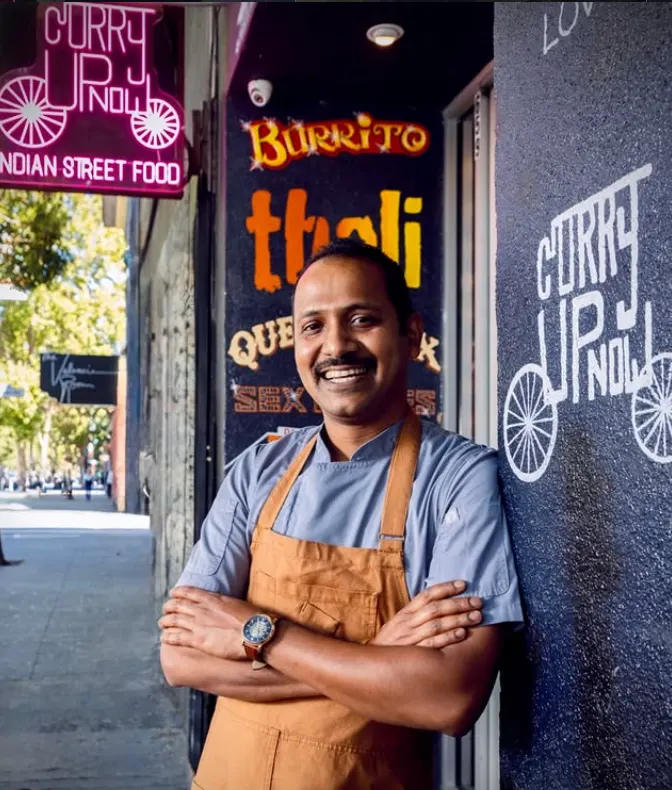
(March 29, 2026) At a time when Indian cuisine is rapidly evolving on the global stage, chefs like Bikram Das are helping reshape its narrative. As Corporate Executive Chef at Curry Up Now, he oversees culinary operations across 17 outlets in the United States, crafting a version of Indian food that is at once rooted and refreshingly contemporary. From Indian burritos to deconstructed chaats, his work reflects a new wave of culinary storytelling that helps shape a cultural dialogue.
But what makes Bikram’s journey particularly compelling is not just where he has arrived, but where he began. A Bengali raised in Bhutan amidst wild, chemical-free produce and trained across some of India’s finest hospitality institutions like Hyatt and Taj Hotels, his path has been anything but linear. From cooking for global business icons like Ratan Tata to navigating the complexities of scaling Indian cuisine in America, his global journey is one of instinct meeting discipline, and tradition finding new expression.
A childhood seasoned by nature
Long before he stepped into professional kitchens, Chef Bikram’s earliest memories were infused with the scent of wild herbs, the crunch of freshly harvested greens, and the quiet abundance of Bhutan’s natural landscape. Born to Bengali parents who were both teachers, his upbringing in Bhutan was anything but conventional. “Everything we ate was natural,” he recalls, almost wistfully in a chat with Global Indian. “No chemicals, no shortcuts, just compost, soil, and time.”
In a world where most aspiring chefs first encounter exotic ingredients in culinary school, the 39-year-old’s childhood pantry already boasted what many would consider gourmet. Gooseberries, wild mushrooms like morels, fresh asparagus, and berries grew around him in quiet abundance. “When I joined culinary school in Kolkata, they started teaching us about these ingredients,” he says. “But I had already seen them growing in the wild.”
Ironically, despite this rich food environment, becoming a chef was far from an obvious path. In a traditional Bengali household of educators, there were only two acceptable career trajectories: engineering or medicine. “Chef wasn’t even a third option,” he says with a laugh. Yet, somewhere between watching his mother cook and experimenting with meat dishes at home, a quiet rebellion was brewing.
School offered him an unexpected entry point. Too small to make it into sports teams, Bikram found his place in cooking classes. “That was the only place where I fit in,” he says. From rolling puris to cooking over open fires during riverside picnics with friends, food became both refuge and identity.
His early fascination leaned heavily toward non-vegetarian cooking. “Whenever we had chicken or mutton at home, I would insist on cooking it,” he recalls. His experiments were simple but telling: mutton curries, kosha mangsho, and slow-cooked dishes where flavours developed without shortcuts. Even today, he prides himself on a mutton preparation that uses no added water, just the natural juices of the meat, onions, and spices.
View this post on Instagram
From the classroom to the kitchen
Bikram’s formal culinary journey began at the Institute of Hotel Management, Kolkata, where he received his first chef’s knife, a symbolic beginning to what would become a global career. Graduating in 2009 in the aftermath of the global financial crisis, opportunities were scarce. “It was a tough time. Very few hotels were hiring,” he recalls.
His first break came as a management trainee at a boutique property in Udaipur. While the experience gave him exposure, it also made him restless. “There were only two seasons, busy and completely dead. I realised I didn’t want a life where I was waiting for work.”
Determined to accelerate his growth, he moved to Hyatt in Pune, where he initially joined as an operational trainee before earning a management trainee role through an internal examination. This marked the beginning of a more structured and demanding phase of his career.
Pivoting to high-stakes dining
Over the years, Bikram worked across India with leading hospitality brands including Taj Hotels and Marriott, moving through cities like Hyderabad, Bengaluru, and Kolkata. Each city added a new dimension to his culinary identity.
Though trained in multiple cuisines, Bikram gravitated toward Pan-Asian food early in his career. “I worked with chefs from China, Thailand, Indonesia,” he says. “That shaped my understanding deeply: you can’t fake authenticity in those cuisines.”
One of his most defining roles was at Blue Ginger in Taj West End, a Vietnamese restaurant known for its refined flavours. Here, he perfected dishes like steamed Chilean sea bass infused with lemongrass, kaffir lime, and chili, a delicate balance of bold and subtle notes.
Later, in Kolkata, he explored Indo-European and Anglo-Indian cuisines while heading operations at Raajkutir. His approach was always rooted in research and immersion. “Before adding a dish like deviled crab to the menu, we went across Kolkata: clubs, institutions, old restaurants, to understand how it was originally made.”
His career also brought him face-to-face with some of India’s most prominent personalities. Among them, his interaction with Ratan Tata remains particularly memorable. “I served him crab meat soup and New Zealand lamb chops,” Bikram recalls. “He asked me what I would recommend, that moment stayed with me.”
Reinventing Indian food in America
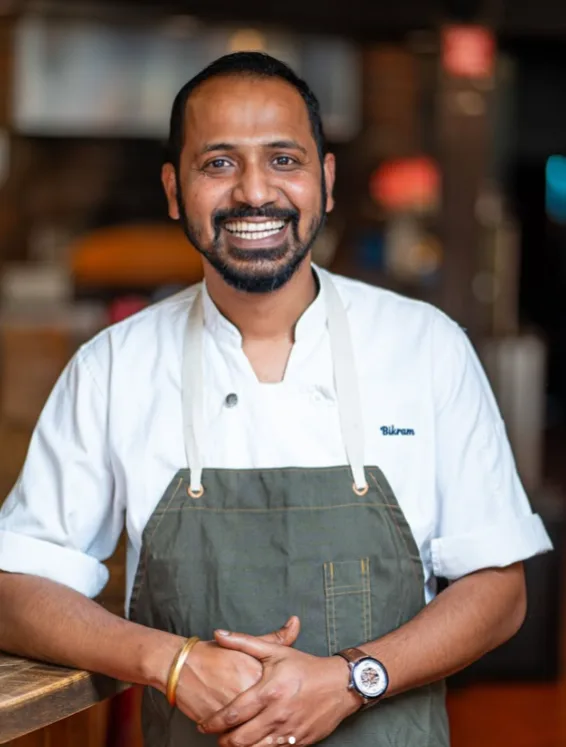
In February 2020, just days before the world shut down due to COVID-19, Bikram landed in California to take on a new role at Amber India. What followed was a baptism by fire. “Within days, everything closed,” he says. “We went from fine dining to survival mode.”
Adapting quickly, his team pivoted to takeout and outdoor dining. The experience reshaped his understanding of food service. “In India, hotels have departments for everything. Here, as a chef, you handle sourcing, logistics, operations: everything.”
After a stint at Mohi Social, where he experimented with American and Spanish cuisine, Bikram took on his current role as Corporate Executive Chef at Curry Up Now in 2023.
The scale of the role was unlike anything he had experienced before. From managing a single kitchen, he was now overseeing culinary operations across 17 outlets in multiple states, including California, Texas, and North Carolina.
“It’s a completely different ballgame,” he says. “In a standalone restaurant, you focus on one kitchen. Here, you’re thinking about consistency across the country.”
One of his biggest challenges was unlearning instinctive cooking. “In India, everything was ‘andaaza’ you feel the dish,” he explains. “Here, everything has to be measured. Two ounces means exactly two ounces.”
Standardisation became both a discipline and a philosophy. Recipes had to be replicable across locations, teams had to be trained uniformly, and supply chains had to be streamlined. At Curry Up Now, Bikram is helping redefine Indian cuisine for a global audience. The brand doesn’t claim authenticity in the traditional sense. Instead, it embraces fusion, what he calls “Californian Indian.”
Signature dishes include Indian-style burritos filled with turmeric rice and butter chicken, as well as inventive chaats like deconstructed samosas topped with chutneys, proteins, and pico de gallo. Indo-Chinese dishes, inspired by Kolkata, also feature prominently on the menu.
“Food evolves,” he says. “What matters is that it resonates with people.” Despite the scale and structure of his current role, Bikram remains deeply connected to his roots. At home, his preferences are simple: dal, bhindi, and sabzi cooked by his wife. “After all the complexity, that’s what brings comfort,” he says.
View this post on Instagram
When not in kitchen
When he is not in the kitchen, Bikram enjoys being out in the mountains, beaches and barbecuing. His ultimate dream is to start his own restaurant, towards which he is actively working and manifesting. Today, as he travels across the United States opening new outlets and refining menus, this culinary whiz represents a new generation of Indian chefs: globally trained, deeply rooted, and constantly evolving.